


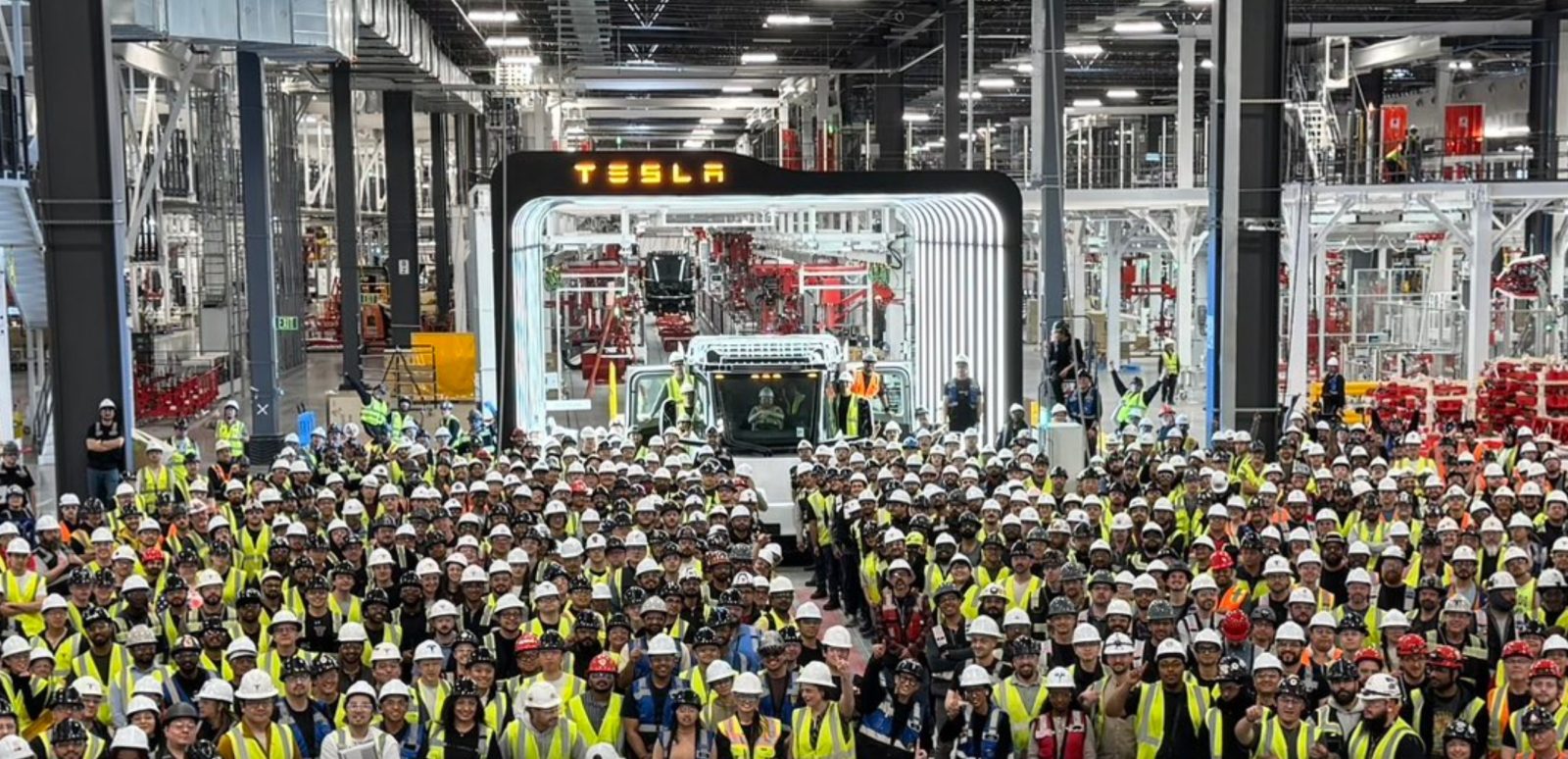
Tesla has produced the first Semi truck off its new high-volume production line at Gigafactory Nevada, marking a critical milestone for the long-delayed electric truck program.
The automaker shared an image of the truck on its official Tesla Semi account on X, confirming volume production is now underway at the dedicated 1.7-million-square-foot factory.
The Tesla Semi has had one of the longest gestation periods in Tesla’s history. First unveiled in 2017, the truck was originally promised for production in 2019. That target slipped repeatedly — to 2020, then 2021, then 2022 — before Tesla finally delivered a handful of units to PepsiCo in late 2022.
Those early trucks were essentially hand-built on a pilot line. Tesla spent the next three years refining the design, cutting roughly 1,000 lbs from the truck, and building out a dedicated factory adjacent to Gigafactory Nevada in Sparks. The company revealed the final production specs in February, confirming two trims: a Standard Range with 325 miles at full 82,000-lb gross combination weight, and a Long Range with 500 miles of range.
Tesla is quoting $290,000 for the 500-mile Long Range version and roughly $260,000 for the Standard Range — making it the lowest-priced Class 8 battery electric tractor on the market.
The shift from a pilot line to a high-volume production line is significant. Tesla’s Semi factory is designed for an annual capacity of 50,000 trucks, though the company will ramp gradually. Analysts project deliveries between 5,000 and 15,000 units in 2026, but that sounds way too optimistic.
A key advantage of the Nevada location is vertical integration. The 4680 battery cells powering the Semi are manufactured in the same complex, eliminating the supply chain bottleneck that forced Tesla to deprioritize the Semi for years while it allocated batteries to its higher-volume passenger cars.
Both trims feature an 800-kW tri-motor drivetrain producing 1,072 hp and support 1.2-MW Megacharger speeds, restoring 60% of range in roughly 30 minutes — conveniently timed around a driver’s mandatory rest break. Tesla has opened its first Megacharger station in Ontario, California, and has mapped 66 Megacharger locations across 15 states.
Tesla enters high-volume production with a meaningful lead on price and range. Daimler’s Freightliner eCascadia and Volvo’s electric trucks are shipping in limited numbers but at higher price points and shorter range. Nikola, once positioned as a direct competitor, went bankrupt.
Volvo is seen as the global leader with thousands of electric trucks delivered already.
In California’s Clean Truck & Bus Voucher program — a useful proxy for commercial demand — the Tesla Semi accounted for 965 of 1,067 applications between January 2025 and February 2026. Daimler, PACCAR, and Volvo combined received fewer than 100.
Meanwhile, the ecosystem around the Semi is expanding. Alyath is preparing to unveil a “Tesla Semi as a Service” model at ACT Expo on May 4, offering fleets access to the truck through a bundled monthly payment that includes the vehicle, charging infrastructure, and energy supply — eliminating the capital expenditure barrier entirely. And drayage operator MDB just launched a three-week freight pilot using the Semi at Southern California ports.
As many of you know, Tesla Semi is basically the only vehicle program that keeps me excited about Tesla.
This is the milestone that matters. Tesla has made a lot of promises about the Semi over the past nine years, and the truck has been “coming soon” for so long that it became easy to dismiss. But rolling the first unit off a high-volume production line — at a dedicated factory with 50,000-unit annual capacity — is a fundamentally different statement than hand-building a few dozen trucks for PepsiCo.
The economics are compelling. At $290,000 for the 500-mile version, the Semi undercuts every other Class 8 BEV on the market. Combined with a 3% TCO advantage over diesel and the operational simplicity of electric drivetrains, the business case for fleets is getting hard to ignore.
The real question now is execution speed. Tesla needs to ramp production, build out the Megacharger network fast enough to support the trucks it’s selling, and prove reliability at scale — not in controlled pilot programs, but in the grinding reality of daily commercial freight. The demand signals are strong, with nearly 1,000 voucher applications in California alone. If Tesla can deliver, the Semi could do to Class 8 trucking what the Model 3 did to midsize sedans.


FTC: We use income earning auto affiliate links. More.
此内容由惯性聚合(RSS阅读器)自动聚合整理,仅供阅读参考。 原文来自 — 版权归原作者所有。