
惯性聚合 高效追踪和阅读你感兴趣的博客、新闻、科技资讯
阅读原文 在惯性聚合中打开

推荐订阅源

T
Threat Research - Cisco Blogs
OSCHINA 社区最新新闻
OSCHINA 社区最新新闻
The Register - Security
A
About on SuperTechFans
Cyber Security Advisories - MS-ISAC
L
LangChain Blog
N
Netflix TechBlog - Medium
量子位
博客园 - 三生石上(FineUI控件)
宝玉的分享
宝玉的分享
H
Help Net Security
D
Docker
D
DataBreaches.Net
T
Tailwind CSS Blog
阮一峰的网络日志
阮一峰的网络日志
B
Blog
博客园 - 聂微东
Apple Machine Learning Research
Google DeepMind News
The Cloudflare Blog
F
Full Disclosure
GbyAI
GbyAI
F
Fortinet All Blogs
Last Week in AI
Last Week in AI
Y
Y Combinator Blog
人人都是产品经理
人人都是产品经理
Recent Announcements
博客园 - Franky
MongoDB | Blog
MongoDB | Blog
有赞技术团队
有赞技术团队
博客园 - 叶小钗
小众软件
小众软件
V
Visual Studio Blog
月光博客
月光博客
Stack Overflow Blog
Stack Overflow Blog
The GitHub Blog
The GitHub Blog
Recorded Future
Recorded Future
J
Java Code Geeks
雷峰网
雷峰网
P
Privacy & Cybersecurity Law Blog
C
Cisco Blogs
C
Cyber Attacks, Cyber Crime and Cyber Security
AWS News Blog
AWS News Blog
Webroot Blog
Webroot Blog
美团技术团队
N
News | PayPal Newsroom
G
Google Developers Blog
Security Archives - TechRepublic
博客园_首页
V
Vulnerabilities – Threatpost

Hacker News: Front Page

SPICE simulation → oscilloscope → verification with Claude Code — Lucas Gerads GitHub - GainSec/AutoProber: Hardware hacker’s flying probe automation stack for agent-driven target discovery, microscope mapping, safety-monitored CNC motion, probe review, and controlled pin probing. Introducing Claude Opus 4.7 Qwen Studio The Future of Everything is Lies, I Guess: Where Do We Go From Here? GitHub - SeanFDZ/macmind: Single-layer transformer in HyperTalk for the classic Macintosh Virginia Bans Sale of Geolocation Data Show HN: Agent-cache – Multi-tier LLM/tool/session caching for Valkey and Redis Ancient DNA reveals pervasive directional selection across West Eurasia [pdf] AI cybersecurity is not proof of work Moving a large-scale metrics pipeline from StatsD to OpenTelemetry / Prometheus GitHub - Nightmare-Eclipse/RedSun: The Red Sun vulnerability repository GitHub - SethPyle376/hiraeth: Local AWS emulator focused on fast integration testing, with SQS support, SQLite-backed state, and a debug-friendly web UI. A Better Ludum Dare; Or, How to Ruin a Legacy GitHub - macOS26/Agent: Any AI, replaces Claude Code, Cursor, OpenClaw. Over 18 LLM providers (Claude, OpenAI, Gemini, Ollama, Zai, HF, Qwen) wired into a native Mac app that writes code, builds Xcode projects, bumps versions, manages git, automates Safari, use AppleScript, JS or Accessibility, extend Agent! w/ MCP Servers, run tasks from your iPhone via Messages. YouTube now lets you turn off Shorts I Made a Terminal Pager Burgers | マクドナルド公式 Commands — HackerNews CLI documentation ChatGPT for Excel PiCore - Raspberry Pi Port of Tiny Core Linux Live Nation illegally monopolized ticketing market, jury finds Google Broke Its Promise to Me. Now ICE Has My Data. Founding Engineer at Adaptional | Y Combinator CRISPR takes important step toward silencing Down syndrome’s extra chromosome GitHub - saffron-health/libretto: The AI toolkit for building reliable browser automations US v. Heppner (S.D.N.Y. 2026) no attorney-client privilege for AI chats [pdf] Unexpected €54k billing spike in 13 hours: Firebase browser key without API restrictions used for Gemini requests Fragments: April 14 Cal.com Goes Closed Source: Why AI Security Is Forcing Our Decision | Cal.com - Scheduling Software for Online Bookings Laravel raised money and now injects ads directly into your agent Codex Hacked a Samsung TV Tech Valuations Back to Pre-AI Boom Levels A perfectable programming language — Soter GitHub - halfwhey/claudraband: Claude Code for the Power User Partnership through Play: Investigating How Long-Distance Couples Use Digital Games to Facilitate Intimacy Textbooks and Methods of Note-Taking in Early Modern Europe (2008) Eternity in six hours: Intergalactic spreading of intelligent life (2013) Seven countries now generate 100% of their electricity from renewable energy Tell HN: OpenAI silently removed Study Mode from ChatGPT Pro Max 5x Quota Exhausted in 1.5 Hours Despite Moderate Usage Show HN: Oberon System 3 runs natively on Raspberry Pi 3 (with ready SD card) Tell HN: docker pull fails in spain due to football cloudflare block Bring Back Idiomatic Design No one owes you supply-chain security GitHub - xsawyerx/curl-doom: DOOM, played over cURL Apple update turns Czech mate for locked-out iPhone user The Grand Line Cache TTL silently regressed from 1h to 5m around early March 2026, causing quota and cost inflation Building a Z-Machine in the worst possible language The peril of laziness lost Iran war: We spoke to the man making Lego-style AI videos that experts say are powerful propaganda AI Will Be Met With Violence, and Nothing Good Will Come of It GitHub - duguyue100/midnight-captain: Inspired by Midnight Commander, tailored to my taste. How to build a `git diff` driver · Jamie Tanna | Software Engineer Center for Responsible, Decentralized Intelligence at Berkeley The Local Universe’s Expansion Rate Is Clearer Than Ever, but Still Doesn’t Add Up - A new synthesis of astronomical measurements confirms a persistent mismatch that could point to physics beyond current models The disturbing white paper Red Hat is trying to erase from the internet – OSnews NetBlocks (@netblocks@mastodon.social) The Future of Everything is Lies, I Guess: Annoyances ‘Abhorrent’: the inside story of the Polymarket gamblers betting millions on war Productive procrastination — Max van IJsselmuiden maps, territory and LMs 447 Terabytes per Square Centimetre at Zero Retention Energy: Non-Volatile Memory at the Atomic Scale on Fluorographane Show HN: Pardonned.com – A searchable database of US Pardons 20 Years on AWS and Never Not My Job The Seasons are Wrong The FAA wants gamers to apply for air traffic control jobs Artemis II crew splashes down near San Diego after historic moon mission Why weekends are under threat We gave an AI a 3 year retail lease in SF and asked it to make a profit | Andon Labs How a dancer with ALS used brainwaves to perform live On filing the corners off my MacBooks Installing every* Firefox extension OpenClaw’s memory is unreliable, and you don’t know when it will break Steve Blank Nowhere Is Safe Chimpanzees in Uganda locked in vicious 'civil war', say researchers watgo - a WebAssembly Toolkit for Go linux/Documentation/process/coding-assistants.rst at master · torvalds/linux GitHub - callumlocke/json-formatter: Makes JSON easy to read. Founding Product Engineer at Bild AI | Y Combinator A compelling title that is cryptic enough to get you to take action on it GitHub - Keychron/Keychron-Keyboards-Hardware-Design: Industrial design files for Keychron keyboards and mice. 100+ models with CAD assets in STEP, DXF, DWG, and PDF. Source-available, with commercial use allowed for original compatible accessories within the license terms. [ANNOUNCE] WireGuardNT v0.11 and WireGuard for Windows v0.6 Released 1D-Chess Helium Is Hard to Replace Keeping a Postgres queue healthy — PlanetScale Serenity Forge (@serenityforge.com) Our response to the Axios developer tool compromise Do Americans read print books, e-books or audiobooks more? Uncharted island soon to appear on nautical charts The Problem That Built an Industry Fragments: April 2 Python Release Python install manager 26.1 Bitcoin miners are losing $19,000 on every BTC produced as difficulty drops 7.8% God sleeps in the minerals Harness engineering: leveraging Codex in an agent-first world Apple Silicon and Virtual Machines: Beating the 2 VM Limit What have been the greatest intellectual achievements? The APL Programming Language Source Code
Powering up a module from the IBM 604: an electronic calculator from 1948
elpocko · 2026-06-08 · via Hacker News: Front Page

1948 was an interesting time for computing. For decades, businesses had used punch card equipment that added and sorted electromechanically. Now these electromechanical relays and counting wheels were being used to build room-filling general-purpose computers such as Harvard Mark I (1944) and IBM's SSEC (1948). But slow electromechanical mechanisms were already becoming obsolete. World War II had fostered the development of electronics and vacuum tubes for radio, radar, and navigation. Electronic technology was being used in massive electronic computers, such as Colossus (1943) and ENIAC (1946). The first stored-program computer, the Manchester Baby, was built in 1948.
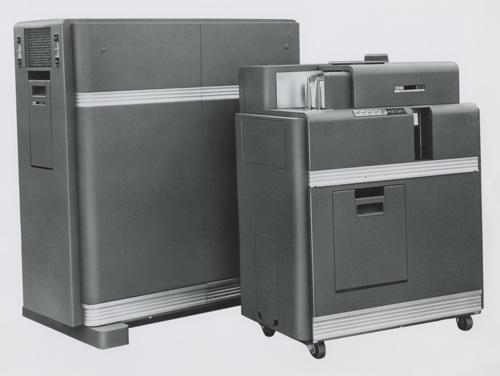
The IBM 604 Electronic Calculating Punch behind a Type 521 Card Reader/Punch. Photo from IBM.
Note the panels in the side of the 604 and in the front of the 521 to hold plugboards.

The IBM 604 Electronic Calculating Punch behind a Type 521 Card Reader/Punch. Photo from IBM. Note the panels in the side of the 604 and in the front of the 521 to hold plugboards.

In the midst of these technological advances, IBM introduced the Electronic Calculating Punch, type 604.1 This system may seem like a step backward: it wasn't a computer, but a programmable calculator that performed a fixed set of operations.2 However, it was much smaller3 than a computer—about the size of a double refrigerator—and much cheaper: renting for $550 a month, it was affordable by businesses and universities. Since it used vacuum tubes, it was much more powerful than electromechanical equipment; it could do 60 operations in under a second, including multiplication and division. As a result, the IBM 604 became very popular, with over 5600 units produced. Moreover, IBM's experience with electronics in the 604 led to the success of its vacuum-tube computers in the 1950s.

One of the innovations of the 604 was the pluggable module, which combined a tube and its associated circuitry as shown below. The insulated handle was used to remove and install modules in the calculator. The nine pins at the bottom of the module plugged into a socket in the 604, with the sockets connected with backplane wiring. The tube was also socketed, so a bad tube could be quickly replaced. At the right, the resistors and capacitors are mounted on insulating wafers in the module.4
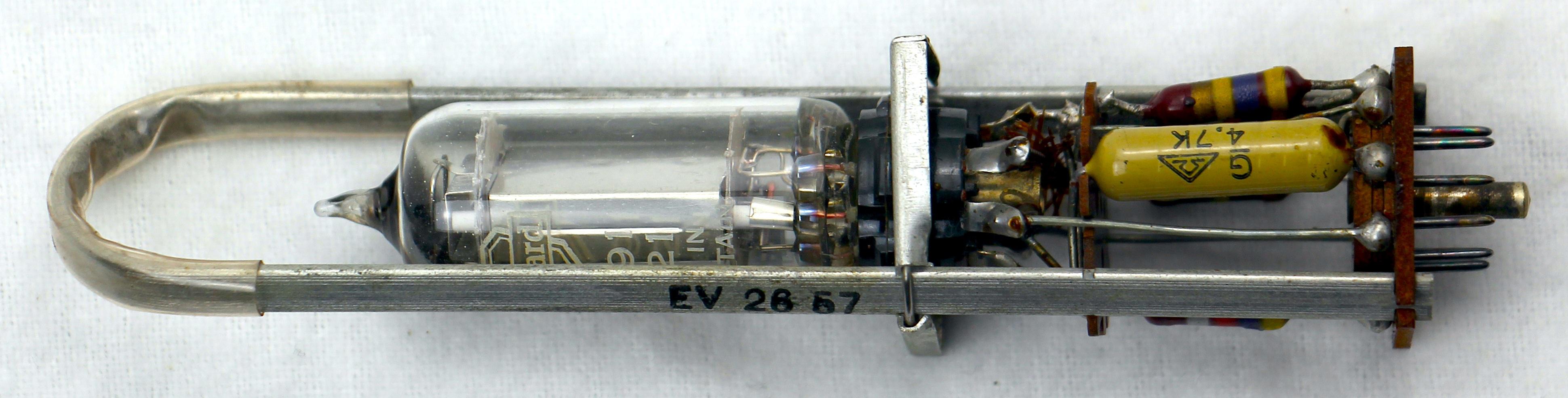
A thyratron tube module from the IBM 604 Electronic Calculating Punch.

A thyratron tube module from the IBM 604 Electronic Calculating Punch.

The 604 used several different types of modules. This module has a thyratron tube, a special type of tube that acts as a high-current switch. I put this module in a circuit and powered it up. The video below shows the module controlling a light bulb. The first button sends a small signal to the module (center), turning it on and illuminating the bulb. As I'll explain below, a thyratron tube stays on until its power is cut off, which I did with the second button.

Pluggable modules may seem trivial, but they were an important innovation. Previously, vacuum tube equipment was typically built from a metal chassis with tubes mounted on the top and the other components, such as resistors and capacitors, mounted underneath. IBM developed a different approach: pluggable modules, where each module held a vacuum tube along with its associated components. These patented modules were dense, since they packed components in three dimensions. Moreover, by using a small set of standardized modules, the modules could be mass-produced and the computers assembled on a production line. Maintenance and repair were simplified; modules could be swapped to find the bad module, which was replaced with a spare. These modules were so important that IBM featured them in ads for the 604. IBM used tube modules in later vacuum tube computers, using larger eight-tube modules in the high-end 700-series computers.

An ad for the IBM 604, highlighting the pluggable modules. From Time magazine, March 31, 1952, page 65. Click this image (or any other) for a larger version.

An ad for the IBM 604, highlighting the pluggable modules. From Time magazine, March 31, 1952, page 65. Click this image (or any other) for a larger version.

Vacuum tubes and the thyratron

The IBM 604 used about 1250 vacuum tubes. While vacuum tubes come in many different types, a typical type is the triode. A triode is analogous to a transistor: a small input signal is amplified to control a much larger current. In a transistor, the control signal is applied to the gate, controlling the current between the source and drain. In a triode tube, the control signal is applied to the grid, controlling the current between the cathode and the plate.
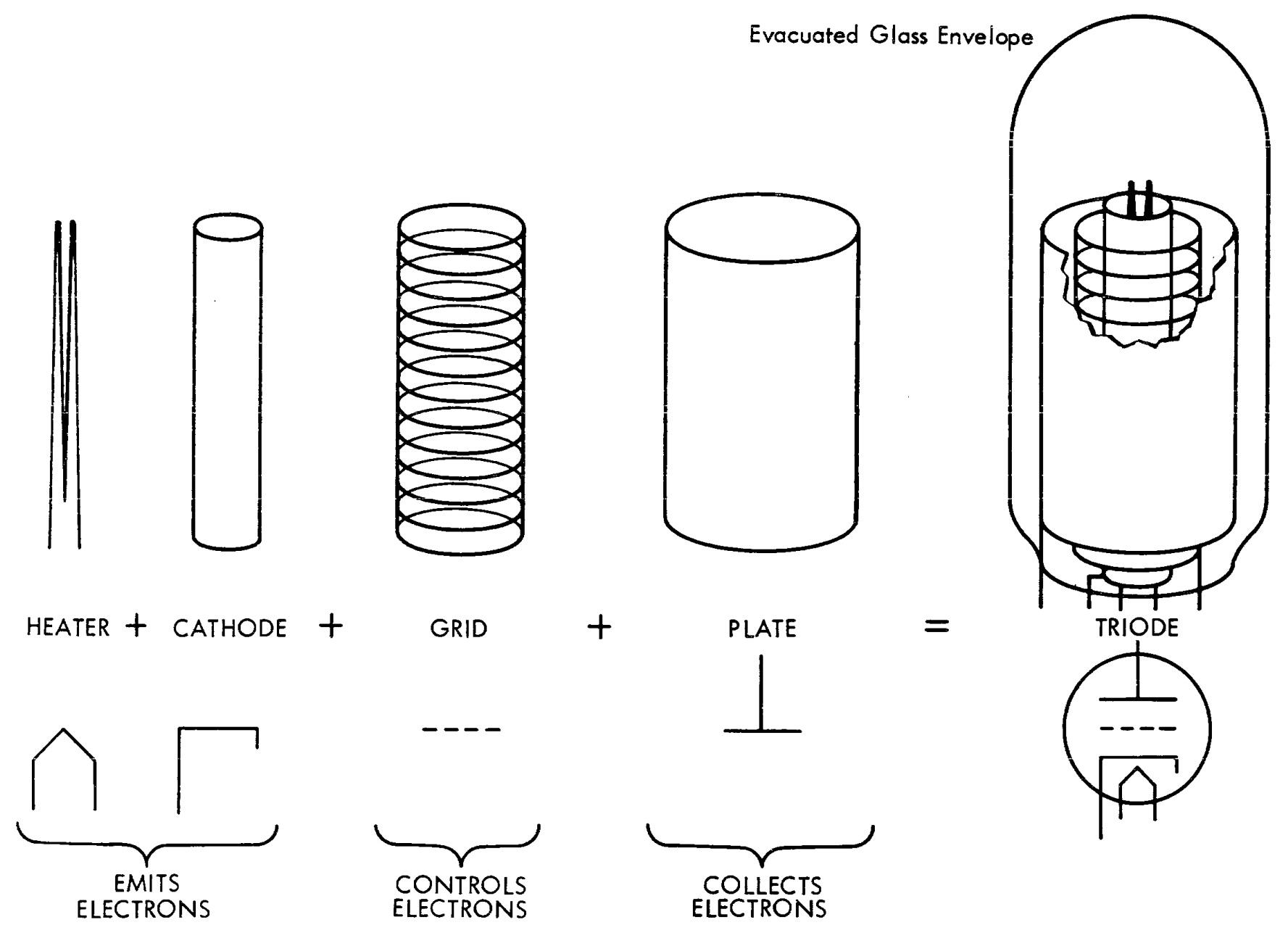
The components of a triode vacuum tube. From IBM 604 Customer Engineering manual.

The diagram above shows the construction of a vacuum tube. The heater is a filament, very similar to an incandescent light bulb, that heats up the cathode to roughly 750 ºC. At this high temperature, the cathode emits electrons. When a large positive voltage (say, 100 volts) is put on the plate, the negatively-charged electrons are attracted. The stream of electrons from the cathode to the plate causes a current to flow through the tube. The current is controlled by the grid: if a small negative voltage is placed on the grid, it repels the negative electrons, preventing them from reaching the plate and blocking the current through the tube.

A thyratron tube is similar to a vacuum tube, except it has a tiny bit of xenon gas inside, allowing it to handle higher current.7 Like a triode, the thyratron is controlled by the grid. However, when current starts to flow through the thyratron, the xenon ionizes and the xenon plasma carries current. Unlike a vacuum tube, the grid cannot stop the flow of current. Once the gas is ionized, a thyratron tube stays on until you remove its power5 and the gas deionizes in microseconds.6

You can see this behavior in the video. When I pushed the first button, a small control signal ionized the gas, turning the tube on. The large current through the ionized gas illuminated the light bulb. The light stayed on until I briefly cut the power with the second button; the gas deionized, turning off the tube.
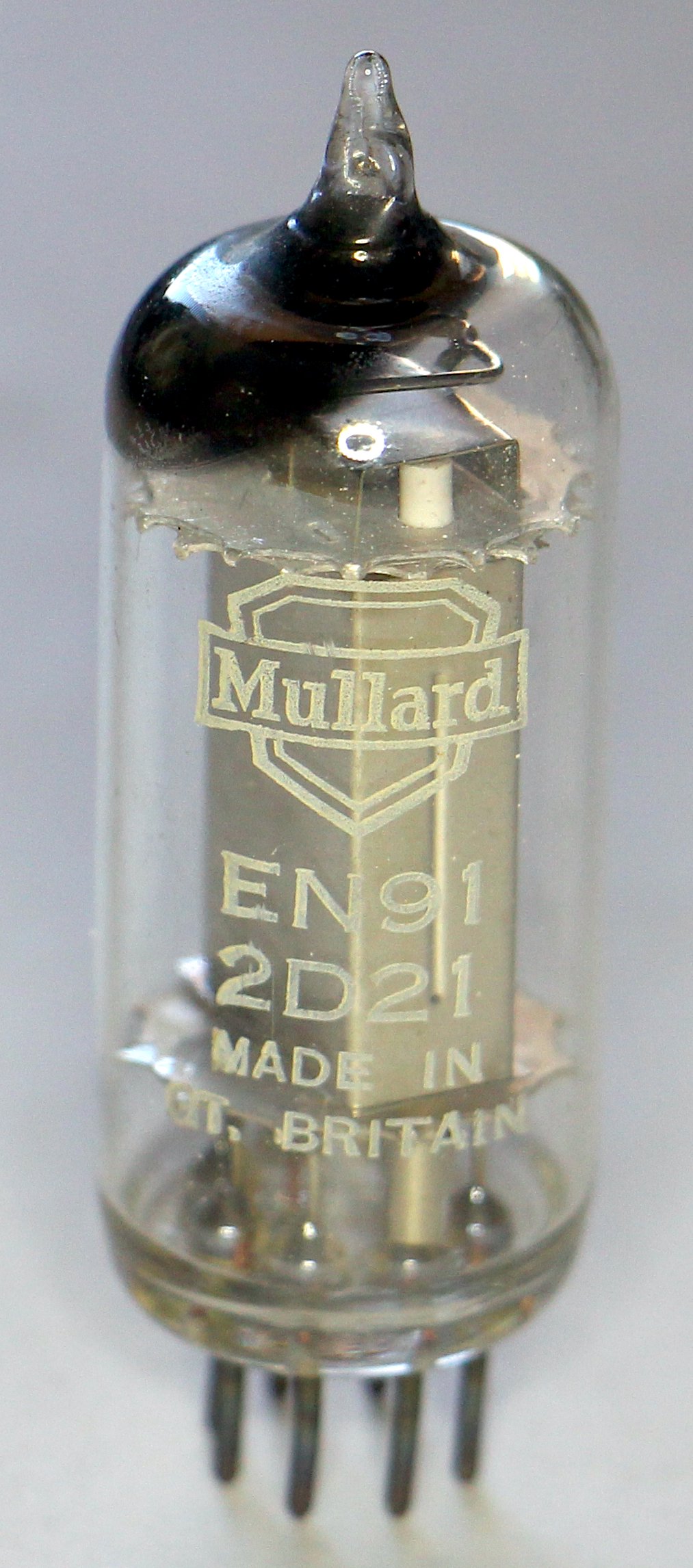
The thyratron tube, type 2D21.

The thyratron tube, type 2D21.

The photo above shows the thyratron tube, type 2D21, a miniature 7-pin tube.8 The plate is visible inside the tube, with the other components hidden by the plate. The dark stain at the top of the tube is the "getter", a reactive substance such as barium that absorbs impurities inside the tube.

In the 604, thyratron tubes drove relay coils and powered the electromagnets that punched holes in cards. Other IBM systems also used these thyratron tubes. For instance, the IBM 83 Card Sorter used thyratron tubes as short-term storage to keep track of which holes had been detected in a card.

Conclusion

The IBM 604 occupies an interesting position between electromechanical accounting machines and electronic computers. Although it has the speed of an electronic computer, it was still a calculator, lacking computer features such as loops, memory, and stored programs. Despite these limitations, the 604 was highly successful and led to other important IBM products.

IBM extended the 604 in 1949 so it could be programmed by punch cards in combination with plugboards; this was called the Card-Programmed Electronic Calculator. This system was still not quite a computer, but was very useful for scientific calculation at places such as Los Alamos National Labs (link). In 1953, IBM announced the successor to the 604, the IBM 650. Unlike the 604, the 650 was a programmable, general-purpose computer; it became the most popular computer of the 1950s.

Eric Schlaepfer (TubeTime) has a box of IBM 650 modules, which we hope to power up soon. For updates, follow me on Bluesky (@righto.com), Mastodon (@[email protected]), or RSS. Thanks to CuriousMarc for extensive milling work to build the socket and colorful breakout box to hold the module.

AI statement: Despite the presence of the em dash, no AI was used in the writing of this article (details).

Notes and references