


惯性聚合 高效追踪和阅读你感兴趣的博客、新闻、科技资讯
阅读原文 在惯性聚合中打开

推荐订阅源

酷 壳 – CoolShell
酷 壳 – CoolShell
GbyAI
GbyAI
SecWiki News
SecWiki News
Project Zero
Project Zero
C
Cisco Blogs
Simon Willison's Weblog
P
Privacy International News Feed
D
Darknet – Hacking Tools, Hacker News & Cyber Security
Scott Helme
Scott Helme
A
Arctic Wolf
Security Latest
Security Latest
Threat Intelligence Blog | Flashpoint
P
Privacy & Cybersecurity Law Blog
Apple Machine Learning Research
T
Tailwind CSS Blog
The Hacker News
The Hacker News
T
Tenable Blog
雷峰网
雷峰网
有赞技术团队
有赞技术团队
V
V2EX
C
CXSECURITY Database RSS Feed - CXSecurity.com
T
Threat Research - Cisco Blogs
T
Threatpost
AWS News Blog
AWS News Blog
L
LINUX DO - 热门话题
Application and Cybersecurity Blog
K
KPMG report finds enterprise disconnect between AI and its ROI | CIO
S
SegmentFault 最新的问题
月光博客
月光博客
Spread Privacy
Spread Privacy
S
Secure Thoughts
宝玉的分享
宝玉的分享
博客园 - 三生石上(FineUI控件)
Forbes - Security
Forbes - Security
T
The Exploit Database - CXSecurity.com
G
GRAHAM CLULEY
The Last Watchdog
The Last Watchdog
Y
Y Combinator Blog
I
Intezer
博客园 - 【当耐特】
B
Blog RSS Feed
Attack and Defense Labs
I
InfoQ
博客园 - 叶小钗
Cyberwarzone
Cyberwarzone
V2EX - 技术
V2EX - 技术
Cyber Security Advisories - MS-ISAC
Hugging Face - Blog
Hugging Face - Blog
H
Help Net Security
C
CERT Recently Published Vulnerability Notes

Hacker News: Front Page

SPICE simulation → oscilloscope → verification with Claude Code — Lucas Gerads GitHub - GainSec/AutoProber: Hardware hacker’s flying probe automation stack for agent-driven target discovery, microscope mapping, safety-monitored CNC motion, probe review, and controlled pin probing. Introducing Claude Opus 4.7 Qwen Studio The Future of Everything is Lies, I Guess: Where Do We Go From Here? GitHub - SeanFDZ/macmind: Single-layer transformer in HyperTalk for the classic Macintosh Virginia Bans Sale of Geolocation Data Show HN: Agent-cache – Multi-tier LLM/tool/session caching for Valkey and Redis Ancient DNA reveals pervasive directional selection across West Eurasia [pdf] AI cybersecurity is not proof of work Moving a large-scale metrics pipeline from StatsD to OpenTelemetry / Prometheus GitHub - Nightmare-Eclipse/RedSun: The Red Sun vulnerability repository GitHub - SethPyle376/hiraeth: Local AWS emulator focused on fast integration testing, with SQS support, SQLite-backed state, and a debug-friendly web UI. A Better Ludum Dare; Or, How to Ruin a Legacy GitHub - macOS26/Agent: Any AI, replaces Claude Code, Cursor, OpenClaw. Over 18 LLM providers (Claude, OpenAI, Gemini, Ollama, Zai, HF, Qwen) wired into a native Mac app that writes code, builds Xcode projects, bumps versions, manages git, automates Safari, use AppleScript, JS or Accessibility, extend Agent! w/ MCP Servers, run tasks from your iPhone via Messages. YouTube now lets you turn off Shorts I Made a Terminal Pager Burgers | マクドナルド公式 Commands — HackerNews CLI documentation ChatGPT for Excel PiCore - Raspberry Pi Port of Tiny Core Linux Live Nation illegally monopolized ticketing market, jury finds Google Broke Its Promise to Me. Now ICE Has My Data. Founding Engineer at Adaptional | Y Combinator CRISPR takes important step toward silencing Down syndrome’s extra chromosome GitHub - saffron-health/libretto: The AI toolkit for building reliable browser automations US v. Heppner (S.D.N.Y. 2026) no attorney-client privilege for AI chats [pdf] Unexpected €54k billing spike in 13 hours: Firebase browser key without API restrictions used for Gemini requests Fragments: April 14 Cal.com Goes Closed Source: Why AI Security Is Forcing Our Decision | Cal.com - Scheduling Software for Online Bookings Laravel raised money and now injects ads directly into your agent Codex Hacked a Samsung TV Tech Valuations Back to Pre-AI Boom Levels A perfectable programming language — Soter GitHub - halfwhey/claudraband: Claude Code for the Power User Partnership through Play: Investigating How Long-Distance Couples Use Digital Games to Facilitate Intimacy Textbooks and Methods of Note-Taking in Early Modern Europe (2008) Eternity in six hours: Intergalactic spreading of intelligent life (2013) Seven countries now generate 100% of their electricity from renewable energy Tell HN: OpenAI silently removed Study Mode from ChatGPT Pro Max 5x Quota Exhausted in 1.5 Hours Despite Moderate Usage Show HN: Oberon System 3 runs natively on Raspberry Pi 3 (with ready SD card) Tell HN: docker pull fails in spain due to football cloudflare block Bring Back Idiomatic Design No one owes you supply-chain security GitHub - xsawyerx/curl-doom: DOOM, played over cURL Apple update turns Czech mate for locked-out iPhone user The Grand Line Cache TTL silently regressed from 1h to 5m around early March 2026, causing quota and cost inflation Building a Z-Machine in the worst possible language The peril of laziness lost Iran war: We spoke to the man making Lego-style AI videos that experts say are powerful propaganda AI Will Be Met With Violence, and Nothing Good Will Come of It GitHub - duguyue100/midnight-captain: Inspired by Midnight Commander, tailored to my taste. How to build a `git diff` driver · Jamie Tanna | Software Engineer Center for Responsible, Decentralized Intelligence at Berkeley The Local Universe’s Expansion Rate Is Clearer Than Ever, but Still Doesn’t Add Up - A new synthesis of astronomical measurements confirms a persistent mismatch that could point to physics beyond current models The disturbing white paper Red Hat is trying to erase from the internet – OSnews NetBlocks (@netblocks@mastodon.social) The Future of Everything is Lies, I Guess: Annoyances ‘Abhorrent’: the inside story of the Polymarket gamblers betting millions on war Productive procrastination — Max van IJsselmuiden maps, territory and LMs 447 Terabytes per Square Centimetre at Zero Retention Energy: Non-Volatile Memory at the Atomic Scale on Fluorographane Show HN: Pardonned.com – A searchable database of US Pardons 20 Years on AWS and Never Not My Job The Seasons are Wrong The FAA wants gamers to apply for air traffic control jobs Artemis II crew splashes down near San Diego after historic moon mission Why weekends are under threat We gave an AI a 3 year retail lease in SF and asked it to make a profit | Andon Labs How a dancer with ALS used brainwaves to perform live On filing the corners off my MacBooks Installing every* Firefox extension OpenClaw’s memory is unreliable, and you don’t know when it will break Steve Blank Nowhere Is Safe Chimpanzees in Uganda locked in vicious 'civil war', say researchers watgo - a WebAssembly Toolkit for Go linux/Documentation/process/coding-assistants.rst at master · torvalds/linux GitHub - callumlocke/json-formatter: Makes JSON easy to read. Founding Product Engineer at Bild AI | Y Combinator A compelling title that is cryptic enough to get you to take action on it GitHub - Keychron/Keychron-Keyboards-Hardware-Design: Industrial design files for Keychron keyboards and mice. 100+ models with CAD assets in STEP, DXF, DWG, and PDF. Source-available, with commercial use allowed for original compatible accessories within the license terms. [ANNOUNCE] WireGuardNT v0.11 and WireGuard for Windows v0.6 Released 1D-Chess Helium Is Hard to Replace Keeping a Postgres queue healthy — PlanetScale Serenity Forge (@serenityforge.com) Our response to the Axios developer tool compromise Do Americans read print books, e-books or audiobooks more? Uncharted island soon to appear on nautical charts The Problem That Built an Industry Fragments: April 2 Python Release Python install manager 26.1 Bitcoin miners are losing $19,000 on every BTC produced as difficulty drops 7.8% God sleeps in the minerals Harness engineering: leveraging Codex in an agent-first world Apple Silicon and Virtual Machines: Beating the 2 VM Limit What have been the greatest intellectual achievements? The APL Programming Language Source Code
Pentagon jumps from $225M to $55B on drones as cheap attacks overwhelm US defenses
anigbrowl · 2026-04-30 · via Hacker News: Front Page

NEWYou can now listen to Fox News articles!

The Pentagon is seeking roughly $55 billion for drone and autonomous warfare programs in its fiscal year 2027 budget, as battlefield conflicts from the Middle East to Ukraine expose a growing problem: cheap drones are increasingly able to overwhelm costly U.S. defenses.

The funding request, a dramatic surge from roughly $225 million a year earlier, signals a major shift in how the U.S. military plans to fight future wars, accelerating a move toward large numbers of lower-cost, AI-enabled systems.

The funding, tied to a little-known Pentagon office known as the Defense Autonomous Warfare Group, represents a broad category spanning multiple programs across the services — including procurement, research, training and sustainment — rather than a single standalone weapons system.

War Secretary Pete Hegseth is expected to face questions on the budget when he testifies before Congress Thursday, as lawmakers begin weighing what would be the largest Pentagon request in modern history. The administration is seeking roughly $1.5 trillion in national defense spending for fiscal year 2027 — a more than 40% increase from the prior year and the biggest single-year jump in decades — with major investments in drones, missile defense and next-generation warfare systems at the center of the request.
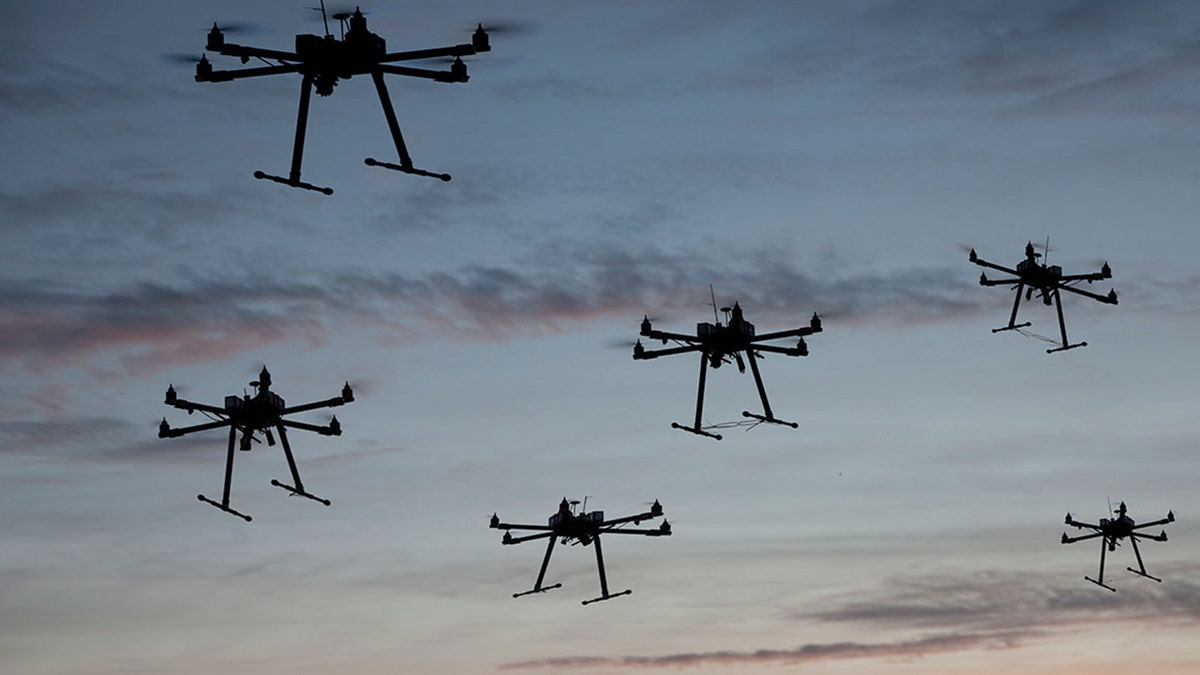
Swarm of drones flying in the sky

The Pentagon is seeking roughly $55 billion for drone and autonomous warfare programs in its fiscal year 2027 budget, as battlefield conflicts from the Middle East to Ukraine expose a growing problem: cheap drones are increasingly able to overwhelm costly U.S. defenses. (iStock/Getty Images)

At the center of the shift is a change in doctrine: moving away from a force built around a small number of high-cost platforms toward one designed to deploy large numbers of cheaper systems capable of operating in coordinated groups, often referred to as drone swarms.

In recent confrontations in the Middle East, Iranian drone and missile attacks have forced U.S. and allied defenses to respond to waves of low-cost aerial threats, exposing what defense officials describe as a growing "math problem" — firing expensive interceptors at far cheaper drones.

In one recent engagement, Gulf air defenses tracked dozens of incoming drones alongside ballistic missiles, intercepting many but underscoring how clustered attacks can strain even advanced systems.

US DRAINS CRITICAL MISSILE STOCKPILES IN IRAN WAR AS YEARSLONG REBUILD LOOMS

The same dynamic has played out in Ukraine, where Russia has used Iranian-designed drones in large numbers to pressure air defenses, forcing defenders to expend significant resources to stop relatively inexpensive systems.

Those battlefield lessons are now shaping Pentagon planning, driving a push toward systems designed not just to defend against drone swarms, but to deploy them at scale.

Unlike traditional unmanned systems operated individually, the Pentagon’s new approach emphasizes networks of drones designed to operate together, sharing data and coordinating movements in real time. In theory, such swarms can overwhelm defenses by attacking from multiple directions at once, forcing adversaries to track and respond to dozens — or even hundreds — of targets simultaneously.

Pentagon initiatives are already moving beyond experimentation, with programs aimed at fielding coordinated drone groups in the near term and allowing a single operator to direct multiple systems simultaneously.

While the concept has been tested in limited scenarios, fully autonomous coordination at scale remains a technical challenge, particularly in contested environments where communications can be disrupted.

The funding supports a wide range of systems across air, land and sea, from small, expendable aerial drones to autonomous surface vessels and ground-based platforms, along with the software and communications networks needed to link them together.

Officials increasingly have emphasized rapid production and lower-cost designs, aiming to field large numbers of systems quickly rather than relying on smaller fleets of more expensive platforms. Much of that effort is expected to draw on commercial technology as the Pentagon seeks to accelerate development timelines.

The shift reflects a broader change in warfare, where industrial capacity and the ability to produce large numbers of systems quickly are becoming as important as technological superiority.

Military planners also have warned that adversaries are investing heavily in similar capabilities.

ALLIES RUSH THOUSANDS OF DRONES TO UKRAINE AS RUSSIA UNLEASHES DEADLY MISSILE BARRAGES

China has demonstrated large-scale drone swarm operations involving hundreds of coordinated systems, highlighting the pace of global competition in autonomous warfare and raising concerns about how such capabilities could be used in a future conflict.

On the battlefield, adversaries are continuing to adapt. Russian forces have begun experimenting with larger "carrier" drones capable of launching smaller attack drones mid-flight, extending range and complicating air defenses, while Iran has refined the use of mass-produced strike drones to overwhelm defenses through sustained attacks.

A soldier holding a drone in the Pentagon parking lot in Arlington, Virginia

A soldier holds a drone in the Pentagon parking lot in Arlington, Virginia, on June 14, 2025, during the U.S. Army's 250th anniversary celebrations. (Samuel Corum/Getty Images)

At the same time, the Pentagon and its allies are racing to develop countermeasures designed to match that scale.

CLICK HERE TO DOWNLOAD THE FOX NEWS APP

Layered defenses now include a mix of traditional interceptors, electronic warfare tools and emerging systems such as interceptor drones, aimed at addressing the cost imbalance exposed by recent conflicts. The goal is to build defenses capable of absorbing large waves of incoming threats without relying solely on high-cost missiles.

Despite the scale of the investment, questions remain about how quickly the Pentagon can field these capabilities at scale. Previous efforts to accelerate drone production have faced delays, and integrating large numbers of autonomous systems into existing military structures presents technical and operational challenges.