

惯性聚合 高效追踪和阅读你感兴趣的博客、新闻、科技资讯
阅读原文 在惯性聚合中打开

推荐订阅源

T
Threat Research - Cisco Blogs
NISL@THU
NISL@THU
A
Arctic Wolf
Threat Intelligence Blog | Flashpoint
S
Schneier on Security
T
Tenable Blog
I
Intezer
S
Securelist
Scott Helme
Scott Helme
V
Visual Studio Blog
Simon Willison's Weblog
Google DeepMind News
T
The Blog of Author Tim Ferriss
D
Darknet – Hacking Tools, Hacker News & Cyber Security
AWS News Blog
AWS News Blog
H
Hackread – Cybersecurity News, Data Breaches, AI and More
MongoDB | Blog
MongoDB | Blog
L
LangChain Blog
F
Fortinet All Blogs
cs.CL updates on arXiv.org
C
Cisco Blogs
L
Lohrmann on Cybersecurity
M
MIT News - Artificial intelligence
G
GRAHAM CLULEY
博客园 - 司徒正美
aimingoo的专栏
aimingoo的专栏
雷峰网
雷峰网
MyScale Blog
MyScale Blog
D
DataBreaches.Net
Cyber Security Advisories - MS-ISAC
Recent Announcements
C
CXSECURITY Database RSS Feed - CXSecurity.com
量子位
博客园 - 三生石上(FineUI控件)
P
Proofpoint News Feed
Blog — PlanetScale
Blog — PlanetScale
云风的 BLOG
云风的 BLOG
大猫的无限游戏
大猫的无限游戏
GbyAI
GbyAI
Cisco Talos Blog
Cisco Talos Blog
Security Latest
Security Latest
Project Zero
Project Zero
K
Kaspersky official blog
罗磊的独立博客
Know Your Adversary
Know Your Adversary
T
The Exploit Database - CXSecurity.com
P
Privacy International News Feed
P
Privacy & Cybersecurity Law Blog
C
Cyber Attacks, Cyber Crime and Cyber Security
Apple Machine Learning Research

Hacker News: Front Page

SPICE simulation → oscilloscope → verification with Claude Code — Lucas Gerads GitHub - GainSec/AutoProber: Hardware hacker’s flying probe automation stack for agent-driven target discovery, microscope mapping, safety-monitored CNC motion, probe review, and controlled pin probing. Introducing Claude Opus 4.7 Qwen Studio The Future of Everything is Lies, I Guess: Where Do We Go From Here? GitHub - SeanFDZ/macmind: Single-layer transformer in HyperTalk for the classic Macintosh Virginia Bans Sale of Geolocation Data Show HN: Agent-cache – Multi-tier LLM/tool/session caching for Valkey and Redis Ancient DNA reveals pervasive directional selection across West Eurasia [pdf] AI cybersecurity is not proof of work Moving a large-scale metrics pipeline from StatsD to OpenTelemetry / Prometheus GitHub - Nightmare-Eclipse/RedSun: The Red Sun vulnerability repository GitHub - SethPyle376/hiraeth: Local AWS emulator focused on fast integration testing, with SQS support, SQLite-backed state, and a debug-friendly web UI. A Better Ludum Dare; Or, How to Ruin a Legacy GitHub - macOS26/Agent: Any AI, replaces Claude Code, Cursor, OpenClaw. Over 18 LLM providers (Claude, OpenAI, Gemini, Ollama, Zai, HF, Qwen) wired into a native Mac app that writes code, builds Xcode projects, bumps versions, manages git, automates Safari, use AppleScript, JS or Accessibility, extend Agent! w/ MCP Servers, run tasks from your iPhone via Messages. YouTube now lets you turn off Shorts I Made a Terminal Pager Burgers | マクドナルド公式 Commands — HackerNews CLI documentation ChatGPT for Excel PiCore - Raspberry Pi Port of Tiny Core Linux Live Nation illegally monopolized ticketing market, jury finds Google Broke Its Promise to Me. Now ICE Has My Data. Founding Engineer at Adaptional | Y Combinator CRISPR takes important step toward silencing Down syndrome’s extra chromosome GitHub - saffron-health/libretto: The AI toolkit for building reliable browser automations US v. Heppner (S.D.N.Y. 2026) no attorney-client privilege for AI chats [pdf] Unexpected €54k billing spike in 13 hours: Firebase browser key without API restrictions used for Gemini requests Fragments: April 14 Cal.com Goes Closed Source: Why AI Security Is Forcing Our Decision | Cal.com - Scheduling Software for Online Bookings Laravel raised money and now injects ads directly into your agent Codex Hacked a Samsung TV Tech Valuations Back to Pre-AI Boom Levels A perfectable programming language — Soter GitHub - halfwhey/claudraband: Claude Code for the Power User Partnership through Play: Investigating How Long-Distance Couples Use Digital Games to Facilitate Intimacy Textbooks and Methods of Note-Taking in Early Modern Europe (2008) Eternity in six hours: Intergalactic spreading of intelligent life (2013) Seven countries now generate 100% of their electricity from renewable energy Tell HN: OpenAI silently removed Study Mode from ChatGPT Pro Max 5x Quota Exhausted in 1.5 Hours Despite Moderate Usage Show HN: Oberon System 3 runs natively on Raspberry Pi 3 (with ready SD card) Tell HN: docker pull fails in spain due to football cloudflare block Bring Back Idiomatic Design No one owes you supply-chain security GitHub - xsawyerx/curl-doom: DOOM, played over cURL Apple update turns Czech mate for locked-out iPhone user The Grand Line Cache TTL silently regressed from 1h to 5m around early March 2026, causing quota and cost inflation Building a Z-Machine in the worst possible language The peril of laziness lost Iran war: We spoke to the man making Lego-style AI videos that experts say are powerful propaganda AI Will Be Met With Violence, and Nothing Good Will Come of It GitHub - duguyue100/midnight-captain: Inspired by Midnight Commander, tailored to my taste. How to build a `git diff` driver · Jamie Tanna | Software Engineer Center for Responsible, Decentralized Intelligence at Berkeley The Local Universe’s Expansion Rate Is Clearer Than Ever, but Still Doesn’t Add Up - A new synthesis of astronomical measurements confirms a persistent mismatch that could point to physics beyond current models The disturbing white paper Red Hat is trying to erase from the internet – OSnews NetBlocks (@netblocks@mastodon.social) The Future of Everything is Lies, I Guess: Annoyances ‘Abhorrent’: the inside story of the Polymarket gamblers betting millions on war Productive procrastination — Max van IJsselmuiden maps, territory and LMs 447 Terabytes per Square Centimetre at Zero Retention Energy: Non-Volatile Memory at the Atomic Scale on Fluorographane Show HN: Pardonned.com – A searchable database of US Pardons 20 Years on AWS and Never Not My Job The Seasons are Wrong The FAA wants gamers to apply for air traffic control jobs Artemis II crew splashes down near San Diego after historic moon mission Why weekends are under threat We gave an AI a 3 year retail lease in SF and asked it to make a profit | Andon Labs How a dancer with ALS used brainwaves to perform live On filing the corners off my MacBooks Installing every* Firefox extension OpenClaw’s memory is unreliable, and you don’t know when it will break Steve Blank Nowhere Is Safe Chimpanzees in Uganda locked in vicious 'civil war', say researchers watgo - a WebAssembly Toolkit for Go linux/Documentation/process/coding-assistants.rst at master · torvalds/linux GitHub - callumlocke/json-formatter: Makes JSON easy to read. Founding Product Engineer at Bild AI | Y Combinator A compelling title that is cryptic enough to get you to take action on it GitHub - Keychron/Keychron-Keyboards-Hardware-Design: Industrial design files for Keychron keyboards and mice. 100+ models with CAD assets in STEP, DXF, DWG, and PDF. Source-available, with commercial use allowed for original compatible accessories within the license terms. [ANNOUNCE] WireGuardNT v0.11 and WireGuard for Windows v0.6 Released 1D-Chess Helium Is Hard to Replace Keeping a Postgres queue healthy — PlanetScale Serenity Forge (@serenityforge.com) Our response to the Axios developer tool compromise Do Americans read print books, e-books or audiobooks more? Uncharted island soon to appear on nautical charts The Problem That Built an Industry Fragments: April 2 Python Release Python install manager 26.1 Bitcoin miners are losing $19,000 on every BTC produced as difficulty drops 7.8% God sleeps in the minerals Harness engineering: leveraging Codex in an agent-first world Apple Silicon and Virtual Machines: Beating the 2 VM Limit What have been the greatest intellectual achievements? The APL Programming Language Source Code
Vesuvius Challenge
Vesuvius Challenge · 2026-06-25 · via Hacker News: Front Page

We read an entire scroll — without ever opening it

PHerc. 1667, sealed since the eruption of Vesuvius in 79 AD, has been virtually unwrapped and read from beginning to end.

June 25th, 2026

Read the preprint: Complete virtual unwrapping and reading of a rolled Herculaneum papyrus (PDF). The data is openly available at scrollprize.org/data, and the code on GitHub.

For almost 2,000 years, the carbonized library of Herculaneum has kept a cruel bargain: its scrolls survived the eruption of Mount Vesuvius, but only by becoming too fragile to open. To read one was to destroy it. Hundreds of rolls have therefore remained sealed, their contents preserved yet unreachable.

Today that changes. We have completely virtually unwrapped and read PHerc. 1667 — the scroll the Vesuvius Challenge community knows as Scroll 4 — without ever touching its pages. It is the first Herculaneum papyrus to be digitally unrolled and read in full, end to end, and made available for sustained scholarly study.

The complete writing surface of PHerc. 1667, virtually unwrapped — roughly 1.4 metres of papyrus and around twenty-two columns of Greek. Scroll sideways to pan; click to zoom. Download the high-resolution image.

From a sealed lump to a readable book

PHerc. 1667 began as a blackened, rolled mass of carbonized papyrus. To read it, we never unrolled it physically. Instead, we scanned it with high-resolution X-rays, reconstructed the wound sheet inside the volume, flattened it into a readable surface, and used machine learning to bring out the faint traces of ancient ink.
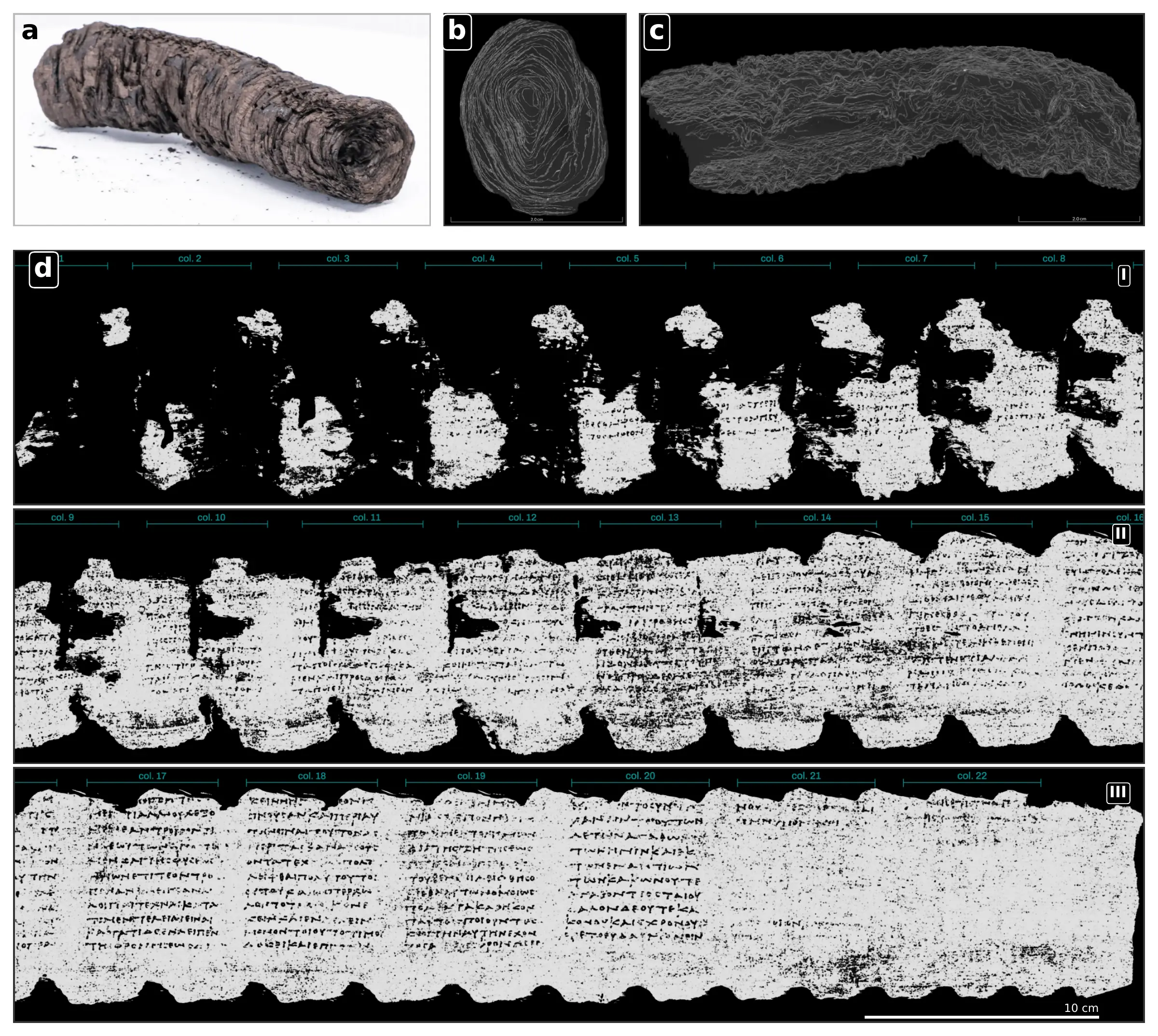
PHerc. 1667 from sealed roll to readable text: a photograph of the carbonized roll, transverse and longitudinal CT cross-sections, and the unwrapped surface showing columns of Greek.
From object to text. The sealed, carbonized roll (top left); cross-sections through the X-ray scan revealing the spiraled sheet inside (top); and the unwrapped surface, where columns of Greek writing emerge as the ink signal is recovered (bottom).

The work reaches beyond a single scroll. Alongside the complete reading of PHerc. 1667, the research establishes a method that holds up under independent checks and scales to other rolls.

PHerc. 1667 — read in full

PHerc. 1667 is what survives of a larger roll: earlier attempts to open it by hand — in the nineteenth century, and again in 1969 and the 1980s — destroyed its outer layers and left only the compact inner core, about 8 cm of an original height of 19–24 cm. From that surviving portion we have now recovered and read the text in full — the lower parts of some twenty-two columns, transcribed and reviewed by papyrologists. It is the first time the preserved text of a rolled Herculaneum scroll has been read continuously, end to end, rather than in isolated words or patches.

The recovered text is a philosophical treatise on ethics, and the evidence points to a Stoic work: it turns on human nature, impulse, and the moral progress of human beings, and its final preserved column names Aristocreon — nephew and disciple of the great Stoic Chrysippus — which, together with the language and themes of the text, places it in a Stoic context and dates it to the 2nd century BC.

Because the papyrus is damaged, the readings are fragmentary, with gaps where the surface is lost. Even so, several passages can be read clearly for the first time in two thousand years:

“…we will inquire into something, but we will not grasp it, if in some way we depart from ourselves and from our own nature…”

“Having…strained ourselves to the utmost through research and learning…possessing the same practical wisdom…”

“…such being the goods for us, even from the opposite evils there will be neither anything good — let alone beautiful — nor anything bad — let alone ugly — nor happiness…”

Translated from the Greek; the full column-by-column transcription is in the preprint.

PHerc. Paris 4 — ink made visible by higher resolution

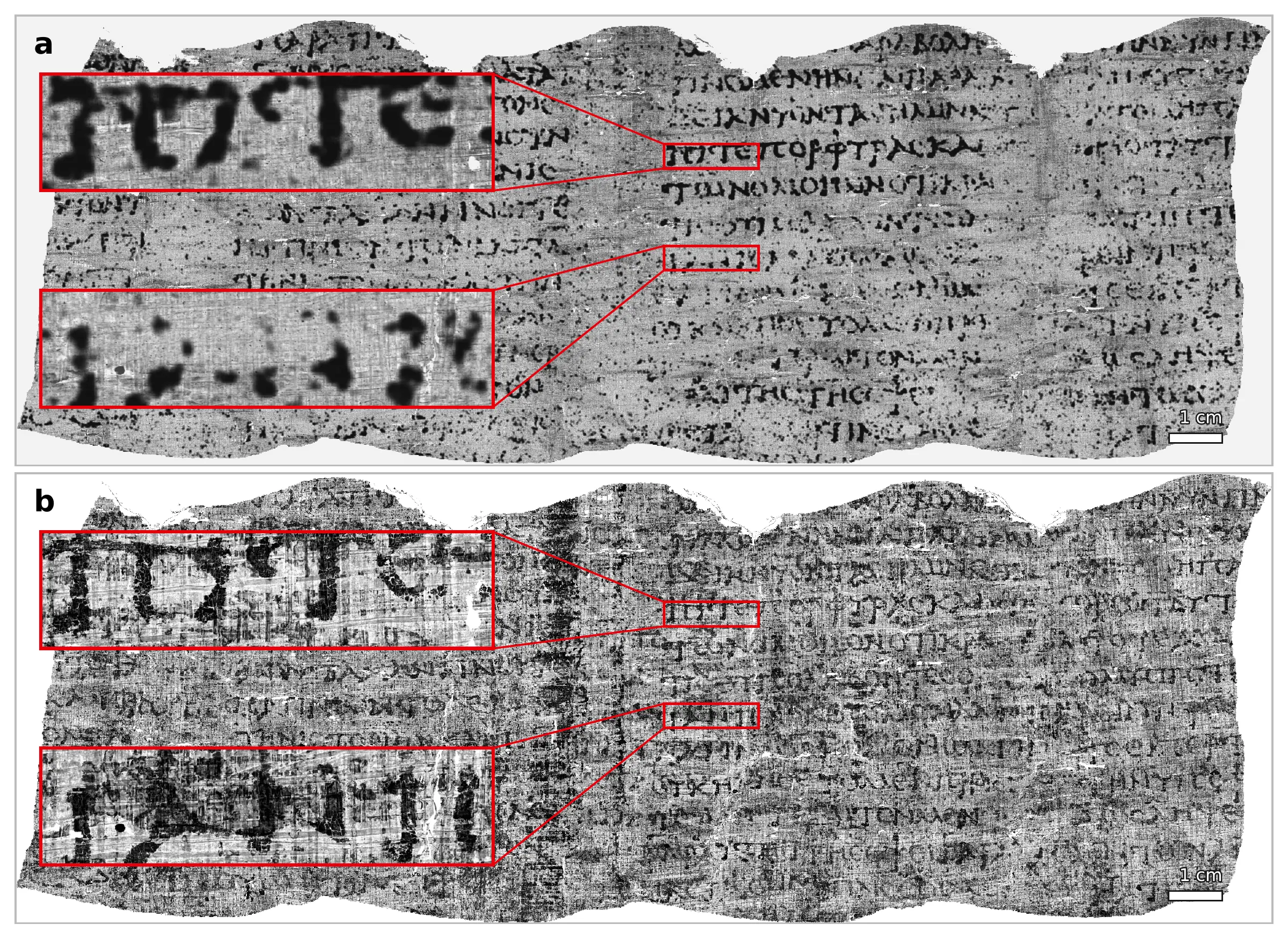
In a second scroll — PHerc. Paris 4, the scroll the Vesuvius Challenge community knows as Scroll 1 — a higher-resolution imaging technique makes the ink directly visible inside the scroll itself, in the three-dimensional X-ray data, for the first time. Segmented in 3D and projected back onto the unwrapped page, that ink matches the text read in the 2023 Grand Prize one-to-one — an independent confirmation, from better data, that the reading is real.
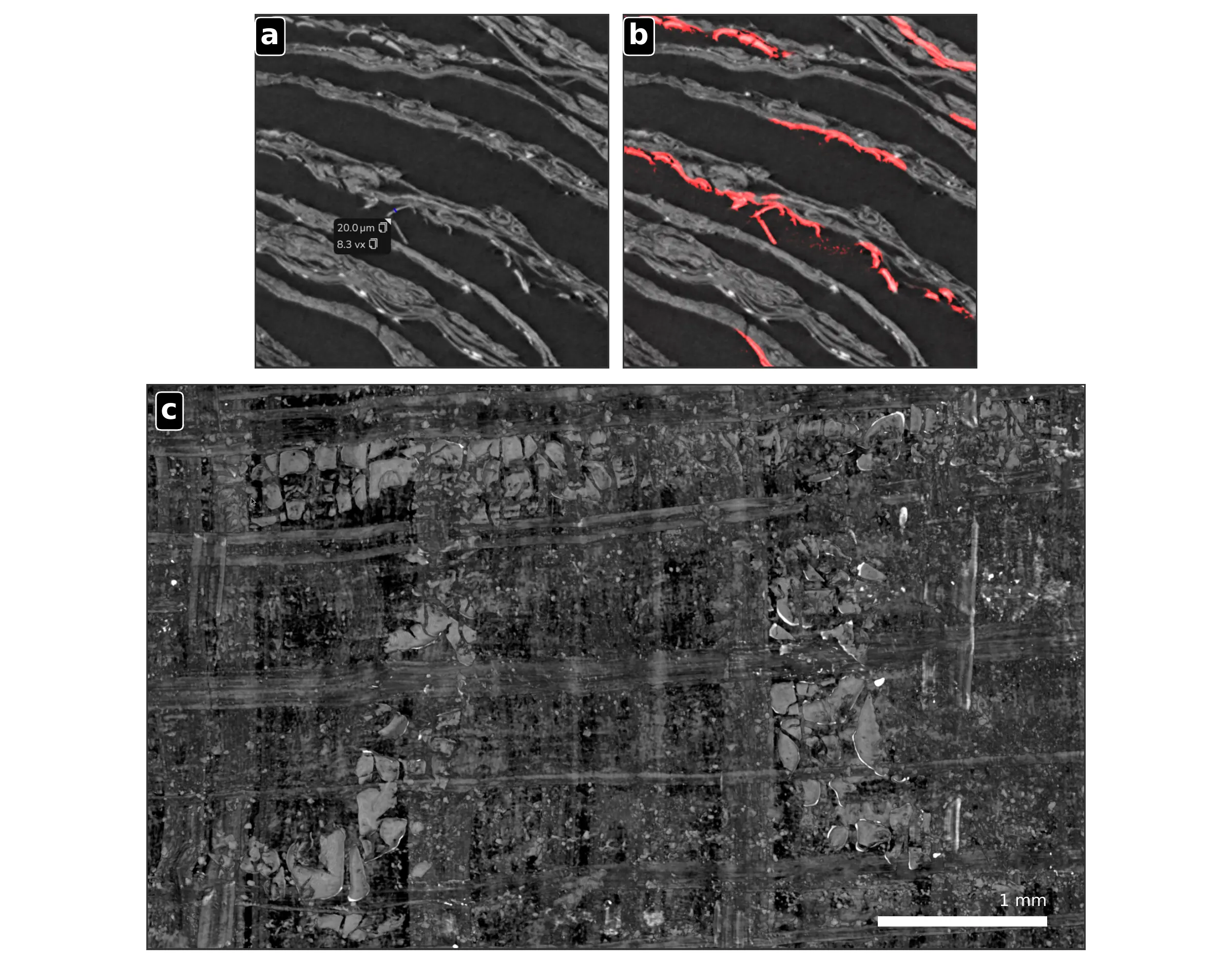
Higher-resolution cross-section of PHerc. Paris 4 showing ink directly visible on the papyrus surface, with the ink segmented in three dimensions.
Ink made visible by higher resolution in PHerc. Paris 4 (Scroll 1). In a cross-section of the X-ray scan, the ink sits directly on the papyrus surface (left); it can then be segmented in three dimensions (red) and projected onto the unwrapped page.
PHerc. Paris 4: the 2023 Grand Prize reading compared with the 2024 high-resolution synchrotron result, showing markedly clearer letters.
PHerc. Paris 4: the 2023 Vesuvius Challenge Grand Prize reading (top) and the new 3D ink segmentation (bottom) — the same text, recovered one-to-one from better data.

In a third scroll, PHerc. 139, we recover the scroll's title and author attribution: the work is identified as Philodemus, On Gods, Book 8 — a treatise by the Epicurean philosopher whose works fill so much of this library. Reading the title of a closed scroll tells scholars what a roll contains before a single column of its body is studied.
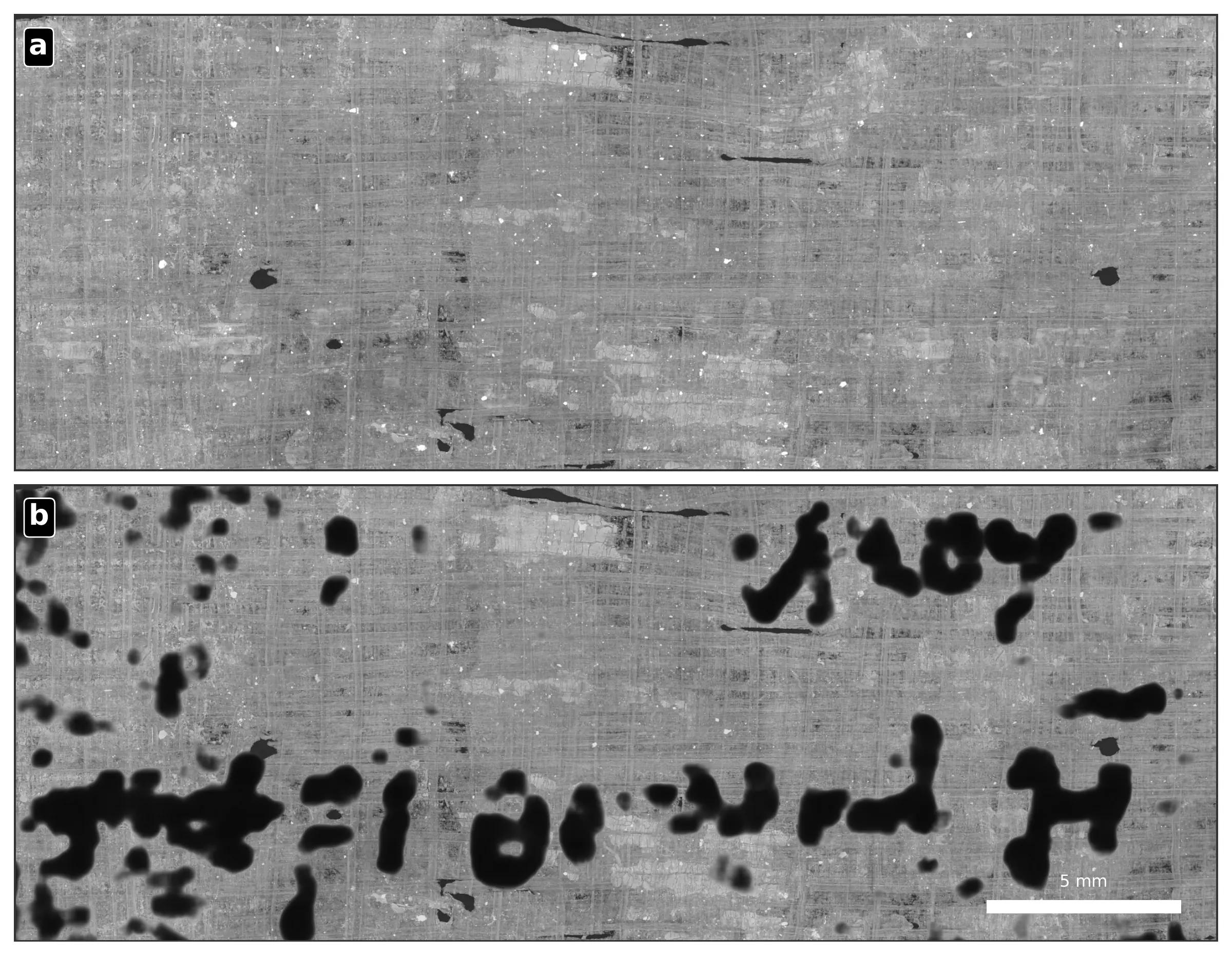
PHerc. 139 title region: surface rendering and ink-enhanced view revealing the title and author attribution, identifying the work as Philodemus, On Gods, Book 8.
The title region of PHerc. 139. Enhancing the ink signal reveals the title and author attribution, identifying the scroll as Philodemus, On Gods, Book 8.

How it was done

The scans were acquired with high-resolution phase-contrast X-ray microtomography on the BM18 beamline at the European Synchrotron Radiation Facility (ESRF) in Grenoble — an instrument able to resolve the wafer-thin, densely packed layers of a Herculaneum roll. The work was carried out in collaboration with the National Library of Naples “Vittorio Emanuele III”, which safeguards the Herculaneum papyri. From those volumes, the team reconstructed the scroll's geometry, traced and flattened its surface into a readable sheet, and trained machine-learning models to detect ink that is almost indistinguishable from the carbonized papyrus beneath it. Each reading was then examined and transcribed by papyrologists.

A cross-section sweeping through the X-ray scan of PHerc. 1667, revealing the sheet of papyrus wound inside the sealed roll.

Crucially, all of this is open. The tomographic data, reconstructed surfaces and transcriptions are released under a Creative Commons licence at scrollprize.org/data and archived at the ESRF, and the code is on GitHub. Anyone can check the work, build on it, and apply it to the scrolls that remain.

A victory for open, global science

This is what open science makes possible. The virtual unwrapping of the Herculaneum scrolls was pioneered at EduceLab by its principal investigator, Professor Brent Seales. In 2023 Seales opened his lab's imaging and software technology to the Vesuvius Challenge — a public, donation-funded effort he co-founded with Nat Friedman and Daniel Gross to read the scrolls in the open — and from there a global community took up the problem. The first letters and the 2023 Grand Prize were won by contestants from across the world.

What is less widely known is what happened next. Most of the Vesuvius Challenge research team first arrived as contestants. They entered the open competition, won prizes for the breakthroughs they made, and were then recruited onto the team that has now read an entire scroll. The people behind this breakthrough are, in large part, the global community the Challenge itself created.

What's next

PHerc. 1667 is one scroll. Hundreds more remain sealed — an entire library of philosophy, poetry and prose waiting to be read for the first time since antiquity. The method shown here is built to scale, and everything needed to apply it is open.

If you want to help read the rest of the library:

The thoughts of the ancient world, sealed in darkness for two millennia, are coming back into the light — a whole scroll at a time.