


It's May 2026 and the layoffs aren't coming. They're here. Meta cut 8,000 this month, roughly 10% of the company, and redirected 7,000 to AI teams. Cloudflare cut 1,100, the first mass layoff in its 16-year history. Tech layoffs have passed 100,000 for the year. The four hyperscalers are planning $725B in AI capex in 2026, up 77% year-over-year.
The "they just overhired during COVID and are self correcting" line was the dominant counter-argument presented by your favorite VC influencers . They've quietly stopped saying that now.
There's no escaping the reality now. AI is going to wipe out a huge chunk of white-collar jobs. Blue-collar ones will also follow once robotics is solved.
Peter Drucker once said: "Because the purpose of business is to create a customer, the business enterprise has two—and only two—basic functions: marketing and innovation. Marketing and innovation produce results; all the rest are costs.
Applying this broadly to most firms today you can divide this up into:
That's it. The rest are fucked.
Cloudflare's CEO Matthew Prince was direct about this in his Wall Street Journal op-ed. The vast majority of those laid off, he wrote, were "measurers": middle management, finance, legal, internal auditing, revenue recognition.
To understand why the middle gets cut, you have to understand where complexity in a firm comes from. There are two sources.
Product complexity. If you're Gmail serving billions of users, that is a genuinely hard engineering, technical, political, and social problem. Uptime. Abuse prevention. Due process for account suspensions. Government data requests. Edge cases at scale. This complexity is intrinsic to the product and it does not go away. DocuSign employees a ton of people partly for this reason. When you're embedded in billions of dollars of legal workflow, the surface area of things that can break is enormous.
Human-to-human complexity. Every person you add to the company is a new node on the social graph. Their own goals, their own incentives, their own emails to be cc'd on, their own resource asks, their own ways to subtly help or hurt morale. Coordination cost scales superlinearly with headcount. Anyone who has worked at a big company knows the productivity per head past a certain threshold is embarrassing.
The conventional wisdom used to be that human-to-human complexity was the unavoidable cost of scale. If you wanted to grow past a certain size, you ate it. You built the org chart, you hired the managers and the managers' managers, you accepted that 40% of your headcount existed to coordinate the other 60%. That was the deal.
AI is going to eat away at the resources needed to work at a certain product complexity...but its biggest short-term leverage is killing the human-to-human complexity. The coordination tax, the reporting layer, the measurers.
Firms get fat for a structural reason. The way you grow inside a company is to manage more people. To manage more people, you need more reports. So every ambitious person has an incentive to hire people they don't strictly need. Multiply that across the org chart for a decade and you get the typical Fortune 500.
Companies are now waking up to the fact that AI lets you reverse it.
Not all firms can do this at the same speed. The companies cutting hardest right now are disproportionately founder-led. Coinbase. Meta under Zuckerberg. Block under Dorsey. Cloudflare under Prince, still founder-CEO.
Founders have the board's trust to make decisions that look brutal in the short term. Hired CEOs do not. A hired CEO cutting 20% of headcount in a single round risks getting fired by a board nervous about optics. A founder cutting 20% writes an op-ed in the Wall Street Journal and gets called brave.
This buys the founder-led firms a 12-to-24-month head start. Eventually the playbook flows to the rest. JPMorgan, Citi, the big consultancies, the big insurers, the Fortune 100 industrials. They will all do this. They have to. Once a competitor in your space is running on 40% smaller headcount and growing faster, you cannot afford to keep your measurers. The board will not let you. Your activist investor will not let you.
Expect the layoffs to accelerate. A growing pool of formerly overpaid, overqualified workers will scramble for any role they can get, crowding out new entrants behind them. The ones who land something will take it at a fraction of what they used to make. For people whose identity was built around being the smart, well-compensated professional, this is going to be devastating in a way the economic numbers won't fully capture.
Startups starting today have an unprecedented structural advantage. They don't have legacy headcount. They don't have a legacy org chart. They don't have the political negotiations involved in firing people, severance costs, WARN Act compliance, or morale fallout. They get to be lean from day one.
And so they are probably in the best place to take advantage of this takeoff in agent capabilities.
A 5-to-10 person company starting today can credibly take on incumbents with thousands of employees. The first one-person billion-dollar company is close. Multi-billion-dollar companies with 5-to-20 people are coming behind it. What does a Fortune 500 firm with 10 employees and hundreds of thousands of agents even look like?
The unit of economic production is being redefined. We are entering the age of maximum leverage.
The 10x engineer is now the 1000x engineer. The leverage profile of cognitive work has inverted.
Token usage data inside the leading firms is going to make this explicit and brutal in the next 12 months. Some engineers, given a fixed token budget, generate exponentially more (and better) output. Other engineers waste their tokens. The variance is enormous, and unlike most performance variance, it is now directly measurable. HR has never had a clearer signal of leverage.
Right now firms are still distributing tokens somewhat evenly across their engineering orgs. This will stop. Uber burnt through their whole AI budget in 4 months. Tokenmaxing as a business strategy is not sustainable. At leats not in the hands of every person.
Some firm will figure out, probably internally and quietly at first, that it is better to give the top 10% of engineers billions of tokens than to give every engineer millions. The math will become undeniable. The best human + AI will b worth far more than the avg human + AI. At least in the short term.
The cuts that follow will be ruthless. The middle of the engineering bell curve gets cut for the same reason the middle of the management bell curve is getting cut now. The tools have rendered the leverage distribution legible.
If the leverage of an individual operator goes 1000x, the wealth distribution downstream follows. We are about to see inequality numbers that the modern American political system has no precedent for handling.
Elon Musk will likely become the first trillionaire. He won't be alone for long. Much like the four minute mile barrier being broken by Roger Bannister, and then quickly equalled by dozens of others, within 12 to 18 months of the first trillionaire we'll see a lot more joining the 4-Comma club. The 2030 list of the world's richest people is going to look like a Forbes 400 from another planet. Several hundred billion will be the floor for top-tier AI founders and the early employees who took equity.
This is not sustainable politically. It's also the part of the scenario almost nobody in tech wants to think clearly about, because thinking clearly forces conclusions that are uncomfortable for the people doing the thinking.
The Trump administration has fumbled enough fronts that the 2028 election is the Democrats' to lose. The Democrats' playbook in 2028 will be tailored to the reaction against runaway AI-driven inequality. Their mandate will be opposition to the elite.
The likely policy menu, some of which will pass and some of which won't:
Whether all of these pass or only some, the cumulative effect is the same. The U.S. AI industry gets dramatically more friction at exactly the moment it needs to sprint. This is the make-or-break window for American technological leadership. China is not going to slow down. They are not going to have a populist anti-AI moment in 2028, because they don't have democratic primaries and their politics doesn't run on the same backlash cycles.
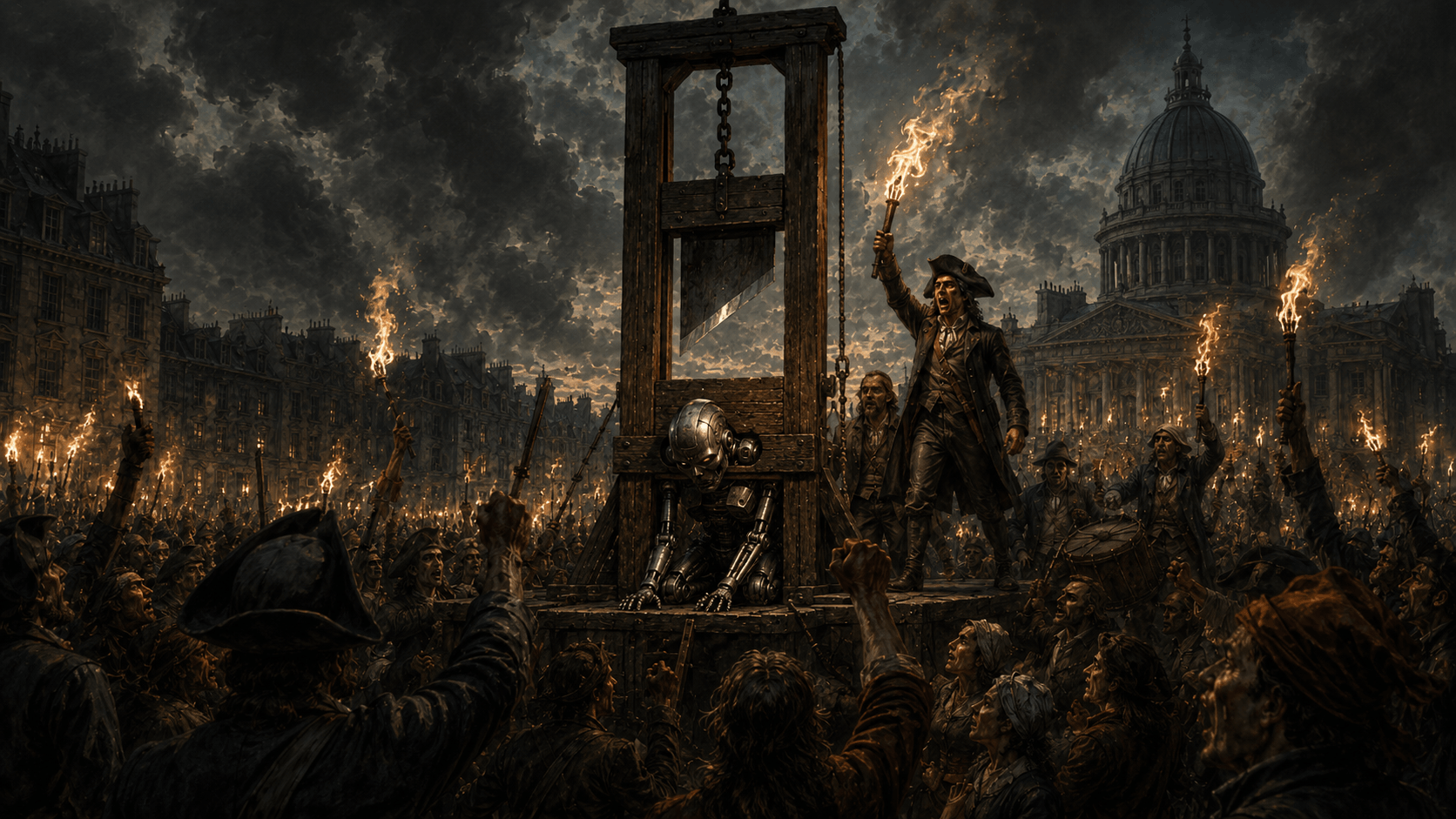
If the progressive wing of the Democratic party captures the 2028 nomination, and the legislation actually passes, the pitchforks come out for the leadership of the AI firms in some literal sense. We've already seen violence such as the Molotov cocktail being thrown at Sam Altman's house. This is only going to escalate.
Side note: Another consequence of AI automation will be a wave of xenophobia and anti-immigrant sentiment. It's much easier to blame the brown dude across the street for taking your job than to blame some abstract efficiency principle where AI agents let 2 people do the work of 10. On this one, Republicans more than Democrats are likely to pass stupid legislation that blocks the best researchers and engineers from working in America. We already see it in the form of poorly worded sweeping bills targeting H-1/O-1 and other visa holders every few months, and it will only get worse. If you're an immigrant waiting on a green card or citizenship, you have my sympathies. The next few years are going to be turbulent and unpredictable.
The double whammy of bad policy on immigration and on AI (power grids, data centers, training restrictions) is why I think the US is unlikely to win against China in this race.
But there is hope.
The only way out, as far as i can see, is for the people about to capture an unprecedented share of the gains to share some of it proactively.
This is the framing I would force on every billionaire in the room: would you rather give up 20% now, or 100% later? A wealth tax is almost on the cards regardless. The question is whether the rich set the terms or the terms get set for them.
Some version of UBI has to be in the proactive offer. It does not solve the long-term problem. It buys breathing room during the volatile transition. People can absorb economic shocks. They cannot absorb economic shocks while watching the people who caused the shock become trillionaires on television. The velocity of the status reversal is what makes it politically toxic. UBI dampens the velocity.
The historical analog is Bismarck's welfare state in the 1880s. Bismarck was not a socialist. He built the world's first modern welfare state specifically to pre-empt the socialists, giving the working class something to defend so they would not align with the people trying to overthrow the system. It worked for about 60 years. We need our Bismarck moment, and we need it now, before the political window closes.
The current administration will not do this. The 2028 administration will, but on terms set by the populist wing of the opposing coalition, which means the terms will be punitive rather than designed.
The obvious counter-argument. Every prior wave of automation has, on net, created more jobs than it destroyed. Farmers became factory workers. Factory workers became service workers. Bank tellers became relationship managers. The internet didn't kill office work; it 10x'd it. Historically, automation reduces the friction of the previous job and opens new opportunities downstream.
This argument has real merit but almost nobody in the AI discourse is engaging with it on a deeper level except, sadly, for the EA crowd which has its own misguided fixation with AI safety and control.
The argument gets one thing right. In the long run, after this transition period, there will be things humans do. We will not all be sitting at home in idle despair.
But here's where I push back. Every prior wave of automation was a tool. The tractor was a tool. The PC was a tool. Spreadsheets are a tool. But AGI (emphasis on the G) is not just a tool. Once you have an agent that is thousands of times smarter than you, runs continuously, never sleeps, never eats, costs a fraction of a human, and improves itself, the historical analogy breaks.
Quick side note: People claim tokens will get more expensive once the VC subsidies dry up. This is one of the dumbest takes around. OpenAI's cost to serve GPT-5.5 is less than its cost to serve GPT-4, because of algorithmic efficiency gains compounded by hardware improvements. The price of an H100 has increased because the same chip now produces more usable intelligence. We have only begun to scratch the surface of how much more efficient we can make these models. The human brain runs on 20 watts. The gap between today's models and that floor is enormous. And we are barely starting on the RSI feedback loop, where AI designs the algorithms that train the next generation of AI, ad infinitum. The cost curve is going down for a long time.
Let's assume we get to AGI. An agent thousands of times smarter than you, infinitely scalable, available for cents on the dollar. What role does a human play in that economy?
"Humans will just move up the stack!" Up to where? If the AGI is smarter than you at every rung of the stack, including the rung you're trying to move up to, the move doesn't work. The historical pattern of moving up the stack assumed the tool stayed below you in capability. AGI does not. AGI is above you at every rung, by definition.
Say an AI can do Carl's job. Fine, you make Carl the manager of a team of AI agents. But pretty soon an AI can manage those agents better than Carl can. So you promote Carl to manage the managers. Then the AI catches up at that level too. There is no rung of the stack where Carl beats the AI for very long. The only place left for Carl is at the very top, as the CEO or the owner of the firm.
So what will humans do if all jobs are gone?
If you told a peasant farmer in 1650 that their descendants would spend their days sitting in pajamas typing on glowing rectangles, they would not have called that a job. They would have called it leisure. So maybe the post-AGI "jobs" exist and we just can't picture them, because they will look like leisure to us.
I find this argument persuasive, but only in the long run. The thing we would call "leisure" today is going to be the thing future humans call work. Maybe we're all artists and storytellers and athletes and explorers and gamers, trading virtual currency for status and meaning. Maybe we run elaborate social games. Maybe we curate experiences for each other. I look forward to that world. I would rather live in a 2050 of universal AI-driven abundance than in a 17th-century farm.
However, that beautiful long-run future requires getting through the next five years unscathed. It requires the people losing their jobs not burning the system down before the system has time to redistribute the gains. It requires the AI labs not getting regulated into irrelevance by a populist backlash. It requires the rich understanding that giving up 20% now is the only way to keep the other 80%.
To get AI, we need the people, which includes the measurers, on board. To get the people on board, we need to give them something: money, security, dignity, a credible story about where they fit. We do not have to figure out the long-run answer to what humans are for. We just have to manage the next five years.
此内容由惯性聚合(RSS阅读器)自动聚合整理,仅供阅读参考。 原文来自 — 版权归原作者所有。