

惯性聚合 高效追踪和阅读你感兴趣的博客、新闻、科技资讯
阅读原文 在惯性聚合中打开

推荐订阅源

SecWiki News
SecWiki News
Vercel News
Vercel News
博客园 - 聂微东
奇客Solidot–传递最新科技情报
奇客Solidot–传递最新科技情报
月光博客
月光博客
N
News and Events Feed by Topic
Application and Cybersecurity Blog
www.infosecurity-magazine.com
博客园 - 【当耐特】
WordPress大学
WordPress大学
Google Online Security Blog
博客园 - Franky
Attack and Defense Labs
Help Net Security
Help Net Security
V
Visual Studio Blog
Jina AI
Jina AI
H
Heimdal Security Blog
小众软件
小众软件
O
OpenAI News
腾讯CDC
The Last Watchdog
The Last Watchdog
雷峰网
雷峰网
Cloudbric
Cloudbric
量子位
博客园_首页
The GitHub Blog
The GitHub Blog
L
LangChain Blog
K
KPMG report finds enterprise disconnect between AI and its ROI | CIO
T
The Blog of Author Tim Ferriss
cs.AI updates on arXiv.org
Last Week in AI
Last Week in AI
V2EX - 技术
V2EX - 技术
Security Archives - TechRepublic
Microsoft Azure Blog
博客园 - 司徒正美
M
MIT News - Artificial intelligence
大猫的无限游戏
大猫的无限游戏
T
Tor Project blog
C
CERT Recently Published Vulnerability Notes
W
WeLiveSecurity
B
Blog
C
Check Point Blog
TaoSecurity Blog
TaoSecurity Blog
T
Threatpost
Hugging Face - Blog
Hugging Face - Blog
Recent Announcements
Project Zero
Project Zero
Hacker News: Ask HN
Hacker News: Ask HN
U
Unit 42
Simon Willison's Weblog

Hacker News: Front Page

SPICE simulation → oscilloscope → verification with Claude Code — Lucas Gerads GitHub - GainSec/AutoProber: Hardware hacker’s flying probe automation stack for agent-driven target discovery, microscope mapping, safety-monitored CNC motion, probe review, and controlled pin probing. Introducing Claude Opus 4.7 Qwen Studio The Future of Everything is Lies, I Guess: Where Do We Go From Here? GitHub - SeanFDZ/macmind: Single-layer transformer in HyperTalk for the classic Macintosh Virginia Bans Sale of Geolocation Data Show HN: Agent-cache – Multi-tier LLM/tool/session caching for Valkey and Redis Ancient DNA reveals pervasive directional selection across West Eurasia [pdf] AI cybersecurity is not proof of work Moving a large-scale metrics pipeline from StatsD to OpenTelemetry / Prometheus GitHub - Nightmare-Eclipse/RedSun: The Red Sun vulnerability repository GitHub - SethPyle376/hiraeth: Local AWS emulator focused on fast integration testing, with SQS support, SQLite-backed state, and a debug-friendly web UI. A Better Ludum Dare; Or, How to Ruin a Legacy GitHub - macOS26/Agent: Any AI, replaces Claude Code, Cursor, OpenClaw. Over 18 LLM providers (Claude, OpenAI, Gemini, Ollama, Zai, HF, Qwen) wired into a native Mac app that writes code, builds Xcode projects, bumps versions, manages git, automates Safari, use AppleScript, JS or Accessibility, extend Agent! w/ MCP Servers, run tasks from your iPhone via Messages. YouTube now lets you turn off Shorts I Made a Terminal Pager Burgers | マクドナルド公式 Commands — HackerNews CLI documentation ChatGPT for Excel PiCore - Raspberry Pi Port of Tiny Core Linux Live Nation illegally monopolized ticketing market, jury finds Google Broke Its Promise to Me. Now ICE Has My Data. Founding Engineer at Adaptional | Y Combinator CRISPR takes important step toward silencing Down syndrome’s extra chromosome GitHub - saffron-health/libretto: The AI toolkit for building reliable browser automations US v. Heppner (S.D.N.Y. 2026) no attorney-client privilege for AI chats [pdf] Unexpected €54k billing spike in 13 hours: Firebase browser key without API restrictions used for Gemini requests Fragments: April 14 Cal.com Goes Closed Source: Why AI Security Is Forcing Our Decision | Cal.com - Scheduling Software for Online Bookings Laravel raised money and now injects ads directly into your agent Codex Hacked a Samsung TV Tech Valuations Back to Pre-AI Boom Levels A perfectable programming language — Soter GitHub - halfwhey/claudraband: Claude Code for the Power User Partnership through Play: Investigating How Long-Distance Couples Use Digital Games to Facilitate Intimacy Textbooks and Methods of Note-Taking in Early Modern Europe (2008) Eternity in six hours: Intergalactic spreading of intelligent life (2013) Seven countries now generate 100% of their electricity from renewable energy Tell HN: OpenAI silently removed Study Mode from ChatGPT Pro Max 5x Quota Exhausted in 1.5 Hours Despite Moderate Usage Show HN: Oberon System 3 runs natively on Raspberry Pi 3 (with ready SD card) Tell HN: docker pull fails in spain due to football cloudflare block Bring Back Idiomatic Design No one owes you supply-chain security GitHub - xsawyerx/curl-doom: DOOM, played over cURL Apple update turns Czech mate for locked-out iPhone user The Grand Line Cache TTL silently regressed from 1h to 5m around early March 2026, causing quota and cost inflation Building a Z-Machine in the worst possible language The peril of laziness lost Iran war: We spoke to the man making Lego-style AI videos that experts say are powerful propaganda AI Will Be Met With Violence, and Nothing Good Will Come of It GitHub - duguyue100/midnight-captain: Inspired by Midnight Commander, tailored to my taste. How to build a `git diff` driver · Jamie Tanna | Software Engineer Center for Responsible, Decentralized Intelligence at Berkeley The Local Universe’s Expansion Rate Is Clearer Than Ever, but Still Doesn’t Add Up - A new synthesis of astronomical measurements confirms a persistent mismatch that could point to physics beyond current models The disturbing white paper Red Hat is trying to erase from the internet – OSnews NetBlocks (@netblocks@mastodon.social) The Future of Everything is Lies, I Guess: Annoyances ‘Abhorrent’: the inside story of the Polymarket gamblers betting millions on war Productive procrastination — Max van IJsselmuiden maps, territory and LMs 447 Terabytes per Square Centimetre at Zero Retention Energy: Non-Volatile Memory at the Atomic Scale on Fluorographane Show HN: Pardonned.com – A searchable database of US Pardons 20 Years on AWS and Never Not My Job The Seasons are Wrong The FAA wants gamers to apply for air traffic control jobs Artemis II crew splashes down near San Diego after historic moon mission Why weekends are under threat We gave an AI a 3 year retail lease in SF and asked it to make a profit | Andon Labs How a dancer with ALS used brainwaves to perform live On filing the corners off my MacBooks Installing every* Firefox extension OpenClaw’s memory is unreliable, and you don’t know when it will break Steve Blank Nowhere Is Safe Chimpanzees in Uganda locked in vicious 'civil war', say researchers watgo - a WebAssembly Toolkit for Go linux/Documentation/process/coding-assistants.rst at master · torvalds/linux GitHub - callumlocke/json-formatter: Makes JSON easy to read. Founding Product Engineer at Bild AI | Y Combinator A compelling title that is cryptic enough to get you to take action on it GitHub - Keychron/Keychron-Keyboards-Hardware-Design: Industrial design files for Keychron keyboards and mice. 100+ models with CAD assets in STEP, DXF, DWG, and PDF. Source-available, with commercial use allowed for original compatible accessories within the license terms. [ANNOUNCE] WireGuardNT v0.11 and WireGuard for Windows v0.6 Released 1D-Chess Helium Is Hard to Replace Keeping a Postgres queue healthy — PlanetScale Serenity Forge (@serenityforge.com) Our response to the Axios developer tool compromise Do Americans read print books, e-books or audiobooks more? Uncharted island soon to appear on nautical charts The Problem That Built an Industry Fragments: April 2 Python Release Python install manager 26.1 Bitcoin miners are losing $19,000 on every BTC produced as difficulty drops 7.8% God sleeps in the minerals Harness engineering: leveraging Codex in an agent-first world Apple Silicon and Virtual Machines: Beating the 2 VM Limit What have been the greatest intellectual achievements? The APL Programming Language Source Code
Never Give Them Your Face
2026-06-22 · via Hacker News: Front Page

They want your face. It will be called safety. Verification. Age assurance. A small step to protect children. But strip the language away and the demand is plain: before you may speak, post, or read, you must first prove who you are. And the only way they've figured out how to do it is with your government ID, or with your face held up to a camera that decides whether you are old enough to be trusted. This is the deal now being written into law on three continents, and you are meant to accept it quietly. Don't.
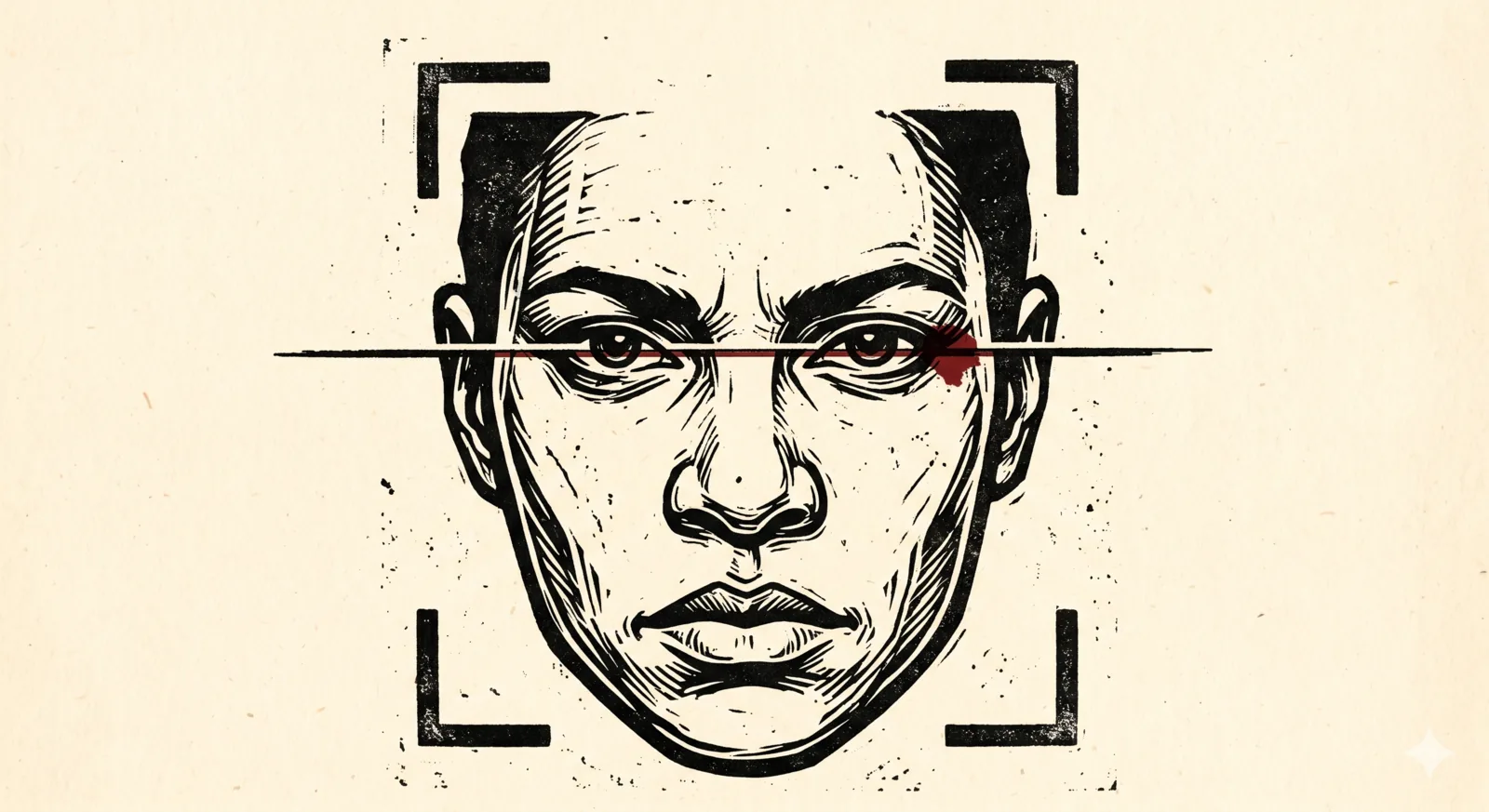
A human face overlaid with facial-recognition brackets and a red scan line.
Fig. 1 — They are not asking your age. They are mapping your face.

It's always "won't someone think of the children?!". But this affects everyone.

No one disputes that the internet can hurt kids. That grief is real, but it's being exploited. Here is the trick: to confirm that a child is not present, a service has to check everybody. Every adult passes through the checkpoint. A law written about sixteen-year-olds quietly becomes an identity requirement for the entire internet. You are not carded because you are suspected of anything. You are carded because carding has become the price of admission to life on the web.

We run background checks on people who want to buy a gun, but we do not background check everyone at all times just in case. Yet that is exactly the design here. It's a permit check at the door of every conversation, applied to all, justified by the few.

It is not age verification. It is identity verification.

Watch the words drift. This whole system was sold as age assurance, which is a yes-or-no question, are you over eighteen? But almost none of these systems are built to answer only that. They are built to know who you are: your name, your date of birth, your document number, your face. This is not age verification at all. It is forced identity tracking. Your real-world identity captured by not only Meta, Facebook, Twitter, Instagram, etc, but shared broadly with every creepy agency you already worry about "having all your data".

Name the places now demanding "age verification," and see how many will accept a plain government document that says only that you are over eighteen — and nothing else. Almost none will. Because age was never the point.

We spent a generation teaching people the first rule of the internet: never give out your real identity to strangers. We have a word, doxxing, for inflicting that exposure on someone against their will. And now the same governments and platforms are asking every citizen to do it to themselves, voluntarily, as a condition of logging in.

You can change a password. You cannot change your face.

A leaked password is an inconvenience. You reset it and move on. Your face, your driver's license, the unique geometry a scanner reduces to a number cannot be reset. A face scan is not a photograph. It is a three-dimensional map of you, a biometric template precise enough to be matched later against a surveillance camera on a street corner. When you hand over and it lives on someone else's server, often a third-party vendor you never chose, cannot name, and cannot hold to account.
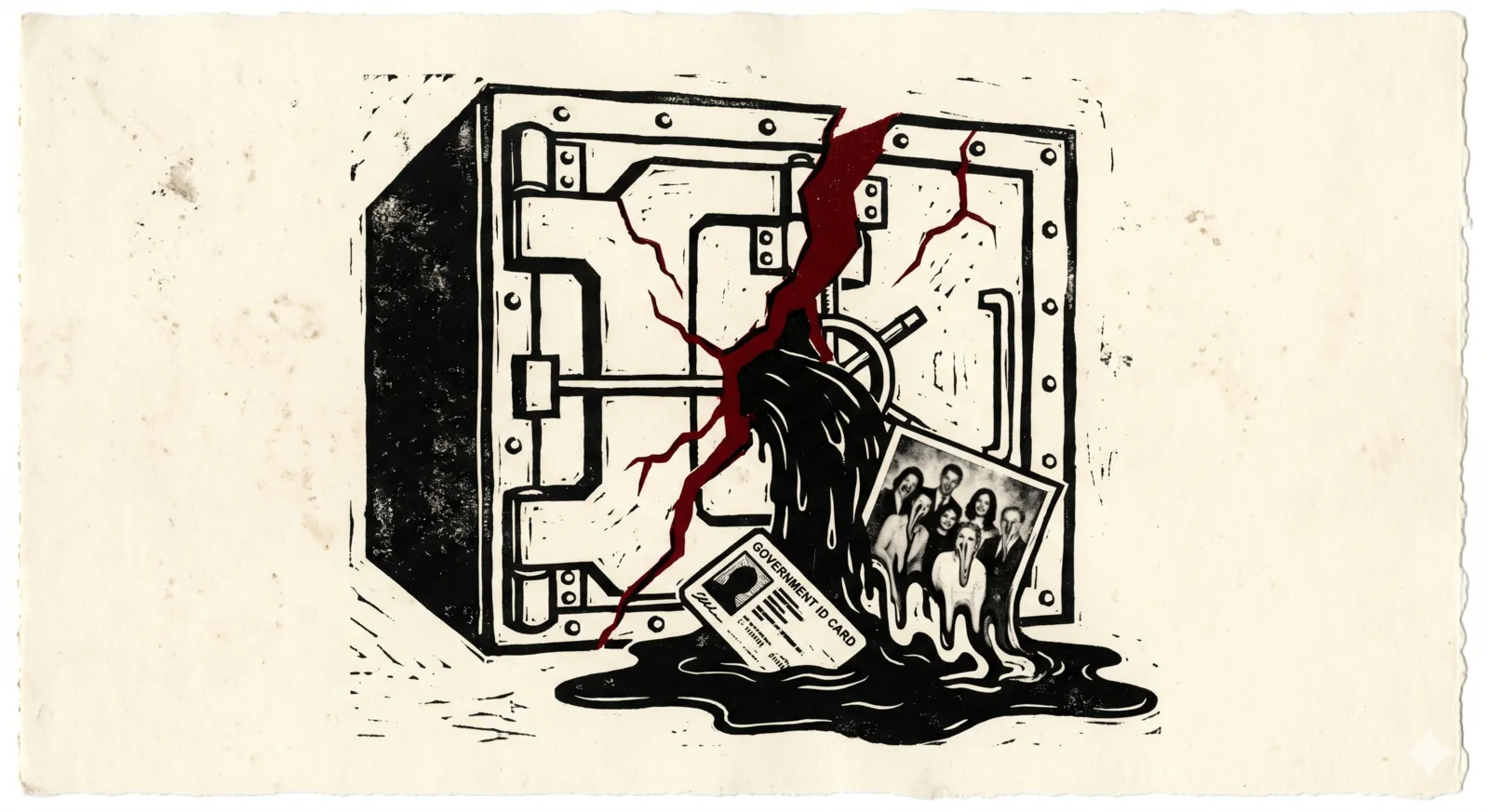
A government ID and photograph spilling from a cracked server vault.
Fig. 2 — Every verification database is a honeypot waiting to spill.

Every one of those databases is a honeypot. The verifier promises your documents are deleted the moment they are checked. They are not always deleted, and the promise is worthless the day the company is breached. Remember the last twenty years of worthles $17.99 Equifax IDentityGuard+ credits from all those data breaches? It has happened, it will happen again, except this time it's not your email, hashed password, or even your SSN. It's your face and passport that's for sale on the dark web.

It does not work — and it makes the danger worse.

Here is the insult beneath the injury: it fails at the one thing it promises. Determined teenagers route around age gates like breathing — a borrowed login, a VPN, a checkbox, a verified account bought for the price of a coffee. Within hours of one platform rolling out age brackets, pre-verified accounts for every age were for sale on eBay. Teenagers machete their way through technologies designed to "protect" or limit them in the same way that water finds the cracks in the wall. They have all the time in the world, all of the incentives, and all of the social structure and obfuscated chat channels to do it.

Worse, the architecture built to "protect" children can endanger them. Sort users into age-labeled pens and you have not only failed to stop a predator, you have created a children index, a phonebook, a way to filter directly for children. Teenagers pushed off mainstream platforms do not stop going online (see point about water above). They move to smaller, darker, unmoderated corners, away from the very oversight that was supposed to keep them safe. The children are not saved. The surveillance is the only thing that survives intact.

Safe now, ??? later

The database you are helping build for a trustworthy government does not stay in trustworthy hands. Administrations change. A registry that merely catalogs who you are today becomes, under a future government, a map of who to find. We already know that US federal agencies spy on citizens wholesale: who attended which protest, who read which forum, who belongs to which group. People are right to be afraid of what a hostile regime would do with a ready-made list. The data does not forget, and it does not take sides. It simply waits for whoever holds it next.

The whole internet starts to feel like the office: everyone too frightened to say anything but the safe thing, lest a real name attached to a real opinion cost them a real job.

A principled stance

Most people are fine with this, based on the same debunked "nothing to hide" fallacies that are always trotted out in these conversations. Surveys find overwhelming majorities want children protected online, and large majorities say they support age verification in the abstract.

This is not a popularity contest, and refusal is not a vote you are trying to win. A verification regime does not need your approval — it needs your participation. It only works if nearly everyone complies. The point of refusal is not to persuade a majority before acting; it is to deny the system the universal cooperation it requires to function at all. You do not need to win the poll. Just don't upload the photo. Never give them your face.

If Starbucks asked to scan your ID and put it in a national database to sell you a latte, would you give it to them? No, because you value your identity more than your latte. Do you not value your identity more than your ability to see some random cousin post about their repugnant political opinions or a picture of someone's dog?

I am but one

In theory, us normal internet users can stop this whole system by opt-ing out, by boycotting the process. Imagine a "National Month of Identity Choice", where no one used any platform demanding your face, no one logged on, no one saw any ads, no one bought any sponsored projects. The platforms would see massive revenue drops, and there would be intense lobbying to reverse these awful laws. We can do it.

The only word they cannot route around is no.

These systems run on compliance. They assume you will sigh, upload the photo, and move on. Their entire business model depends on it. Which is also their weakness. A verification wall that no one verifies for is a wall with no one standing at it.

A flat raised palm covering a camera lens, with a red REFUSE stamp.
Fig. 3 — The only word they cannot route around is no.

So refuse. Refuse the scan. Refuse the upload. Close the accounts that demand it and tell them, in writing, exactly why you are leaving. The platforms need you far more than you need them. \You can live without the feed, they cannot live without the crowd. Do not comply in advance. The face on your ID is the most permanent thing you own.

Never give them your face.