




惯性聚合 高效追踪和阅读你感兴趣的博客、新闻、科技资讯
阅读原文 在惯性聚合中打开

推荐订阅源

V
Visual Studio Blog
U
Unit 42
让小产品的独立变现更简单 - ezindie.com
The GitHub Blog
The GitHub Blog
Microsoft Azure Blog
有赞技术团队
有赞技术团队
Stack Overflow Blog
Stack Overflow Blog
爱范儿
爱范儿
博客园 - 司徒正美
Vercel News
Vercel News
I
InfoQ
GbyAI
GbyAI
C
Check Point Blog
B
Blog RSS Feed
Martin Fowler
Martin Fowler
B
Blog
MyScale Blog
MyScale Blog
腾讯CDC
博客园 - Franky
Blog — PlanetScale
Blog — PlanetScale
钛媒体:引领未来商业与生活新知
钛媒体:引领未来商业与生活新知
Hugging Face - Blog
Hugging Face - Blog
freeCodeCamp Programming Tutorials: Python, JavaScript, Git & More
博客园 - 三生石上(FineUI控件)

Hacker News: Front Page

SPICE simulation → oscilloscope → verification with Claude Code — Lucas Gerads Introducing Claude Opus 4.7 Qwen Studio The Future of Everything is Lies, I Guess: Where Do We Go From Here? GitHub - SeanFDZ/macmind: Single-layer transformer in HyperTalk for the classic Macintosh Show HN: Agent-cache – Multi-tier LLM/tool/session caching for Valkey and Redis Ancient DNA reveals pervasive directional selection across West Eurasia [pdf] AI cybersecurity is not proof of work Moving a large-scale metrics pipeline from StatsD to OpenTelemetry / Prometheus GitHub - Nightmare-Eclipse/RedSun: The Red Sun vulnerability repository GitHub - SethPyle376/hiraeth: Local AWS emulator focused on fast integration testing, with SQS support, SQLite-backed state, and a debug-friendly web UI. A Better Ludum Dare; Or, How to Ruin a Legacy GitHub - macOS26/Agent: Any AI, replaces Claude Code, Cursor, OpenClaw. Over 18 LLM providers (Claude, OpenAI, Gemini, Ollama, Zai, HF, Qwen) wired into a native Mac app that writes code, builds Xcode projects, bumps versions, manages git, automates Safari, use AppleScript, JS or Accessibility, extend Agent! w/ MCP Servers, run tasks from your iPhone via Messages. YouTube now lets you turn off Shorts I Made a Terminal Pager Burgers | マクドナルド公式 Commands — HackerNews CLI documentation ChatGPT for Excel PiCore - Raspberry Pi Port of Tiny Core Linux Live Nation illegally monopolized ticketing market, jury finds Google Broke Its Promise to Me. Now ICE Has My Data. Founding Engineer at Adaptional | Y Combinator CRISPR takes important step toward silencing Down syndrome’s extra chromosome GitHub - saffron-health/libretto: The AI toolkit for building reliable browser automations US v. Heppner (S.D.N.Y. 2026) no attorney-client privilege for AI chats [pdf] Unexpected €54k billing spike in 13 hours: Firebase browser key without API restrictions used for Gemini requests Fragments: April 14 Cal.com Goes Closed Source: Why AI Security Is Forcing Our Decision | Cal.com - Scheduling Software for Online Bookings Laravel raised money and now injects ads directly into your agent Codex Hacked a Samsung TV
Zenzizenzizenzic - Wikipedia
Contributors to Wikimedia projects · 2026-06-20 · via Hacker News: Front Page

From Wikipedia, the free encyclopedia

Zenzizenzizenzic is an obsolete form of mathematical notation representing the eighth power of a number (that is, the zenzizenzizenzic of {\displaystyle x} is {\displaystyle x^{8}}), dating from a time when powers were written out in words rather than as superscript numbers. This term was suggested by Robert Recorde, a 16th-century Welsh physician, mathematician and writer of popular mathematics textbooks, in his 1557 work The Whetstone of Witte (although his spelling was zenzizenzizenzike); he wrote that it "doeth represent the square of squares squaredly".

Page from The Whetstone of Witte, 1557. Zenzizenzizenzike occurs at the top of the right hand page.

At the time Recorde proposed this notation, there was no easy way of denoting the powers of numbers other than squares and cubes. The root word for Recorde's notation is zenzic, which is a German spelling of the medieval Italian word censo, meaning 'squared'.[1] Since the square of a square of a number is its fourth power, Recorde used the word zenzizenzic (spelled by him as zenzizenzike) to express it. Some of the terms had prior use in Latin zenzicubicus, zensizensicus and zensizenzum.[2] Similarly, as the sixth power of a number is equal to the square of its cube, Recorde used the word zenzicubike to express it; a more modern spelling, zenzicube, is found in Samuel Jeake's Arithmetick Surveighed and Reviewed. Finally, the word zenzizenzizenzic denotes the square of the square of a number's square, which is its eighth power: in modern notation,
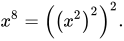
{\displaystyle x^{8}=\left(\left(x^{2}\right)^{2}\right)^{2}.}

Samuel Jeake gives zenzizenzizenzizenzike (the square of the square of the square of the square, or 16th power) in a table in A Compleat Body of Arithmetick (1701):[3]

Indices Characters Signification of the characters
0 N An absolute number, as if it had no mark
... ... ...
16 ℨℨℨℨ A Zenzizenzizenzizenzike or square of squares squaredly squared
... ... ...

The word, as well as the system, is obsolete except as a curiosity; the Oxford English Dictionary (OED) has only one citation for it.[4][5] As well as being a mathematical oddity, it survives as a linguistic oddity: zenzizenzizenzic has more Zs than any other word in the OED.[6][7]

Notation for other powers

[edit]

Recorde proposed three mathematical terms by which any power (that is, index or exponent) greater than 1 could be expressed: zenzic, i.e. squared; cubic; and sursolid, i.e. raised to a prime number greater than three, the smallest of which is five. Sursolids were as follows: 5 was the first; 7, the second; 11, the third; 13, the fourth; etc.

Table of powers, symbols and names or descriptions from 0 to 24 by Samuel Jeake, written in 1671

Therefore, a number raised to the power of six would be zenzicubic, a number raised to the power of seven would be the second sursolid, hence bissursolid (not a multiple of two and three), a number raised to the twelfth power would be the "zenzizenzicubic" and a number raised to the power of ten would be the square of the (first) sursolid. The fourteenth power was the square of the second sursolid, and the twenty-second was the square of the third sursolid.

Jeake's text appears to designate a written exponent of 0 as being equal to an "absolute number, as if it had no Mark", thus using the notation {\displaystyle x^{0}} to refer to an independent term of a polynomial, while a written exponent of 1, in his text, denotes "the Root of any number" (using root with the meaning of the base number, i.e. its first power {\displaystyle x^{1}}, as demonstrated in the examples provided in the book).

  1. ^ Quinion, Michael, "Zenzizenzizenzic - the eighth power of a number", World Wide Words, retrieved 19 March 2010.
  2. ^ Michael Stifel, Arithmetica Integra (in Latin), Nuremberg, p. 61
  3. ^ Samuel Jeake (1701), Samuel Jeake the Younger (ed.), A Compleat Body of Arithmetick, London: T. Newborough, p. 272
  4. ^ Knight, Charles (1868), The English Cyclopaedia, Bradbury, Evans, p. 1045
  5. ^ Reilly, Edwin D. (2003), Milestones in Computer Science and Information Technology, Greenwood Publishing Group, p. 3, ISBN 978-1-57356-521-9
  6. ^ "Recorde also coined zenzizenzizenzic, OED with more Zs than any other" (Reilly 2003).
  7. ^ It uniquely contains six Zs. Thus, it is the only hexazetic word in the English language.Numerical Adjectives, Greek and Latin Number Prefixes, phrontistery.info, retrieved 19 March 2010