惯性聚合 高效追踪和阅读你感兴趣的博客、新闻、科技资讯
阅读原文 在惯性聚合中打开

推荐订阅源

Google DeepMind News
爱范儿
爱范儿
J
Java Code Geeks
L
LangChain Blog
V
V2EX
大猫的无限游戏
大猫的无限游戏
S
SegmentFault 最新的问题
博客园 - Franky
Microsoft Azure Blog
Jina AI
Jina AI
Blog — PlanetScale
Blog — PlanetScale
奇客Solidot–传递最新科技情报
奇客Solidot–传递最新科技情报
The Cloudflare Blog
博客园 - 司徒正美
B
Blog
G
Google Developers Blog
Stack Overflow Blog
Stack Overflow Blog
罗磊的独立博客
OSCHINA 社区最新新闻
OSCHINA 社区最新新闻
Apple Machine Learning Research
Engineering at Meta
Engineering at Meta
MyScale Blog
MyScale Blog
有赞技术团队
有赞技术团队
Hugging Face - Blog
Hugging Face - Blog

Hacker News: Front Page

SPICE simulation → oscilloscope → verification with Claude Code — Lucas Gerads Introducing Claude Opus 4.7 Qwen Studio The Future of Everything is Lies, I Guess: Where Do We Go From Here? GitHub - SeanFDZ/macmind: Single-layer transformer in HyperTalk for the classic Macintosh Show HN: Agent-cache – Multi-tier LLM/tool/session caching for Valkey and Redis Ancient DNA reveals pervasive directional selection across West Eurasia [pdf] AI cybersecurity is not proof of work Moving a large-scale metrics pipeline from StatsD to OpenTelemetry / Prometheus GitHub - Nightmare-Eclipse/RedSun: The Red Sun vulnerability repository GitHub - SethPyle376/hiraeth: Local AWS emulator focused on fast integration testing, with SQS support, SQLite-backed state, and a debug-friendly web UI. A Better Ludum Dare; Or, How to Ruin a Legacy GitHub - macOS26/Agent: Any AI, replaces Claude Code, Cursor, OpenClaw. Over 18 LLM providers (Claude, OpenAI, Gemini, Ollama, Zai, HF, Qwen) wired into a native Mac app that writes code, builds Xcode projects, bumps versions, manages git, automates Safari, use AppleScript, JS or Accessibility, extend Agent! w/ MCP Servers, run tasks from your iPhone via Messages. YouTube now lets you turn off Shorts I Made a Terminal Pager Burgers | マクドナルド公式 Commands — HackerNews CLI documentation ChatGPT for Excel PiCore - Raspberry Pi Port of Tiny Core Linux Live Nation illegally monopolized ticketing market, jury finds Google Broke Its Promise to Me. Now ICE Has My Data. Founding Engineer at Adaptional | Y Combinator CRISPR takes important step toward silencing Down syndrome’s extra chromosome GitHub - saffron-health/libretto: The AI toolkit for building reliable browser automations US v. Heppner (S.D.N.Y. 2026) no attorney-client privilege for AI chats [pdf] Unexpected €54k billing spike in 13 hours: Firebase browser key without API restrictions used for Gemini requests Fragments: April 14 Cal.com Goes Closed Source: Why AI Security Is Forcing Our Decision | Cal.com - Scheduling Software for Online Bookings Laravel raised money and now injects ads directly into your agent Codex Hacked a Samsung TV
Conversations with a six-year-old on functional programming
Posted on · 2026-06-14 · via Hacker News: Front Page

My six-year-old son walked up to me yesterday. “What are you reading?”

At the time, I was reading part of Janis Voigtländer’s habilitation thesis. Unsure where to even start, I decided to just answer straightforwardly: “I’m reading a very long story about free theorems.”

He persisted. “What are free theorems?”

Never one to shrink from a pedagogical challenge, I thought for a moment, then began: “Do you know what a function is?” He didn’t. “A function is like a machine where you put something in one end and something comes out the other end. For example, maybe you put a number in, and the number that is one bigger comes out. So if you put in three, four comes out, or if you put in six, seven comes out.” This clearly made sense to him, so I continued, “The type of a function machine tells you what kinds of things you put in and what kinds of things come out. So maybe you put a number in and get a number out. Or maybe you put in a list of numbers and get a number out.” He interrupted excitedly, “Or maybe you could put words in??” “Yes, exactly! Maybe you can put words in and get words out. Or maybe there is a function machine where you put other function machines in and get function machines out!” He gasped in astonishment at the idea of putting function machines into function machines.

“So,” I concluded, “a free theorem is when you can say something that is always true about a function machine if you only know its type, but you don’t know anything about what it does on the inside.” This seemed a bit beyond him (and to be fair, free theorems are only interesting when polymorphism is involved which I definitely didn’t want to go into). But the whole conversation had given me a different idea.

“Hey, I have a good idea for a game,” I said. “It’s called the function machine game. I will think of a function machine. You tell me things to put into the function machine, and I will tell you what comes out. Then you have to guess what the function machine does.” He immediately liked this game and it has been a huge hit; he wants to play it all the time. We played it while driving to a party yesterday, and we played it this morning while I was in the shower. So far, he has correctly guessed:

  • \lambda x.\, x + 1
  • \lambda x.\, x - 3
  • \lambda x.\, 10x
  • \lambda x.\, 2x
  • \lambda x.\, 6
  • \lambda w\!:\!\text{English noun}.\, \text{plural}(w)
  • \lambda x.\, 10 \lfloor x/10 \rfloor

I tried \lambda x.\, \min(x+2,10) but that was a bit tough for him. I realized that in some cases he may understand intuitively what the function does but have trouble expressing it in words (this was also a problem with \lambda x.\, 10 \lfloor x/10 \rfloor), so we started using the obvious variant where once the guesser thinks they know what the function does, the players switch roles and the person who came up with function specifies some inputs in order to test whether the guesser is able to produce the correct outputs.

\lambda x.\, 6 was also surprisingly difficult for him to guess (though he did get it right eventually). I think he was just stuck on the idea of the function doing something arithmetical to the input, and was having trouble coming up with some sort of arithmetic procedure which would result in 6 no matter what you put in! It simply hadn’t occurred to him that the machine might not care about the input. (Interestingly, many students in my functional programming class this semester were also confused by constant functions when we were learning about the lambda calculus; they really wanted to substitute the input somewhere and were upset/confused by the fact that the bound variable did not occur in the body at all!)

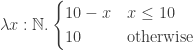
After a few rounds of guessing my functions, he wanted to come up with his own functions for me to guess (as I knew he would). Sometimes his functions are great and sometimes they don’t make sense (usually because his idea of what the function does changes over time, which of course he, in all sincerity, denies), but it’s fun either way. And after he finally understood \lambda x. \min(x+2, 10), he came up with his own function which was something like

\lambda x:\mathbb{N}. \begin{cases} 10 - x & x \leq 10 \\ 10 & \text{otherwise} \end{cases}

inspired, I think, by his kindergarten class where they were learning about pairs of numbers that added up to 10.

Definitely one of my better parenting days.

Unknown's avatar

About Brent

Associate Professor of Computer Science at Hendrix College. Functional programmer, mathematician, teacher, pianist, follower of Jesus.

This entry was posted in teaching and tagged , , , , , . Bookmark the permalink.