


惯性聚合 高效追踪和阅读你感兴趣的博客、新闻、科技资讯
阅读原文 在惯性聚合中打开

推荐订阅源

N
News and Events Feed by Topic
S
Security @ Cisco Blogs
S
Secure Thoughts
Attack and Defense Labs
cs.AI updates on arXiv.org
Hacker News - Newest:
Hacker News - Newest: "LLM"
Recent Commits to openclaw:main
H
Hacker News: Front Page
博客园 - 叶小钗
H
Heimdal Security Blog
Microsoft Security Blog
Forbes - Security
Forbes - Security
AI
AI
cs.CV updates on arXiv.org
T
Troy Hunt's Blog
罗磊的独立博客
Application and Cybersecurity Blog
爱范儿
爱范儿
GbyAI
GbyAI
The Last Watchdog
The Last Watchdog
TaoSecurity Blog
TaoSecurity Blog
C
CXSECURITY Database RSS Feed - CXSecurity.com
D
DataBreaches.Net
Recent Announcements
Schneier on Security
C
Cisco Blogs
美团技术团队
D
Docker
让小产品的独立变现更简单 - ezindie.com
WordPress大学
WordPress大学
月光博客
月光博客
雷峰网
雷峰网
Threat Intelligence Blog | Flashpoint
H
Hackread – Cybersecurity News, Data Breaches, AI and More
A
Arctic Wolf
B
Blog RSS Feed
Cisco Talos Blog
Cisco Talos Blog
C
Cybersecurity and Infrastructure Security Agency CISA
V
Vulnerabilities – Threatpost
V2EX - 技术
V2EX - 技术
Y
Y Combinator Blog
N
News and Events Feed by Topic
www.infosecurity-magazine.com
W
WeLiveSecurity
Security Archives - TechRepublic
G
GRAHAM CLULEY
Jina AI
Jina AI
Hugging Face - Blog
Hugging Face - Blog
酷 壳 – CoolShell
酷 壳 – CoolShell
The Hacker News
The Hacker News

Hacker News: Front Page

SPICE simulation → oscilloscope → verification with Claude Code — Lucas Gerads GitHub - GainSec/AutoProber: Hardware hacker’s flying probe automation stack for agent-driven target discovery, microscope mapping, safety-monitored CNC motion, probe review, and controlled pin probing. Introducing Claude Opus 4.7 Qwen Studio The Future of Everything is Lies, I Guess: Where Do We Go From Here? GitHub - SeanFDZ/macmind: Single-layer transformer in HyperTalk for the classic Macintosh Virginia Bans Sale of Geolocation Data Show HN: Agent-cache – Multi-tier LLM/tool/session caching for Valkey and Redis Ancient DNA reveals pervasive directional selection across West Eurasia [pdf] AI cybersecurity is not proof of work Moving a large-scale metrics pipeline from StatsD to OpenTelemetry / Prometheus GitHub - Nightmare-Eclipse/RedSun: The Red Sun vulnerability repository GitHub - SethPyle376/hiraeth: Local AWS emulator focused on fast integration testing, with SQS support, SQLite-backed state, and a debug-friendly web UI. A Better Ludum Dare; Or, How to Ruin a Legacy GitHub - macOS26/Agent: Any AI, replaces Claude Code, Cursor, OpenClaw. Over 18 LLM providers (Claude, OpenAI, Gemini, Ollama, Zai, HF, Qwen) wired into a native Mac app that writes code, builds Xcode projects, bumps versions, manages git, automates Safari, use AppleScript, JS or Accessibility, extend Agent! w/ MCP Servers, run tasks from your iPhone via Messages. YouTube now lets you turn off Shorts I Made a Terminal Pager Burgers | マクドナルド公式 Commands — HackerNews CLI documentation ChatGPT for Excel PiCore - Raspberry Pi Port of Tiny Core Linux Live Nation illegally monopolized ticketing market, jury finds Google Broke Its Promise to Me. Now ICE Has My Data. Founding Engineer at Adaptional | Y Combinator CRISPR takes important step toward silencing Down syndrome’s extra chromosome GitHub - saffron-health/libretto: The AI toolkit for building reliable browser automations US v. Heppner (S.D.N.Y. 2026) no attorney-client privilege for AI chats [pdf] Unexpected €54k billing spike in 13 hours: Firebase browser key without API restrictions used for Gemini requests Fragments: April 14 Cal.com Goes Closed Source: Why AI Security Is Forcing Our Decision | Cal.com - Scheduling Software for Online Bookings Laravel raised money and now injects ads directly into your agent Codex Hacked a Samsung TV Tech Valuations Back to Pre-AI Boom Levels A perfectable programming language — Soter GitHub - halfwhey/claudraband: Claude Code for the Power User Partnership through Play: Investigating How Long-Distance Couples Use Digital Games to Facilitate Intimacy Textbooks and Methods of Note-Taking in Early Modern Europe (2008) Eternity in six hours: Intergalactic spreading of intelligent life (2013) Seven countries now generate 100% of their electricity from renewable energy Tell HN: OpenAI silently removed Study Mode from ChatGPT Pro Max 5x Quota Exhausted in 1.5 Hours Despite Moderate Usage Show HN: Oberon System 3 runs natively on Raspberry Pi 3 (with ready SD card) Tell HN: docker pull fails in spain due to football cloudflare block Bring Back Idiomatic Design No one owes you supply-chain security GitHub - xsawyerx/curl-doom: DOOM, played over cURL Apple update turns Czech mate for locked-out iPhone user The Grand Line Cache TTL silently regressed from 1h to 5m around early March 2026, causing quota and cost inflation Building a Z-Machine in the worst possible language The peril of laziness lost Iran war: We spoke to the man making Lego-style AI videos that experts say are powerful propaganda AI Will Be Met With Violence, and Nothing Good Will Come of It GitHub - duguyue100/midnight-captain: Inspired by Midnight Commander, tailored to my taste. How to build a `git diff` driver · Jamie Tanna | Software Engineer Center for Responsible, Decentralized Intelligence at Berkeley The Local Universe’s Expansion Rate Is Clearer Than Ever, but Still Doesn’t Add Up - A new synthesis of astronomical measurements confirms a persistent mismatch that could point to physics beyond current models The disturbing white paper Red Hat is trying to erase from the internet – OSnews NetBlocks (@netblocks@mastodon.social) The Future of Everything is Lies, I Guess: Annoyances ‘Abhorrent’: the inside story of the Polymarket gamblers betting millions on war Productive procrastination — Max van IJsselmuiden maps, territory and LMs 447 Terabytes per Square Centimetre at Zero Retention Energy: Non-Volatile Memory at the Atomic Scale on Fluorographane Show HN: Pardonned.com – A searchable database of US Pardons 20 Years on AWS and Never Not My Job The Seasons are Wrong The FAA wants gamers to apply for air traffic control jobs Artemis II crew splashes down near San Diego after historic moon mission Why weekends are under threat We gave an AI a 3 year retail lease in SF and asked it to make a profit | Andon Labs How a dancer with ALS used brainwaves to perform live On filing the corners off my MacBooks Installing every* Firefox extension OpenClaw’s memory is unreliable, and you don’t know when it will break Steve Blank Nowhere Is Safe Chimpanzees in Uganda locked in vicious 'civil war', say researchers watgo - a WebAssembly Toolkit for Go linux/Documentation/process/coding-assistants.rst at master · torvalds/linux GitHub - callumlocke/json-formatter: Makes JSON easy to read. Founding Product Engineer at Bild AI | Y Combinator A compelling title that is cryptic enough to get you to take action on it GitHub - Keychron/Keychron-Keyboards-Hardware-Design: Industrial design files for Keychron keyboards and mice. 100+ models with CAD assets in STEP, DXF, DWG, and PDF. Source-available, with commercial use allowed for original compatible accessories within the license terms. [ANNOUNCE] WireGuardNT v0.11 and WireGuard for Windows v0.6 Released 1D-Chess Helium Is Hard to Replace Keeping a Postgres queue healthy — PlanetScale Serenity Forge (@serenityforge.com) Our response to the Axios developer tool compromise Do Americans read print books, e-books or audiobooks more? Uncharted island soon to appear on nautical charts The Problem That Built an Industry Fragments: April 2 Python Release Python install manager 26.1 Bitcoin miners are losing $19,000 on every BTC produced as difficulty drops 7.8% God sleeps in the minerals Harness engineering: leveraging Codex in an agent-first world Apple Silicon and Virtual Machines: Beating the 2 VM Limit What have been the greatest intellectual achievements? The APL Programming Language Source Code
Surprising Economics of Load-Balanced Systems
Marc Brooker · 2026-06-20 · via Hacker News: Front Page

The M/M/c model may not behave like you expect.

I have a system with c servers, each of which can only handle a single concurrent request, and has no internal queuing. The servers sit behind a load balancer, which contains an infinite queue. An unlimited number of clients offer c * 0.8 requests per second to the load balancer on average. In other words, we increase the offered load linearly with c to keep the per-server load constant. Once a request arrives at a server, it takes one second to process, on average. How does the client-observed mean request time vary with c?
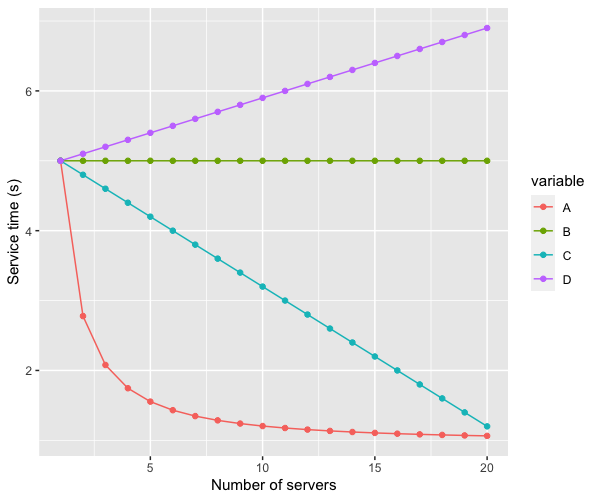
Option A is that the mean latency decreases quickly, asymptotically approaching one second as c increases (in other words, the time spent in queue approaches zero). Option B is constant. Option C is a linear improvement, and D is a linear degradation in latency. Which curve do you, intuitively, think that the latency will follow?

I asked my Twitter followers the same question, and got an interestingly mixed result:

Breaking down the problem a bit will help figure out which is the right answer. First, names. In the terminology of queue theory, this is an M/M/c queuing system: Poisson arrival process, exponentially distributed client service time, and c backend servers. In teletraffic engineering, it’s Erlang’s delay system (or, because terminology is fun, M/M/n). We can use a classic result of queuing theory to analyze this system: Erlang’s C formula E2,n(A), which calculates the probability that an incoming customer request is enqueued (rather than handled immediately), based on the number of servers (n aka c), and the offered traffic A. For the details, see page 194 of the Teletraffic Engineering Handbook. Here’s the basic shape of the curve (using our same parameters):

Follow the blue line up to half the saturation point, at 2.5 rps offered load, and see how the probability is around 13%. Now look at the purple line at half its saturation point, at 5 rps. Just 3.6%. So at half load the 5-server system is handling 87% of traffic without queuing, with double the load and double the servers, we handle 96.4% without queuing. Which means only 3.6% see any additional latency.

It turns out this improvement is, indeed, asymptotically approaching 1. The right answer to the Twitter poll is A.

Using the mean to measure latency is controversial (although perhaps it shouldn’t be). To avoid that controversy, we need to know whether the percentiles get better at the same rate. Doing that in closed form is somewhat complicated, but this system is super simple, so we can plot them out using a Monte-Carlo simulation. The results look like this:

That’s entirely good news. The median (p50) follows the mean line nicely, and the high percentiles (99th and 99.9th) have a similar shape. No hidden problems.

It’s also good news for cloud and service economics. With larger c we get better latency at the same utilization, or better utilization for the same latency, all at the same per-server throughput. That’s not good news only for giant services, because most of this goodness happens at relatively modest c. There are few problems related to scale and distributed systems that get easier as c increases. This is one of them.

There are some reasonable follow-up questions. Are the results robust to our arbitrary choice of 0.8? Yes, they are1. Are the M/M/c assumptions of Poisson arrivals and exponential service time reasonable for typical services? I’d say they are reasonable, albeit wrong. Exponential service time is especially wrong: realistic services tend to be something more like log-normal. It may not matter. More on that another time.

Update: Dan Ports responded to my thread with a fascinating Twitter thread pointing to Tales of the Tail: Hardware, OS, and Application-level Sources of Tail Latency from SoCC’14 which looks at this effect in the wild.

Footnotes

  1. Up to a point. As soon as the mean arrival rate exceeds the system’s ability to complete requests, the queue grows without bound and latency goes to infinity. In our case, that happens when the request load exceeds c. More generally, for this system to be stable λ/cμ must be less than 1, where λ is the mean arrival rate, and μ is the mean time taken for a server to process a request.