
惯性聚合 高效追踪和阅读你感兴趣的博客、新闻、科技资讯
阅读原文 在惯性聚合中打开

推荐订阅源

D
Darknet – Hacking Tools, Hacker News & Cyber Security
V
Vulnerabilities – Threatpost
C
CXSECURITY Database RSS Feed - CXSecurity.com
The Hacker News
The Hacker News
T
The Exploit Database - CXSecurity.com
Cyberwarzone
Cyberwarzone
I
InfoQ
Latest news
Latest news
WordPress大学
WordPress大学
C
Cybersecurity and Infrastructure Security Agency CISA
G
GRAHAM CLULEY
P
Privacy & Cybersecurity Law Blog
aimingoo的专栏
aimingoo的专栏
H
Hackread – Cybersecurity News, Data Breaches, AI and More
雷峰网
雷峰网
A
Arctic Wolf
P
Proofpoint News Feed
小众软件
小众软件
D
Docker
T
Threatpost
酷 壳 – CoolShell
酷 壳 – CoolShell
Project Zero
Project Zero
Vercel News
Vercel News
GbyAI
GbyAI
C
Cisco Blogs
S
Securelist
博客园 - 叶小钗
NISL@THU
NISL@THU
Hacker News - Newest:
Hacker News - Newest: "LLM"
AI
AI
S
SegmentFault 最新的问题
博客园 - Franky
V
V2EX
Cyber Security Advisories - MS-ISAC
Forbes - Security
Forbes - Security
Google DeepMind News
阮一峰的网络日志
阮一峰的网络日志
奇客Solidot–传递最新科技情报
奇客Solidot–传递最新科技情报
F
Full Disclosure
CTFtime.org: upcoming CTF events
H
Hacker News: Front Page
K
KPMG report finds enterprise disconnect between AI and its ROI | CIO
S
Security Archives - TechRepublic
Microsoft Security Blog
cs.AI updates on arXiv.org
博客园 - 司徒正美
Schneier on Security
Jina AI
Jina AI
Engineering at Meta
Engineering at Meta
The Last Watchdog
The Last Watchdog

Hacker News: Front Page

Trump administration reclassifies cannabis as less dangerous Release raylib v6.0 · raysan5/raylib GitHub - russellromney/honker: SQLite extension + bindings for Postgres NOTIFY/LISTEN semantics with durable queues, streams, pub/sub, and scheduler Writing a C Compiler, in Zig crawshaw - 2026-04-22 MacBook Neo and How the iPad Should Be It's time to reclaim the word "Palantir" for J.R.R. Tolkien Arch Linux now has a bit-for-bit reproducible Docker image Fundamental Theorem of Calculus | David Álvarez Rosa | Personal Website Bring Your Agent to Teams Ars Technica newsroom AI policy France confirms data breach at government agency that manages citizens’ IDs New study compares growing corn for energy to solar production. It's no contest NAEP Long-Term Trend Assessment Results: Reading and Mathematics Convergent Evolution: How Different Language Models Learn Similar Number Representations We found a stable Firefox identifier linking all your private Tor identities GitHub - besimple-oss/broccoli: Broccoli turns Linear tickets into shipped PRs — powered by Claude and Codex, running on your own Google Cloud. Youth Suicides Declined After Creation of National Hotline Top MAGA influencer revealed to be AI — created by a guy in India who made a mint off lonely men online Ping-pong robot beats top-level human players Announcing DuckDB 1.5.2 The handmade beauty of Machine Age data visualizations Treetops glowing during storms captured on film for first time Columnar Storage is Normalization TPU 8t and TPU 8i technical deep dive Our eighth generation TPUs: two chips for the agentic era Introducing Google Cloud Fraud Defense, the next evolution of reCAPTCHA Kernel code removals driven by LLM-created security reports tante.cc Nobody Got Fired for Uber's $8 Million Ledger Mistake? Introducing workspace agents in ChatGPT Sure, xor’ing a register with itself is the idiom for zeroing it out, but why not sub? What Async Promised and What it Delivered — Causality GitHub - justrach/kuri: Browser automation and web crawling for AI agents. Zig-native, token-efficient CDP snapshots, HAR recording, and a standalone fetcher. Drunk Post: Things I’ve Learned as a Senior Engineer Claude Code to be removed from Anthropic's Pro plan? Another Day Has Come 'Something sinister could be happening': FBI looks into dead or missing nuclear and space defense scientists tied to NASA, Blue Origin, and SpaceX | Fortune GitHub - calcom/cal.diy: Scheduling infrastructure for absolutely everyone. Meta to start capturing employee mouse movements, keystrokes for AI training The Vercel Breach: OAuth Supply Chain Attack Exposes the Hidden Risk in Platform Environment Variables Member of Technical Staff, Product Engineering (full-time) at Trellis AI | Y Combinator CATL's new LFP battery can charge from 10 to 98% in less than 7 minutes Jobs at Bloom | Y Combinator The printing press for biological data (Sterling Hooten) Brussels launched an age checking app. Hackers took 2 minutes to break it Inside GitHub's Fake Star Economy The Illuminated Man by Christopher Priest and Nina Allan review – an unconventional portrait of JG Ballard IEA: Solar overtakes all energy sources in a major global first Stripe’s payments APIs: The first 10 years GitHub - esutcu/planb-lpm GitHub - browser-use/browser-harness: Self-healing browser harness that enables LLMs to complete any task. Claude Token Counter, now with model comparisons GitHub - shivampkumar/trellis-mac Six levels of dark mode The Bromine Chokepoint: How Strife in the Middle East Could Halt Production of the World’s Memory Chips Turtle WoW classic server announces shutdown after Blizzard wins injunction Scoring 500 Show HN pages for AI design patterns Vercel April 2026 security incident | Vercel Knowledge Base Dubai police arrest airline worker after accessing private WhatsApp group Prompt → Diagram — Gemma 4 E2B in desktop Chrome (WebGPU) Binary GCD - Algorithmica madhadron - The seven programming ur-languages Keep Pushing: We Get 10 More Days to Reform Section 702 The world in which IPv6 was a good design Zero-Copy GPU Inference from WebAssembly on Apple Silicon The RAM shortage could last years Any Color You Like: NIST Scientists Create ‘Any Wavelength’ Lasers in Tiny Circuits for Light Optimizing Ruby Path Methods A college instructor turns to typewriters to curb AI-written work and teach life lessons UpCodes | Careers The electromechanical angle computer inside the B-52 bomber's star tracker Why Japan has such good railways - Works in Progress Magazine State of Kdenlive - 2026 GitHub - smol-machines/smolvm: Tool to build & run portable, lightweight, self-contained virtual machines. Head of Engineering at Kyber | Y Combinator GitHub - paniclock/paniclock: Instantly disable Touch ID and lock your Mac with one click or keyboard shortcut. Detecting DOSBox from within the Box I Measured Claude 4.7's New Tokenizer. Here's What It Costs You. Introducing Claude Design by Anthropic Labs Middle schooler finds coin from Troy in Berlin It Is Time to Ban the Sale of Precise Geolocation Isaac Asimov: The Last Question Teddy Roosevelt and Abraham Lincoln in the same photo Healthchecks.io Now Uses Self-hosted Object Storage Bluesky has been dealing with a DDoS attack for nearly a full day. Harness Engineer at Substrate | Y Combinator GitHub - dacracot/Klondike3-Simulator SPICE simulation → oscilloscope → verification with Claude Code — Lucas Gerads Email could have been X.400 times better Newly unsealed records reveal Amazon’s price-fixing tactics, California attorney general claims GitHub - GainSec/AutoProber: Hardware hacker’s flying probe automation stack for agent-driven target discovery, microscope mapping, safety-monitored CNC motion, probe review, and controlled pin probing. A Better R Programming Experience Thanks to Tree-sitter Clojure - Documentary GPT‑Rosalind for life sciences research How a Tiny Yellow Handheld Changed How Duke University Teaches Game Design - Playdate News Android CLI and skills: Build Android apps 3x faster using any agent Qwen3.6-35B-A3B on my laptop drew me a better pelican than Claude Opus 4.7 Codex for almost everything GitHub - GRVYDEV/marky: A lightweight easy to use markdown viewer
Rome Fell and Nobody Noticed
Fried Kielbasa · 2026-06-15 · via Hacker News: Front Page

When I first began learning about the Roman Empire in middle school, I was most interested in what everyone else seems to be interested in — the time of Caesar and Augustus. Recently, however, I’ve become far more interested in the decline & fall of the Roman Empire. You always hear the date 476 as the definitive end. As far as dates go, 476 is as good a date as any to mark the end of the official Roman Empire, but it always struck me as a bit weird. After that date, could it be said that Rome no longer existed? When I investigated what Rome was like after 476, it seemed oddly continuous. The fundamental institutions mostly existed, and life went on as usual. Nobody at the time figured that was the end.

My favorite figure in the post-Roman period is Theoderic — ruling 493 to 526, twenty years after the “fall” of Rome. He took over the structure of the Roman Empire and ruled it as a functionally emperor-like figure. He was a Goth and an Arian Christian, or in other words, a barbarian and a heretic. He spent his youth as a hostage in Constantinople, which enabled him to understand the Roman system from the inside.

The fall of 476 was notable primarily for symbolic reasons. A general named Odoacer deposed the last western Roman emperor and shipped off the imperial regalia to Constantinople — ending the chain of emperors. He controlled Italy not as emperor, but as king — albeit keeping the Roman civil service intact. Theoderic was sent by the Eastern Roman Emperor in order to depose Odoacer, which he did first with an army, then with his own hands, at a banquet.

When he took over the machinery of the Western Roman Empire, he was able to preserve it for 33 years, longer than the previous nine western emperors combined. Things that people associate with the Roman Empire continued on under his care. Roads were repaired, trade continued, things generally ran well. This isn’t to say that everything was wonderful, but it didn’t seem clear at the time that Rome was in terminal decline and would never again rise to where it used to be.

At a real level, the Roman governmental system remained. Theoderic was not an emperor per se, but he did hold official titles which were associated with the Roman Empire. He technically was titled as magister militum and patricius — the legal fiction legitimizing his rule as custodian of the Western Roman Empire. There’s a lot of symbolic continuity through those terms! The Consuls continued to be appointed — Theoderic chose the western consul and Constantinople confirmed his choices. In 519, Theoderic’s son in law Eutharic actually held the consulship together with emperor Justin. Theoderic’s imperial communications were written by Roman scribes and writers who continued writing in the Roman imperial style (chancery style), which was at that point extremely intricate and could only be interpreted by well educated Romans. Even the communications with his bureaucracy and other government officials utilized Roman means and methods. The Senate continued to meet under Theoderic’s rule — the continuity of local power was maintained. During Theoderic’s visit to Rome in 500, he addressed the Senate, organized one of the last games ever in Rome, and likely created the gold medallion of himself to commemorate the occasion.
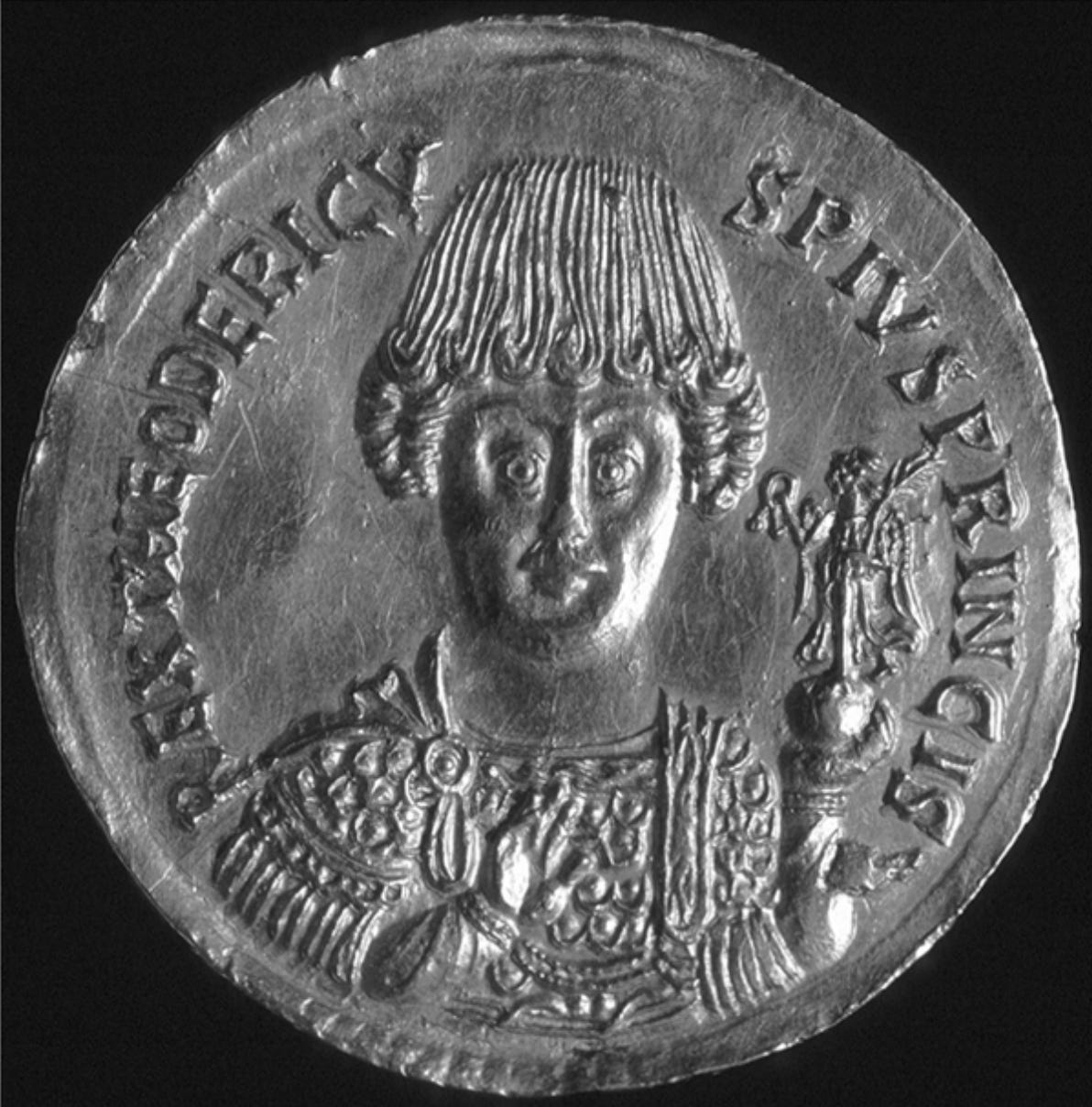
Portrait in imperial costume, but the text shows Rex, not Augustus, and he has a Gothic mustache. Note that regular coinage still bore the face of the Eastern Roman Emperor

After the Goths invaded Italy and defeated Odoacer, there was no competing military force — the Roman army was long gone and Odoacer’s army was destroyed. It was straightforward to swap the command top-down for a different military while keeping the civilian Roman infrastructure in place. This was enabled by a reform Diocletian began and Constantine completed: the separation of civilian and military command. The new magister peditum and magister equitum (later combined into the title of magister militum) sat on an entirely different career track from the provincial governors. The purpose behind this was to reduce the number of military coup attempts — governors with legions kept attempting to usurp the emperors. This parallel authority structure, which existed at the time of Theoderic’s takeover, meant that civilian governance could continue on as it previously had existed while the Gothic army could hot swap into the place where the Roman imperial army used to be. The exact reform that was intended to prevent internal strife enabled the easy docking of a foreign army onto the Roman state. This was a real discontinuity, but it didn’t disrupt the rest of government or regular life.

After Theoderic and his Goths invaded Italy, he needed to reward his Gothic army. He decided that the best path was to grant them land. Land, in this case, really means land rent, aristocrat style. Tenant farmers work for you while you collect rent and relax on your estate. This was accomplished in an extremely Roman way — the land redistribution was run by a Roman, Liberius, operating through the Roman bureaucracy. Liberius was given the office of praetorian prefect and he was represented locally by officials of the prefecture called delegatores. Once the Gothic recipients got their land, they also received certificates (pittacia) detailing their title of ownership. The Roman bureaucracy was present, useful, and was still able to serve Theoderic’s purposes. There is an interesting argument about whether the redistribution was monetary or whether it involved land actually changing hands. Walter Goffart, in an influential 1980 book, makes the argument that the land redistribution left so few detailed records that it implied the land was not actually redistributed, but instead only the money from the land was redistributed in the form of payment. Many historians think that real land did change hands, but I think the important point is that land redistribution was such a routine operation for the Roman bureaucracy that this generated no particularly noteworthy amount of paperwork. This was simply considered a matter of course.

In 523, Constantinople began persecuting Arians. Theoderic, king of a Catholic Italy, became suspicious of the Roman elite. His attempts at finding treason included putting Boethius on trial — who wrote the Consolation of Philosophy while awaiting execution. The first cracks in the West’s stability came from the East.

Within a decade after Theoderic’s demise, the Ostrogothic state had irreversibly begun disintegrating, and the Italian peninsula became a violent place. Succession to the throne led to infighting among the Goths, then Emperor Justinian began a reconquest of Italy. Akin more to cannibalism than conquest — the Eastern Roman Empire and not barbarians at the gates caused the collapse of Roman society. To give an idea of how bad it got, Venice was settled in the decades of chaos after Theoderic’s rule because Italy had become so dangerous that it was preferable to live on the water.

Rome was still around for a while after 476. The people were still around — the real disorder didn’t start until 50 years or so after the official fall. Political change doesn’t necessarily destroy culture in the same way that physical destruction can. The archaeological record after the official fall faced a steep decline, but it was continuous. The lights of Italy dimmed slowly into a long dusk.

Discussion about this post

Ready for more?