



WASHINGTON — Microbiologists are used to looking at gross pictures and hearing scary statistics. So when a moderator of a session on emerging fungal infections at the ASM Microbe meeting uttered the words “somewhat terrifying,” it caught my attention. He was referring to a sexually transmitted skin infection that is becoming increasingly drug resistant. But what came next was even more horrifying to me.
Medical mycologist Shawn Lockhart stepped to the podium and began describing a fungal disease that attacks cats, causing oozing skin ulcers and worse, and spreads to humans. It isn’t yet in the United States … that officials know of. But the disease, caused by Sporothrix brasiliensis, has sickened and killed thousands of cats and infected more than 11,000 people and at least 200 dogs in South America since its emergence in Brazil in the 1990s.
“What we have right now is this ginormous ongoing outbreak of Sporothrix brasiliensis in Brazil,” Lockhart, a senior adviser at the U.S. Centers for Disease Control and Prevention, said June 7. The fungus has spread beyond Brazil to cats, dogs and people in Paraguay, Chile, Argentina and most recently Uruguay.
“It’s just a matter of time” until the fungus reaches the United States, Lockhart told me after the session. “We’re waiting.”
Here’s why he’s so concerned.
He worries about the fungus spreading in big cities such as Istanbul and Bangkok where “cats are just everywhere,” and in rural areas in the United States where large populations of farm cats roam freely. “All it takes is one traveler [from South America] bringing their cat with them, and it can emerge anywhere,” Lockhart said during the presentation. “This is something we are very, very worried about.”
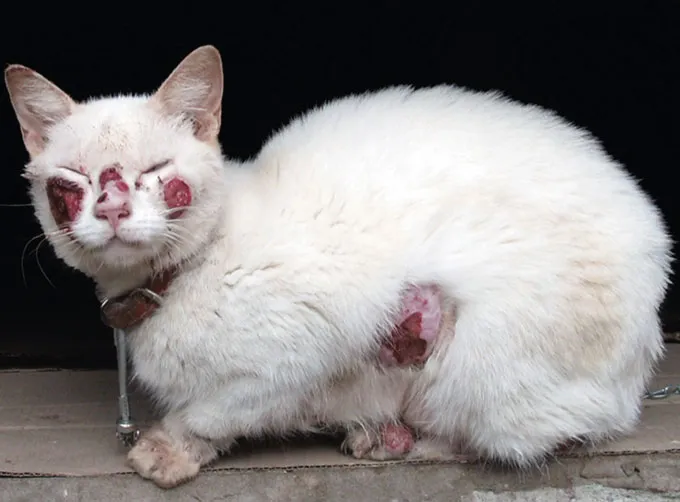
Infected cats develop skin ulcers and nodules and swollen lymph glands. If the infection isn’t treated with antifungal drugs, it can become a respiratory disease and spread throughout the body. “Without treatment, it’s 100 percent fatal, and even with treatment, it has a pretty high fatality rate,” Lockhart said. In people, it causes painful skin ulcers. If untreated, the disease can also be severe and may kill those who have weakened immune systems.
Risk of contagion is complicated because symptoms don’t always show up right away. Two members of a family who moved from Brazil to the United Kingdom developed the disease three years after the move, health authorities reported in 2022. One of the family’s two cats turns out to have been infected with Sporothrix brasiliensis. A vet who treated the cat was also infected.
The fungi’s unusual properties may help it conquer new territory.
The cat-infecting fungus is a relative of Sporothrix schenckii fungi that cause skin infections , called sporotrichosis or rose growers’ disease. Like many other soil-dwelling fungi, Sporothrix fungi are dimorphic, meaning they have two forms. “It is a mold in the cold and a yeast in the beast,” Lockhart said. That means it grows as long, stringy filaments known as hyphae in soil but then changes to single-celled yeast when its spores infect people or animals.
Most fungal infections happen when people inhale spores or, in the case of rose growers’ disease, when spores enter skin through scratches and puncture wounds from rose thorns. But S. brasiliensis can spread in its yeast form, Lockhart said. “That doesn’t happen with any of the other dimorphic fungi.”
In soil, Sporothrix brasiliensis grows as long threads called hyphae (right) but in the body the fungus transforms into single-celled yeast (left) like these taken from a wound from an infected cat. Shown are yeast (oblong shapes with white outlines) in and among feline immune cells (larger cells). Usually spores from fungi are inhaled or enter through breaks in the skin, but the yeast form of S. brasiliensis is also contagious.

Cat behavior may be why felines seem more susceptible to catching S. brasiliensis, Lockhart said. “Those of you who have cats, you know they do two things: They’re loving all over each other, grooming each other, licking, or they’re fighting, biting and scratching. Those are their two most frequent activities, both of which allow the transfer of Sporothrix brasiliensis from one to another.”
Cat scratches and bites may inject the yeast directly into other cats, people, dogs and other animals. “I’m convinced that half of the human cases that come from cats are people who are trying to stuff pills down their cat’s throats to treat the sporotrichosis,” getting scratched and bitten in the process. Grooming may also spread the fungus around the cat’s body or to other cats, he said.
The fungus has another unusual means of spread: Cats can sneeze out infectious yeast, researchers reported in Medical Mycology in 2022. “When the cat’s sneezing, it’s going on the surface, it’s going on the lab coats, it’s going into the air, it’s going everywhere,” Lockhart says.
The firehose of fungus-laden snot from a cat’s nose might also pose a danger to humans and felines after the infected cat has left the room. That’s because the fungi may live a long time on surfaces, Lockhart said. Up to 10 weeks, according to one lab experiment testing how long the fungi could grow on stainless steel discs that mimic the examination tables in veterinary offices. By contrast, Candida albicans, fungi that people naturally carry and that sometimes cause yeast infections, lasted 48 hours. Candida auris, a fungus that can cause infections in those with weakened immune systems, died after about a month, he said.
S. brasiliensis’ persistence means that if veterinarians miss a spot while cleaning, the lingering fungus could infect other patients. The good news is that the fungi is easily killed with bleach and ethanol, Lockhart said.
There’s no commercially available test for S. brasiliensis and cats coming into the United States just need a certificate from a vet saying that they appear healthy. That makes the disease easy to miss.
Because veterinarians may be the first to notice when the fungus arrives in a new country, Lockhart urged pet health professionals to notify local public health labs or the CDC if they start seeing cases of sporotrichosis. “There is an opportunity for it to spread quite easily,” he said. “We need veterinarians working with infection prevention and public health to make sure that this doesn’t get here and happen in the U.S.”
此内容由惯性聚合(RSS阅读器)自动聚合整理,仅供阅读参考。 原文来自 — 版权归原作者所有。