
惯性聚合 高效追踪和阅读你感兴趣的博客、新闻、科技资讯
阅读原文 在惯性聚合中打开

推荐订阅源

B
Blog RSS Feed
Spread Privacy
Spread Privacy
T
Threatpost
C
Cisco Blogs
P
Palo Alto Networks Blog
AI
AI
Cyberwarzone
Cyberwarzone
NISL@THU
NISL@THU
P
Privacy & Cybersecurity Law Blog
G
GRAHAM CLULEY
Simon Willison's Weblog
T
Tor Project blog
Latest news
Latest news
AWS News Blog
AWS News Blog
D
Docker
S
SegmentFault 最新的问题
博客园 - 聂微东
WordPress大学
WordPress大学
Vercel News
Vercel News
S
Securelist
爱范儿
爱范儿
J
Java Code Geeks
Know Your Adversary
Know Your Adversary
S
Schneier on Security
Hugging Face - Blog
Hugging Face - Blog
F
Fortinet All Blogs
Last Week in AI
Last Week in AI
D
DataBreaches.Net
宝玉的分享
宝玉的分享
D
Darknet – Hacking Tools, Hacker News & Cyber Security
MongoDB | Blog
MongoDB | Blog
Engineering at Meta
Engineering at Meta
K
Kaspersky official blog
美团技术团队
博客园 - 叶小钗
阮一峰的网络日志
阮一峰的网络日志
量子位
博客园_首页
Attack and Defense Labs
S
Secure Thoughts
Google Online Security Blog
Application and Cybersecurity Blog
Threat Intelligence Blog | Flashpoint
腾讯CDC
T
Threat Research - Cisco Blogs
雷峰网
雷峰网
有赞技术团队
有赞技术团队
www.infosecurity-magazine.com
P
Privacy International News Feed
S
Security Affairs

Hacker News: Front Page

SPICE simulation → oscilloscope → verification with Claude Code — Lucas Gerads GitHub - GainSec/AutoProber: Hardware hacker’s flying probe automation stack for agent-driven target discovery, microscope mapping, safety-monitored CNC motion, probe review, and controlled pin probing. Introducing Claude Opus 4.7 Qwen Studio The Future of Everything is Lies, I Guess: Where Do We Go From Here? GitHub - SeanFDZ/macmind: Single-layer transformer in HyperTalk for the classic Macintosh Virginia Bans Sale of Geolocation Data Show HN: Agent-cache – Multi-tier LLM/tool/session caching for Valkey and Redis Ancient DNA reveals pervasive directional selection across West Eurasia [pdf] AI cybersecurity is not proof of work Moving a large-scale metrics pipeline from StatsD to OpenTelemetry / Prometheus GitHub - Nightmare-Eclipse/RedSun: The Red Sun vulnerability repository GitHub - SethPyle376/hiraeth: Local AWS emulator focused on fast integration testing, with SQS support, SQLite-backed state, and a debug-friendly web UI. A Better Ludum Dare; Or, How to Ruin a Legacy GitHub - macOS26/Agent: Any AI, replaces Claude Code, Cursor, OpenClaw. Over 18 LLM providers (Claude, OpenAI, Gemini, Ollama, Zai, HF, Qwen) wired into a native Mac app that writes code, builds Xcode projects, bumps versions, manages git, automates Safari, use AppleScript, JS or Accessibility, extend Agent! w/ MCP Servers, run tasks from your iPhone via Messages. YouTube now lets you turn off Shorts I Made a Terminal Pager Burgers | マクドナルド公式 Commands — HackerNews CLI documentation ChatGPT for Excel PiCore - Raspberry Pi Port of Tiny Core Linux Live Nation illegally monopolized ticketing market, jury finds Google Broke Its Promise to Me. Now ICE Has My Data. Founding Engineer at Adaptional | Y Combinator CRISPR takes important step toward silencing Down syndrome’s extra chromosome GitHub - saffron-health/libretto: The AI toolkit for building reliable browser automations US v. Heppner (S.D.N.Y. 2026) no attorney-client privilege for AI chats [pdf] Unexpected €54k billing spike in 13 hours: Firebase browser key without API restrictions used for Gemini requests Fragments: April 14 Cal.com Goes Closed Source: Why AI Security Is Forcing Our Decision | Cal.com - Scheduling Software for Online Bookings Laravel raised money and now injects ads directly into your agent Codex Hacked a Samsung TV Tech Valuations Back to Pre-AI Boom Levels A perfectable programming language — Soter GitHub - halfwhey/claudraband: Claude Code for the Power User Partnership through Play: Investigating How Long-Distance Couples Use Digital Games to Facilitate Intimacy Textbooks and Methods of Note-Taking in Early Modern Europe (2008) Eternity in six hours: Intergalactic spreading of intelligent life (2013) Seven countries now generate 100% of their electricity from renewable energy Tell HN: OpenAI silently removed Study Mode from ChatGPT Pro Max 5x Quota Exhausted in 1.5 Hours Despite Moderate Usage Show HN: Oberon System 3 runs natively on Raspberry Pi 3 (with ready SD card) Tell HN: docker pull fails in spain due to football cloudflare block Bring Back Idiomatic Design No one owes you supply-chain security GitHub - xsawyerx/curl-doom: DOOM, played over cURL Apple update turns Czech mate for locked-out iPhone user The Grand Line Cache TTL silently regressed from 1h to 5m around early March 2026, causing quota and cost inflation Building a Z-Machine in the worst possible language The peril of laziness lost Iran war: We spoke to the man making Lego-style AI videos that experts say are powerful propaganda AI Will Be Met With Violence, and Nothing Good Will Come of It GitHub - duguyue100/midnight-captain: Inspired by Midnight Commander, tailored to my taste. How to build a `git diff` driver · Jamie Tanna | Software Engineer Center for Responsible, Decentralized Intelligence at Berkeley The Local Universe’s Expansion Rate Is Clearer Than Ever, but Still Doesn’t Add Up - A new synthesis of astronomical measurements confirms a persistent mismatch that could point to physics beyond current models The disturbing white paper Red Hat is trying to erase from the internet – OSnews NetBlocks (@netblocks@mastodon.social) The Future of Everything is Lies, I Guess: Annoyances ‘Abhorrent’: the inside story of the Polymarket gamblers betting millions on war Productive procrastination — Max van IJsselmuiden maps, territory and LMs 447 Terabytes per Square Centimetre at Zero Retention Energy: Non-Volatile Memory at the Atomic Scale on Fluorographane Show HN: Pardonned.com – A searchable database of US Pardons 20 Years on AWS and Never Not My Job The Seasons are Wrong The FAA wants gamers to apply for air traffic control jobs Artemis II crew splashes down near San Diego after historic moon mission Why weekends are under threat We gave an AI a 3 year retail lease in SF and asked it to make a profit | Andon Labs How a dancer with ALS used brainwaves to perform live On filing the corners off my MacBooks Installing every* Firefox extension OpenClaw’s memory is unreliable, and you don’t know when it will break Steve Blank Nowhere Is Safe Chimpanzees in Uganda locked in vicious 'civil war', say researchers watgo - a WebAssembly Toolkit for Go linux/Documentation/process/coding-assistants.rst at master · torvalds/linux GitHub - callumlocke/json-formatter: Makes JSON easy to read. Founding Product Engineer at Bild AI | Y Combinator A compelling title that is cryptic enough to get you to take action on it GitHub - Keychron/Keychron-Keyboards-Hardware-Design: Industrial design files for Keychron keyboards and mice. 100+ models with CAD assets in STEP, DXF, DWG, and PDF. Source-available, with commercial use allowed for original compatible accessories within the license terms. [ANNOUNCE] WireGuardNT v0.11 and WireGuard for Windows v0.6 Released 1D-Chess Helium Is Hard to Replace Keeping a Postgres queue healthy — PlanetScale Serenity Forge (@serenityforge.com) Our response to the Axios developer tool compromise Do Americans read print books, e-books or audiobooks more? Uncharted island soon to appear on nautical charts The Problem That Built an Industry Fragments: April 2 Python Release Python install manager 26.1 Bitcoin miners are losing $19,000 on every BTC produced as difficulty drops 7.8% God sleeps in the minerals Harness engineering: leveraging Codex in an agent-first world Apple Silicon and Virtual Machines: Beating the 2 VM Limit What have been the greatest intellectual achievements? The APL Programming Language Source Code
MIT's virtual violin offers luthiers a new design tool
Jennifer Oue · 2026-05-04 · via Hacker News: Front Page

Skip to content

a physics-based 3D model

Computational model lets users tweak parameters to hear effect on the sound in early design process.

A 1729 Stradivari known as the "Solomon, Ex-Lambert" on display at Christie's in New York in March 2007. Credit: Don Emmert/AFP/Getty Images

Violin makers, aka luthiers, traditionally learn from hands-on experience how to craft parts and select materials to shape an instrument’s final sound. MIT engineers hope to streamline that painstaking process with their new virtual violin. It’s a computer simulation tool that can capture the precise physics of the instrument and even reproduce a realistic sound of a plucked string, according to a paper published in the journal npj Acoustics.

Unlike the more common software programs and plugins that simulate violin sounds via sampling, averaging the final sound based on thousands of notes, the MIT model is based on the fundamental physics of the instrument. “We’re not saying that we can reproduce the artisan’s magic,” said co-author Nicholas Makris. “We’re just trying to understand the physics of violin sound, and perhaps help luthiers in the design process.”

Violin acoustics has long been a hot topic of research among acousticians, particularly when it comes to unlocking the secret to the superior sounds of violins crafted during the so-called “Golden Age”—notably the instruments of famed Cremona luthier Antonio Stradivari, as well as those of the Amati family and Giuseppe Guarneri. There are plenty of variables to consider, given a violin’s acoustic complexity.

Per my 2021 article, the (perceived) unique sound can’t just be due to the instrument’s geometry, although Stradivari’s geometrical approach gave us the violin’s signature shape. It might be due to the wood; some researchers have hypothesized that Stradivari used Alpine spruce grown during a period of uncommonly cold weather for the region. The annual growth rings were closer together, making the wood unusually dense. Differences in wood density, they argue, would have an impact on the instrument’s vibrational efficiency and hence its sound.
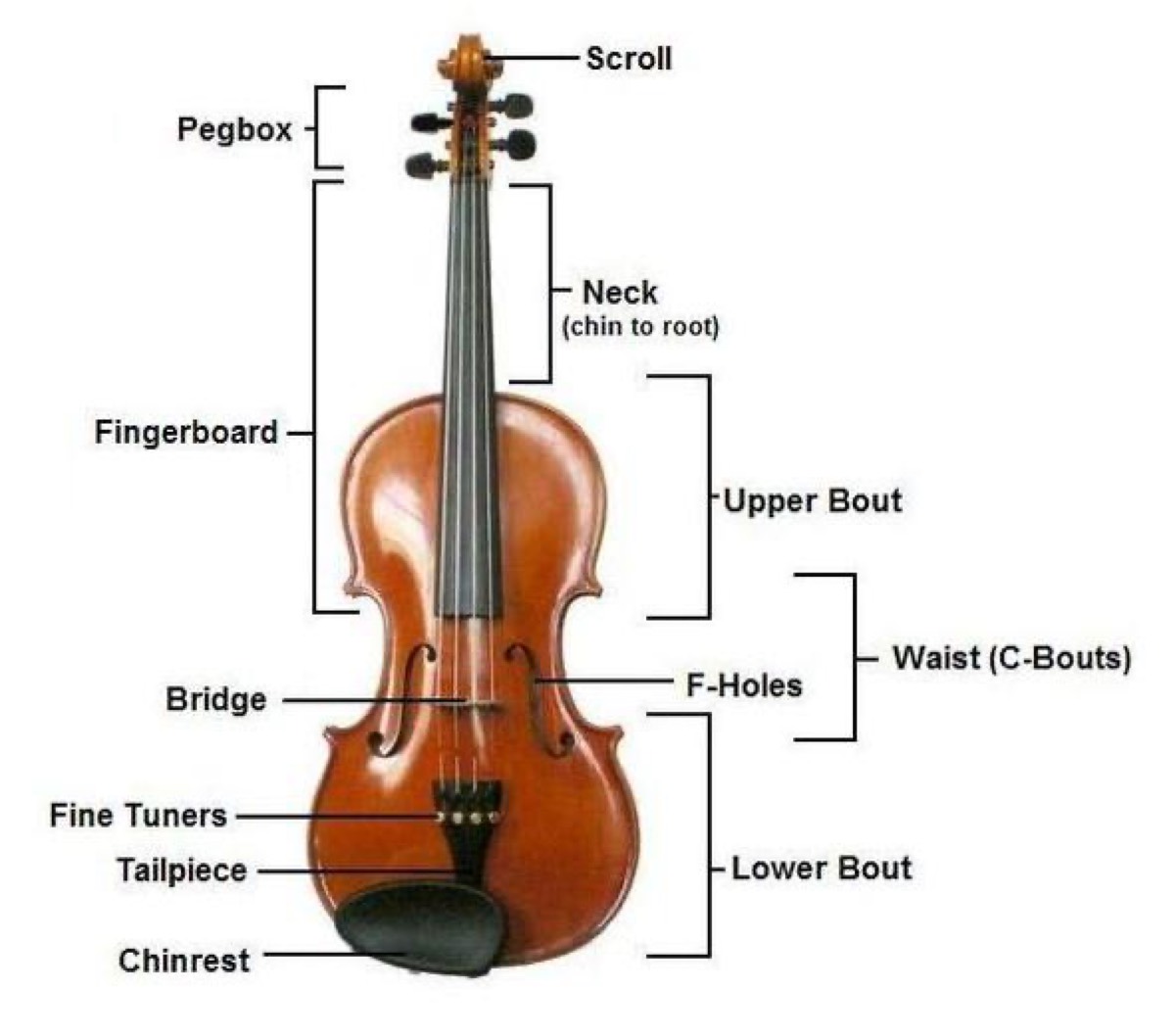
The construction of a violin

The construction of a violin.

The construction of a violin. Credit: Sotakeit/CC BY-SA 3.0

Or perhaps it was the varnish Stradivari used: a cocktail of honey, egg whites, and gum arabic. A 2022 study involving nanoscale imaging of two such instruments revealed a protein-based layer at the interface of the wood and the varnish, which may influence the wood’s natural resonance.

Biochemist Joseph Nagyvary has argued that it was the chemicals used to treat the wood that give Stradivari violins their unique sound, specifically salts of copper, iron, and chromium used to preserve the wood—all of which are excellent wood preservers but may also have altered the instruments’ acoustical properties. A 2021 study supported that argument, identifying borax, zinc, copper, alum, and lime water as the most likely chemicals affecting the sound.

CT scans have provided quite a bit of insight into the conundrum, since the technique can reveal wood density, size and shapes, volume measurements, and thickness graduation, as well as any damage or repairs to a given instrument. For instance, a 2009 study used CT scans to study the material properties of the wood. In 2011, Minnesota radiologist Steven Sirr took detailed CT scans of the 1704 “Betts” violin and then collaborated with two luthiers to make a replica.

One of the most thorough investigations was the Strad3D project, spearheaded in 2006 by the late George Bissinger. That project used 3D scanning lasers to make detailed quantitative measurements of the acoustic properties of several Stradivarius violins, essentially mapping out precisely how the instruments vibrate and hence produce their distinctive sound. (For what it’s worth, when I interviewed Bissinger way back in 2007, he was skeptical of efforts to one day reproduce the sound quality of a Stradivarius violin on a mass scale, insisting that making an instrument is as much art as science and that there is no single secret to the Stradivari sound.)

Simulating the system
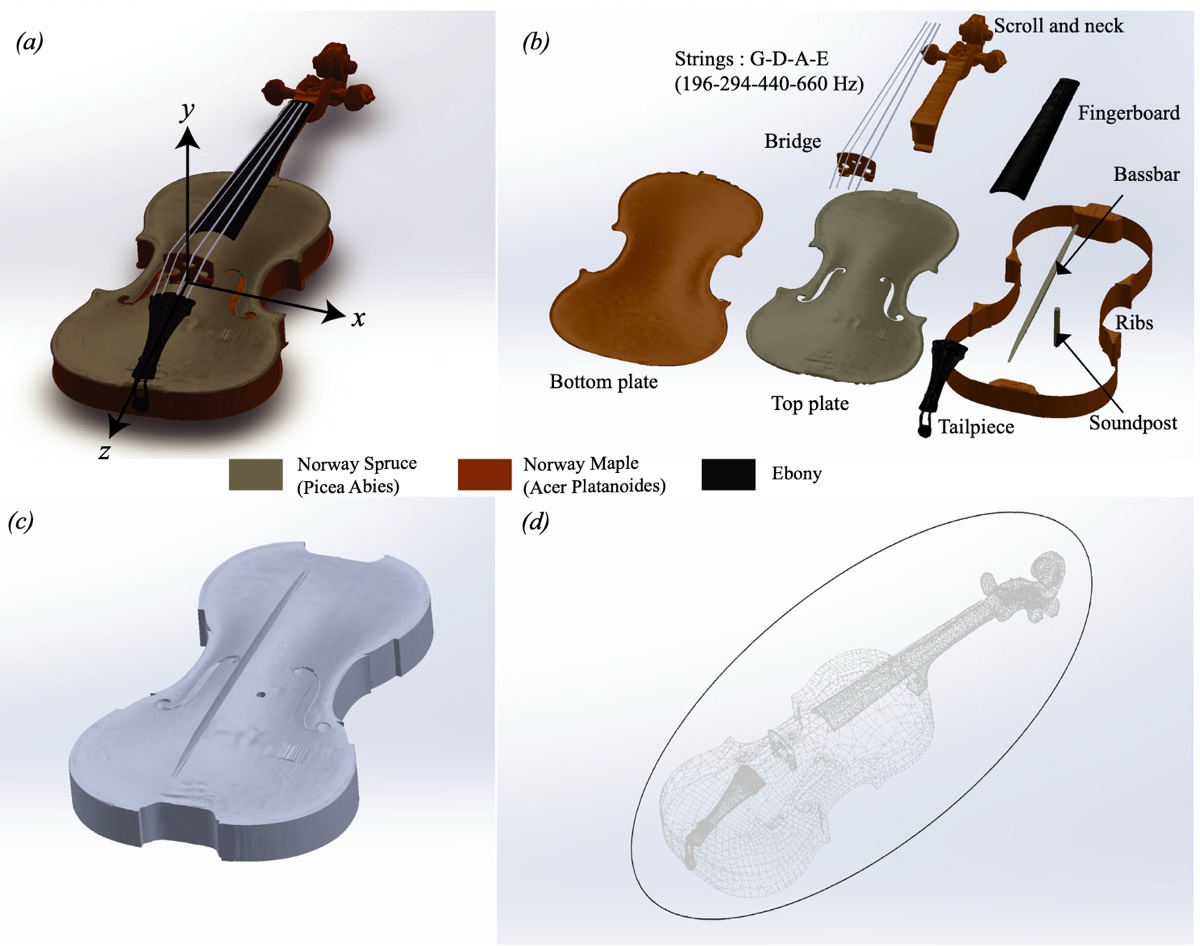
a Complete instrument. b Components, where wood types are color-coded. c Internal air domain bounded by the plates, ribs, bass bar, sound post and blocks. d External air domain consisting of an ellipsoid that encloses the violin.

Virtually reconstructed violin: (a) Complete instrument. (b) Components, where wood types are color-coded. (c) Internal air domain. (d) External air domain consisting of an ellipsoid that encloses the violin.

Credit: Arun Krishnadas et al., 2026

Virtually reconstructed violin: (a) Complete instrument. (b) Components, where wood types are color-coded. (c) Internal air domain. (d) External air domain consisting of an ellipsoid that encloses the violin. Credit: Arun Krishnadas et al., 2026

MIT’s virtual violin is based on the Strad3D project’s scan of the 1715 “Titian” Stradivarius. Makris et al. imported that data into a modeling software program and generated a 3D model of the instrument. Then they ran a simulation that broke down the violin into millions of cubes, noting which materials were used in each cube—such as the kind of wood that makes up the back plate, or whether it had natural fiber or steel strings. Next, the team used physics equations to predict how those materials would move and interact relative to every other element in the violin. Those elements include the air surrounding the instrument, simulated using acoustic wave equations.

Having built their virtual violin, Makris et al. were able to simulate the sound of a single plucked string—a playing technique called “pizzicato”—and program it to pluck out several notes of Bach’s “Fugue in G Minor,” as well as “Daisy Bell (A Bicycle Built for Two).” They have not yet figured out how to simulate bowing, which is a much more complicated interaction, but that is a focus for their future research.

In the meantime, the team hopes their virtual violin will prove useful for luthiers in the early design process, enabling them to test the effects of various parameters, such as wood type or body thickness. “You can tweak the model, to hear the effect on the sound,” said Makris. “Since everything obeys the laws of physics, including a violin and the music it makes, this approach can add an appreciation to what makes violin sound. But ultimately, we get most of our inspiration from the artisans.”

DOI: npj Acoustics, 2026. 10.1038/s44384-026-00049-6  (About DOIs).
Photo of Jennifer Ouellette

Jennifer is a senior writer at Ars Technica with a particular focus on where science meets culture, covering everything from physics and related interdisciplinary topics to her favorite films and TV series. Jennifer lives in Baltimore with her spouse, physicist Sean M. Carroll, and their two cats, Ariel and Caliban.

10 Comments