


惯性聚合 高效追踪和阅读你感兴趣的博客、新闻、科技资讯
阅读原文 在惯性聚合中打开

推荐订阅源

T
Tenable Blog
Engineering at Meta
Engineering at Meta
The Register - Security
N
Netflix TechBlog - Medium
D
Docker
Vercel News
Vercel News
云风的 BLOG
云风的 BLOG
月光博客
月光博客
钛媒体:引领未来商业与生活新知
钛媒体:引领未来商业与生活新知
freeCodeCamp Programming Tutorials: Python, JavaScript, Git & More
D
DataBreaches.Net
IT之家
IT之家
V
V2EX
人人都是产品经理
人人都是产品经理
F
Fortinet All Blogs
J
Java Code Geeks
酷 壳 – CoolShell
酷 壳 – CoolShell
博客园 - 叶小钗
OSCHINA 社区最新新闻
OSCHINA 社区最新新闻
雷峰网
雷峰网
博客园 - Franky
Hugging Face - Blog
Hugging Face - Blog
有赞技术团队
有赞技术团队
aimingoo的专栏
aimingoo的专栏
MongoDB | Blog
MongoDB | Blog
P
Privacy International News Feed
F
Full Disclosure
P
Proofpoint News Feed
B
Blog RSS Feed
T
Tor Project blog
T
The Blog of Author Tim Ferriss
B
Blog
Webroot Blog
Webroot Blog
腾讯CDC
T
Troy Hunt's Blog
T
Tailwind CSS Blog
H
Heimdal Security Blog
AWS News Blog
AWS News Blog
G
Google Developers Blog
Spread Privacy
Spread Privacy
NISL@THU
NISL@THU
A
About on SuperTechFans
SecWiki News
SecWiki News
CTFtime.org: upcoming CTF events
Cyber Security Advisories - MS-ISAC
I
InfoQ
M
MIT News - Artificial intelligence
大猫的无限游戏
大猫的无限游戏
美团技术团队
L
LangChain Blog

Hacker News: Front Page

SPICE simulation → oscilloscope → verification with Claude Code — Lucas Gerads GitHub - GainSec/AutoProber: Hardware hacker’s flying probe automation stack for agent-driven target discovery, microscope mapping, safety-monitored CNC motion, probe review, and controlled pin probing. Introducing Claude Opus 4.7 Qwen Studio The Future of Everything is Lies, I Guess: Where Do We Go From Here? GitHub - SeanFDZ/macmind: Single-layer transformer in HyperTalk for the classic Macintosh Virginia Bans Sale of Geolocation Data Show HN: Agent-cache – Multi-tier LLM/tool/session caching for Valkey and Redis Ancient DNA reveals pervasive directional selection across West Eurasia [pdf] AI cybersecurity is not proof of work Moving a large-scale metrics pipeline from StatsD to OpenTelemetry / Prometheus GitHub - Nightmare-Eclipse/RedSun: The Red Sun vulnerability repository GitHub - SethPyle376/hiraeth: Local AWS emulator focused on fast integration testing, with SQS support, SQLite-backed state, and a debug-friendly web UI. A Better Ludum Dare; Or, How to Ruin a Legacy GitHub - macOS26/Agent: Any AI, replaces Claude Code, Cursor, OpenClaw. Over 18 LLM providers (Claude, OpenAI, Gemini, Ollama, Zai, HF, Qwen) wired into a native Mac app that writes code, builds Xcode projects, bumps versions, manages git, automates Safari, use AppleScript, JS or Accessibility, extend Agent! w/ MCP Servers, run tasks from your iPhone via Messages. YouTube now lets you turn off Shorts I Made a Terminal Pager Burgers | マクドナルド公式 Commands — HackerNews CLI documentation ChatGPT for Excel PiCore - Raspberry Pi Port of Tiny Core Linux Live Nation illegally monopolized ticketing market, jury finds Google Broke Its Promise to Me. Now ICE Has My Data. Founding Engineer at Adaptional | Y Combinator CRISPR takes important step toward silencing Down syndrome’s extra chromosome GitHub - saffron-health/libretto: The AI toolkit for building reliable browser automations US v. Heppner (S.D.N.Y. 2026) no attorney-client privilege for AI chats [pdf] Unexpected €54k billing spike in 13 hours: Firebase browser key without API restrictions used for Gemini requests Fragments: April 14 Cal.com Goes Closed Source: Why AI Security Is Forcing Our Decision | Cal.com - Scheduling Software for Online Bookings Laravel raised money and now injects ads directly into your agent Codex Hacked a Samsung TV Tech Valuations Back to Pre-AI Boom Levels A perfectable programming language — Soter GitHub - halfwhey/claudraband: Claude Code for the Power User Partnership through Play: Investigating How Long-Distance Couples Use Digital Games to Facilitate Intimacy Textbooks and Methods of Note-Taking in Early Modern Europe (2008) Eternity in six hours: Intergalactic spreading of intelligent life (2013) Seven countries now generate 100% of their electricity from renewable energy Tell HN: OpenAI silently removed Study Mode from ChatGPT Pro Max 5x Quota Exhausted in 1.5 Hours Despite Moderate Usage Show HN: Oberon System 3 runs natively on Raspberry Pi 3 (with ready SD card) Tell HN: docker pull fails in spain due to football cloudflare block Bring Back Idiomatic Design No one owes you supply-chain security GitHub - xsawyerx/curl-doom: DOOM, played over cURL Apple update turns Czech mate for locked-out iPhone user The Grand Line Cache TTL silently regressed from 1h to 5m around early March 2026, causing quota and cost inflation Building a Z-Machine in the worst possible language The peril of laziness lost Iran war: We spoke to the man making Lego-style AI videos that experts say are powerful propaganda AI Will Be Met With Violence, and Nothing Good Will Come of It GitHub - duguyue100/midnight-captain: Inspired by Midnight Commander, tailored to my taste. How to build a `git diff` driver · Jamie Tanna | Software Engineer Center for Responsible, Decentralized Intelligence at Berkeley The Local Universe’s Expansion Rate Is Clearer Than Ever, but Still Doesn’t Add Up - A new synthesis of astronomical measurements confirms a persistent mismatch that could point to physics beyond current models The disturbing white paper Red Hat is trying to erase from the internet – OSnews NetBlocks (@netblocks@mastodon.social) The Future of Everything is Lies, I Guess: Annoyances ‘Abhorrent’: the inside story of the Polymarket gamblers betting millions on war Productive procrastination — Max van IJsselmuiden maps, territory and LMs 447 Terabytes per Square Centimetre at Zero Retention Energy: Non-Volatile Memory at the Atomic Scale on Fluorographane Show HN: Pardonned.com – A searchable database of US Pardons 20 Years on AWS and Never Not My Job The Seasons are Wrong The FAA wants gamers to apply for air traffic control jobs Artemis II crew splashes down near San Diego after historic moon mission Why weekends are under threat We gave an AI a 3 year retail lease in SF and asked it to make a profit | Andon Labs How a dancer with ALS used brainwaves to perform live On filing the corners off my MacBooks Installing every* Firefox extension OpenClaw’s memory is unreliable, and you don’t know when it will break Steve Blank Nowhere Is Safe Chimpanzees in Uganda locked in vicious 'civil war', say researchers watgo - a WebAssembly Toolkit for Go linux/Documentation/process/coding-assistants.rst at master · torvalds/linux GitHub - callumlocke/json-formatter: Makes JSON easy to read. Founding Product Engineer at Bild AI | Y Combinator A compelling title that is cryptic enough to get you to take action on it GitHub - Keychron/Keychron-Keyboards-Hardware-Design: Industrial design files for Keychron keyboards and mice. 100+ models with CAD assets in STEP, DXF, DWG, and PDF. Source-available, with commercial use allowed for original compatible accessories within the license terms. [ANNOUNCE] WireGuardNT v0.11 and WireGuard for Windows v0.6 Released 1D-Chess Helium Is Hard to Replace Keeping a Postgres queue healthy — PlanetScale Serenity Forge (@serenityforge.com) Our response to the Axios developer tool compromise Do Americans read print books, e-books or audiobooks more? Uncharted island soon to appear on nautical charts The Problem That Built an Industry Fragments: April 2 Python Release Python install manager 26.1 Bitcoin miners are losing $19,000 on every BTC produced as difficulty drops 7.8% God sleeps in the minerals Harness engineering: leveraging Codex in an agent-first world Apple Silicon and Virtual Machines: Beating the 2 VM Limit What have been the greatest intellectual achievements? The APL Programming Language Source Code
Scaling OpenComputer from one VM to a million sandboxes – OpenComputer
Mohamed Habib · 2026-06-18 · via Hacker News: Front Page

Written by Mohamed Habib ·

We started OpenComputer with a single virtual machine in one Azure region. The company grew quickly, but Azure couldn't raise our compute quota in that region any further, and we found ourselves growing against a fixed pool of CPUs.

So we had to find another way to scale.

This post covers what we did to reach a point where we can keep adding capacity more or less indefinitely. We'll go through how we split the system into cells, how a global registry at the edge decides where every sandbox lives, and how four cloud providers add up to a million CPUs.

Tweet by Mohamed Habib (@motatoeshq), June 7, 2026: “How we're scaling opencomputer.dev to 1M sandboxes”. View at https://twitter.com/motatoeshq/status/2063679701873492299.

Interactive architecture diagram with four stages. Stage 1 (1–100 sandboxes): one control plane connected to one worker. Stage 2 (100–1K): the same control plane scheduling across three workers in a single region. Stage 3 (1K–10K): the control-plane-plus-workers unit becomes a cell, with two cells sitting under an edge termination layer (Cloudflare Workers + D1 registry) that routes each create to the cell with the most room and receives heartbeats back. Stage 4 (10K–100K+): four cells under the edge layer, repeating across regions and clouds. Adding capacity is now a deployment step. Click the stage buttons or type a number of sandboxes to create and the architecture animates to match.

Our entire capacity lived inside one Azure region's quota

Sandboxes are full VMs, VMs need physical hardware, and cloud providers ration that hardware per region. Our problem started with the rationing, so it helps to spell out how it works first.

Behind cloud quotas

Every cloud provider bounds you by regional capacity, which is basically where the physical data center exists with finite hardware and a long queue of customers who want it.

So providers hand out capacity as a quota, measured in total CPU count. Quotas start small and grow only after you build usage history. The working protocol is to run your existing allocation at around 50% utilization for a week or two, request an increase, and let the usage data justify it. Request 10,000 CPUs on day one and the answer is no.

We hit the 300-CPU ceiling early

Our first region was Azure US East 2, with a starting quota of about 300 CPUs. The plan was to consume it and request more, the way the ladder normally works.

But unfortunately we had picked one of the busiest data centers in the world, and 300 CPUs was the ceiling there regardless of our usage history. Meanwhile new users were signing up against a fixed pool of compute.

Why migrating to another region wouldn't have fixed the scale issue

The obvious move was relocating to a quieter region or a different cloud and collecting a bigger quota there. We also held Azure credits we wanted to use. But the deeper problem is that migrating regions or cloud providers only resets the clock.

Every region has an upper limit, providers raise it gradually, but a single-region architecture scaling fast enough will hit the ceiling at some point.

On top of that, sandbox demand at 10K, 100K, or 1M concurrent VMs can't physically be served from one data center. We needed to rethink the architecture so that adding a region of any cloud is a deployment step rather than a migration project. And we had to take our existing architecture apart to make that happen.

Starting with a single control plane

Our first version of OpenComputer was a single VM handling everything with a control plane.

The second version is where we scaled to multiple VMs in one region, coordinated by one control plane that did everything: the web UI, the dashboard, billing logic, and the actual orchestration of VMs, all in one place.

A single control plane (running web UI, dashboard, billing, and orchestration) connected to three workers, all inside one Azure region shown as a dashed boundary box.

That design served roughly a thousand sandboxes comfortably. It assumed all compute lived in one region, and the component that orchestrates VMs can also be the component that runs the product around them. We had to split those two jobs apart.

Cells made capacity a deployable unit

We started with cutting the control plane down to a single job (orchestrating VMs), and we packaged it with the workers it manages into a unit that deploys into any cloud region. That unit is a "cell."

The control plane shrinks to one job

The redesign stripped the control plane down to the lifecycle of VMs in its own region:
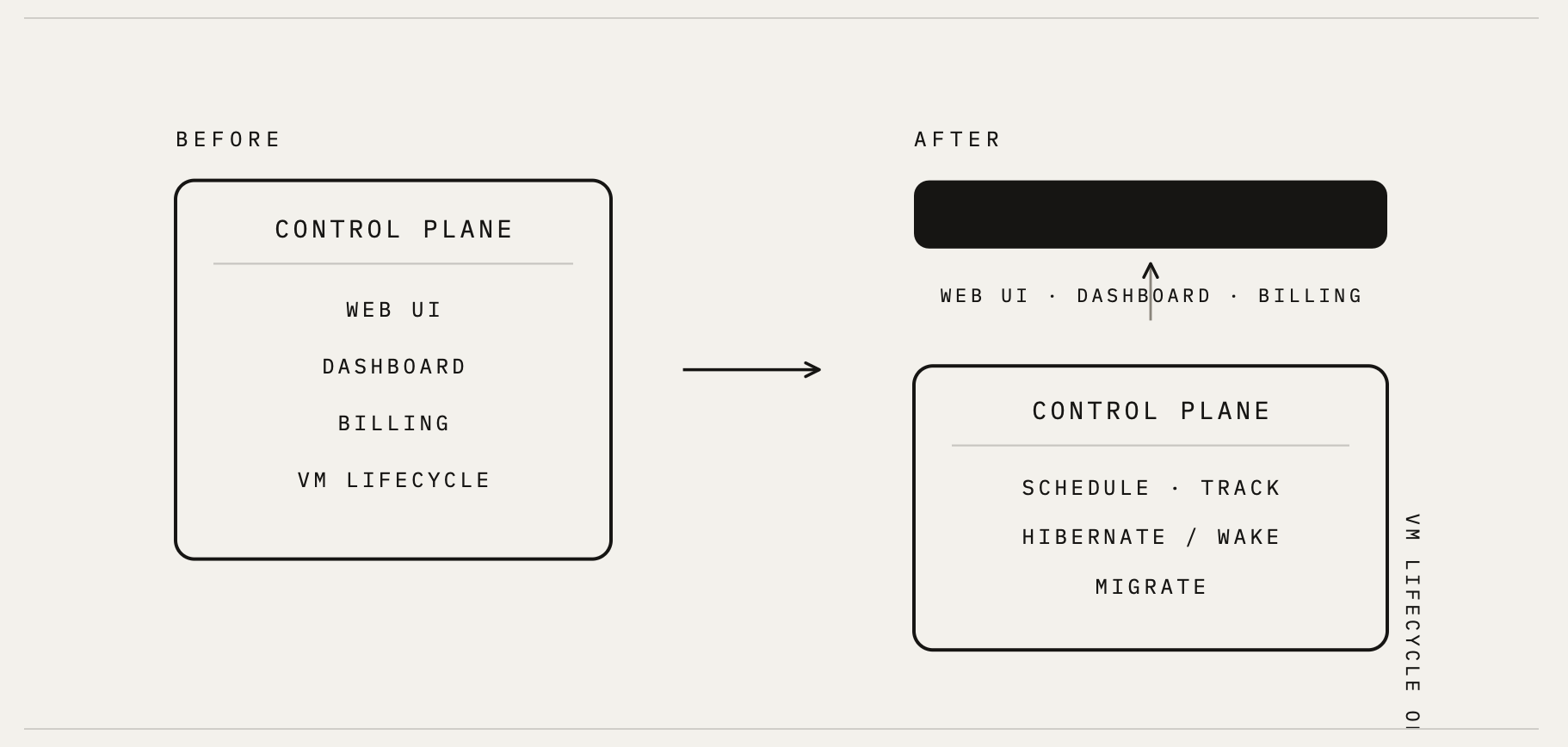
A cell's control plane has four jobs: schedule a sandbox onto a worker, track every VM's state, hibernate idle VMs to S3, and migrate VMs between workers when rebalancing.
  1. Schedule a requested sandbox onto a specific worker.
  2. Track where every VM lives and what state it's in.
  3. Hibernate idle VMs to S3-backed storage and wake them on demand.
  4. Migrate a VM from one worker to another when a rebalance calls for it.

Components inside a cell know about each other and about nothing outside the cell. The dashboard, billing logic, and everything user-facing moved out of the cell entirely.

A cell is the smallest unit of failure isolation, and its identifier encodes everything about what server region it lives in. Each cell owns 5 to 10 workers running QEMU VMs.

VM placement is more than picking the least-loaded worker

When a create request is sent with memory, CPU, disk, and a template, the control plane could pick a specific worker based on certain criteria. A simplistic control plane would look for the least-loaded worker and spawn a VM there.

A good control plane should weigh:

  • Resource fit so fragmentation doesn't kill capacity
  • Template warmth (a worker already holding a warm golden snapshot creates in about 200ms where a cold one takes seconds)
  • Hardware differences like ARM against amd64
  • Soft affinity that keeps an org's sandboxes near their caches
  • Anti-affinity that keeps paid workloads away from noisy free-tier neighbors

The same cell deploys into any cloud

One cell glyph (a control plane plus its workers) fans out into four cloud provider rows: AWS (~20 regions), Azure (~20 regions), GCP (~20 regions), and OCI (fewer regions). The same cell shape stamps unchanged into each.

A cell makes no assumptions about which provider it runs on. The worker shape we use has an equivalent instance type in AWS, Azure, GCP, and OCI, so the same cell deploys into any of them unchanged.

With this, capacity stopped being "our Azure quota" and became "the sum of every cell we've deployed."

A global registry at the edge routes every sandbox

With multiple independent cells, something has to answer which cell gets the sandbox. That job sits outside every cell, at the edge.

How a create request finds its cell

The edge layer is a set of Cloudflare Workers, with a D1 database holding the global registry and Durable Objects receiving the event stream coming back from the cells.

That registry knows every cell that exists, where it runs, and how much free capacity it holds. We think of it as a control plane of control planes.

A create request lands at the nearest edge location, the Worker picks the emptiest cell, and that cell's control plane owns the sandbox from there.

Only creates cost time at the edge

A create is rare and expensive anyway, so spending an extra 50 to 100ms at the edge on auth, credit checks, and cell selection is a fine trade.

Everything frequent (exec, file reads and writes, PTY traffic, destroy) goes straight to the cell's control plane over a connection authenticated by a signed JWT, with zero synchronous Cloudflare lookups in the path.

The edge decides where a sandbox is born, and after that the cell serves it directly.

Why Cloudflare Workers and D1 database carry this layer

The registry's workload is small and read-heavy: a row per cell, capacity counters, lifecycle state.

The D1 database is enough for that, and running the lookup at the edge means the routing decision happens close to the user with no round-trip to a home region.

The rest of the global state lives in the same stack. KV holds sessions and event dedup keys, R2 archives the raw event stream, and Durable Objects hold the per-org credit accounting and the per-sandbox routing state.

Heartbeats keep the registry and the billing current

Routing is the downstream half of the edge. The upstream half is the event stream flowing from every running VM back through Durable Objects and into the registry.

Per-second billing from 10-second heartbeats

The most important event in that stream is the heartbeat.

Every running VM reports "still alive" every 10 seconds, and we aggregate those ticks into billing, which is how we charge for each second a sandbox actually runs.

State changes are pushed to the registry instead of waiting for a poll

The same stream also carries lifecycle events. For instance, a VM hibernates, gets stopped, or migrates, and the registry is updated with a push so the next routing decision works from current capacity.

Inside a cell, workers publish events onto Redis Streams, and a forwarder batches them over HTTPS to a Cloudflare ingest Worker, which authenticates each batch with an HMAC, deduplicates on event IDs in KV, and fans out to the registry and the billing objects. Events are idempotent by design, and when Cloudflare is unreachable they buffer in Redis until the link comes back, so a cell never loses billing ticks to a network blip.

The registry is only as good as the events feeding it, and a stale registry keeps routing new sandboxes into a cell that's already full. That's the reason state changes push the moment they happen rather than waiting on a poll.

Boot, hibernate, and wake latencies in production

The cell design only matters if the VMs inside it are fast. And much of our engineering and tuning effort has gone into lifecycle latency. Our hypervisor is QEMU. While a stock QEMU cold boot takes around 30 seconds, we've brought sandbox boot under 1 second at p95.

Horizontal bars on a 0–30-second axis. Boot is under 1 second at p95 (shown in coral). Wake is 1–2 seconds. Hibernate is about 6 seconds. A dashed reference bar across the full axis shows a stock QEMU cold boot of around 30 seconds, for comparison.

Hibernation creates a VM checkpoint in S3-backed storage and the process completes in about 6 seconds in the typical successful case. Waking the hibernated sandbox averages 1 to 2 seconds, and the speed depends on whether the checkpoint is still warm on the worker or has to be pulled back from S3.

Where we are today in terms of scaling

We were initially stuck at 300 CPUs because our whole system depended on a single region of a single cloud provider. Now the unit of deployment is a cell that owns its own VM lifecycle, and a region holds as many cells as we choose to put there.

The edge registry routes every sandbox creation to whichever cell has room, and the heartbeat stream keeps billing honest at one-second granularity.

The product promise stays unchanged through all of it. You get a full Linux VM, scheduled close to you, billed for the seconds it actually runs.