












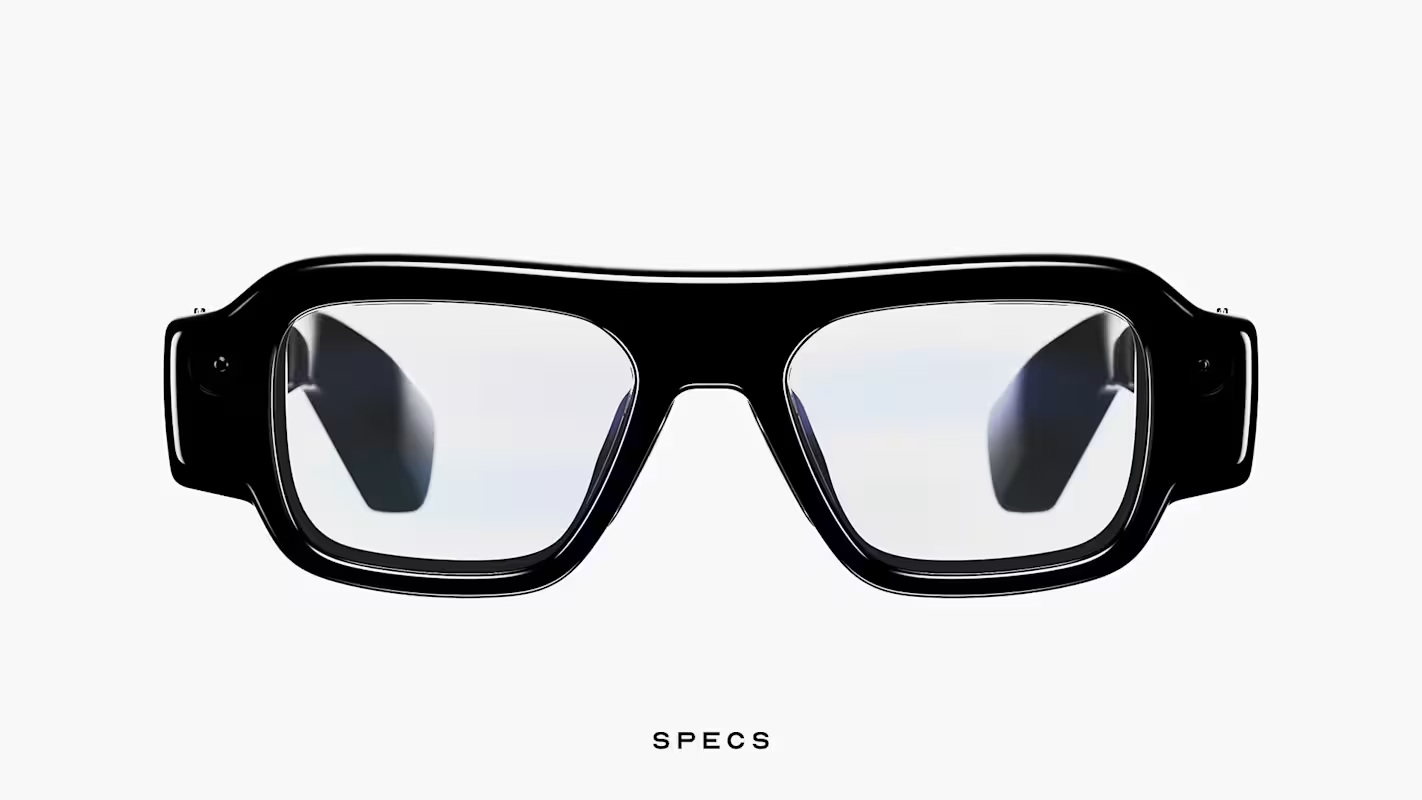
Today at Augmented World Expo 2026, we introduced SPECS, our new augmented reality glasses.
When we started Snap, we believed technology could help people connect more deeply with one another. Over time, that belief led us to augmented reality. For more than a decade, we've been building toward a future where computers can understand the world the way we do, not just through text and taps, but through sight, sound, movement, and context.
Computers have become smaller, more powerful, and more personal. They went from filling entire rooms to fitting in our pockets. But as computers became more capable, they also demanded more of our attention. Too often, we find ourselves looking down at a screen instead of looking at the people we're with, the places we're exploring, or the things we're trying to learn.
We think technology can do better. We believe the best technology fades into the background, helping when it's needed and getting out of the way when it's not. That's why we built SPECS.
SPECS bring computing into the world around us. Instead of pulling us away from the moment, they make it possible to access information, entertainment, and assistance while staying engaged with the people and places around us. We believe augmented reality is the most natural way to use a computer because it aligns with how people already experience the world: visually, socially, and in three dimensions.
Built for everyday life
Building a computer that fits into a pair of glasses is incredibly difficult. From the beginning, our goal was simple: build something powerful enough for augmented reality and light enough to be worn for hours.
Today's devices often require a tradeoff. AI glasses are lightweight but limited in what they can do, while headsets are powerful but can feel isolating and cumbersome. We wanted to build something different.
SPECS are fully standalone, with no puck and no tether. They're made from high-performance Swiss TR90 polymer and come in two sizes, with the 47 mm model weighing just 132 grams and the 52 mm model weighing 136 grams. Removable inserts support a wide range of prescriptions.
The display system is powered by our proprietary liquid crystal on silicon technology, delivering a 51-degree field of view and 16 million colors. The result is a large, vivid display that feels like a 24-inch desktop monitor when you're working, or a 115-inch home cinema screen placed about 10 feet away when you're watching a movie.
We also redesigned our waveguide technology to create a clearer and more seamless view of the world around you. Our new waveguide uses billions of invisibly small nanostructures, so small that more than 10,000 can fit on the tip of a single hair. SPECS use the same advanced technology found in Boeing 787 Dreamliner windows, so the electrochromic lenses gently shift from clear to tinted in just 10 seconds.
Every design decision came back to the same idea: technology should feel natural. SPECS aren't designed to replace the world. They're designed to help us engage with it.
Useful in the moment
The promise of augmented reality isn't putting screens everywhere. It's making computing useful in the moment.
Imagine walking through a city and seeing directions exactly where you need them, measuring a space without pulling out a tape measure, or getting help from AI while you're working on a project instead of stopping to search for an answer. That's what makes augmented reality different.
SPECS can also transform almost any place into a workspace. You can cast a screen, stream content, open a whiteboard, or collaborate with others while remaining aware of the people and environment around you. And because augmented reality is inherently social, SPECS make entirely new kinds of shared experiences possible.
Developers have already built hundreds of Lenses for SPECS, unlocking shared experiences that screens cannot, from reading the green, to overlaying interactive lessons onto your drum set with Drum Kit, to education tools like Vector Fields that make invisible forces visible.
When people first hear about augmented reality, they often imagine existing software floating in front of their face. We think the opportunity is much bigger than that. Some experiences will help people learn, some will help people work, some will help people create, and some will simply be fun. Many of them haven't been imagined yet.
Built to understand the world
For augmented reality to feel natural, digital experiences need to understand the physical world around us. That's why SPECS are powered by two Snapdragon processors. One is dedicated to computer vision and the other is dedicated to running Lenses.
Together, they enable fast hand tracking, low latency, and responsive interactions that help digital content feel anchored in the real world. SPECS deliver 7-millisecond motion-to-photon latency, verified through advanced robotic measurement systems.
SPECS offer up to four hours of mixed-use battery life, including audio and video playback, Lenses, AI assistance, Bluetooth notifications, and more. The included charging case provides four additional charges on the go for up to 20 total hours of mixed use.
We've spent more than a decade building toward this moment. Along the way, we've invested across the entire augmented reality stack—from developer tools and our operating system to displays, optics, computer vision, and hardware. We've also filed more than 7,000 patents throughout SPECS development as part of that work.
Building a new kind of computer takes patience, but hardware is only the beginning.
A platform for developers
Every important computing platform has been defined by what people built with it. The PC became meaningful because developers built software. The web became meaningful because developers built websites. Smartphones became meaningful because developers built apps. We believe augmented reality will be no different.
Over the past year and a half, we've shipped 10 Snap OS updates with more than 40 new features and APIs. Developers have already published hundreds of Lenses for SPECS, and today we're introducing even more tools to help them build.
We’re introducing agentic development for building SPECS Lenses in Lens Studio through a developer preview rolling out in Claude Code, Codex, and Cursor. We're also introducing the SPECS Spatial Benchmark, the Migration Agent, and a new Native Development Kit that allows developers to bring their own code and libraries into Lens Studio.
We're excited to see what developers create next, especially as AI opens up entirely new possibilities for augmented reality.
AI that can see what you see
AI becomes more useful when it understands context. With SPECS, AI isn't limited to a text box. It can see what you see, understand what you're trying to accomplish, and help in the moment.
That means guidance can appear exactly where it's needed, information can be connected to the objects and places around you, and developers can build experiences that respond intelligently to the real world in real time.
We believe AI and augmented reality are a natural fit because both help people better understand and interact with the world around them. Of course, technology like this only works when people trust it.
Privacy from the beginning
Privacy has been a core design principle at Snap from the very beginning.
SPECS are designed to be transparent about how they work. They ask clearly before accessing sensitive information, and an LED indicator lights up when recording is taking place. SPECS prioritize on-device processing, and give people control over what gets stored, synced, shared, or deleted.
People should understand what information is being used and remain in control of their experience. Trust isn't something that can be added later—it has to be built in from the start.
Creativity inspires technology
One of the things we've learned over the years is that technology becomes meaningful when creative people use it in unexpected ways.
That's why we're launching a global SPECS campaign photographed by Steven Meisel and featuring Jimmy Butler, Imogen Heap, Hoyeon, Jack Harlow, and Kaia Gerber. Each Visionary has been working with Snap to imagine new SPECS experiences that will debut this fall, supporting creativity, expression, presence, and play.
We're excited to share more later this year.
Today, SPECS are available for pre-order at SPECS.COM for $2,195, with a $200 refundable deposit.
SPECS are expected to ship this fall in the United States, the United Kingdom, and France.
We've spent years imagining what computing could look like if it worked more naturally with the way people experience the world. Today is an important step toward that future.
We believe the best technology doesn't pull us away from life. It helps us live it.