


惯性聚合 高效追踪和阅读你感兴趣的博客、新闻、科技资讯
阅读原文 在惯性聚合中打开

推荐订阅源

H
Help Net Security
博客园 - 聂微东
Jina AI
Jina AI
Simon Willison's Weblog
cs.CL updates on arXiv.org
博客园 - 叶小钗
P
Proofpoint News Feed
C
CXSECURITY Database RSS Feed - CXSecurity.com
N
Netflix TechBlog - Medium
WordPress大学
WordPress大学
B
Blog
D
Docker
MyScale Blog
MyScale Blog
The GitHub Blog
The GitHub Blog
S
Schneier on Security
G
Google Developers Blog
Microsoft Azure Blog
量子位
Security Latest
Security Latest
S
Secure Thoughts
T
Tor Project blog
E
Exploit-DB.com RSS Feed
D
DataBreaches.Net
N
News and Events Feed by Topic
B
Blog RSS Feed
IT之家
IT之家
N
News | PayPal Newsroom
Attack and Defense Labs
C
Check Point Blog
V
V2EX
让小产品的独立变现更简单 - ezindie.com
Recorded Future
Recorded Future
Martin Fowler
Martin Fowler
S
SegmentFault 最新的问题
cs.AI updates on arXiv.org
L
LangChain Blog
Hugging Face - Blog
Hugging Face - Blog
阮一峰的网络日志
阮一峰的网络日志
M
MIT News - Artificial intelligence
Last Week in AI
Last Week in AI
D
Darknet – Hacking Tools, Hacker News & Cyber Security
博客园_首页
The Hacker News
The Hacker News
The Register - Security
T
Threat Research - Cisco Blogs
腾讯CDC
P
Privacy International News Feed
T
Troy Hunt's Blog
云风的 BLOG
云风的 BLOG
L
LINUX DO - 最新话题

Hacker News: Front Page

Trump administration reclassifies cannabis as less dangerous Release raylib v6.0 · raysan5/raylib GitHub - russellromney/honker: SQLite extension + bindings for Postgres NOTIFY/LISTEN semantics with durable queues, streams, pub/sub, and scheduler Writing a C Compiler, in Zig crawshaw - 2026-04-22 MacBook Neo and How the iPad Should Be It's time to reclaim the word "Palantir" for J.R.R. Tolkien Arch Linux now has a bit-for-bit reproducible Docker image Fundamental Theorem of Calculus | David Álvarez Rosa | Personal Website Bring Your Agent to Teams Ars Technica newsroom AI policy France confirms data breach at government agency that manages citizens’ IDs New study compares growing corn for energy to solar production. It's no contest NAEP Long-Term Trend Assessment Results: Reading and Mathematics Convergent Evolution: How Different Language Models Learn Similar Number Representations We found a stable Firefox identifier linking all your private Tor identities GitHub - besimple-oss/broccoli: Broccoli turns Linear tickets into shipped PRs — powered by Claude and Codex, running on your own Google Cloud. Youth Suicides Declined After Creation of National Hotline Top MAGA influencer revealed to be AI — created by a guy in India who made a mint off lonely men online Ping-pong robot beats top-level human players Announcing DuckDB 1.5.2 The handmade beauty of Machine Age data visualizations Treetops glowing during storms captured on film for first time Columnar Storage is Normalization TPU 8t and TPU 8i technical deep dive Our eighth generation TPUs: two chips for the agentic era Introducing Google Cloud Fraud Defense, the next evolution of reCAPTCHA Kernel code removals driven by LLM-created security reports tante.cc Nobody Got Fired for Uber's $8 Million Ledger Mistake? Introducing workspace agents in ChatGPT Sure, xor’ing a register with itself is the idiom for zeroing it out, but why not sub? What Async Promised and What it Delivered — Causality GitHub - justrach/kuri: Browser automation and web crawling for AI agents. Zig-native, token-efficient CDP snapshots, HAR recording, and a standalone fetcher. Drunk Post: Things I’ve Learned as a Senior Engineer Claude Code to be removed from Anthropic's Pro plan? Another Day Has Come 'Something sinister could be happening': FBI looks into dead or missing nuclear and space defense scientists tied to NASA, Blue Origin, and SpaceX | Fortune GitHub - calcom/cal.diy: Scheduling infrastructure for absolutely everyone. Meta to start capturing employee mouse movements, keystrokes for AI training The Vercel Breach: OAuth Supply Chain Attack Exposes the Hidden Risk in Platform Environment Variables Member of Technical Staff, Product Engineering (full-time) at Trellis AI | Y Combinator CATL's new LFP battery can charge from 10 to 98% in less than 7 minutes Jobs at Bloom | Y Combinator The printing press for biological data (Sterling Hooten) Brussels launched an age checking app. Hackers took 2 minutes to break it Inside GitHub's Fake Star Economy The Illuminated Man by Christopher Priest and Nina Allan review – an unconventional portrait of JG Ballard IEA: Solar overtakes all energy sources in a major global first Stripe’s payments APIs: The first 10 years GitHub - esutcu/planb-lpm GitHub - browser-use/browser-harness: Self-healing browser harness that enables LLMs to complete any task. Claude Token Counter, now with model comparisons GitHub - shivampkumar/trellis-mac Six levels of dark mode The Bromine Chokepoint: How Strife in the Middle East Could Halt Production of the World’s Memory Chips Turtle WoW classic server announces shutdown after Blizzard wins injunction Scoring 500 Show HN pages for AI design patterns Vercel April 2026 security incident | Vercel Knowledge Base Dubai police arrest airline worker after accessing private WhatsApp group Prompt → Diagram — Gemma 4 E2B in desktop Chrome (WebGPU) Binary GCD - Algorithmica madhadron - The seven programming ur-languages Keep Pushing: We Get 10 More Days to Reform Section 702 The world in which IPv6 was a good design Zero-Copy GPU Inference from WebAssembly on Apple Silicon The RAM shortage could last years Any Color You Like: NIST Scientists Create ‘Any Wavelength’ Lasers in Tiny Circuits for Light Optimizing Ruby Path Methods A college instructor turns to typewriters to curb AI-written work and teach life lessons UpCodes | Careers The electromechanical angle computer inside the B-52 bomber's star tracker Why Japan has such good railways - Works in Progress Magazine State of Kdenlive - 2026 GitHub - smol-machines/smolvm: Tool to build & run portable, lightweight, self-contained virtual machines. Head of Engineering at Kyber | Y Combinator GitHub - paniclock/paniclock: Instantly disable Touch ID and lock your Mac with one click or keyboard shortcut. Detecting DOSBox from within the Box I Measured Claude 4.7's New Tokenizer. Here's What It Costs You. Introducing Claude Design by Anthropic Labs Middle schooler finds coin from Troy in Berlin It Is Time to Ban the Sale of Precise Geolocation Isaac Asimov: The Last Question Teddy Roosevelt and Abraham Lincoln in the same photo Healthchecks.io Now Uses Self-hosted Object Storage Bluesky has been dealing with a DDoS attack for nearly a full day. Harness Engineer at Substrate | Y Combinator GitHub - dacracot/Klondike3-Simulator SPICE simulation → oscilloscope → verification with Claude Code — Lucas Gerads Email could have been X.400 times better Newly unsealed records reveal Amazon’s price-fixing tactics, California attorney general claims GitHub - GainSec/AutoProber: Hardware hacker’s flying probe automation stack for agent-driven target discovery, microscope mapping, safety-monitored CNC motion, probe review, and controlled pin probing. A Better R Programming Experience Thanks to Tree-sitter Clojure - Documentary GPT‑Rosalind for life sciences research How a Tiny Yellow Handheld Changed How Duke University Teaches Game Design - Playdate News Android CLI and skills: Build Android apps 3x faster using any agent Qwen3.6-35B-A3B on my laptop drew me a better pelican than Claude Opus 4.7 Codex for almost everything GitHub - GRVYDEV/marky: A lightweight easy to use markdown viewer
How did Atari apply side art to Arcade Cabinets?
2026-06-14 · via Hacker News: Front Page

One of the most fascinating sequences in Atari’s arcade manufacturing process in the early 80s, was the application of the fabulous artwork that adorned all of its cabinets from the golden age of arcade gaming. So this week, I thought it would be interesting to take a look at how this cabinet artwork was actually printed.

The technique used is called screen printing (often called silkscreen printing), and it’s a world away from the large-format digital printers used today.

Let’s take a look at the process in action. This great footage shows the process in full. Shot in 1982, the cabinet sides being printed are for Atari’s Quantum arcade cabinet – it is interesting that this happened to be filmed at the time, as the cabinet run was relatively low, at only 500 cabinets:

Atari coin-op screen printing process

What you’re seeing there, isn’t a giant sticker being applied. Atari is printing the artwork directly onto the cabinet side panel. And here’s the key bit; it is being done one colour at a time.

To create a side-art design, Atari’s artists first had to break the artwork into individual colour layers. Each colour required its own printing screen.

For example, if a design contained light blue, dark blue, red, yellow and black, then five separate screens would be created.

Each screen contained only the areas for a single colour. When all of the colours were printed in sequence, one layer on top of another, they combined to create the finished artwork. Over time, Atari would get smarter at this process and mix say, a blue with a yellow on top to create a green.

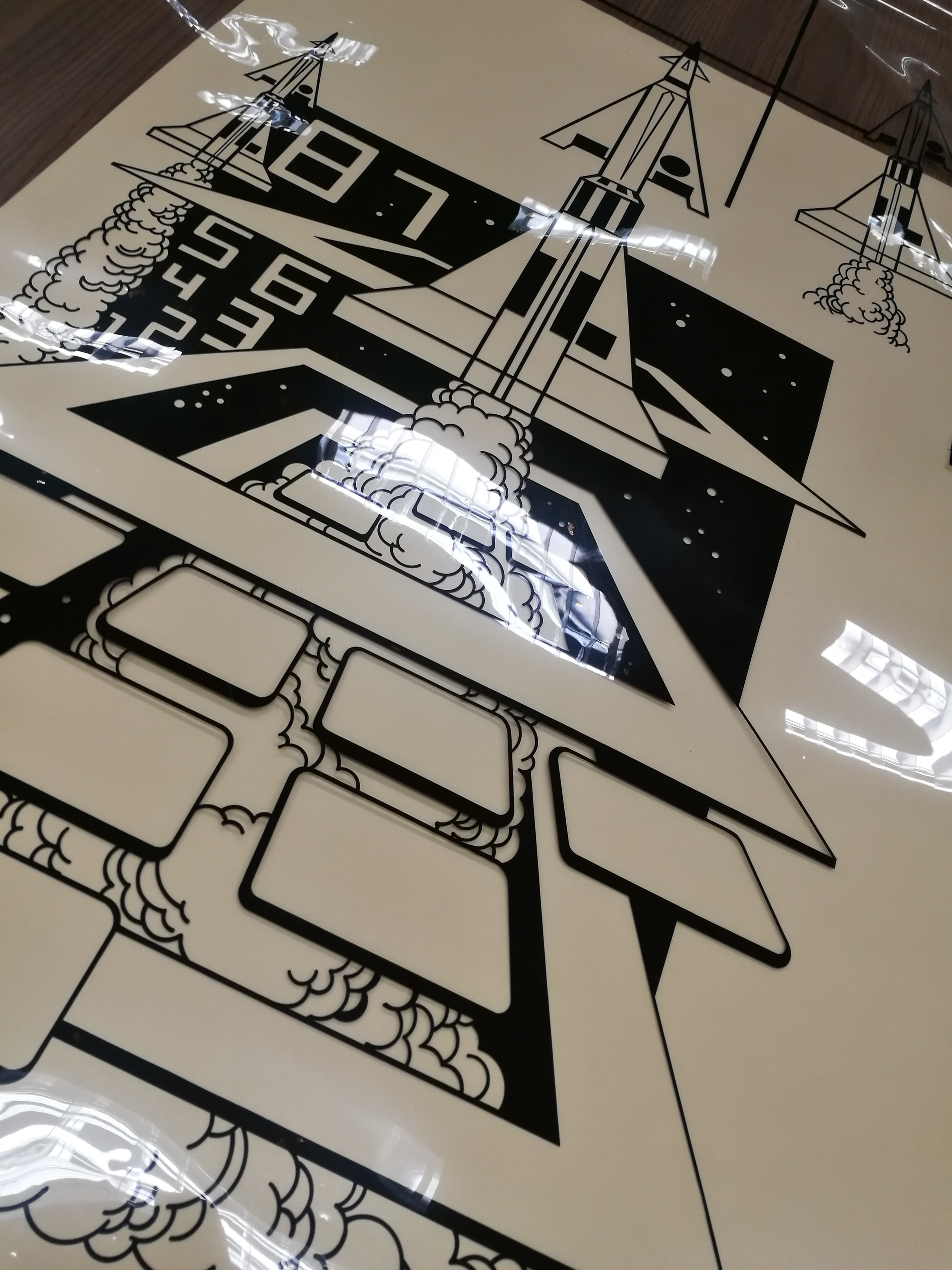
The screens themselves were large rectangular frames fitted with a tightly stretched mesh. The artwork wasn’t painted directly onto the screen. Instead, artists created a separate piece of photographic film for each colour. These films were typically clear acetate sheets with opaque black artwork representing the areas that would print. Here’s an example from Missile Command:
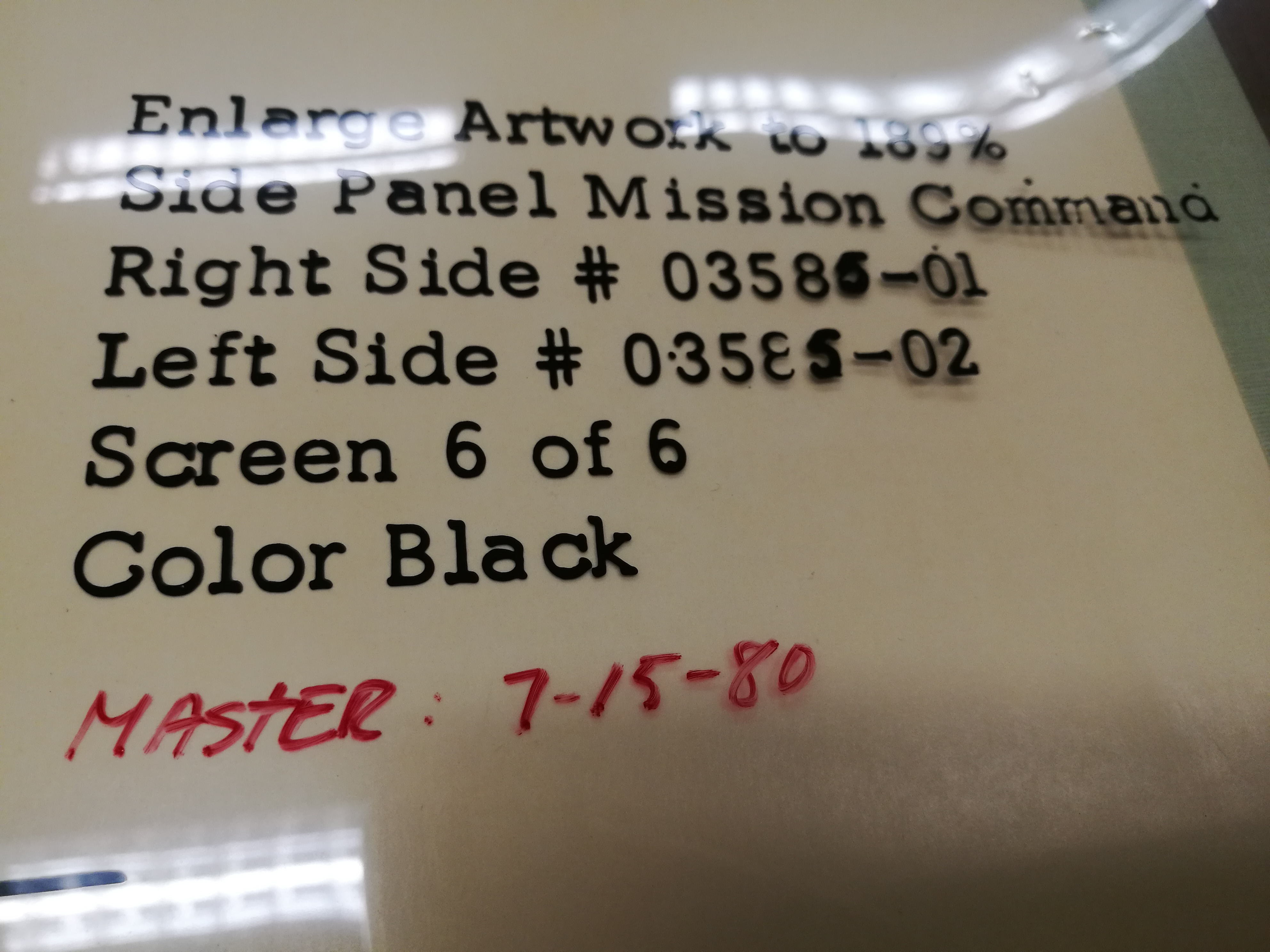
Instructions for the screen printers for this particular film. “Mission Command” I think was an unintentional spelling mistake!
A ‘film positive’ for Atari’s Missile Command. This film is for the black parts of the side art

The film positive was placed over a screen that was coated with light-sensitive emulsion, and then exposed to bright light. The exposed emulsion on the screen below hardened, while the areas hidden by the black artwork remained soft and would then be washed away. The result was a stencil in the mesh that allowed ink to pass through only where that particular colour was needed.

In the footage above, you can see the side panel positioned beneath a large printing head. Let’s watch it again from the 50 second mark:

Atari coin-op screen printing process

A screen is lowered onto the panel and ink is spread across the mesh using a rubber squeegee. The pressure forces ink through the open areas of the stencil (determined by the black parts of the film positives), and onto the wood surface below. When the screen lifts, you can clearly see that one colour section is printed onto the panel. The panel then moves on to the next station where another screen adds the next colour. This process would be repeated several times until the artwork was complete.

The secret to producing clean-looking side-art was something printers call registration. Every screen had to line up perfectly with the colours that had already been printed. If a screen shifted even slightly, outlines would appear blurry and colours would overlap incorrectly. To prevent this, the printing tables used locating pins, stops and alignment guides that ensured each panel returned to exactly the same position for every pass.

Considering the speed of production, it’s impressive how accurately these operators worked.
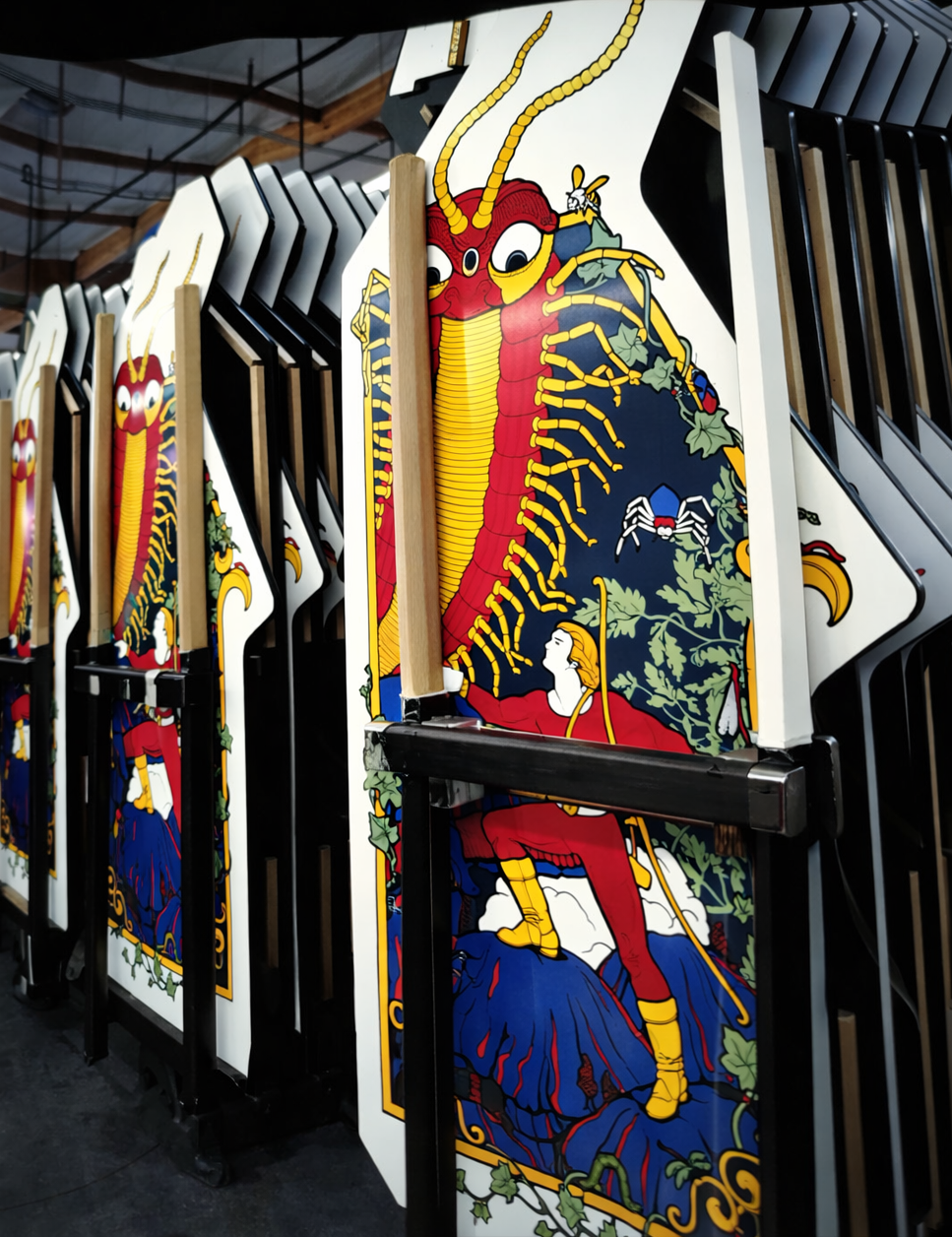
Rows of Millipede side panels, printed and ready for construction. Notice the left and right hand panels next to each other. Interesting the t-molding is already applied…

Atari used a semi-automatic flatbed screen-printing system rather than a completely manual setup. This made sense when you consider something like Missile Command had a production run of 14,000 cabinets. This required 28,000 panels to be printed! So any form of automation would have helped speed this process up.

The production line would have included:

Large screen-printing frames
Photographic colour-separation films
Light-sensitive emulsions
Registration fixtures and alignment guides
Screen-printing inks
Industrial squeegee mechanisms
Drying or curing stations between passes

The machinery handled much of the movement, but trained operators were still essential for setup, colour control and quality inspection.
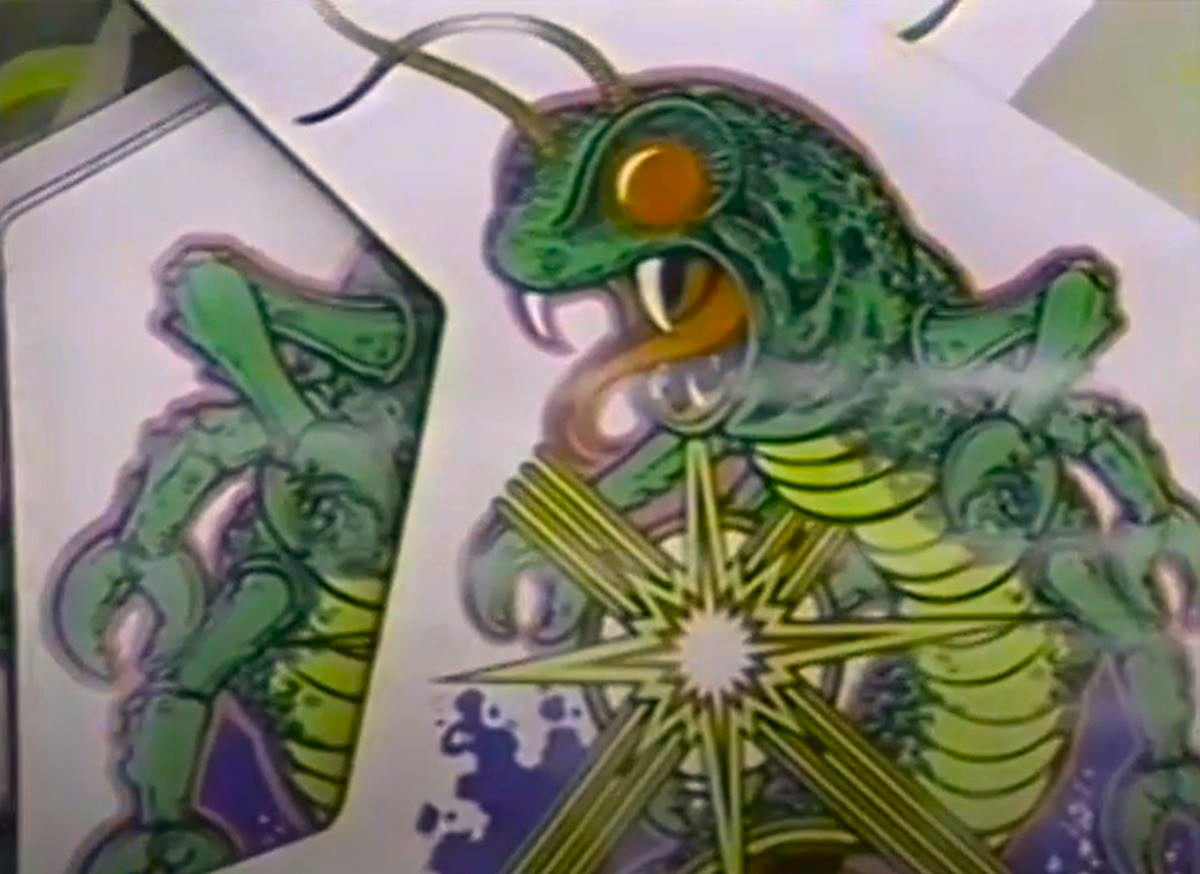
Newly printed Centipede cabinet sides waiting for construction

One reason original Atari side-art still looks so vibrant today is that screen printing lays down a relatively thick, opaque layer of ink. Unlike modern inkjet printing, colours aren’t built from tiny dots. Each colour is applied as a solid layer, giving the artwork a richness and depth that’s difficult to replicate.

When you see a Missile Command cabinet with bright blues, vivid reds and crisp graphics, you’re looking at the result of multiple carefully aligned printing passes, each adding another layer to the final image.
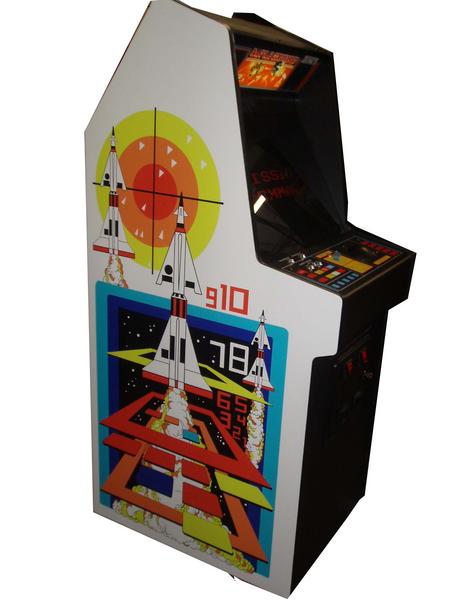
Missile Command side art

Watching the footage today is a reminder that arcade cabinets weren’t simply wooden boxes that happened to contain videogames. They were industrially produced works of graphic art, that needed to be bold and colourful in order to stand out in arcades full of games from various manufacturers. This meant that every stripe, logo and illustration on an Atari cabinet passed through a painstaking sequence of screen-printing operations before the game ever reached an arcade floor. Long before digital printers and vinyl wraps became standard, Atari was creating its iconic cabinet artwork using a process that relied on craftsmanship, precision and a surprising amount of manual skill.

And that’s exactly why these cabinets still look so good more than forty years later.

You can check out another brief glimpse of the side art printing process in this video, of Atari Star Wars and Crystal Castles cabinets being built. Watch from 2:55 onwards:

Thanks for checking in this week – more cool stuff coming down the line!

Tony