


This post tells the story of the session at FOO camp this year that I co-ran with Matt Webb on the Manufactured Normalcy Field. It explains the background of the idea, describes the structure of the brainstorming session, outlines its results, and then tracks some of the uptake of the idea since FOO, specifically in a recent episode of A Show with Ze Frank.
A few months back, Nick Pinkston turned me on to Ribbonfarm, the blog of Venkatesh Rao, a researcher and entrepreneur. Ever since, it’s become a reliable source of mind-grenades for me: explosive ideas that carve up reality in a way I’d never imagined and stimulate new ideas. Ideas you can not just think about, but think with.
The most productive of these ideas for me so far has been the Manufactured Normalcy Field. The Field is Rao’s attempt to explain the process of technical adoption. Rao argues that when they’re presented with new technological experiences people work hard to maintain a “familiar sense of a static, continuous present”. In fact, he claims that we change our mental models and behaviors the minimum amount necessary to work productively with the results of any change.
In cultural practice this process of minimal change takes two primary forms. First, we create stories and metaphors that map strange new experiences back to something we already understand. Rao gives a number of examples of this: the smartphone uses a phone metaphor to make mobile computing comprehensible, the web uses a document metaphor, which has persisted in our user interfaces even as the underlying technology has changed, and “we understand Facebook in terms of school year-books”.
Secondly, we make intentional design choices aimed to de-emphasize the strangeness of new technologies. Here, Rao explains via the example of air travel (a field in which he was educated as an engineer):
"A great deal of effort goes into making sure passengers never realize just how unnatural their state of motion is, on a commercial airplane. Climb rates, bank angles and acceleration profiles are maintained within strict limits. Airline passengers don’t fly. They travel in a manufactured normalcy field.
When you are sitting on a typical modern jetliner, you are traveling at 500 mph in an aluminum tube that is actually capable of some pretty scary acrobatics. Including generating brief periods of zero-g. Yet a typical air traveler never experiences anything that one of our ancestors could not experience on a fast chariot or a boat."
Given this framework, much of the way we currently market new technology is misguided. Geeks, especially, are prone to praise an innovation as disruptively, radically new. But if we believe Rao, that’s the worst way we could advocate on its behalf. What we should do instead is try to normalize the new technology by figuring out the smallest stretch needed to get the Manufactured Normalcy Field to encompass it.
In fact, taking this into account, Rao describes a new role for user experience design:
“Successful products are precisely those that do not attempt to move user experiences significantly, even if the underlying technology has shifted radically. In fact the whole point of user experience design is to manufacture the necessary normalcy for a product to succeed and get integrated into the Field. In this sense user experience design is reductive with respect to technological potential.”
Rao’s essay proceeds to examine the threats he currently sees to the MNF and the anxiety that produces in us. It’s a fascinating (and important) line of thought and I recommend you read the full article.
For my part, though, Rao’s account of the MNF got me thinking about how it might be useful to me as a designer. It occurred me that, when making, marketing, or designing products, there are two different relationships to the Field you might want to forge.
First, as already hinted at, you might have a new technology whose adoption you want to encourage. In this case, you would design the product to disturb the existing state of the Field as little as possible. You’d search for existing well-understood products and experiences to analogize it to. You’d try to make it familiar. Think of Apple’s advertising for the iPad, which depicts the device as a totally natural and harmless part of normal domestic life, basically a “glass magazine”.
Second, you might have the opposite situation: a product that’s become boring to the point of invisibility. Air travel. Routers. Refrigerators. If you wanted to make these seem more exciting or innovative, you’d want to “denormalize” or defamiliarize them: push them to the edge of the Manufactured Normalcy Field so that we notice them again and they feel new. For example, imagine an airplane with as much visibility for the passengers as was feasible: huge windows that really let you feel and see the speed and angle of the plane’s flight.
So, I came to FOO with this broad structure in mind for a brainstorming session based on Rao’s Manufactured Normalcy Field. I was feeling nervous about the idea because it was new and I’d barely talked to other people about it, let alone leading a brainstorming session with people of the incredible caliber that O’Reilly gathers for FOO.
Despite my trepidation, I reserved a session time: “Designing for and Against the Manufactured Normalcy Field”. And to buttress my nervousness, I recruited Matt Webb, CEO of the excellent BERG London to co-lead the session with me. Webb is an experienced invention workshop leader and I thought this idea would be right up his alley. He was generous enough to agree immediately with just a short semi-fevered pitch from me to go on.
In the run-up to the session, I explained a little bit more of what I was thinking to Matt (basically gave him a short, verbal, version of the above). He then boiled that down into a structure for a brainstorming session. After a short introduction from me, Matt divided the white board into three sections, labeled respectively “Things That Feel Weird” (i.e. things that need to be pushed further inside the Field), “Things That Feel Normal” (boring things that need de-normalization), and “Things That We Use To Feel About Things” (strategies for normalizing and de-normalizing).
Much to my surprise and delight what ensued was a fantastic brainstorming session. Part of that was the incredibly creativity of the FOO audience. You couldn’t hope for a better group for this kind of exercise than one that contains the likes of Ze Frank, Tom Coates, Tim O’Reilly, etc. etc. And another part of that was Matt’s expert execution of our structure.
Here’s a photo of the white board with the results:

The first category we started with was Things That Feel Weird. Unsurprisingly, given the audience, these tended towards cutting-edge technologies:
The Things That Feel Normal were interestingly more diverse, stretching from long-mundane parts of domestic life to bits of technology only recently incorporated into The Field:
The last category, Things That We Use To Feel About Things, may have been the most fascinating and useful. It ended up eliciting existing cultural techniques that we use to normalize weird things or to allow us to defamiliarize the mundane.
It’s an amazing list, both conceptually and practically. I don’t think I would have seen anything in common between these practices before seeing them emerge in this context. Also, they’re all things I can now actively imagine using in a design process.
After we’d filled in these three areas, Matt suggested a final step of the process that would lead towards actionable design concepts. He asked people to call out Things That Need Weirding and Things That Need Normaling and, for each thing, he asked the rest of the group to think of ways to make that thing either weirder or more normal, as appropriate.
Here were the candidates (time was getting short at this point so we only got to do a few):
Things That Need Weirding
Things That Need Normaling
(there were others of these called out, but I didn’t capture them)
And here were the concepts that emerged by trying to weird the normal things and normal the weird ones:
This is a partial list I’m reconstructing from the white board photo and my own memories. It doesn’t do a great job capturing the thrill and playfulness of the ideas and the energy and excitement of the participants.
It was an incredibly fun session. I was surprised and very pleased by how well it came out. I can imagine running a similar brainstorming session with other groups in more targeted environments with productive results.
After FOO camp, last week, Ze Frank (who was in the audience at the session and was a major contributor to the brainstorming) made an episde of his show, breaking normal, where he talked about the session. Ze focused on the making-normal-things-weird side of the spectrum. He gave the example of re-imagining how he pictures himself standing on the earth:
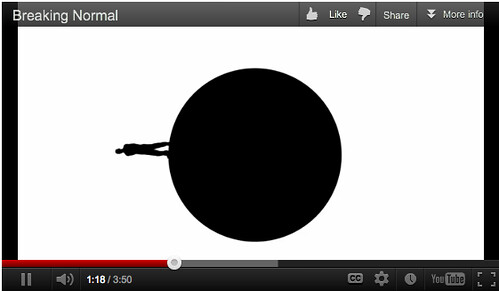
Instead of always imagining himself standing on the top of the earth, he started imagining himself standing on the side of it looking down:
I started imagining that I was facing down when I was standing and looking forward when I was lying down and suddenly I got dizzy. So I lied down, but now lying down had the same feeling as this (dangling feet off the edge of a building), like my back was stuck to a ball and below me was just space.
At the end of the episode, Ze asked his audience to play along, inviting them to describe a normal thing in a way that reveals its inherent weirdness. Ze’s viewers did an amazing job of it. Here are some of my favorites from the comments on that video:
Fishspawned described a thermos:
a thermos is a container that contains a container inside of it surrounded by nothing because if you put stuff into something and surround it with nothing it will keep on being what it is and can’t change into something else. so a thermos acts as a sort of mobile suspended animation device
Ark86 on computers:
In reality, I’m staring at a flat panel made from superheated sand that is connected via strips of ores and really heavily processed dinosaur remains to a thing that we all pretend to understand called “the internet”. Also, I’m sitting on a cow skin painted black and stapled onto some more processed dinosaur remains. I think it’s weird how much ancient animal matter is still being used to make everything we do possible. Thanks, Stegosaurus!
Grendelkhan on work and money:
Five out of seven days, a significant proportion of people go to a small, confined space and sit still for roughly eight hours, staring at a screen and typing. They do not physically move or construct anything.
Later on, they go to other buildings, and take food and other necessities. These two activities are related in an entirely conceptual way–no physical tokens are moved, and the providers of physical goods don’t know anything about the small, confined space.
NephilimMuse on clapping:
Applauding a performance is weird. More specifically, clapping is weird. We just smack our hands together to make a noise that expresses some sort of satisfaction or adoration. It makes the receiving person(s) feel validated. I don’t get it. the motion of clapping is weird. Smack smack smack.
In reading these descriptions, it struck me that they are very resonant with Object-Oriented Ontology (which I’ve written about before here and here). Breaking the abstraction of some behavior or acculturated object (or “opening the black box” as Graham Harman describes it in Prince of Networks) lets us see all the objects and materials that actually constitute these concepts and abstractions. This weirding process puts the material of superheated sand, the air inside a thermos, and cow skin painted black on the same footing as computers, thermoses, and jobs – culturally important categories we routinely consider.
In Object-Oriented Ontology terms, this weirding process is pushing us towards a “flat ontology” where everything exists equally. It’s great that Ze and his viewers have found this game that vividly flattens their personal ontologies and that the result is wonder.
此内容由惯性聚合(RSS阅读器)自动聚合整理,仅供阅读参考。 原文来自 — 版权归原作者所有。