












Every once in a while on social media, people start intensely wondering what explains why Northern Italy is roughly twice as developed as the South. The regional differences really are quite dramatic (see below), and Matt Yglesias rightly (and humorously) references Putnam’s1 1993 Making Democracy Work: Civic Traditions in Modern Italy as a good starting point for understanding the puzzle.
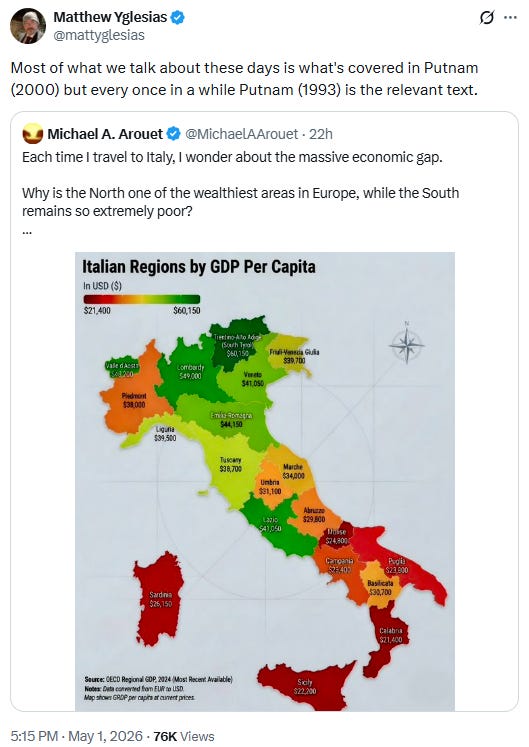
According to Putnam et al., Northern and central Italian regions had denser traditions of local self-government, guilds, cooperatives, and participatory municipal politics, which generated lower corruption, trust, and effective collective action. Southern regions, by contrast, were shaped more by hierarchical authority and landlord domination, which produced lower interpersonal trust and weaker monitoring of public officials. As a result, what on paper look as identical country-level institutions performed very differently in practice. The institutions were embedded in different regional civic environments, which pushed their workings in the direction of accountability and low corruption, alongside higher productivity in the North; while in the South, there was a tendency towards patronage and clientelism, which stifles growth and productivity.
It’s all about long-run social capital, which is what you should expect if you’re reading Putnam.
Oh, and here’s a prettier and provincial-level plot I whipped up.
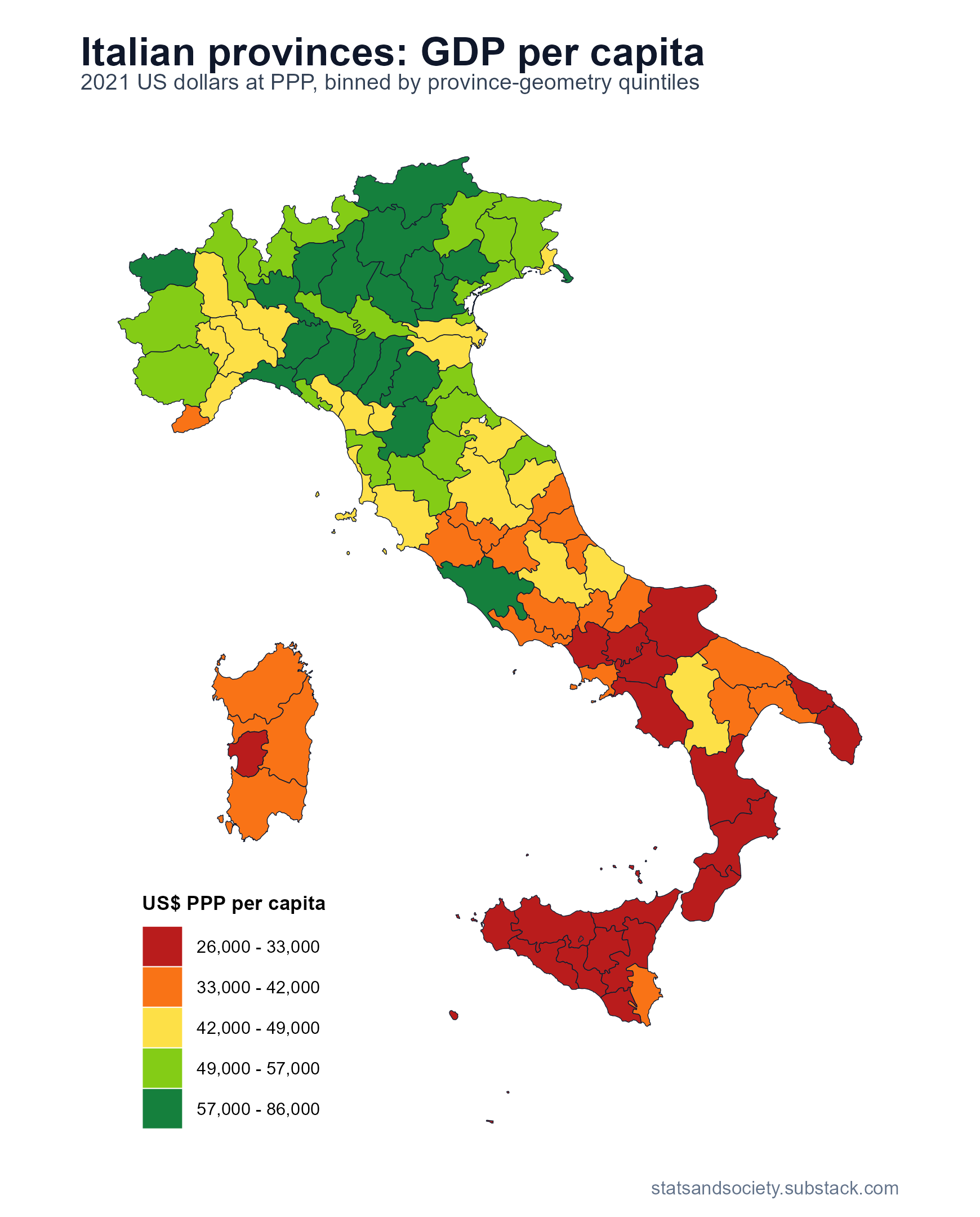
The good modern quantitative evidence we have corroborates parts of Putnam’s story. But there are a few crucial things that are missing or remain unsatisfactory about it.
First, as David Oks put it in one of his characteristically good posts:
Yes, southern Italy has institutions and cultural norms that seem to be less conducive to development; but the interesting question is why it has those institutions and northern Italy does not.
In other words, social/civic capital (= trust, cooperation, public goods, political participation) is the proximate but not the ultimate cause of the differences. And it’s fine as a proximate explanation, but we would also want to know about the ultimate reason, which is causally speaking upstream of today’s cooperation and productivity. (For the general social science case against sweeping cultural explanations along similar lines, see the awesome recent post by Alex Nowrasteh on The Culture Crutch. Also, I’m not actually so sure that trust specifically is an important determinant of economic development.)
Second, when we turn to ultimate causes, geography and environmental disease stress seem to be a key determinant. More specifically, we can blame malaria. This is the point Oks makes, though we shouldn’t turn it into to monocausal a story. Moreover, when people hear “It was malaria!” they might overlook the important mediators and mechanisms that sit on the path between malaria and underdevelopment. It’s not just that people got sick and were thus unproductive, as some might infer. Oks, of course, is careful and spends a lot of time meditating on the mechanisms.
Third, and closely related to point two above, alongside social capital as a proximate cause and malaria as an ultimate cause, you have to additionally introduce at least two things:
the Mafia, lying somewhere between the proximate and the ultimate, I guess,
and, more explicitly related to Putnam’s thesis, the legacy and persistence of medieval self-government, as an ultimate cause, which can itself be traced to what happened in both regions in the times of the Norman kingdom.
The argument that was well-made by Oks is that Southern Italy’s historical disease environment encouraged large estates (and absentee landlordism), which we know even from prior research in other countries and regions are just a huge negative determinant of subsequent industrial development and democratization. One absolutely ironclad law we have in the study of democratization is that landlord power retards it and does so in a very strong manner. For instance, as Usmani (2018) finds:
A little more than half of the democracy gap between the developing and advanced worlds is explained by the muted capacity of nonelites and the elevated power of landlords.
We also know huge land inequality and landlord domination do nothing good for social and human capital or productivity for that matter.
Any way, here’s a brief review of two recent studies we have on this causal chain.
Buonanno et al. (2020/2026 -- it’s in R&R limbo) show that long exposure to malaria shaped how whole agricultural communities were organized and what forms of farming were viable. They combine historical malaria maps with newly digitized landholding data and instrument observed malaria with climate-based predicted malaria risk. They find a large relationship between malaria exposure and land concentration. Malarial municipalities had much less land in small farms, much more land in very large estates, and substantially higher land Gini coefficients.
How so? Ostensibly because malaria added a recurring health risk in periods when agricultural labor was most needed (summer and especially autumn). Small owner-operated farms were poorly placed to handle that risk, because a sick household member could disrupt production and hiring replacements was costly. But large estates could spread risk across workers, or bring in temporary labor, and choose production methods less exposed to seasonal disease shocks.
There is also more direct evidence linking land concentration to education. Mariella (2023) studies post-unification Italy from 1871 to 1921 and finds that landownership concentration had an adverse effect on literacy. The paper uses malaria pervasiveness as an instrument for land inequality and examines many mechanisms such as school enrollment, school density, child labor, and the like. The interpretation is that concentrated landownership reduced both the supply of schooling, through local political power, and the private demand for education among landless rural households, which makes a lot of sense.
There are many other papers more or less like that. Malaria presence seems to shape agrarian, pre-industrial institutions, which then strongly condition how/when/if industrial development takes off through various mechanisms such as education, political power, productivity, and so on.
But malaria is not everything. One important and perhaps secondary channel is the long-run persistence of civic institutions, as already intimated by Putnam.
Guiso et al. (2016) looked at whether medieval self-government (in the North) left durable effects on modern social capital, thereby indirectly influencing modern development. They argue that Northern towns exposed to the free city-state experience indeed developed higher civic capital and more political accountability, while similar towns in the South were prevented from following that path by the centralized Norman kingdom. Their empirical strategy uses historical predictors of city-state formation and a difference-in-differences comparison between North and South.
I say “historical predictors,” because obviously, you have to be clever about the analysis if you want plausibly causal effects. So, they don’t just correlate old communes with modern trust and participation but instead instrument the probability of becoming a free city-state using historical predictors such as having a bishop around the year 1000. Why a bishop? Bishops could help solve the coordination problem involved in forming a sworn civic pact. Early communes required sworn collective action among urban elites, and bishops could make such oaths more credible by guaranteeing them and threatening religious exclusion against defectors.
This predictor should matter only where free city-states could actually emerge. In the South, where the Norman kingdom imposed centralized rule, the same bishops couldn’t generate communes. So the authors compare whether these historical predictors are associated with civic capital in the North but not in the South. Pretty neat. (They also check that bishop seats created after the commune era do not have the same effect, which helps rule out the idea that “having a bishop” mechanically produces civic capital.)
After doing all of that, their key estimate is that the absence of the free-city-state experience accounts for at least half of the North–South gap in social capital!
Another, more recent determinant of the divergence is the rise of the Sicilian Mafia in the late nineteenth century. Acemoglu et al. (2020) showed that the spread of socialist Peasant Fasci organizations created a threat to landholders and local elites in areas of weak state presence, leading some elites to rely on Mafia groups for private enforcement and repression. Their identification strategy uses the severe drought of 1893 as a source of variation affecting the location of the Fasci, and then estimates the effect of Fasci presence on Mafia presence in 1900.
Like before, you have to be clever about how to get at causality. Here, we need a source of variation in where the Peasant Fasci appeared that is not simply a reflection of places already being more conflict-prone, or poorer, or more likely to develop Mafia activity for other reasons. Now, the drought damaged agricultural conditions, but it did not hit every Sicilian municipality equally. In places where rainfall fell more sharply, rural distress was also (consequently) greater, making peasant mobilization more likely. That gives them a plausible way to isolate the part of Fasci presence that was driven by an unusual weather shock rather than by confounded local characteristics. (And yes, they show that rainfall in other periods does not predict Mafia presence or related outcomes in the same way.)
Unsurprisingly, the main finding is that Mafia presence later reduced literacy and public goods and had persistent effects on political competition.
Modern evidence also indicates that organized crime can have direct economic effects. Fenizia and Saggio (2024) study Italian municipalities whose city councils were dissolved because of Mafia infiltration. Using a matched difference-in-differences design and social-security records, they find that dismissals increased employment, the number of firms, and industrial real-estate prices. The effects were concentrated in Mafia-dominated sectors and in municipalities where fewer incumbents were reelected. This seems to suggest that local institutional capture by organized crime can depress economic activity, and that weakening such capture can improve outcomes (anyone surprised?).
Going into this, I was sure that the literature on Italian South-North divergence is a mess and that nothing coherent will emerge from reviewing it, but for “We don’t really know what explains it.” However, I was pleasantly surprised to find that we have a fairly good grasp on both the proximal and ultimate reasons for the regional developmental gap.
People of X, don’t be puzzled by Italy’s internal divergence! Social science has mostly solved this one.