


惯性聚合 高效追踪和阅读你感兴趣的博客、新闻、科技资讯
阅读原文 在惯性聚合中打开

推荐订阅源

S
SegmentFault 最新的问题
A
About on SuperTechFans
NISL@THU
NISL@THU
V
Visual Studio Blog
奇客Solidot–传递最新科技情报
奇客Solidot–传递最新科技情报
B
Blog RSS Feed
Engineering at Meta
Engineering at Meta
GbyAI
GbyAI
美团技术团队
CTFtime.org: upcoming CTF events
Google DeepMind News
小众软件
小众软件
博客园 - Franky
罗磊的独立博客
The Cloudflare Blog
H
Hackread – Cybersecurity News, Data Breaches, AI and More
酷 壳 – CoolShell
酷 壳 – CoolShell
量子位
Hugging Face - Blog
Hugging Face - Blog
云风的 BLOG
云风的 BLOG
MongoDB | Blog
MongoDB | Blog
freeCodeCamp Programming Tutorials: Python, JavaScript, Git & More
B
Blog
The GitHub Blog
The GitHub Blog
钛媒体:引领未来商业与生活新知
钛媒体:引领未来商业与生活新知
P
Proofpoint News Feed
有赞技术团队
有赞技术团队
Hacker News - Newest:
Hacker News - Newest: "LLM"
Cyberwarzone
Cyberwarzone
C
CXSECURITY Database RSS Feed - CXSecurity.com
Project Zero
Project Zero
Security Latest
Security Latest
L
Lohrmann on Cybersecurity
AWS News Blog
AWS News Blog
The Hacker News
The Hacker News
I
Intezer
J
Java Code Geeks
OSCHINA 社区最新新闻
OSCHINA 社区最新新闻
P
Privacy International News Feed
月光博客
月光博客
A
Arctic Wolf
Apple Machine Learning Research
D
Darknet – Hacking Tools, Hacker News & Cyber Security
博客园_首页
WordPress大学
WordPress大学
cs.CL updates on arXiv.org
T
Tor Project blog
博客园 - 三生石上(FineUI控件)
The Last Watchdog
The Last Watchdog
cs.CV updates on arXiv.org

Hacker News: Front Page

SPICE simulation → oscilloscope → verification with Claude Code — Lucas Gerads GitHub - GainSec/AutoProber: Hardware hacker’s flying probe automation stack for agent-driven target discovery, microscope mapping, safety-monitored CNC motion, probe review, and controlled pin probing. Introducing Claude Opus 4.7 Qwen Studio The Future of Everything is Lies, I Guess: Where Do We Go From Here? GitHub - SeanFDZ/macmind: Single-layer transformer in HyperTalk for the classic Macintosh Virginia Bans Sale of Geolocation Data Show HN: Agent-cache – Multi-tier LLM/tool/session caching for Valkey and Redis Ancient DNA reveals pervasive directional selection across West Eurasia [pdf] AI cybersecurity is not proof of work Moving a large-scale metrics pipeline from StatsD to OpenTelemetry / Prometheus GitHub - Nightmare-Eclipse/RedSun: The Red Sun vulnerability repository GitHub - SethPyle376/hiraeth: Local AWS emulator focused on fast integration testing, with SQS support, SQLite-backed state, and a debug-friendly web UI. A Better Ludum Dare; Or, How to Ruin a Legacy GitHub - macOS26/Agent: Any AI, replaces Claude Code, Cursor, OpenClaw. Over 18 LLM providers (Claude, OpenAI, Gemini, Ollama, Zai, HF, Qwen) wired into a native Mac app that writes code, builds Xcode projects, bumps versions, manages git, automates Safari, use AppleScript, JS or Accessibility, extend Agent! w/ MCP Servers, run tasks from your iPhone via Messages. YouTube now lets you turn off Shorts I Made a Terminal Pager Burgers | マクドナルド公式 Commands — HackerNews CLI documentation ChatGPT for Excel PiCore - Raspberry Pi Port of Tiny Core Linux Live Nation illegally monopolized ticketing market, jury finds Google Broke Its Promise to Me. Now ICE Has My Data. Founding Engineer at Adaptional | Y Combinator CRISPR takes important step toward silencing Down syndrome’s extra chromosome GitHub - saffron-health/libretto: The AI toolkit for building reliable browser automations US v. Heppner (S.D.N.Y. 2026) no attorney-client privilege for AI chats [pdf] Unexpected €54k billing spike in 13 hours: Firebase browser key without API restrictions used for Gemini requests Fragments: April 14 Cal.com Goes Closed Source: Why AI Security Is Forcing Our Decision | Cal.com - Scheduling Software for Online Bookings Laravel raised money and now injects ads directly into your agent Codex Hacked a Samsung TV Tech Valuations Back to Pre-AI Boom Levels A perfectable programming language — Soter GitHub - halfwhey/claudraband: Claude Code for the Power User Partnership through Play: Investigating How Long-Distance Couples Use Digital Games to Facilitate Intimacy Textbooks and Methods of Note-Taking in Early Modern Europe (2008) Eternity in six hours: Intergalactic spreading of intelligent life (2013) Seven countries now generate 100% of their electricity from renewable energy Tell HN: OpenAI silently removed Study Mode from ChatGPT Pro Max 5x Quota Exhausted in 1.5 Hours Despite Moderate Usage Show HN: Oberon System 3 runs natively on Raspberry Pi 3 (with ready SD card) Tell HN: docker pull fails in spain due to football cloudflare block Bring Back Idiomatic Design No one owes you supply-chain security GitHub - xsawyerx/curl-doom: DOOM, played over cURL Apple update turns Czech mate for locked-out iPhone user The Grand Line Cache TTL silently regressed from 1h to 5m around early March 2026, causing quota and cost inflation Building a Z-Machine in the worst possible language The peril of laziness lost Iran war: We spoke to the man making Lego-style AI videos that experts say are powerful propaganda AI Will Be Met With Violence, and Nothing Good Will Come of It GitHub - duguyue100/midnight-captain: Inspired by Midnight Commander, tailored to my taste. How to build a `git diff` driver · Jamie Tanna | Software Engineer Center for Responsible, Decentralized Intelligence at Berkeley The Local Universe’s Expansion Rate Is Clearer Than Ever, but Still Doesn’t Add Up - A new synthesis of astronomical measurements confirms a persistent mismatch that could point to physics beyond current models The disturbing white paper Red Hat is trying to erase from the internet – OSnews NetBlocks (@netblocks@mastodon.social) The Future of Everything is Lies, I Guess: Annoyances ‘Abhorrent’: the inside story of the Polymarket gamblers betting millions on war Productive procrastination — Max van IJsselmuiden maps, territory and LMs 447 Terabytes per Square Centimetre at Zero Retention Energy: Non-Volatile Memory at the Atomic Scale on Fluorographane Show HN: Pardonned.com – A searchable database of US Pardons 20 Years on AWS and Never Not My Job The Seasons are Wrong The FAA wants gamers to apply for air traffic control jobs Artemis II crew splashes down near San Diego after historic moon mission Why weekends are under threat We gave an AI a 3 year retail lease in SF and asked it to make a profit | Andon Labs How a dancer with ALS used brainwaves to perform live On filing the corners off my MacBooks Installing every* Firefox extension OpenClaw’s memory is unreliable, and you don’t know when it will break Steve Blank Nowhere Is Safe Chimpanzees in Uganda locked in vicious 'civil war', say researchers watgo - a WebAssembly Toolkit for Go linux/Documentation/process/coding-assistants.rst at master · torvalds/linux GitHub - callumlocke/json-formatter: Makes JSON easy to read. Founding Product Engineer at Bild AI | Y Combinator A compelling title that is cryptic enough to get you to take action on it GitHub - Keychron/Keychron-Keyboards-Hardware-Design: Industrial design files for Keychron keyboards and mice. 100+ models with CAD assets in STEP, DXF, DWG, and PDF. Source-available, with commercial use allowed for original compatible accessories within the license terms. [ANNOUNCE] WireGuardNT v0.11 and WireGuard for Windows v0.6 Released 1D-Chess Helium Is Hard to Replace Keeping a Postgres queue healthy — PlanetScale Serenity Forge (@serenityforge.com) Our response to the Axios developer tool compromise Do Americans read print books, e-books or audiobooks more? Uncharted island soon to appear on nautical charts The Problem That Built an Industry Fragments: April 2 Python Release Python install manager 26.1 Bitcoin miners are losing $19,000 on every BTC produced as difficulty drops 7.8% God sleeps in the minerals Harness engineering: leveraging Codex in an agent-first world Apple Silicon and Virtual Machines: Beating the 2 VM Limit What have been the greatest intellectual achievements? The APL Programming Language Source Code
What I've learned about the trombone
Bryan Hu · 2026-06-03 · via Hacker News: Front Page

I’ve been playing the trombone since fourth grade. Today, I’m going to share what I’ve learned about, especially the technical aspects of playing such an instrument.

But first, what’s a trombone?

To understand why playing the trombone is so different, let’s first look at the instrument itself.

Yamaha tenor trombone

Pictured here is a Yamaha tenor trombone. It’s very simple to assemble as it’s just 2 parts: the horn and the large tuning slide.

The trombone is the only brass instrument in a classical orchestra (I specify classical because variations such as the superbone also exist) where the main mode of pitch control is by moving the tuning slide. This means that, like string instruments (violin, viola, cello, etc), the pitch is continuous: I will get into why this is important later. But for now, one obvious advantage is that this allows us to do “real” glissandos, where the pitch smoothly transitions from one note to another.

As a brass instrument, you also “buzz” into the metal mouthpiece in order to play the trombone. “Buzzing” is the act of vibrating the lips against the mouthpiece to produce sound. If you just relax your lips and blow air (without vocalizing any pitch), that’s pretty close to what we call a “buzz”.

On a piano, you just press a key to play a note. For a trombone, you change the “slide position” where extending it makes a lower note.

Of course, since there’s only 7 slide positions (where 1st position is where the slide is fully retracted and the 7th is where the slide is fully extended), you would also need to adjust your embouchure (the way you shape your lips and tongue) to get to different “partials” to hit higher or lower notes.

To understand how that works (one of the hardest parts of playing a brass instrument), we need to look at the standing waves inside the trombone.

Side note: while the mechanics of this is technically the same for all wind instruments, the trombone is also unique in that it’s the most visually simple example of this system.

Physics!

When you buzz into the mouthpiece, you create a standing wave (vibrating air column) inside the trombone, which produces a specific pitch. The trombone can be modeled as a tube with one end open (the bell) and the other end closed (the mouthpiece which you are playing into).
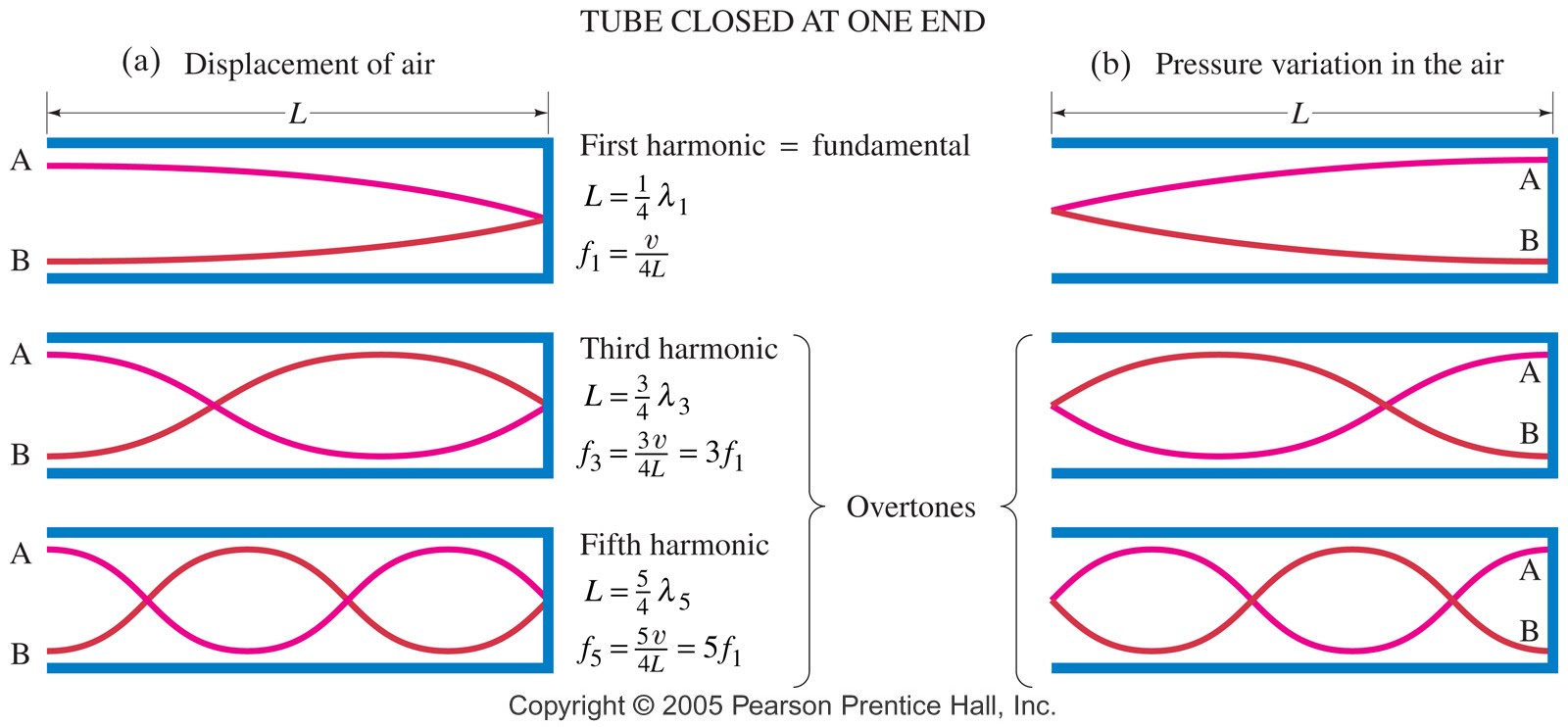
Image courtesy of Dan Russell, licensed under a Creative Commons Attribution-NonCommercial-NoDerivatives 4.0 International License.

For now, the equation that’s useful here is

f=v4Lf = \frac{v}{4L}

Where ff is the frequency, vv is the speed of sound, and LL is the length of the air column (the length of the slide).

Since pitch is frequency, and frequency is inversely proportional to the length of slide, extending the slide decreases the frequency, and thus lowers the pitch. Simple, right?

Uh, how about the notes beyond the seven positions?

Those notes need to be accessed with different “partials” achieved by changing your embouchure (lip and mouth technique).

Look at what the other diagrams are showing. When you play a note on a trombone (or any instrument actually), you’re not just playing the fundamental frequency (which is the main pitch you hear), but also a series of higher frequencies called overtones or harmonics. These overtones contribute to the unique timbre of the instrument and are why every instrument sounds different, even if they’re playing the exact same note.

Since the vibration of our lips is what creates the standing wave inside the trombone, changing the speed of our lips (e.g. by making it tighter) will “change the fundamental frequency” of the standing wave: if the frequency of our lips resonates (i.e. matches frequency) with one of the overtones, it amplifies it, making it sound like the “new fundamental frequency.” Yes: that means the higher we go, there will be “less” (or at least audible) overtones in the sound, making the tone sound more pure and closer to a pure sine wave.

By the way, when I say changing the speed of our lips is what selects the partial, while it’s technically true, it’s not a good way to teach technique.

Why not?

Just like how playing the piano isn’t just moving a finger up and down (even technically that’s all what’s happening) but instead involving the whole arm, to effectively control your trombone playing, you need to involve your tongue as well.

In fact, even if your lips are the main source of sound, your tongue actually does a lot of work in helping your lips with managing the air speed. Overstressing the lips is one of the most common mistakes beginners make when trying to reach the high partials. We call the overall technique of how you control your face to play into a wind instrument embouchure, and good embouchure is important for good sound.

Speaking of good sound, let’s talk about

Tuning!

Being a “continous pitch” instrument is both a blessing and a curse: while you technically have the capability to always be in tune, it also means there’s more responsibility on you with regards to tuning.

Whereas you can just press a key on a piano to make a sound, you have to physically adjust the pitch of the trombone to match the desired frequency. This includes adjusting the length of the slide, the tension of the lips, and even where your lips are positioned on the mouthpiece! Everything changes the sound slightly.

But, how can a trombone ever be better than the piano when there’s so many variables? Well, unlike a piano, where each key produces a fixed pitch, a trombone lets me subtly adjust every note as I play.

A little rabbit hole…

Here’s a little detour into musical instrument tuning systems. Let’s say I play a note at 440 Hz (this would be the standard A above middle C). Let’s say I were to play another note at 450 Hz. What would happen?

The two notes would sound slightly out of tune, creating a beat frequency of 10 Hz. This is because the frequencies are not exact multiples of each other. Since the human ear can detect small differences in pitch, these slight discrepancies can be perceived as dissonance or even unpleasantness. Nice-looking frequency ratios like 1:1 (octave), 3:2 (perfect fifth), 4:3 (perfect fourth), etc, sound “good” to our ears, because they’re the most resonant. This is called just intonation. In just intonation, we base the tuning of notes on each other using these nice ratios. Of course, that definition varies wildly depending on what note you are referencing and what intervals you use, and it could lead to really, really ugly intervals known as wolf intervals.

So, the modern piano isn’t tuned this way. That’s because we want be able to use the piano to play in all 12 keys. Everything should sound relatively good. Thus, the piano is tuned to a system that equally divides an octave into 12 equal parts, known as equal temperament. This system ensures that every key and every note sounds equally good, but it sacrifices the purity of just intonation.

But any instrument that’s not the piano or guitar can actually make micro-adjustments while playing a song. This means that we can actually have the nice-sounding just intonation without the hassle. For most wind instruments, this involves embouchure adjustments. For string instruments, this involves slight adjustments to the finger placement.

For trombonists, while you can also make embouchure micro adjustments, you can also just simply move the slide up or down.

In practice, I never actually think about “oh I have to tune this note around 13 cents flat than how I would normally play it because it functions as the third of this chord.” Instead, I am instead always listening to the rest of the band and I try to fit in my note before I play it. It’s not that deep: use your ears to determine if it sounds good or not.

Conclusion

While there’s a lot more aspects of the trombone (and brass instruments in general) I could talk about (such as the triggers or how to achieve good tone), this is the core of what I’ve learned about playing the trombone.

This blog post is hosted on GitHub. If you want a part 2 covering the other aspects, let me know!