
惯性聚合 高效追踪和阅读你感兴趣的博客、新闻、科技资讯
阅读原文 在惯性聚合中打开

推荐订阅源

Threat Intelligence Blog | Flashpoint
W
WeLiveSecurity
O
OpenAI News
N
News and Events Feed by Topic
K
KPMG report finds enterprise disconnect between AI and its ROI | CIO
cs.CV updates on arXiv.org
Webroot Blog
Webroot Blog
Google Online Security Blog
云风的 BLOG
云风的 BLOG
N
News | PayPal Newsroom
H
Hacker News: Front Page
博客园_首页
Exploit-DB.com RSS Feed
The Last Watchdog
The Last Watchdog
钛媒体:引领未来商业与生活新知
钛媒体:引领未来商业与生活新知
H
Heimdal Security Blog
cs.AI updates on arXiv.org
S
Schneier on Security
宝玉的分享
宝玉的分享
H
Hackread – Cybersecurity News, Data Breaches, AI and More
Recent Commits to openclaw:main
Y
Y Combinator Blog
Cyberwarzone
Cyberwarzone
Microsoft Security Blog
C
CXSECURITY Database RSS Feed - CXSecurity.com
GbyAI
GbyAI
Cloudbric
Cloudbric
TaoSecurity Blog
TaoSecurity Blog
人人都是产品经理
人人都是产品经理
P
Palo Alto Networks Blog
M
MIT News - Artificial intelligence
G
GRAHAM CLULEY
C
Check Point Blog
Apple Machine Learning Research
Last Week in AI
Last Week in AI
T
Troy Hunt's Blog
L
Lohrmann on Cybersecurity
www.infosecurity-magazine.com
P
Proofpoint News Feed
Blog — PlanetScale
Blog — PlanetScale
量子位
博客园 - 聂微东
S
Securelist
博客园 - 三生石上(FineUI控件)
F
Full Disclosure
G
Google Developers Blog
L
LINUX DO - 热门话题
P
Proofpoint News Feed
AI
AI
PCI Perspectives
PCI Perspectives

News and Events Feed by Topic

NIST Receives New Patent for Microbe-Killing Water Heater Spotlight: How NIST Helps Make Sure the Fish You Catch Are Safe to Eat NIST Expands Its Library of ‘Chemical Fingerprints’ to Identify Unknown Substances SRM Story: SRM 1947a Great Lakes Fish Tissue SRM Story: SRMs 3672a and 3673a Organic Contaminants in Smokers’ and Nonsmokers’ Urine Space: The Final Frontier for Standards Securing Smart Speakers for Home Health Care: NIST Offers New Guidelines NIST’s ‘Living Reference Material’ Could Accelerate R&D of Lifesaving Biological Drugs NIST Awards Over $1.8 Million to Small Businesses Advancing AI, Semiconductors, Additive Manufacturing and More SRM Story: SRM 965c Glucose in Frozen Human Serum Second Seminar on Building an In-Space Circular Economy New NIST Reference Material to Strengthen Quality Control for Biological Drugs NIST Releases Trove of Genetic Data to Spur Cancer Research New NIST Research Grade Test Material to support mRNA therapeutics NIST Shares Preliminary Findings From Hurricane Maria Investigation New NIST Standard Helps Deliver the Right Dosage of Cancer-Fighting Drugs Second Series of Workshops on Measurements and Standards for Advanced Therapy NIST Researcher Addresses London Healthcare Innovation Forum NIST Releases Reference Material to Aid Gut Microbiome Research NIST Researchers Develop Material for Measuring Arsenic in Shellfish 2025 NIST Workshop on Rapid Microbial Testing Methods An SRM for Accuracy in Electrolyte Panel Clinical Tests Study Highlights Need for Standardized Measurement Methods in Gene Therapy NIST Develops Genetic Material for Validating H5N1 Bird Flu Diagnostic Tests PFAS Found in Firefighter Gloves, Hoods and Wildland Gear AI and Flow Cytometry Workshop Genome Editing Consortium Workshop Social Spotlight: Engineered Cells as a Shoebox NIST Scientists Use DNA Origami on a Chip to Detect Biomolecules NIST Awards Up to $1.5 Million to Support Development of Regenerative Medicine Standards Curricula NIST Research Leader Featured in Medical IoT Discussions Spotlight: Game-Changing Microscopy Technique for Identifying Cancerous Cells Spotlight: Cassie Stoffer Helps Run Calibration and Measurement Services Related to Magnetic Resonance Spotlight: SURF Student Zainab Altamimi Spends Her Summer Researching the Capsules and Tablets in 3D Drug Printing From Pandemics to Pedicures: NIST Rebuilds World-Class UV Calibration System NIST Partners With the Gates Foundation to Develop Breathalyzers for Malaria and Tuberculosis Research Finds Dolphins With Elevated Mercury Levels in Florida and Georgia NIST Awards Over $1.2 Million to Small Businesses to Advance Cybersecurity, Biopharmaceuticals, Semiconductors and More Spotlight: Shape-Shifting Probes Will Help Improve MRI Imaging NIST Researchers Use Cellphone Compass to Measure Tiny Concentrations of Compounds Important for Human Health CHIPS R&D National Advanced Packaging Manufacturing Program (NAPMP) Advanced Packaging Summit NIST-Led Working Group Developing Standards for Organ-on-a-Chip Research 2024 NIST Rapid Microbial Testing Methods Consortium Workshop
NIST Researchers to Test New Approach for Detecting Cannabis in Breath
Lawrence Goodman · 2024-08-15 · via News and Events Feed by Topic
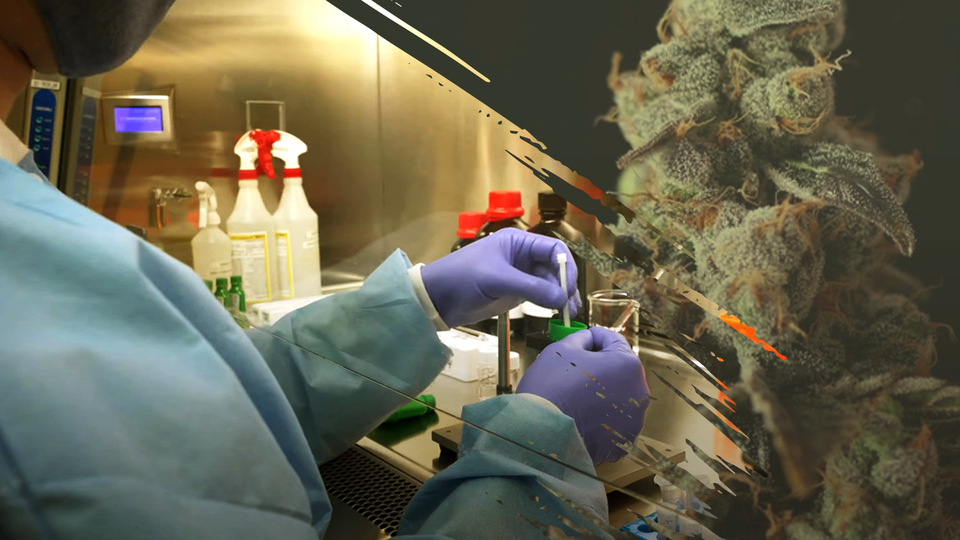
A researcher's hands holding a vial in the lab are juxtaposed with a cannabis plant.

An illustration showing a researcher analyzing breath samples in the lab.

Credit: NIST

With cannabis now outpacing alcohol as Americans’ daily drug of choice, there is a critical need for a scientifically validated breath test to detect the recent use of the substance in drivers.

But developing such a breath test has proved a significant challenge.

Last year, researchers at the National Institute of Standards and Technology (NIST) and the University of Colorado Boulder found that a single breath test may not be reliable in detecting recent cannabis use because cannabis can linger in the body for weeks, making it difficult to distinguish between past and present use. 

Now, these researchers are considering a new approach: two breath tests administered within roughly an hour of each other. If their research is successful, it could lead to a roadside test for cannabis use that involves two breath tests given at a specified interval apart.

“This is potentially paradigm-changing,” said NIST materials research engineer Kavita Jeerage. “If successful, it could pave the way for on-the-spot detection of recent cannabis use by law enforcement.”

Breath tests for alcohol have been around for nearly a century. They detect ethanol, which is exhaled in a gaseous vapor and correlates with the amount of ethanol in the blood.

But tetrahydrocannabinol (THC), the main psychoactive ingredient in cannabis, is present in the breath at a much smaller concentration than ethanol. NIST chemical engineer Tara Lovestead has likened detecting it to “looking for a needle in a haystack.”

In addition, the body breaks down and eliminates cannabis much more slowly than ethanol. NIST and University of Colorado researchers have found that the amount of THC in regular cannabis users’ breath on days they don’t smoke can sometimes be similar to the amount an hour after they’ve used cannabis. This makes it challenging to distinguish recent and past cannabis consumption among regular users.

Currently, when police pull over a driver they suspect of cannabis impairment, they typically use a battery of roadside tests such as heel-to-toe walking or repeating a sentence correctly. But field sobriety tests, as they are called, can be imprecise, weren’t designed for cannabis, and, according to a recent study, can lead to false positives. 

“A reliable breath test for cannabis is both a public safety and equity issue,” said Lovestead.
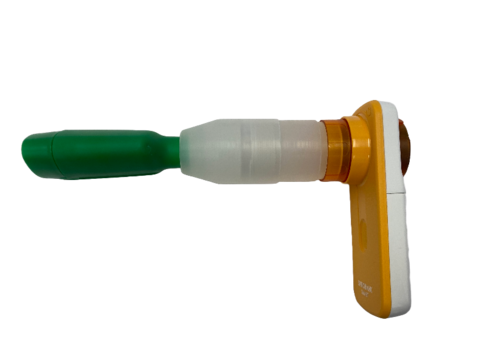
Cannabis breathalyzer device has a yellow plastic handle and green plastic mouthpiece.

Participants in the study will breathe into a device like this.

Credit: J. Berry/NIST

Police can also request that the driver pass a blood test, but that may require obtaining a warrant, which usually can’t be done on-site and may take hours.

Blood tests may also have a similar problem to breath tests in that cannabis lingers in the bloodstream. Daily cannabis users may maintain elevated levels of THC in their blood for days.

Several breath tests are currently being piloted by law enforcement agencies across the country, but there is still no scientific consensus on whether they work. While NIST doesn’t itself develop breathalyzers or breath tests, it does provide guidance and technical expertise on best measurement practices to other government agencies and private industry. 

In 2019, researchers at the University of California San Francisco reported that THC levels in the breath of people who smoked cannabis fell by about 95% over three hours after use. According to NIST’s Kavita Jeerage, this suggests that sharply falling THC levels in breath may be unique to recent cannabis use. Individuals who have used cannabis days earlier yet still have traces of THC in their breath may not experience either the same amount or the same rate of decline, she said. 

In theory, two tests given at different times could determine whether a significant falloff in THC levels was occurring in a driver’s breath. It’s still not known how far apart the tests would need to be given. Ideally, it would be as short as possible, Jeerage said.

Whether two breath tests spaced 20 or 30 minutes apart would be feasible or practical for drivers and law enforcement officers is an open question and outside the study’s scope. 

The two-breath test pilot study is being undertaken as part of a $1.5 million interagency agreement between NIST and the National Institute of Justice, part of the U.S. Department of Justice. NIST is carrying out the study in collaboration with the University of Colorado Boulder.

Here’s how the study will work:

  • Approximately 45 individuals between 25 and 50 years old are being recruited from the Denver and Boulder, Colorado, areas.
  • Researchers will assign half the participants a THC-based strain of flower cannabis and half a THC-based cannabis concentrate. They will purchase the drug independently and use it in their homes to ensure compliance with federal laws. Participants can use as little or as much of the cannabis as they wish.
  • When they’re done, they will immediately come to a mobile pharmacology laboratory operated by the University of Colorado Boulder and parked near their homes. Over two hours, they will complete 10 breath tests at set time intervals apart. Even though participants are taking multiple breath tests, the study’s main goal is to find the ideal timing between two breath tests.
  • The breath samples will be analyzed for THC, chemical compounds produced when the body breaks down THC (THC metabolites), and selected natural compounds found in cannabis plants (cannabinoids). They will also provide blood samples and complete a questionnaire on cannabis use. 

Enrolling participants, carrying out the experiment and analyzing the results are expected to take several years. 

“The ultimate goal is to develop a reliable tool that supports fair law enforcement and helps keep our roads safe,” said Cinnamon Bidwell, associate professor and co-director of CUChange, a research center at the University of Colorado Boulder that studies health and risk behavior.

Related Video

Analyzing THC in the breath of cannabis smokers

Analyzing THC in the breath of cannabis smokers

NIST scientists conduct foundational research on measuring THC and related compounds in the breath of people who have smoked cannabis. This video describes an earlier stage of the research related to the development of a reliable cannabis breathalyzer.