
惯性聚合 高效追踪和阅读你感兴趣的博客、新闻、科技资讯
阅读原文 在惯性聚合中打开

推荐订阅源

The Register - Security
云风的 BLOG
云风的 BLOG
U
Unit 42
F
Fortinet All Blogs
The GitHub Blog
The GitHub Blog
cs.CV updates on arXiv.org
D
Docker
Cyber Security Advisories - MS-ISAC
S
Secure Thoughts
Hacker News: Ask HN
Hacker News: Ask HN
Vercel News
Vercel News
S
Security @ Cisco Blogs
GbyAI
GbyAI
Stack Overflow Blog
Stack Overflow Blog
Exploit-DB.com RSS Feed
I
Intezer
MongoDB | Blog
MongoDB | Blog
AI
AI
MyScale Blog
MyScale Blog
Engineering at Meta
Engineering at Meta
Y
Y Combinator Blog
Threat Intelligence Blog | Flashpoint
P
Proofpoint News Feed
钛媒体:引领未来商业与生活新知
钛媒体:引领未来商业与生活新知
W
WeLiveSecurity
博客园 - 叶小钗
S
SegmentFault 最新的问题
N
News | PayPal Newsroom
WordPress大学
WordPress大学
freeCodeCamp Programming Tutorials: Python, JavaScript, Git & More
D
DataBreaches.Net
小众软件
小众软件
Microsoft Azure Blog
Spread Privacy
Spread Privacy
H
Help Net Security
美团技术团队
博客园 - 司徒正美
T
Threat Research - Cisco Blogs
cs.AI updates on arXiv.org
K
Kaspersky official blog
Application and Cybersecurity Blog
K
KPMG report finds enterprise disconnect between AI and its ROI | CIO
V
Vulnerabilities – Threatpost
TaoSecurity Blog
TaoSecurity Blog
N
Netflix TechBlog - Medium
L
Lohrmann on Cybersecurity
J
Java Code Geeks
量子位
Martin Fowler
Martin Fowler
博客园_首页

News and Events Feed by Topic

NIST Receives New Patent for Microbe-Killing Water Heater Spotlight: How NIST Helps Make Sure the Fish You Catch Are Safe to Eat NIST Expands Its Library of ‘Chemical Fingerprints’ to Identify Unknown Substances SRM Story: SRM 1947a Great Lakes Fish Tissue SRM Story: SRMs 3672a and 3673a Organic Contaminants in Smokers’ and Nonsmokers’ Urine Space: The Final Frontier for Standards Securing Smart Speakers for Home Health Care: NIST Offers New Guidelines NIST’s ‘Living Reference Material’ Could Accelerate R&D of Lifesaving Biological Drugs NIST Awards Over $1.8 Million to Small Businesses Advancing AI, Semiconductors, Additive Manufacturing and More SRM Story: SRM 965c Glucose in Frozen Human Serum Second Seminar on Building an In-Space Circular Economy New NIST Reference Material to Strengthen Quality Control for Biological Drugs NIST Releases Trove of Genetic Data to Spur Cancer Research New NIST Research Grade Test Material to support mRNA therapeutics NIST Shares Preliminary Findings From Hurricane Maria Investigation New NIST Standard Helps Deliver the Right Dosage of Cancer-Fighting Drugs Second Series of Workshops on Measurements and Standards for Advanced Therapy NIST Researcher Addresses London Healthcare Innovation Forum NIST Releases Reference Material to Aid Gut Microbiome Research NIST Researchers Develop Material for Measuring Arsenic in Shellfish 2025 NIST Workshop on Rapid Microbial Testing Methods An SRM for Accuracy in Electrolyte Panel Clinical Tests Study Highlights Need for Standardized Measurement Methods in Gene Therapy NIST Develops Genetic Material for Validating H5N1 Bird Flu Diagnostic Tests PFAS Found in Firefighter Gloves, Hoods and Wildland Gear AI and Flow Cytometry Workshop Genome Editing Consortium Workshop Social Spotlight: Engineered Cells as a Shoebox NIST Scientists Use DNA Origami on a Chip to Detect Biomolecules NIST Awards Up to $1.5 Million to Support Development of Regenerative Medicine Standards Curricula Spotlight: Game-Changing Microscopy Technique for Identifying Cancerous Cells Spotlight: Cassie Stoffer Helps Run Calibration and Measurement Services Related to Magnetic Resonance NIST Researchers to Test New Approach for Detecting Cannabis in Breath Spotlight: SURF Student Zainab Altamimi Spends Her Summer Researching the Capsules and Tablets in 3D Drug Printing From Pandemics to Pedicures: NIST Rebuilds World-Class UV Calibration System NIST Partners With the Gates Foundation to Develop Breathalyzers for Malaria and Tuberculosis Research Finds Dolphins With Elevated Mercury Levels in Florida and Georgia NIST Awards Over $1.2 Million to Small Businesses to Advance Cybersecurity, Biopharmaceuticals, Semiconductors and More Spotlight: Shape-Shifting Probes Will Help Improve MRI Imaging NIST Researchers Use Cellphone Compass to Measure Tiny Concentrations of Compounds Important for Human Health CHIPS R&D National Advanced Packaging Manufacturing Program (NAPMP) Advanced Packaging Summit NIST-Led Working Group Developing Standards for Organ-on-a-Chip Research 2024 NIST Rapid Microbial Testing Methods Consortium Workshop
NIST Research Leader Featured in Medical IoT Discussions
2024-10-01 · via News and Events Feed by Topic
NIST Research Leader Featured in Medical IoT Discussions

Credit: ctl

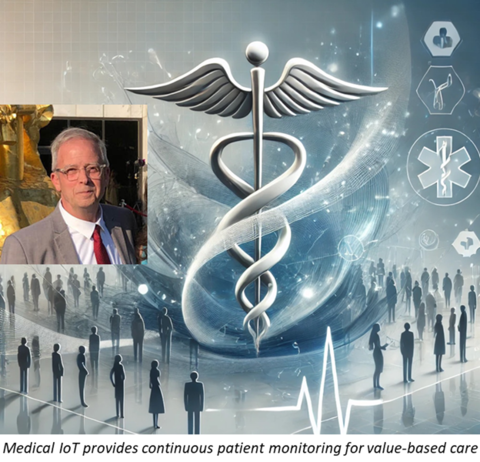
NIST researcher Dr. Edward Griffor has contributed to recent dialogs on the role of Internet of Things technologies to advance future healthcare. For a podcast, Griffor was interviewed by Dr. Rod Rodriguez-Fernandez, Global Health Advisor, Wellness & Mental Health of International SOS (ISOS) on the topic of integrating IoT in future Healthcare technologies for improved global delivery of Emergency Medicine (EMS) and clinical care under austere conditions. Griffor and Rodriguez discussed applications and challenges associated with the use of IoT devices and infrastructure, including:

  • Challenges to merging and contextualizing patient data across instances of care
  • Improving quality of care through continuous monitoring of patient status and response to treatment
  • Implementing an integrated healthcare taxonomy as a widely accessible “database” to align future standards and to enable predictive diagnostics
  • Use of AI/ML driven predictive analytics for global disease evolution and progression
  • Integrating design and development of medical IoT with advances in biochemical foundations

In addition, Dr. Griffor was an invited Medical Internet of Things (IoT) panelist at a Palo Alto Meeting of medical experts and technologists on Future Healthcare, held on September 13-14, 2024. Healthcare is evolving rapidly, with innovations creating both challenges and opportunities. In this gathering, experts in the field met to share insights and explore strategies needed to stay ahead in the ever-changing landscape of global health.

Griffor discussed the integration of IoT in future healthcare for improved clinical and post-release care. In his remarks, Griffor emphasized pressing questions about the future of healthcare:

  • How will AI reshape patient care?
  • How might this change with the integration of IoT technologies?
  • Can IoT help to reduce expenditures on healthcare?

Griffor described the cost of healthcare as being $4.5 trillion or $13,493 per person in the U.S. in 2022 — while countries like Japan, Germany, and Denmark achieve healthcare outcomes with less. He also discussed IoT applications and challenges for future healthcare including:

  • Healthcare professionals’ concerns about automation, e.g. Pressure Control Ventilation interpreting exhalatory pressure as patient breathing effort
  • Improving quality of care through wearable devices for continuous monitoring of patient status
  • Implementing an integrated machine learning (ML) taxonomy to align pre- and post-clinical care standards
  • Predictive diagnostics for cardiac medicine
  • Assuring AI/ML analytics for assessing disease evolution and progression, e.g. demonstrating reduced readmissions for exacerbated heart failure patients

Griffor had previously held a joint workshop with EU and U.S. medical and technology experts at the Gdansk University Medical School (GUMED) in May 2024, and he is working with GUMED biochemists and Stanford Medical Center Cardiac ICU practitioners to devise novel computational models of signaling and metabolic pathways.