
惯性聚合 高效追踪和阅读你感兴趣的博客、新闻、科技资讯
阅读原文 在惯性聚合中打开

推荐订阅源

C
CXSECURITY Database RSS Feed - CXSecurity.com
K
Kaspersky official blog
A
Arctic Wolf
Attack and Defense Labs
L
LINUX DO - 热门话题
N
News | PayPal Newsroom
cs.CV updates on arXiv.org
L
Lohrmann on Cybersecurity
PCI Perspectives
PCI Perspectives
cs.AI updates on arXiv.org
The Last Watchdog
The Last Watchdog
B
Blog RSS Feed
让小产品的独立变现更简单 - ezindie.com
W
WeLiveSecurity
Know Your Adversary
Know Your Adversary
博客园 - Franky
T
Tenable Blog
T
Tailwind CSS Blog
钛媒体:引领未来商业与生活新知
钛媒体:引领未来商业与生活新知
Help Net Security
Help Net Security
WordPress大学
WordPress大学
T
The Exploit Database - CXSecurity.com
www.infosecurity-magazine.com
博客园 - 司徒正美
阮一峰的网络日志
阮一峰的网络日志
D
Darknet – Hacking Tools, Hacker News & Cyber Security
H
Heimdal Security Blog
TaoSecurity Blog
TaoSecurity Blog
S
Security Affairs
J
Java Code Geeks
小众软件
小众软件
freeCodeCamp Programming Tutorials: Python, JavaScript, Git & More
Apple Machine Learning Research
NISL@THU
NISL@THU
O
OpenAI News
The Cloudflare Blog
月光博客
月光博客
Google Online Security Blog
V
V2EX
罗磊的独立博客
美团技术团队
博客园 - 三生石上(FineUI控件)
Security Latest
Security Latest
奇客Solidot–传递最新科技情报
奇客Solidot–传递最新科技情报
C
Cyber Attacks, Cyber Crime and Cyber Security
cs.CL updates on arXiv.org
Cyberwarzone
Cyberwarzone
L
LINUX DO - 最新话题
Hacker News - Newest:
Hacker News - Newest: "LLM"
大猫的无限游戏
大猫的无限游戏

News and Events Feed by Topic

NIST Receives New Patent for Microbe-Killing Water Heater Spotlight: How NIST Helps Make Sure the Fish You Catch Are Safe to Eat NIST Expands Its Library of ‘Chemical Fingerprints’ to Identify Unknown Substances SRM Story: SRM 1947a Great Lakes Fish Tissue SRM Story: SRMs 3672a and 3673a Organic Contaminants in Smokers’ and Nonsmokers’ Urine Space: The Final Frontier for Standards Securing Smart Speakers for Home Health Care: NIST Offers New Guidelines NIST’s ‘Living Reference Material’ Could Accelerate R&D of Lifesaving Biological Drugs NIST Awards Over $1.8 Million to Small Businesses Advancing AI, Semiconductors, Additive Manufacturing and More SRM Story: SRM 965c Glucose in Frozen Human Serum Second Seminar on Building an In-Space Circular Economy New NIST Reference Material to Strengthen Quality Control for Biological Drugs NIST Releases Trove of Genetic Data to Spur Cancer Research New NIST Research Grade Test Material to support mRNA therapeutics NIST Shares Preliminary Findings From Hurricane Maria Investigation New NIST Standard Helps Deliver the Right Dosage of Cancer-Fighting Drugs Second Series of Workshops on Measurements and Standards for Advanced Therapy NIST Researcher Addresses London Healthcare Innovation Forum NIST Releases Reference Material to Aid Gut Microbiome Research NIST Researchers Develop Material for Measuring Arsenic in Shellfish 2025 NIST Workshop on Rapid Microbial Testing Methods An SRM for Accuracy in Electrolyte Panel Clinical Tests NIST Develops Genetic Material for Validating H5N1 Bird Flu Diagnostic Tests PFAS Found in Firefighter Gloves, Hoods and Wildland Gear AI and Flow Cytometry Workshop Genome Editing Consortium Workshop Social Spotlight: Engineered Cells as a Shoebox NIST Scientists Use DNA Origami on a Chip to Detect Biomolecules NIST Awards Up to $1.5 Million to Support Development of Regenerative Medicine Standards Curricula NIST Research Leader Featured in Medical IoT Discussions Spotlight: Game-Changing Microscopy Technique for Identifying Cancerous Cells Spotlight: Cassie Stoffer Helps Run Calibration and Measurement Services Related to Magnetic Resonance NIST Researchers to Test New Approach for Detecting Cannabis in Breath Spotlight: SURF Student Zainab Altamimi Spends Her Summer Researching the Capsules and Tablets in 3D Drug Printing From Pandemics to Pedicures: NIST Rebuilds World-Class UV Calibration System NIST Partners With the Gates Foundation to Develop Breathalyzers for Malaria and Tuberculosis Research Finds Dolphins With Elevated Mercury Levels in Florida and Georgia NIST Awards Over $1.2 Million to Small Businesses to Advance Cybersecurity, Biopharmaceuticals, Semiconductors and More Spotlight: Shape-Shifting Probes Will Help Improve MRI Imaging NIST Researchers Use Cellphone Compass to Measure Tiny Concentrations of Compounds Important for Human Health CHIPS R&D National Advanced Packaging Manufacturing Program (NAPMP) Advanced Packaging Summit NIST-Led Working Group Developing Standards for Organ-on-a-Chip Research 2024 NIST Rapid Microbial Testing Methods Consortium Workshop
Study Highlights Need for Standardized Measurement Methods in Gene Therapy
Lawrence Goodman · 2025-01-06 · via News and Events Feed by Topic
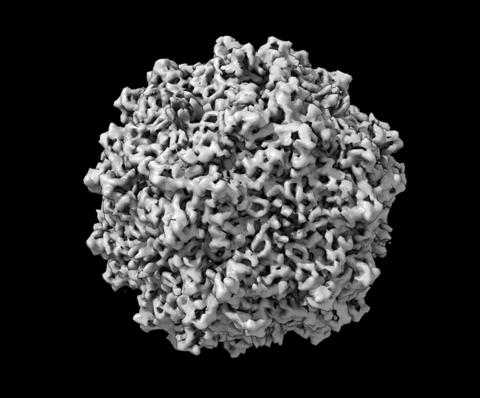
This AAV vector is a bumpy sphere that looks like it's made up of tiny crumpled black and white tubes.

Some gene therapy treatments use modified adeno-associated viruses (AAVs) like the one shown here to deliver therapeutic genetic material into a patient’s cells. 

Credit: Thomas Cleveland (IBBR/NIST)

In a finding with implications for one of the most promising cutting-edge medical treatments, researchers evaluated several measurement techniques commonly used in gene therapy. The study determined that one of the most popular techniques was “problematic” and requires further development and standardization.

In gene therapy, a person’s faulty genes are either replaced or modified to treat or prevent disease. With roughly two dozen products on the market and hundreds of clinical trials in progress or planned, the treatment is hailed as a revolutionary method for targeting the root genetic causes of diseases ranging from sickle cell to cancer.

Some gene therapy treatments use modified adeno-associated viruses (AAVs) to deliver therapeutic genetic material into a patient’s cells. These AAVs are engineered to target specific cell types. Then their infectious genetic material is replaced with the therapeutic genetic material, and they are administered to the patient. 

Correctly measuring AAV vectors, as they are called, is critical to their safety and efficacy. 

In a recently released study, researchers at the National Institute of Standards and Technology, the National Institute for Innovation in Manufacturing Biopharmaceuticals (NIIMBL), and the U.S. Pharmacopeia (USP) recruited six industry labs in the United States and Europe to measure sample AAV vectors. 

The labs were asked to quantify the concentration of genetic material and viral particles in the vectors. They used four measurement techniques and reported their results back to the study’s authors. 

Of the four measurement methods deployed, polymerase chain reaction-enzyme-linked immunosorbent assay (PCR-ELISA) had the lowest accuracy and precision. By accuracy, researchers mean how close the measurement is to the correct value. Precision refers to whether the method produces consistently similar results. 

PCR-ELISA’s imprecision led the study’s authors to conclude that the method had “poor reproducibility.” Its results could not be reliably replicated both within the same lab and at different labs.

The method “should not be used for quantitative [measurements of AAV vectors] without further method development and harmonization,” they added.

PCR-ELISA is actually two separate tools combined into one. PCR is used to quantify genetic material, and ELISA measures the proteins that make up the viral shell. Both tests have been around for decades, and there are dozens of versions of each currently sold on the market.

As a result, there are subtle but important differences in the ways PCR-ELISA is manufactured and used, NIST chemical engineer Wyatt N. Vreeland said. Everyone may think they are doing the same thing when conducting a PCR-ELISA test, he said, but they often aren’t.

“It’s like a recipe for the same chocolate cake,” said Vreeland, who was the principal investigator on the study. “You can give someone the same ingredients, but when you use different equipment to make them or bake them in different ovens, the cakes don’t turn out the same.”

Here’s what the study found about the other three methods:

  • SEC-MALS (size exclusion chromatography with multi-angle light scattering and tandem UV/Vis and/or refractive index) was the most accurate and precise of the methods tested.  
  • SV-AUC (sedimentation velocity-analytical ultracentrifugation) with UV/Vis and/or Rayleigh interference optics was less accurate and precise than SEC-MALS, which surprised the researchers since SV-AUC is considered the “gold standard” for AAV vector measurement. However, SV-AUC was better than SEC-MALS in creating a detailed “map” of the distribution of the genetic and viral particles in the AAV vector. The study suggested that “SEC-MALS could be implemented as a general method with [SV-AUC] being used for more complete analysis as necessary.”
  • A260/A280 dual wavelength ultraviolet spectrophotometry, which measures the absorption of ultraviolet light by a sample, has significant limitations compared with other methods. It cannot distinguish between partially filled or overfilled AAV vectors. Additionally, AAV protein particles are too large for the equipment to handle without producing errors. These issues with spectrophotometry are well documented, and the technique is generally not relied upon for highly accurate measurements.

The study did not draw conclusions about past, ongoing or future gene therapy research that relied upon these methods for measuring AAV vectors. It also did not make any policy or regulatory recommendations.

In future work, researchers at NIST, USP and NIIMBL, a NIST-supported public-private partnership to support biopharmaceutical manufacturing, plan to develop standard operating procedures (SOPs) for the SV-AUC. SOPs are a detailed, written set of instructions for a specific technology or methodology. The scientists believe having widely accepted SOPs for SV-AUC will improve its reproducibility performance to the same level as that of SEC-MALS, for which there are already SOPs.

“All the different methods we tested have their limitations and uncertainties,” said Vreeland. “What’s important is that you understand what your measurement technique can and cannot tell you.” 


Paper: Sean E. Lehman et al. Interlaboratory Measurement of Adeno-Associated Virus: Comparative Quantification of Full and Empty Capsids. Human Gene Therapy. Published online Dec. 26, 2024. DOI: 10.1089/hum.2024.124