
惯性聚合 高效追踪和阅读你感兴趣的博客、新闻、科技资讯
阅读原文 在惯性聚合中打开

推荐订阅源

Forbes - Security
Forbes - Security
A
Arctic Wolf
M
MIT News - Artificial intelligence
T
Threat Research - Cisco Blogs
T
The Exploit Database - CXSecurity.com
C
CERT Recently Published Vulnerability Notes
NISL@THU
NISL@THU
L
Lohrmann on Cybersecurity
Martin Fowler
Martin Fowler
A
About on SuperTechFans
P
Palo Alto Networks Blog
Project Zero
Project Zero
The GitHub Blog
The GitHub Blog
WordPress大学
WordPress大学
Blog — PlanetScale
Blog — PlanetScale
博客园_首页
大猫的无限游戏
大猫的无限游戏
Cisco Talos Blog
Cisco Talos Blog
P
Proofpoint News Feed
D
DataBreaches.Net
Cyberwarzone
Cyberwarzone
T
Tor Project blog
IT之家
IT之家
P
Proofpoint News Feed
Help Net Security
Help Net Security
S
Securelist
Threat Intelligence Blog | Flashpoint
C
CXSECURITY Database RSS Feed - CXSecurity.com
Microsoft Azure Blog
V2EX - 技术
V2EX - 技术
K
Kaspersky official blog
Hugging Face - Blog
Hugging Face - Blog
MongoDB | Blog
MongoDB | Blog
B
Blog
N
News and Events Feed by Topic
The Cloudflare Blog
S
Schneier on Security
P
Privacy & Cybersecurity Law Blog
T
The Blog of Author Tim Ferriss
Recorded Future
Recorded Future
Last Week in AI
Last Week in AI
The Last Watchdog
The Last Watchdog
Hacker News - Newest:
Hacker News - Newest: "LLM"
L
LangChain Blog
I
InfoQ
F
Full Disclosure
The Register - Security
阮一峰的网络日志
阮一峰的网络日志
H
Hacker News: Front Page
V
V2EX

News and Events Feed by Topic

NIST Receives New Patent for Microbe-Killing Water Heater Spotlight: How NIST Helps Make Sure the Fish You Catch Are Safe to Eat NIST Expands Its Library of ‘Chemical Fingerprints’ to Identify Unknown Substances SRM Story: SRMs 3672a and 3673a Organic Contaminants in Smokers’ and Nonsmokers’ Urine Space: The Final Frontier for Standards Securing Smart Speakers for Home Health Care: NIST Offers New Guidelines NIST’s ‘Living Reference Material’ Could Accelerate R&D of Lifesaving Biological Drugs NIST Awards Over $1.8 Million to Small Businesses Advancing AI, Semiconductors, Additive Manufacturing and More SRM Story: SRM 965c Glucose in Frozen Human Serum Second Seminar on Building an In-Space Circular Economy New NIST Reference Material to Strengthen Quality Control for Biological Drugs NIST Releases Trove of Genetic Data to Spur Cancer Research New NIST Research Grade Test Material to support mRNA therapeutics NIST Shares Preliminary Findings From Hurricane Maria Investigation New NIST Standard Helps Deliver the Right Dosage of Cancer-Fighting Drugs Second Series of Workshops on Measurements and Standards for Advanced Therapy NIST Researcher Addresses London Healthcare Innovation Forum NIST Releases Reference Material to Aid Gut Microbiome Research NIST Researchers Develop Material for Measuring Arsenic in Shellfish 2025 NIST Workshop on Rapid Microbial Testing Methods An SRM for Accuracy in Electrolyte Panel Clinical Tests Study Highlights Need for Standardized Measurement Methods in Gene Therapy NIST Develops Genetic Material for Validating H5N1 Bird Flu Diagnostic Tests PFAS Found in Firefighter Gloves, Hoods and Wildland Gear AI and Flow Cytometry Workshop Genome Editing Consortium Workshop Social Spotlight: Engineered Cells as a Shoebox NIST Scientists Use DNA Origami on a Chip to Detect Biomolecules NIST Awards Up to $1.5 Million to Support Development of Regenerative Medicine Standards Curricula NIST Research Leader Featured in Medical IoT Discussions Spotlight: Game-Changing Microscopy Technique for Identifying Cancerous Cells Spotlight: Cassie Stoffer Helps Run Calibration and Measurement Services Related to Magnetic Resonance NIST Researchers to Test New Approach for Detecting Cannabis in Breath Spotlight: SURF Student Zainab Altamimi Spends Her Summer Researching the Capsules and Tablets in 3D Drug Printing From Pandemics to Pedicures: NIST Rebuilds World-Class UV Calibration System NIST Partners With the Gates Foundation to Develop Breathalyzers for Malaria and Tuberculosis Research Finds Dolphins With Elevated Mercury Levels in Florida and Georgia NIST Awards Over $1.2 Million to Small Businesses to Advance Cybersecurity, Biopharmaceuticals, Semiconductors and More Spotlight: Shape-Shifting Probes Will Help Improve MRI Imaging NIST Researchers Use Cellphone Compass to Measure Tiny Concentrations of Compounds Important for Human Health CHIPS R&D National Advanced Packaging Manufacturing Program (NAPMP) Advanced Packaging Summit NIST-Led Working Group Developing Standards for Organ-on-a-Chip Research 2024 NIST Rapid Microbial Testing Methods Consortium Workshop
SRM Story: SRM 1947a Great Lakes Fish Tissue
Melissa Meaney Phillips · 2026-04-28 · via News and Events Feed by Topic
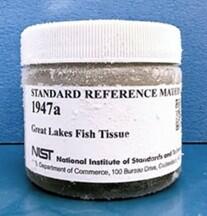
glass jar container with a white cap and white label that reads "Standard Reference Material 1947a great lakes fish tissue"

Credit: Carolyn Burdette, NIST

The American Sportfishing Association indicates that US recreational and sport fishing is a $230.5 billion industry that supports 1.1 million jobs nationwide and provides entertainment for one in six Americans. Even an experienced angler cannot tell if the water in which they fish or the fish they catch are safe and free from pollution. The only way to know is through chemical testing in a laboratory. To ensure that fish caught by anglers are safe to eat, each State monitors the fish in its waters, with support from the Environmental Protection Agency. Because fish live and feed in our waterways, they accumulate heavy metals and other chemicals present in the water from sources such as factories, sewage treatment plants, or runoff from cities and farms. Some chemicals make fish unsafe to eat for everyone, while others are particularly risky only for certain populations, such as pregnant women, children, or the elderly. State and federal laboratories monitor fish for contaminants such as mercury, per- and polyfluoroalkyl substances (PFAS), polychlorinated biphenyls (PCBs), and dichloro-diphenyl-trichloroethane (DDT). NIST supports the accuracy of these monitoring efforts by providing SRMs designed for detecting these low-level contaminants in real fish tissue.

SRM 1947a Great Lakes Fish Tissue is designed as the successor to two widely used but now sold-out standards: SRM 1946 Lake Superior Fish Tissue and SRM 1947 Lake Michigan Fish Tissue. Since the early 2000s, these materials have enabled accurate, precise determination of contaminants to protect public health and our natural water resources. Released in December 2025, SRM 1947a was prepared from twice-cryomilled Lake Ontario trout, ensuring perfectly uniform, homogenized frozen fish tissue for unparalleled precision across every bottle. NIST researchers utilized state-of-the-art techniques to assign values for total mercury and persistent organic pollutants. The availability of this SRM and its accompanying Certificate of Analysis (COA) is essential to ensure users can appropriately validate their testing methods and ensure the accuracy of monitoring efforts.

As the US National Metrology Institute (NMI), NIST provides materials like SRM 1947a to enable users to establish metrological traceability to the International System of Units (SI). The international network of NMIs, including NIST, maintains measurement equivalence through SI traceability, ensuring, for decades to come, that laboratories around the world can accurately and comparably measure contaminants in our environment. Whether validating a new analytical method or performing routine quality control, measurements performed by a laboratory in California will yield the same results as those in Ontario. With accurate test methods and appropriate reference materials, contamination of fish can be identified before it’s consumed and people get sick.

Technical details regarding the production and certification of this material are documented in NIST Special Publication 260-260.