






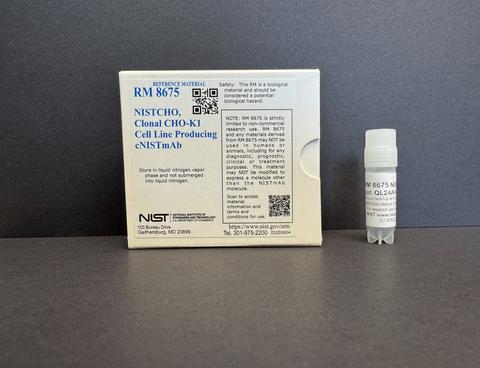
The NISTCHO RM consists of one milliliter of a solution containing 10 million NISTCHO cells. The image here depicts a sample of cells, which are stained in two different colors. The DNA inside the cells is stained blue, and a protein called actin is stained green.
Credit: M. Cleveland/NIST
A type of drug called monoclonal antibodies (mAbs) can halt the growth of breast tumors, block the effects of rheumatoid arthritis, and treat many other diseases, from leukemia and colon cancer to asthma and osteoporosis. To manufacture these drugs, pharmaceutical companies genetically engineer living cells, grow those cells in large bioreactors, and harvest the mAb proteins that the cells produce.
To support the manufacturing of these drugs, researchers at the National Institute of Standards and Technology (NIST) have collaborated with biotech company MilliporeSigma and the National Institute for Innovation in Manufacturing Biopharmaceuticals (NIIMBL) to develop a “living” reference material: specially tailored living cells that make mAbs with well-known properties.
“Our reference material will help biopharmaceutical companies optimize their manufacturing processes and quality assurance methods,” said NIST biologist Zvi Kelman. “This will help U.S. industry to maintain its leading role in developing new, lifesaving drugs.”
In addition, the reference material could assist equipment manufacturers in developing more advanced cell culture media, analytical hardware and bioreactors for growing cells. It can also be used as a training tool to help meet the need for a skilled workforce in this field.
The global market for mAbs is growing rapidly. It was estimated to be worth $249 billion in 2024, and is projected to exceed $619 billion in 2031.
Pharmaceutical companies must surmount many challenges to produce monoclonal antibodies. For example, a living cell doesn’t churn out perfectly identical copies of mAb proteins: They can have subtle differences. Therefore, biomanufacturers need to measure the quality and uniformity of their mAb drugs to ensure that they are safe and effective.
In 2016, NIST first addressed this need by releasing a reference protein, known as the NIST Monoclonal Antibody (NISTmAb), which comes with a long list of its measured properties. Manufacturers use the NISTmAb protein to check the accuracy of their instruments and methods for measuring mAbs. The original NISTmAb material has been so widely adopted by the pharmaceutical industry that it is currently one of NIST’s best-selling reference materials. However, because the NISTmAb molecule represents the end product of biomanufacturing, it does not provide direct insights on how to improve the process of manufacturing the drugs.
Credit: M. Cleveland/NIST
That’s why researchers developed a living reference material (RM), consisting of biological cells that produce NISTmAb. Using this RM, manufacturers can see how their bioreactor designs, cell culture methods, and steps such as purification and storage can affect the final properties of the NISTmAb protein, thereby obtaining clues on how to improve the production of their own drugs.
To make monoclonal antibodies, the biotech industry commonly uses Chinese hamster ovary (CHO) cells, which have numerous advantages, including high production yields and safety. Because this type of cell is used in the industry to produce 80% of mAb therapeutics, NIST also used CHO cells to make the new reference material. Called NISTCHO, it’s designed to produce the CHO version of the NISTmAb protein.
“What makes it different than other RMs is that it’s no longer a single-use material, meaning if a researcher purchased a vial of NISTmAb, they would have to purchase another one because their stock ran out. Now, researchers have a continuous supply and don’t need to come to NIST each time to run their tests,” said Kelman.
NIST introduced the first version of NISTCHO two years ago. It was classified as a “research grade test material,” distributed to multiple labs so they could make measurements with the material and compare results. In contrast, the new NISTCHO is a full-fledged reference material (RM). It is the product of years of study, elevating it for use in reference measurements, quality assurance and development of manufacturing methods.
The RM version of NISTCHO, officially called Reference Material 8675 NISTCHO, Clonal CHO-K1 Cell Line Producing cNISTmAb, consists of one milliliter of a solution containing approximately 10 million NISTCHO cells.
To develop the reference material, MilliporeSigma scientists inserted the genes encoding the NISTmAb protein into CHO host cells. They then performed a process called clone selection to identify individual single cells, so-called clones, that both multiplied efficiently and produced high yields of mAb proteins. They then used the top-performing clone as the basis of NISTCHO.
In addition, NIST researchers measured the ratio of the genes that make the mAb protein to other genes in the CHO genome. NIST ensures that this ratio will be the same (within a measured level of uncertainty) for each vial of NISTCHO cells purchased by a customer.
NIST produces over a thousand reference materials for industries ranging from food to fuels to environmental health and safety. From cholesterol to cement, peanut butter to paint, reference materials enable laboratories to accurately measure and understand all sorts of substances, helping to ensure that our food is safe, our buildings are sturdy, and our blood test results are correct.
此内容由惯性聚合(RSS阅读器)自动聚合整理,仅供阅读参考。 原文来自 — 版权归原作者所有。