
惯性聚合 高效追踪和阅读你感兴趣的博客、新闻、科技资讯
阅读原文 在惯性聚合中打开

推荐订阅源

博客园_首页
阮一峰的网络日志
阮一峰的网络日志
S
Secure Thoughts
Threat Intelligence Blog | Flashpoint
C
Cyber Attacks, Cyber Crime and Cyber Security
T
Threat Research - Cisco Blogs
P
Privacy & Cybersecurity Law Blog
The Hacker News
The Hacker News
H
Heimdal Security Blog
W
WeLiveSecurity
L
LINUX DO - 热门话题
Hacker News: Ask HN
Hacker News: Ask HN
WordPress大学
WordPress大学
The Last Watchdog
The Last Watchdog
Hugging Face - Blog
Hugging Face - Blog
博客园 - 【当耐特】
D
DataBreaches.Net
I
Intezer
Webroot Blog
Webroot Blog
C
Cisco Blogs
AWS News Blog
AWS News Blog
博客园 - 聂微东
T
The Blog of Author Tim Ferriss
V
Vulnerabilities – Threatpost
罗磊的独立博客
Google DeepMind News
N
Netflix TechBlog - Medium
Schneier on Security
宝玉的分享
宝玉的分享
博客园 - 叶小钗
PCI Perspectives
PCI Perspectives
D
Docker
Scott Helme
Scott Helme
NISL@THU
NISL@THU
J
Java Code Geeks
B
Blog RSS Feed
Google Online Security Blog
OSCHINA 社区最新新闻
OSCHINA 社区最新新闻
T
The Exploit Database - CXSecurity.com
AI
AI
美团技术团队
Cloudbric
Cloudbric
月光博客
月光博客
P
Proofpoint News Feed
T
Tailwind CSS Blog
Google DeepMind News
小众软件
小众软件
www.infosecurity-magazine.com
The Cloudflare Blog
cs.CV updates on arXiv.org

News and Events Feed by Topic

NIST Receives New Patent for Microbe-Killing Water Heater Spotlight: How NIST Helps Make Sure the Fish You Catch Are Safe to Eat NIST Expands Its Library of ‘Chemical Fingerprints’ to Identify Unknown Substances SRM Story: SRM 1947a Great Lakes Fish Tissue SRM Story: SRMs 3672a and 3673a Organic Contaminants in Smokers’ and Nonsmokers’ Urine Space: The Final Frontier for Standards Securing Smart Speakers for Home Health Care: NIST Offers New Guidelines NIST’s ‘Living Reference Material’ Could Accelerate R&D of Lifesaving Biological Drugs NIST Awards Over $1.8 Million to Small Businesses Advancing AI, Semiconductors, Additive Manufacturing and More SRM Story: SRM 965c Glucose in Frozen Human Serum Second Seminar on Building an In-Space Circular Economy New NIST Reference Material to Strengthen Quality Control for Biological Drugs NIST Releases Trove of Genetic Data to Spur Cancer Research New NIST Research Grade Test Material to support mRNA therapeutics NIST Shares Preliminary Findings From Hurricane Maria Investigation New NIST Standard Helps Deliver the Right Dosage of Cancer-Fighting Drugs Second Series of Workshops on Measurements and Standards for Advanced Therapy NIST Researcher Addresses London Healthcare Innovation Forum NIST Releases Reference Material to Aid Gut Microbiome Research NIST Researchers Develop Material for Measuring Arsenic in Shellfish 2025 NIST Workshop on Rapid Microbial Testing Methods An SRM for Accuracy in Electrolyte Panel Clinical Tests Study Highlights Need for Standardized Measurement Methods in Gene Therapy NIST Develops Genetic Material for Validating H5N1 Bird Flu Diagnostic Tests PFAS Found in Firefighter Gloves, Hoods and Wildland Gear AI and Flow Cytometry Workshop Genome Editing Consortium Workshop Social Spotlight: Engineered Cells as a Shoebox NIST Awards Up to $1.5 Million to Support Development of Regenerative Medicine Standards Curricula NIST Research Leader Featured in Medical IoT Discussions Spotlight: Game-Changing Microscopy Technique for Identifying Cancerous Cells Spotlight: Cassie Stoffer Helps Run Calibration and Measurement Services Related to Magnetic Resonance NIST Researchers to Test New Approach for Detecting Cannabis in Breath Spotlight: SURF Student Zainab Altamimi Spends Her Summer Researching the Capsules and Tablets in 3D Drug Printing From Pandemics to Pedicures: NIST Rebuilds World-Class UV Calibration System NIST Partners With the Gates Foundation to Develop Breathalyzers for Malaria and Tuberculosis Research Finds Dolphins With Elevated Mercury Levels in Florida and Georgia NIST Awards Over $1.2 Million to Small Businesses to Advance Cybersecurity, Biopharmaceuticals, Semiconductors and More Spotlight: Shape-Shifting Probes Will Help Improve MRI Imaging NIST Researchers Use Cellphone Compass to Measure Tiny Concentrations of Compounds Important for Human Health CHIPS R&D National Advanced Packaging Manufacturing Program (NAPMP) Advanced Packaging Summit NIST-Led Working Group Developing Standards for Organ-on-a-Chip Research 2024 NIST Rapid Microbial Testing Methods Consortium Workshop
NIST Scientists Use DNA Origami on a Chip to Detect Biomolecules
Ron Cowen · 2024-10-17 · via News and Events Feed by Topic

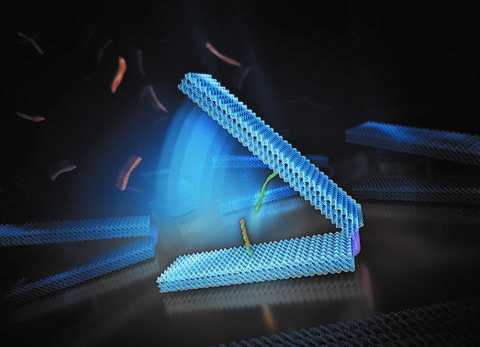
DNA hinge illustration

DNA hinges attached to an electrode are immersed in a solution containing short DNA strands. When one of these short strands (orange) enters a hinge, it binds to the hinge and causes it to pop open.

Credit: S. Kelley/NIST

Using strands of DNA to create miniature hinges that pop open or shut when binding to specific molecules, researchers at the National Institute of Standards and Technology (NIST) have developed a chip-scale device that has the potential to measure with high accuracy the presence and concentration of trace amounts of compounds important for human health and the environment.

Folding long strands of DNA into a variety of shapes, a technique known as DNA origami was developed nearly 20 years ago. The folded DNA can be tailored to bind to an assortment of different molecules. Jacob Majikes, Arvind Balijepalli, and their NIST colleagues adapted the origami method to create DNA structures that changed their shape upon electrochemically binding to a specific molecule. In particular, they constructed DNA “hinges” that opened or closed when they attached to the molecule they were designed to detect.

Droplets of liquid containing as few as 12,000 molecules were fed by a micro vessel onto a chip containing as many as a million of the DNA hinges. Each hinge contained about 8,000 base pairs—the rungs on the ladder that support the DNA helix.

For their initial experiment, the team tested the ability of the hinges to detect short strands of DNA, about 20 to 30 base pairs long. Over the next year, the researchers plan to reach their ultimate goal: Binding the origami shapes to molecules that have a direct impact on the environment, such as toxins or pollutants, and to human health, such as markers for cancer or other human diseases.
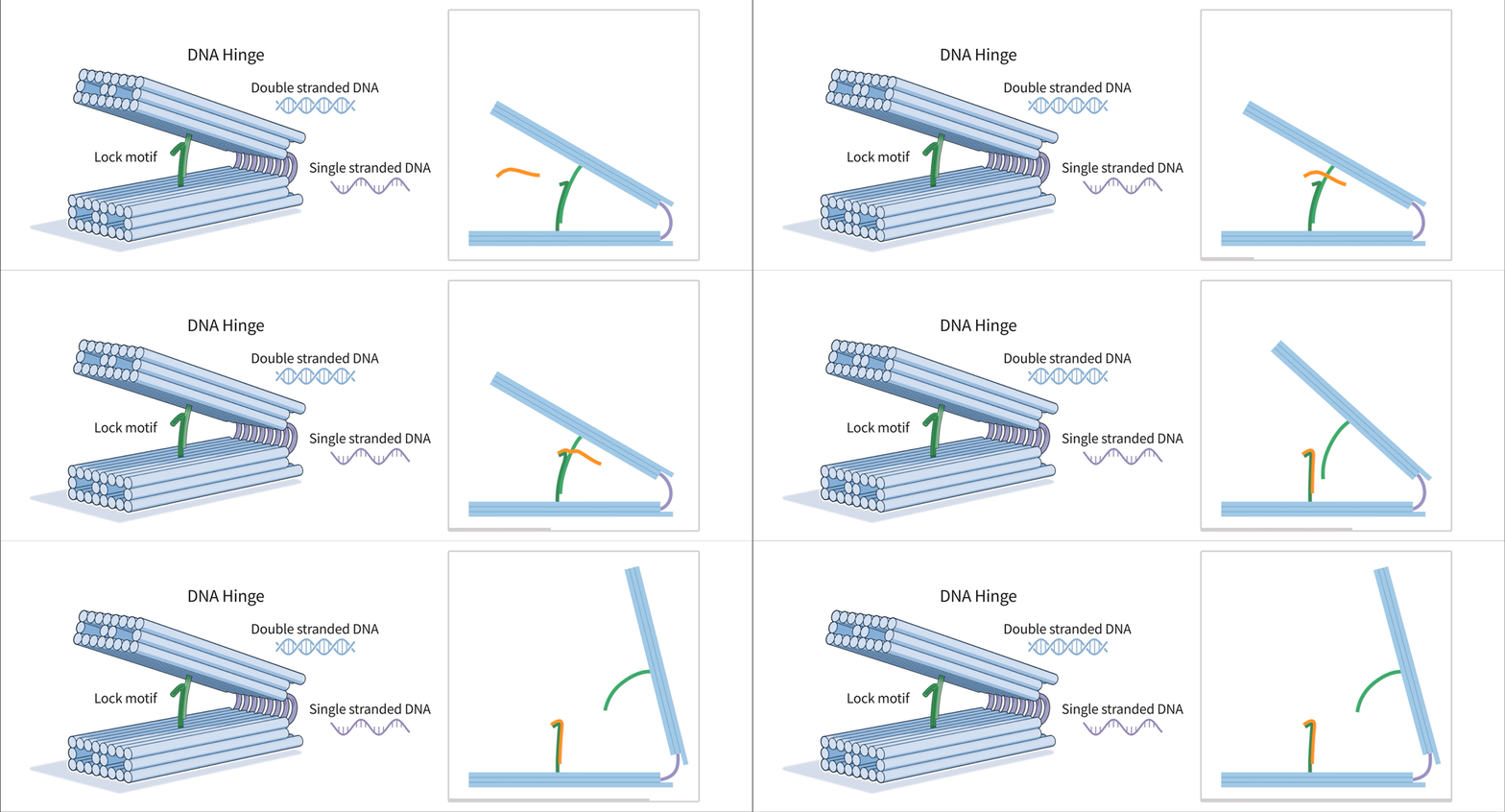
DNA hinge operation animation

Hinge operation (right). The hinge is designed to detect specific short strands of DNA. When one of these short strands (orange) enters the hinge, it attaches to an overhanging section of the lock motif called a “toehold.” The strand then unzips the lock, causing the hinge to pop open.

Credit: S. Kelley/NIST

To determine how well their system recognized the short DNA strands, the researchers measured the change in capacitance—the ability to store electrical charge—of the hinges before and after they bound to the strands. The scientists then compared those measurements to the change in capacitance recorded when chains of DNA strands without hinges bound to the same short DNA strands. The scientists found that the hinges amplified the electrical signal about 20,000 times, dramatically enhancing the ability to detect molecule of interest.

The team not only detected the presence of the short strands through their electro-chemical interaction with the hinges, but also determined the concentration of the strands. The scientists accomplished this by assessing how many closed hinges popped open and how many opened hinges snapped closed. The greater the concentration of the short strands, the greater the number of hinges that changed their configuration and the larger the measured signal.

The researchers, which also include Seulki Cho, Thomas Cleveland and J. Alexander Liddle, reported their study online Oct. 16 in RSC Nanoscale.


Paper: Jacob M. Majikes, Seulki Cho, Thomas E. Cleveland IV, J. Alexander Liddle, Arvind Balijepalli. Variable Gain DNA Nanostructure Charge Amplifiers for Biosensing. RSC Nanoscale, 2024. DOI: https://doi.org/10.1039/D4NR02959C