


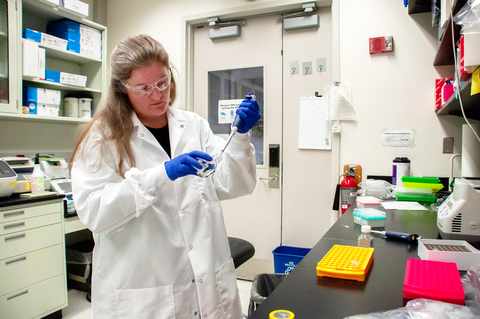
NIST researcher Megan Cleveland was part of a team that developed a nonhazardous, synthetic genetic material that will aid in the development of new diagnostic tests for the H5N1 virus, in collaboration with the U.S. Centers for Disease Control and Prevention
Credit: A. Boss/NIST
To bolster the nation’s preparedness for a pandemic, the National Institute of Standards and Technology (NIST) has developed a synthetic, nonhazardous genetic material to support the development and validation of diagnostic tests for the H5N1 virus (commonly known as bird flu). This genetic material will enable test manufacturers to assess and calibrate new diagnostic tests, which would be essential in the event of an H5N1 pandemic.
“We believe this genetic material will significantly advance our national readiness for potential pandemic threats,” said NIST research chemist Peter M. Vallone.
“The sooner this genetic material reaches manufacturers, the faster we can facilitate the development and validation of new H5N1 diagnostics,” added NIST microbial geneticist Scott Jackson.
The H5N1 virus is currently a low-risk threat to human health for the general public. However, recent highly pathogenic strains affecting cattle and poultry have raised concerns about human infection and the risk of a pandemic. There are currently a limited number of diagnostic tests for the virus on the market. One developed by the U.S. Centers for Disease Control and Prevention (CDC) is available in the U.S. and distributed to around 100 local and state labs.
Should H5N1 spread widely among humans, millions of diagnostic tests will be needed. To boost capacity, the CDC wants private companies to develop tests for detecting infections caused by the strain of the H5N1 virus that could cause an outbreak in humans. In June 2024, NIST entered a $1.5 million interagency agreement with the CDC to develop a genetic material that will help commercial entities produce reliable diagnostic tests.
Credit: A. Boss/NIST
The material developed by NIST includes three segments of RNA corresponding to certain proteins of the H5N1 virus — the hemagglutinin, neuraminidase and matrix proteins. Most H5N1 tests rely on the presence of these genetic targets to identify H5N1.
Each unit of the material includes three 100-microliter vials, each containing one of the RNA fragments, with approximately 1 million RNA molecules per microliter. Because this genetic material is synthetic and noninfectious, it offers manufacturers a safe way to test and calibrate their equipment and methods. Tests that produce positive results when using this genetic material will meet a key benchmark for diagnostic reliability.
The H5N1 material is NIST’s latest tool to support the nation’s response to outbreaks of infectious disease. In 2020, NIST released synthetic gene fragments to aid with the manufacturing of diagnostic tests for COVID-19, followed two years later by genetic material for mpox (formerly known as monkeypox).
“NIST is known for producing high-quality reference materials to support pathogen detection,” said Todd Davis, acting chief of CDC’s Virology, Surveillance and Diagnosis Branch. “Our collaboration with NIST exemplifies how the U.S. government unites expertise to prepare for pandemics.”
The H5N1 genetic material is classified as a research-grade test material (RGTM). NIST also develops standard reference materials (SRMs), which are used by manufacturers but are more extensively characterized than RGTMs. However, SRMs take longer to produce. In this case, NIST scientists decided to move quickly and release an RGTM because of the pressing public health concerns. NIST plans to release a more thoroughly characterized reference material in the future.
NIST produces over 1,000 reference materials, from food safety to industrial standards. These materials play a critical role in standardizing tools across industries. By using these resources, companies can ensure quality control, compare their results to rigorous benchmarks and improve public health readiness.
NIST is distributing the H5N1 genetic material for free (with a small fee for shipping and packaging) to companies entering the H5N1 diagnostic market. Technical information and instructions for requesting the material are available on the NIST website.
此内容由惯性聚合(RSS阅读器)自动聚合整理,仅供阅读参考。 原文来自 — 版权归原作者所有。