

惯性聚合 高效追踪和阅读你感兴趣的博客、新闻、科技资讯
阅读原文 在惯性聚合中打开

推荐订阅源

A
About on SuperTechFans
C
Cybersecurity and Infrastructure Security Agency CISA
N
News and Events Feed by Topic
C
Cisco Blogs
Cisco Talos Blog
Cisco Talos Blog
A
Arctic Wolf
Scott Helme
Scott Helme
P
Palo Alto Networks Blog
S
Schneier on Security
D
Darknet – Hacking Tools, Hacker News & Cyber Security
T
Tor Project blog
量子位
G
Google Developers Blog
H
Hackread – Cybersecurity News, Data Breaches, AI and More
B
Blog RSS Feed
NISL@THU
NISL@THU
Exploit-DB.com RSS Feed
AWS News Blog
AWS News Blog
爱范儿
爱范儿
Last Week in AI
Last Week in AI
Y
Y Combinator Blog
L
LINUX DO - 最新话题
Security Archives - TechRepublic
Threat Intelligence Blog | Flashpoint
S
Secure Thoughts
Cloudbric
Cloudbric
aimingoo的专栏
aimingoo的专栏
L
Lohrmann on Cybersecurity
TaoSecurity Blog
TaoSecurity Blog
Recent Commits to openclaw:main
Hacker News: Ask HN
Hacker News: Ask HN
freeCodeCamp Programming Tutorials: Python, JavaScript, Git & More
The GitHub Blog
The GitHub Blog
有赞技术团队
有赞技术团队
S
Security @ Cisco Blogs
cs.CL updates on arXiv.org
C
Cyber Attacks, Cyber Crime and Cyber Security
G
GRAHAM CLULEY
P
Proofpoint News Feed
V
V2EX
Martin Fowler
Martin Fowler
C
CERT Recently Published Vulnerability Notes
Attack and Defense Labs
C
CXSECURITY Database RSS Feed - CXSecurity.com
The Cloudflare Blog
SecWiki News
SecWiki News
罗磊的独立博客
CTFtime.org: upcoming CTF events
小众软件
小众软件
The Last Watchdog
The Last Watchdog

News and Events Feed by Topic

NIST Receives New Patent for Microbe-Killing Water Heater Spotlight: How NIST Helps Make Sure the Fish You Catch Are Safe to Eat NIST Expands Its Library of ‘Chemical Fingerprints’ to Identify Unknown Substances SRM Story: SRM 1947a Great Lakes Fish Tissue SRM Story: SRMs 3672a and 3673a Organic Contaminants in Smokers’ and Nonsmokers’ Urine Space: The Final Frontier for Standards Securing Smart Speakers for Home Health Care: NIST Offers New Guidelines NIST’s ‘Living Reference Material’ Could Accelerate R&D of Lifesaving Biological Drugs NIST Awards Over $1.8 Million to Small Businesses Advancing AI, Semiconductors, Additive Manufacturing and More SRM Story: SRM 965c Glucose in Frozen Human Serum Second Seminar on Building an In-Space Circular Economy NIST Releases Trove of Genetic Data to Spur Cancer Research New NIST Research Grade Test Material to support mRNA therapeutics NIST Shares Preliminary Findings From Hurricane Maria Investigation New NIST Standard Helps Deliver the Right Dosage of Cancer-Fighting Drugs Second Series of Workshops on Measurements and Standards for Advanced Therapy NIST Researcher Addresses London Healthcare Innovation Forum NIST Releases Reference Material to Aid Gut Microbiome Research NIST Researchers Develop Material for Measuring Arsenic in Shellfish 2025 NIST Workshop on Rapid Microbial Testing Methods An SRM for Accuracy in Electrolyte Panel Clinical Tests Study Highlights Need for Standardized Measurement Methods in Gene Therapy NIST Develops Genetic Material for Validating H5N1 Bird Flu Diagnostic Tests PFAS Found in Firefighter Gloves, Hoods and Wildland Gear AI and Flow Cytometry Workshop Genome Editing Consortium Workshop Social Spotlight: Engineered Cells as a Shoebox NIST Scientists Use DNA Origami on a Chip to Detect Biomolecules NIST Awards Up to $1.5 Million to Support Development of Regenerative Medicine Standards Curricula NIST Research Leader Featured in Medical IoT Discussions Spotlight: Game-Changing Microscopy Technique for Identifying Cancerous Cells Spotlight: Cassie Stoffer Helps Run Calibration and Measurement Services Related to Magnetic Resonance NIST Researchers to Test New Approach for Detecting Cannabis in Breath Spotlight: SURF Student Zainab Altamimi Spends Her Summer Researching the Capsules and Tablets in 3D Drug Printing From Pandemics to Pedicures: NIST Rebuilds World-Class UV Calibration System NIST Partners With the Gates Foundation to Develop Breathalyzers for Malaria and Tuberculosis Research Finds Dolphins With Elevated Mercury Levels in Florida and Georgia NIST Awards Over $1.2 Million to Small Businesses to Advance Cybersecurity, Biopharmaceuticals, Semiconductors and More Spotlight: Shape-Shifting Probes Will Help Improve MRI Imaging NIST Researchers Use Cellphone Compass to Measure Tiny Concentrations of Compounds Important for Human Health CHIPS R&D National Advanced Packaging Manufacturing Program (NAPMP) Advanced Packaging Summit NIST-Led Working Group Developing Standards for Organ-on-a-Chip Research 2024 NIST Rapid Microbial Testing Methods Consortium Workshop
New NIST Reference Material to Strengthen Quality Control for Biological Drugs
Alex Boss · 2025-07-31 · via News and Events Feed by Topic
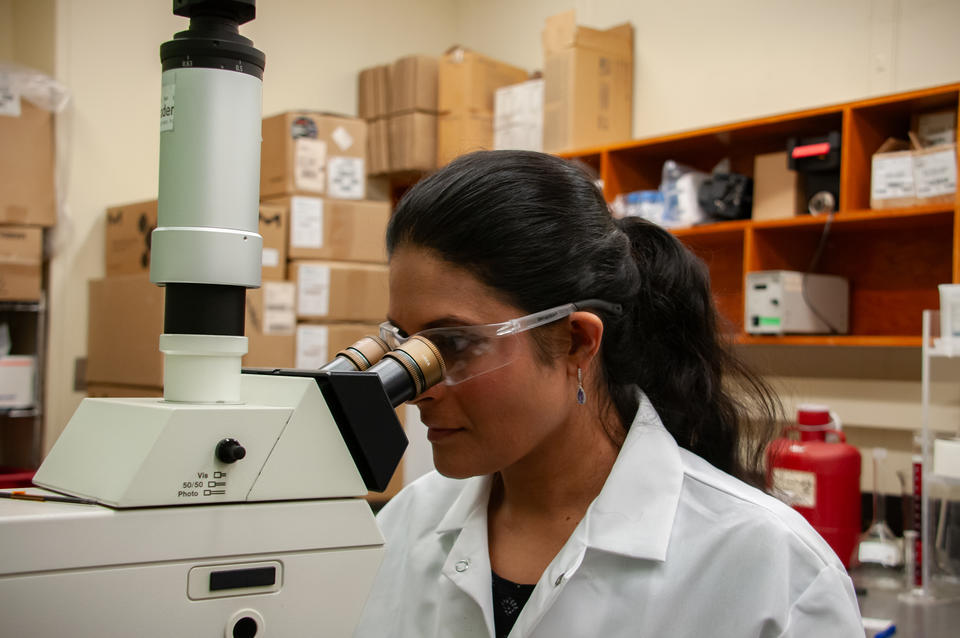
A woman wearing a lab coat and safety glasses stares into a large microscope.

Protein-based biotherapeutics are drugs made with genetically engineered proteins. These large protein molecules can stick together during the drug manufacturing process to form particles. A team of NIST researchers, including Srivalli Telikepalli (shown here), developed a standard reference material that will help biopharmaceutical companies better detect these particles in their drug products.

Credit: A. Boss/NIST

A rapidly growing category of drugs called protein-based biotherapeutics can be used to treat cancers and genetic and autoimmune disorders. These drugs, which usually take the form of large protein molecules, are manufactured by growing living cells that are genetically engineered to produce the proteins. These large protein molecules, however, can stick together during the manufacturing process to form particles that can cause an unwanted immune response in patients. 

To manage these particles, biopharmaceutical companies need to be able to measure and monitor them. A new standard reference material (SRM) from the National Institute of Standards and Technology (NIST) will help them do that. The new material, SRM 1989: Monodisperse Irregularly Shaped Epoxy-Based Particles, consists of three vials containing particles of different sizes: 220 micrometers, 150 micrometers and 100 micrometers. (For comparison, a sheet of regular printer paper is roughly 100 micrometers thick.)  

“This material will be the first publicly available visible particle standard for protein-based particles in biotherapeutic drugs,” said NIST research chemist Srivalli Telikepalli. “This will help drug manufacturers monitor particles in their products so that they can ensure that those products are safe and effective.”
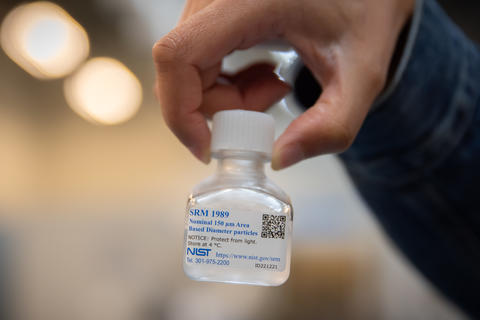
A hand holds a small, clear bottle full of a liquid solution with a label that says SRM 1989.

The new material, called SRM 1989: Monodisperse Irregularly Shaped Epoxy-Based Particles, consists of three vials containing particles of different sizes: 220 micrometers, 150 micrometers and 100 micrometers.

Credit: R. Wilson/NIST

Protein-based particles, which are small but sometimes visible to the naked eye, form because proteins can be unstable. Any stress, like a temperature change or sudden shaking of a drug vial, can cause proteins to clump together into particles. This can happen when the drug products are being purified, packaged, shipped or stored for long periods of time. 

At biopharmaceutical manufacturing plants, trained analysts visually inspect each vial of drug product. If the vial contains visible particles, it is removed from the batch. If a certain number of vials fail, the entire batch will be discarded. Each failed batch can cost the manufacturer millions of dollars. 

“Without a particle size standard for reference, errors can occur, as different analysts may perceive particles differently. Because of this, the inspection process can be subjective,” said Telikepalli. “Our new reference material will help make the particulate inspection process more uniform.” The SRM can be included in training kits to mimic protein particles and help train analysts to accurately identify these particles in each drug product.

Inspections can also be automated using laboratory instruments. Instrument manufacturers can use the NIST SRM to ensure that their instruments are working properly and to improve their accuracy over time. Analysts can also use the SRM to validate their automated inspection process that uses these laboratory instruments to make sure the process is accurate.

For both manual and automated inspections, a more accurate and uniform inspection process can help ensure that drug batches are not discarded unnecessarily.   

To make the particles, NIST researchers shined ultraviolet (UV) light onto a silicon wafer coated with an epoxy-like substance that hardens when exposed to UV light. This created a pattern of particles on the wafer. The same technique, called photolithography, is used when creating microscopic electronic circuits on computer chips. The particles were then removed from the wafer and put into a liquid mixture, or solution. This was done at NIST’s Center for Nanoscale Science and Technology, an important center for semiconductor manufacturing research.
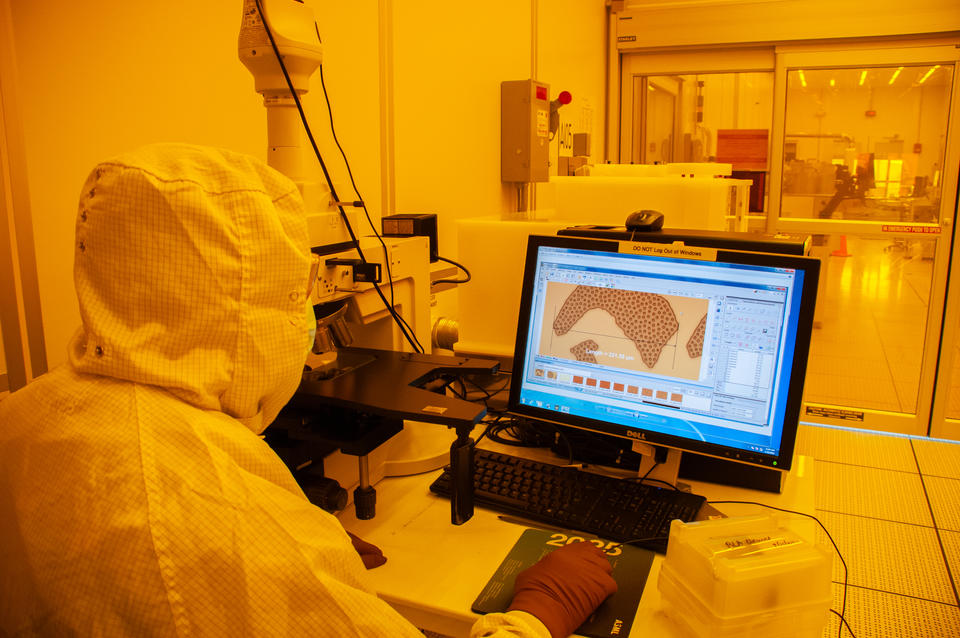
In a lab with orange lighting, a scientist wearing a full suit of protective gear sits at a table with a microscope and looks at images on a screen.

The standard reference material was made at NIST’s Center for Nanoscale Science and Technology. The process for making the particles, called photolithography, is an innovative technique usually used to create microscopic electronic circuits on computer chips.

Credit: A. Boss/NIST

The particles resemble protein particles — irregular in shape and transparent. And crucially, they are all essentially the same size. “Because of our measurement capabilities, we are able to reliably verify the size of these particles with very high precision,” said NIST electrical engineer Michael Carrier. 

Using a semiconductor manufacturing technique to simulate protein-based particles is an innovation that might only have happened at a place like NIST.

“NIST has experts in both biopharmaceutical and semiconductor manufacturing,” said Mike Tarlov, chief of NIST’s Biomolecular Measurements Division. “This allows us to bring together measurement expertise from across very different domains to solve real-world problems.”

NIST has produced over a thousand SRMs that support public health and safety and promote U.S. industry. These SRMs help ensure accurate measurements in industries ranging from health and medicine (human urine) to building construction (Charpy Impact Test materials) to semiconductor manufacturing (semiconductor thin film) and many more. 

NIST also produces several other SRMs for the biopharmaceutical industry, including a monoclonal antibody protein called the NISTmAb and the NISTCHO — a living cell that expresses a version of the NISTmAb protein. All these SRMs support an industry that’s projected to grow from an estimated $666 billion in 2025 to $1,184 billion by 2032.

SRM 1989: Monodisperse Irregularly Shaped Epoxy-Based Particles is now available for purchase from the NIST Store