
惯性聚合 高效追踪和阅读你感兴趣的博客、新闻、科技资讯
阅读原文 在惯性聚合中打开

推荐订阅源

Security Archives - TechRepublic
T
The Exploit Database - CXSecurity.com
P
Proofpoint News Feed
Scott Helme
Scott Helme
NISL@THU
NISL@THU
Cisco Talos Blog
Cisco Talos Blog
C
Cybersecurity and Infrastructure Security Agency CISA
AWS News Blog
AWS News Blog
V
Vulnerabilities – Threatpost
J
Java Code Geeks
U
Unit 42
The GitHub Blog
The GitHub Blog
H
Help Net Security
T
Tenable Blog
aimingoo的专栏
aimingoo的专栏
Jina AI
Jina AI
Spread Privacy
Spread Privacy
Apple Machine Learning Research
人人都是产品经理
人人都是产品经理
L
Lohrmann on Cybersecurity
T
Threatpost
让小产品的独立变现更简单 - ezindie.com
Engineering at Meta
Engineering at Meta
A
About on SuperTechFans
I
InfoQ
Microsoft Azure Blog
B
Blog
L
LINUX DO - 最新话题
K
Kaspersky official blog
cs.CV updates on arXiv.org
T
Threat Research - Cisco Blogs
C
Check Point Blog
T
The Blog of Author Tim Ferriss
有赞技术团队
有赞技术团队
宝玉的分享
宝玉的分享
Help Net Security
Help Net Security
Google DeepMind News
A
Arctic Wolf
Y
Y Combinator Blog
N
News | PayPal Newsroom
M
MIT News - Artificial intelligence
Latest news
Latest news
H
Hacker News: Front Page
Blog — PlanetScale
Blog — PlanetScale
腾讯CDC
I
Intezer
爱范儿
爱范儿
F
Fortinet All Blogs
P
Palo Alto Networks Blog
C
CERT Recently Published Vulnerability Notes

News and Events Feed by Topic

NIST Receives New Patent for Microbe-Killing Water Heater Spotlight: How NIST Helps Make Sure the Fish You Catch Are Safe to Eat NIST Expands Its Library of ‘Chemical Fingerprints’ to Identify Unknown Substances SRM Story: SRM 1947a Great Lakes Fish Tissue SRM Story: SRMs 3672a and 3673a Organic Contaminants in Smokers’ and Nonsmokers’ Urine Space: The Final Frontier for Standards Securing Smart Speakers for Home Health Care: NIST Offers New Guidelines NIST’s ‘Living Reference Material’ Could Accelerate R&D of Lifesaving Biological Drugs NIST Awards Over $1.8 Million to Small Businesses Advancing AI, Semiconductors, Additive Manufacturing and More SRM Story: SRM 965c Glucose in Frozen Human Serum Second Seminar on Building an In-Space Circular Economy New NIST Reference Material to Strengthen Quality Control for Biological Drugs NIST Releases Trove of Genetic Data to Spur Cancer Research New NIST Research Grade Test Material to support mRNA therapeutics NIST Shares Preliminary Findings From Hurricane Maria Investigation New NIST Standard Helps Deliver the Right Dosage of Cancer-Fighting Drugs Second Series of Workshops on Measurements and Standards for Advanced Therapy NIST Researcher Addresses London Healthcare Innovation Forum NIST Releases Reference Material to Aid Gut Microbiome Research NIST Researchers Develop Material for Measuring Arsenic in Shellfish 2025 NIST Workshop on Rapid Microbial Testing Methods An SRM for Accuracy in Electrolyte Panel Clinical Tests Study Highlights Need for Standardized Measurement Methods in Gene Therapy NIST Develops Genetic Material for Validating H5N1 Bird Flu Diagnostic Tests PFAS Found in Firefighter Gloves, Hoods and Wildland Gear AI and Flow Cytometry Workshop Genome Editing Consortium Workshop Social Spotlight: Engineered Cells as a Shoebox NIST Scientists Use DNA Origami on a Chip to Detect Biomolecules NIST Awards Up to $1.5 Million to Support Development of Regenerative Medicine Standards Curricula NIST Research Leader Featured in Medical IoT Discussions Spotlight: Game-Changing Microscopy Technique for Identifying Cancerous Cells Spotlight: Cassie Stoffer Helps Run Calibration and Measurement Services Related to Magnetic Resonance NIST Researchers to Test New Approach for Detecting Cannabis in Breath Spotlight: SURF Student Zainab Altamimi Spends Her Summer Researching the Capsules and Tablets in 3D Drug Printing NIST Partners With the Gates Foundation to Develop Breathalyzers for Malaria and Tuberculosis Research Finds Dolphins With Elevated Mercury Levels in Florida and Georgia NIST Awards Over $1.2 Million to Small Businesses to Advance Cybersecurity, Biopharmaceuticals, Semiconductors and More Spotlight: Shape-Shifting Probes Will Help Improve MRI Imaging NIST Researchers Use Cellphone Compass to Measure Tiny Concentrations of Compounds Important for Human Health CHIPS R&D National Advanced Packaging Manufacturing Program (NAPMP) Advanced Packaging Summit NIST-Led Working Group Developing Standards for Organ-on-a-Chip Research 2024 NIST Rapid Microbial Testing Methods Consortium Workshop
From Pandemics to Pedicures: NIST Rebuilds World-Class UV Calibration System
Katie Palubicki · 2024-07-22 · via News and Events Feed by Topic
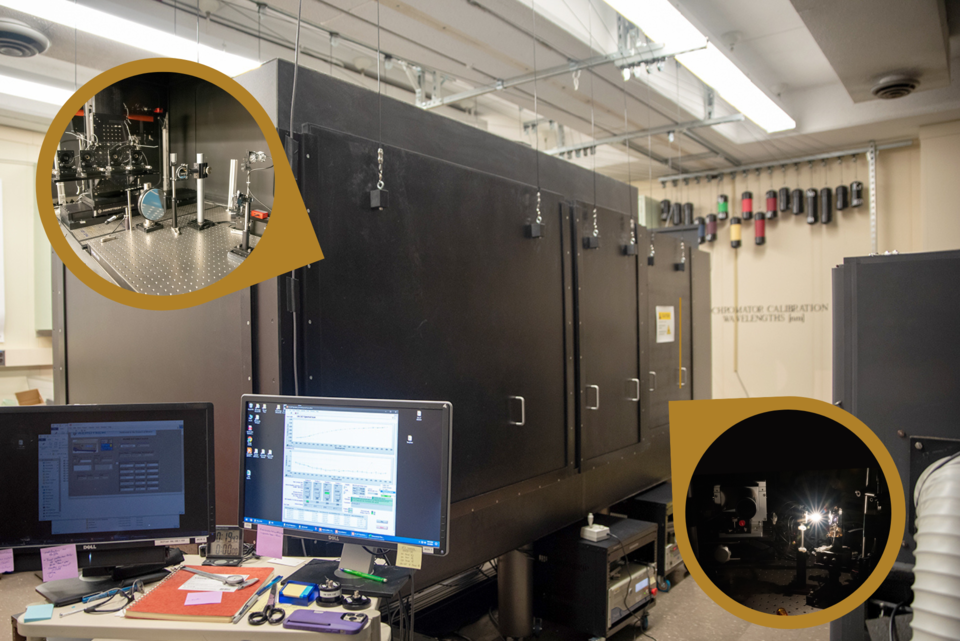
A high-tech laboratory with large black equipment featuring two circular insets showing detailed machinery setups. A computer workstation is in the foreground.

This automobile-sized black box is the heart of NIST’s Ultraviolet Spectral Comparator Facility, which holds the instruments used to calibrate UV detectors.

Credit: B. Hayes/NIST

Ultraviolet (UV) light may seem like an invisible hero, quietly disinfecting our hospitals, curing our nail polish, and killing pathogens in our water. But how can we be sure it’s being used in ways that are safe and effective? To help ensure that every UV beam serves its purpose with accuracy and precision, the National Institute of Standards and Technology (NIST) has rebuilt its specialized calibration laboratory, called the Ultraviolet Spectral Comparator Facility (UVSCF), where industry customers send their UV detection equipment to be precisely measured and calibrated.

UV light serves a wide variety of applications. The germicidal properties of UV light make it a valuable tool for sanitization and disinfection, especially in health-care settings. It also is an effective way to combat microbial contamination in water and is used for drinking water, wastewater and surface water disinfection. Homeowners use UV-cured epoxy to put new kitchen countertops in place. In the nail salon industry, UV light boxes cure gel nail products. And, in recent years, a proliferation of new consumer products, such as UV-protective clothing, prevent unwanted exposure to UV light. Carefully calibrated UV light sources are needed to ensure that these products work as intended.

Understanding the UV Spectrum

Ultraviolet light is invisible, having shorter wavelengths than the light we can see with our eyes. There are three different categories of UV light based on the wavelength: UVA, UVB and UVC. Wavelength refers to the distance between the peaks of a light wave and, when visible, different colors of light. While NIST's new calibration system caters to all three, its unique forte lies in accurately measuring UVC light, which falls into the 200-300 nanometer range.

UVC light has shorter, higher-energy wavelengths compared with UVA and UVB. This makes UVC very effective at killing germs and viruses.

“Approximately 100,000 people a year die from health care-associated infections in the U.S. They go into a hospital to be treated for one thing, but then end up with an infection from inadequate sanitization,” said NIST research chemist Cameron Miller. “Using UV light to disinfect rooms and equipment offers a potential solution.”

However, UVC light can also harm human skin and eyes, so it needs to be used carefully. 

Organizations that use UV light, from the military and research institutions to universities and industrial manufacturers, can check that UV light sources are emitting the right amount and intensity of light with a compact, hand-held device called a UV detector. Like any other measurement instrument, these detectors need to be calibrated, so users periodically pack them up and send them to NIST’s Ultraviolet Spectral Comparator Facility.

Just as one might calibrate a scale by putting an object of known weight on it, NIST experts calibrate the detectors by exposing them to specific UV wavelengths and comparing their readings to a precisely calibrated standard detector. They then assign the calibration values for each detector.

“We are able to measure UV light at very short wavelengths with extremely high accuracy and precision,” said NIST physicist Jeanne Houston. “The UVC range of the UV spectrum is the most challenging part to measure, so achieving this level of precision is something we don’t typically see in this field.”

NIST then returns the detector to the customer, who can have confidence in using it to ensure the safety and effectiveness of their UV systems and products.

Serving the Needs of Emerging Technologies

NIST has maintained a UV calibration facility since the late 1980s. However, by the mid-2010s, the facility could no longer meet the needs of emerging technologies such as UV disinfection because it was not optimized for the critical wavelength range needed for disinfection. The COVID-19 pandemic brought a new interest in improving and rebuilding the system.

“Once COVID struck, UV disinfection was hitting the big time and we were able to totally rebuild the system,” said Houston. “We have implemented massive improvements, and it is my opinion that our new facility is the best in the world.”

For more information, visit the NIST website.