




惯性聚合 高效追踪和阅读你感兴趣的博客、新闻、科技资讯
阅读原文 在惯性聚合中打开

推荐订阅源

TaoSecurity Blog
TaoSecurity Blog
L
LINUX DO - 最新话题
Help Net Security
Help Net Security
N
News | PayPal Newsroom
www.infosecurity-magazine.com
cs.AI updates on arXiv.org
The Last Watchdog
The Last Watchdog
S
Security @ Cisco Blogs
W
WeLiveSecurity
C
CXSECURITY Database RSS Feed - CXSecurity.com
Webroot Blog
Webroot Blog
T
Troy Hunt's Blog
V
Vulnerabilities – Threatpost
Google Online Security Blog
N
News and Events Feed by Topic
T
Threat Research - Cisco Blogs
Security Archives - TechRepublic
钛媒体:引领未来商业与生活新知
钛媒体:引领未来商业与生活新知
T
Tor Project blog
freeCodeCamp Programming Tutorials: Python, JavaScript, Git & More
D
Darknet – Hacking Tools, Hacker News & Cyber Security
PCI Perspectives
PCI Perspectives
Google DeepMind News
T
Tailwind CSS Blog
让小产品的独立变现更简单 - ezindie.com
Apple Machine Learning Research
IT之家
IT之家
S
SegmentFault 最新的问题
J
Java Code Geeks
P
Privacy & Cybersecurity Law Blog
Threat Intelligence Blog | Flashpoint
博客园 - 【当耐特】
博客园_首页
H
Hacker News: Front Page
T
Threatpost
Jina AI
Jina AI
博客园 - Franky
月光博客
月光博客
L
LINUX DO - 热门话题
The Cloudflare Blog
H
Heimdal Security Blog
博客园 - 司徒正美
酷 壳 – CoolShell
酷 壳 – CoolShell
Cloudbric
Cloudbric
雷峰网
雷峰网
Hugging Face - Blog
Hugging Face - Blog
S
Secure Thoughts
T
Tenable Blog
I
Intezer
OSCHINA 社区最新新闻
OSCHINA 社区最新新闻

OpenAI News

Using custom GPTs ChatGPT for customer success teams Applications of AI at OpenAI Research with ChatGPT Analyzing data with ChatGPT Financial services Responsible and safe use of AI Writing with ChatGPT ChatGPT for research Creating images with ChatGPT Personalizing ChatGPT ChatGPT for finance teams Getting started with ChatGPT Working with files in ChatGPT ChatGPT for sales teams Prompting fundamentals ChatGPT for managers Using projects in ChatGPT ChatGPT for marketing teams Brainstorming with ChatGPT AI fundamentals ChatGPT for operations teams Healthcare Our response to the Axios developer tool compromise Using skills OpenAI Full Fan Mode Contest: Terms & Conditions CyberAgent moves faster with ChatGPT Enterprise and Codex The next phase of enterprise AI Introducing the Child Safety Blueprint Introducing the OpenAI Safety Fellowship Industrial policy for the Intelligence Age OpenAI acquires TBPN Codex now offers more flexible pricing for teams Gradient Labs gives every bank customer an AI account manager OpenAI raises $122 billion to accelerate the next phase of AI Helping disaster response teams turn AI into action across Asia STADLER reshapes knowledge work at a 230-year-old company Inside our approach to the Model Spec Introducing the OpenAI Safety Bug Bounty program Helping developers build safer AI experiences for teens Update on the OpenAI Foundation Powering Product Discovery in ChatGPT Creating with Sora Safely How we monitor internal coding agents for misalignment OpenAI to acquire Astral Introducing GPT-5.4 mini and nano OpenAI Japan announces Japan Teen Safety Blueprint to put teen safety first Equipping workers with insights about compensation Why Codex Security Doesn’t Include a SAST Report Designing AI agents to resist prompt injection From model to agent: Equipping the Responses API with a computer environment Rakuten fixes issues twice as fast with Codex Wayfair boosts catalog accuracy and support speed with OpenAI Improving instruction hierarchy in frontier LLMs New ways to learn math and science in ChatGPT OpenAI to acquire Promptfoo Codex Security: now in research preview How Descript engineers multilingual video dubbing at scale How Balyasny Asset Management built an AI research engine Reasoning models struggle to control their chains of thought, and that’s good Introducing GPT-5.4 GPT-5.4 Thinking System Card Ensuring AI use in education leads to opportunity VfL Wolfsburg turns ChatGPT into a club-wide capability OpenAI and NORAD team up to bring new magic to “NORAD Tracks Santa” Accenture and OpenAI accelerate enterprise AI success OpenAI takes an ownership stake in Thrive Holdings to accelerate enterprise AI adoption What to know about a recent Mixpanel security incident Expanding data residency access to business customers worldwide Our approach to mental health-related litigation Inside JetBrains—the company reshaping how the world writes code Introducing shopping research in ChatGPT How GPT-5 helped mathematician Ernest Ryu solve a 40-year-old open problem OpenAI and Foxconn collaborate to strengthen U.S. manufacturing across the AI supply chain Disrupting malicious uses of AI: June 2025 Creating websites in minutes with AI Website Builder Addendum to OpenAI o3 and o4-mini system card: OpenAI o3 Operator OpenAI Deutschland Shipping code faster with o3, o4-mini, and GPT-4.1 Introducing Stargate UAE New tools and features in the Responses API Introducing Codex Addendum to o3 and o4-mini system card: Codex AI powers Expedia’s marketing evolution Strengthening America’s AI leadership with the U.S. National Laboratories Introducing ChatGPT Gov Operator System Card Computer-Using Agent Introducing Operator Bertelsmann powers creativity and productivity with OpenAI Trading Inference-Time Compute for Adversarial Robustness Announcing The Stargate Project Stargate Infrastructure The power of personalized AI Delivering LLM-powered health solutions Increasing accuracy of pediatric visit notes Practices for Governing Agentic AI Systems Superalignment Fast Grants Weak-to-strong generalization Partnership with Axel Springer to deepen beneficial use of AI in journalism
Stripe
2023-03-14 · via OpenAI News

Earlier this year, Stripe asked 100 employees to do something highly unusual: stop their day jobs and instead, dream up features and functionality for the payment platform using the newest generation of OpenAI’s language learning model, GPT‑4. Engineers from teams spanning support, onboarding, risk, and docs considered where Stripe could use artificial intelligence that understands free-form text and images and builds human-like responses, to improve-or alter-a feature or workflow.

"Our mission was to identify products and workflows across Stripe that could be accelerated by large language models and to really understand where LLMs work well today and where they still struggle," says Eugene Mann, product lead for Stripe’s Applied Machine Learning team. "But just having access to GPT‑4 enabled us to realize, ‘Oh, there are all these problems that could be solved with GPT surprisingly well.’"

Stripe powers the payments of small and large businesses across the internet. While Stripe builds their ecosystem to support all aspects of the payment process, developers-those building with and integrating Stripe’s software-are their primary users. The more adept Stripe developers get at deploying Stripe, the farther Stripe will spread through the digital payments universe and grow the GDP of the internet.

Stripe had previously been using GPT‑3 to help their support team better serve users through tasks like routing issue tickets and summarizing a user’s question.
stripe ui image

“GPT-4 was a game changer. It opened up a lot of areas.”

Eugene Mann, Product Lead, Stripe Applied Machine Learning

Stripe’s team put together a list of 50 potential applications to test GPT‑4; and after vetting and testing, 15 of the prototypes were considered strong candidates to be integrated into the platform, including support customization, answering questions about support, and fraud detection.

To better serve users and provide the right type of support, Stripe tries to understand exactly how each business uses the platform and customizes support accordingly. It’s an obvious and important step, but one that requires a lot of human hours.

"Many businesses, such as nightclubs, keep their websites sparse and mysterious so it can take a great deal of searching and clicking to understand what’s going on," says Mann.

Now, Stripe uses GPT‑4 to scan these sites and deliver a summary, which outperforms those written by people.

"When we started hand-checking the results, we realized, ‘Wait a minute, the humans were wrong and the model was right.’" Mann says. "GPT‑4 was basically better than human reviewers."

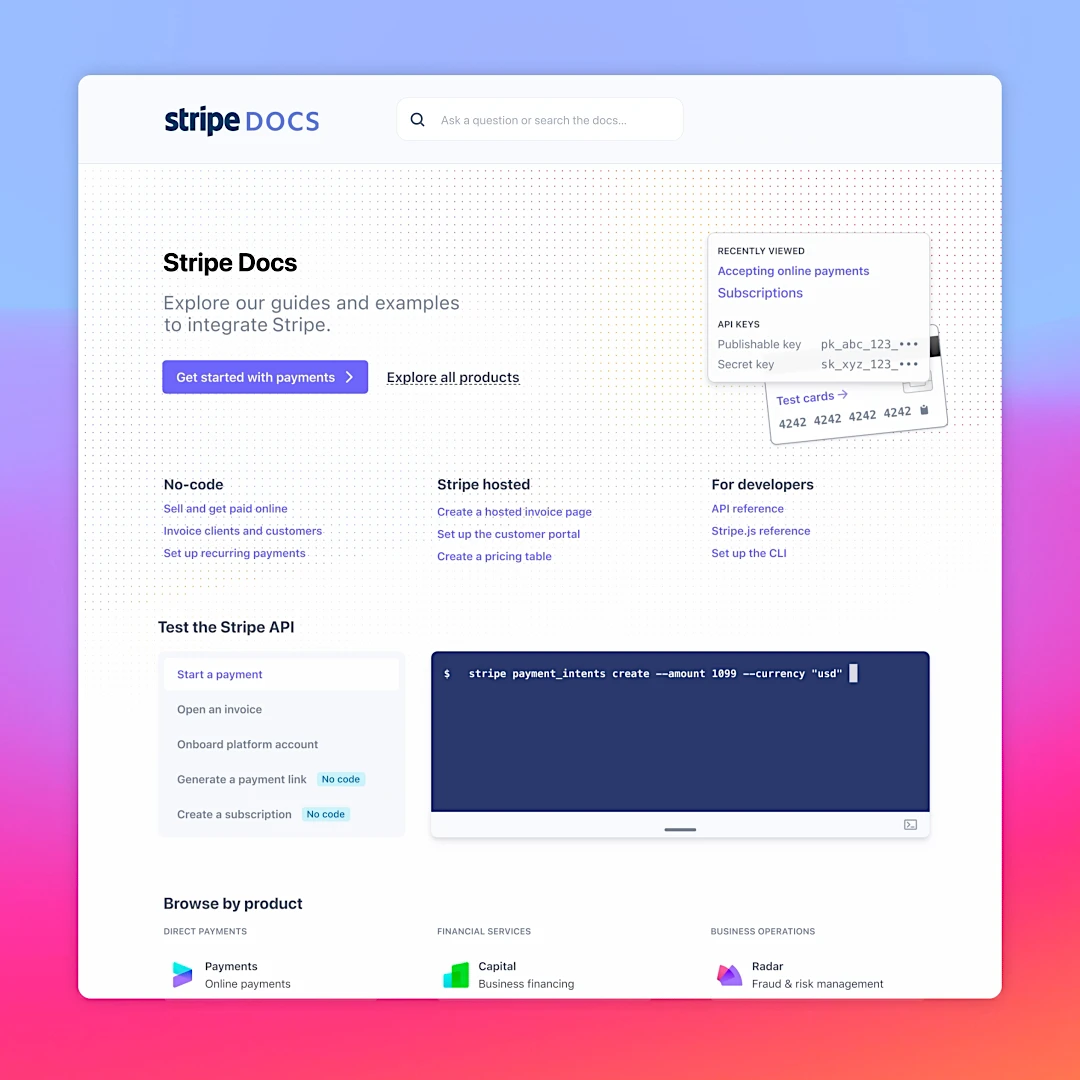
Another critical way Stripe supports developers is through extensive technical documentation and a robust developer support team to answer technical questions or troubleshoot issues. GPT‑4 is able to digest, understand and become that virtual assistant-almost instantly.

"GPT just works out of the box," he says. "That’s not how you’d expect software for large language models to work."

GPT is able to understand the user’s question, read detailed documentation on their behalf, identify the relevant section and summarize the solution in one place.

There's also the need to manage malicious or bad actors. Stripe maintains a robust community on forums like Discord, which not only crowdsources help for niche technical questions but raises the visibility of developers for future work. However-because it is on the internet-malicious actors find their way into these forums, often trying to gain critical information from community members or regain credibility with Stripe's community team after being kicked off the platform.

Just by analyzing the syntax of posts in Discord, GPT‑4 has been flagging accounts where Stripe's fraud team should follow up and be sure it isn't, in fact, a fraudster playing nice. GPT‑4 can help scan inbound communications, identifying coordinated activity from malicious actors.

Now the Stripe team is thinking about the next round of features. GPT could be deployed as a business coach that can understand revenue models or advise businesses on strategies. With the potential applications only broadening as GPT gets smarter over time.

Mann says he and his team are essentially painting with a new canvas every day.

"Some of these features," he says after listing all the ways Stripe has had success so far, "feel like magic."