

惯性聚合 高效追踪和阅读你感兴趣的博客、新闻、科技资讯
阅读原文 在惯性聚合中打开

推荐订阅源

Hacker News - Newest:
Hacker News - Newest: "LLM"
S
SegmentFault 最新的问题
The Cloudflare Blog
T
The Exploit Database - CXSecurity.com
C
CXSECURITY Database RSS Feed - CXSecurity.com
钛媒体:引领未来商业与生活新知
钛媒体:引领未来商业与生活新知
P
Privacy & Cybersecurity Law Blog
有赞技术团队
有赞技术团队
www.infosecurity-magazine.com
雷峰网
雷峰网
Google DeepMind News
cs.CL updates on arXiv.org
T
Threatpost
The Hacker News
The Hacker News
人人都是产品经理
人人都是产品经理
阮一峰的网络日志
阮一峰的网络日志
大猫的无限游戏
大猫的无限游戏
L
Lohrmann on Cybersecurity
cs.AI updates on arXiv.org
W
WeLiveSecurity
T
Threat Research - Cisco Blogs
博客园 - 叶小钗
量子位
Exploit-DB.com RSS Feed
Simon Willison's Weblog
I
Intezer
S
Secure Thoughts
V
V2EX
Apple Machine Learning Research
小众软件
小众软件
酷 壳 – CoolShell
酷 壳 – CoolShell
Microsoft Azure Blog
博客园_首页
Help Net Security
Help Net Security
爱范儿
爱范儿
C
Cybersecurity and Infrastructure Security Agency CISA
freeCodeCamp Programming Tutorials: Python, JavaScript, Git & More
腾讯CDC
让小产品的独立变现更简单 - ezindie.com
C
Check Point Blog
WordPress大学
WordPress大学
Last Week in AI
Last Week in AI
T
Tor Project blog
NISL@THU
NISL@THU
奇客Solidot–传递最新科技情报
奇客Solidot–传递最新科技情报
I
InfoQ
The Register - Security
Recent Announcements
N
News and Events Feed by Topic
B
Blog RSS Feed

OpenAI News

Using custom GPTs ChatGPT for customer success teams Applications of AI at OpenAI Research with ChatGPT Analyzing data with ChatGPT Financial services Responsible and safe use of AI Writing with ChatGPT ChatGPT for research Creating images with ChatGPT Personalizing ChatGPT ChatGPT for finance teams Getting started with ChatGPT Working with files in ChatGPT ChatGPT for sales teams Prompting fundamentals ChatGPT for managers Using projects in ChatGPT ChatGPT for marketing teams Brainstorming with ChatGPT AI fundamentals ChatGPT for operations teams Healthcare Our response to the Axios developer tool compromise Using skills OpenAI Full Fan Mode Contest: Terms & Conditions CyberAgent moves faster with ChatGPT Enterprise and Codex The next phase of enterprise AI Introducing the Child Safety Blueprint Introducing the OpenAI Safety Fellowship Industrial policy for the Intelligence Age OpenAI acquires TBPN Codex now offers more flexible pricing for teams Gradient Labs gives every bank customer an AI account manager OpenAI raises $122 billion to accelerate the next phase of AI Helping disaster response teams turn AI into action across Asia STADLER reshapes knowledge work at a 230-year-old company Inside our approach to the Model Spec Introducing the OpenAI Safety Bug Bounty program Helping developers build safer AI experiences for teens Update on the OpenAI Foundation Powering Product Discovery in ChatGPT Creating with Sora Safely How we monitor internal coding agents for misalignment OpenAI to acquire Astral Introducing GPT-5.4 mini and nano OpenAI Japan announces Japan Teen Safety Blueprint to put teen safety first Equipping workers with insights about compensation Why Codex Security Doesn’t Include a SAST Report Designing AI agents to resist prompt injection From model to agent: Equipping the Responses API with a computer environment Rakuten fixes issues twice as fast with Codex Wayfair boosts catalog accuracy and support speed with OpenAI Improving instruction hierarchy in frontier LLMs New ways to learn math and science in ChatGPT OpenAI to acquire Promptfoo Codex Security: now in research preview How Descript engineers multilingual video dubbing at scale How Balyasny Asset Management built an AI research engine Reasoning models struggle to control their chains of thought, and that’s good Introducing GPT-5.4 GPT-5.4 Thinking System Card Ensuring AI use in education leads to opportunity VfL Wolfsburg turns ChatGPT into a club-wide capability OpenAI and NORAD team up to bring new magic to “NORAD Tracks Santa” Accenture and OpenAI accelerate enterprise AI success OpenAI takes an ownership stake in Thrive Holdings to accelerate enterprise AI adoption What to know about a recent Mixpanel security incident Expanding data residency access to business customers worldwide Our approach to mental health-related litigation Inside JetBrains—the company reshaping how the world writes code Introducing shopping research in ChatGPT How GPT-5 helped mathematician Ernest Ryu solve a 40-year-old open problem OpenAI and Foxconn collaborate to strengthen U.S. manufacturing across the AI supply chain Disrupting malicious uses of AI: June 2025 Creating websites in minutes with AI Website Builder Addendum to OpenAI o3 and o4-mini system card: OpenAI o3 Operator OpenAI Deutschland Shipping code faster with o3, o4-mini, and GPT-4.1 Introducing Stargate UAE New tools and features in the Responses API Introducing Codex Addendum to o3 and o4-mini system card: Codex AI powers Expedia’s marketing evolution Strengthening America’s AI leadership with the U.S. National Laboratories Introducing ChatGPT Gov Operator System Card Computer-Using Agent Introducing Operator Bertelsmann powers creativity and productivity with OpenAI Trading Inference-Time Compute for Adversarial Robustness Announcing The Stargate Project Stargate Infrastructure The power of personalized AI Delivering LLM-powered health solutions Increasing accuracy of pediatric visit notes Practices for Governing Agentic AI Systems Superalignment Fast Grants Weak-to-strong generalization Partnership with Axel Springer to deepen beneficial use of AI in journalism
Introducing text and code embeddings
2022-01-25 · via OpenAI News
OpenAI

We are introducing embeddings, a new endpoint in the OpenAI API that makes it easy to perform natural language and code tasks like semantic search, clustering, topic modeling, and classification.

Embeddings are numerical representations of concepts converted to number sequences, which make it easy for computers to understand the relationships between those concepts. Our embeddings outperform top models in 3 standard benchmarks, including a 20% relative improvement in code search.

Embeddings are useful for working with natural language and code, because they can be readily consumed and compared by other machine learning models and algorithms like clustering or search.

Embeddings that are numerically similar are also semantically similar. For example, the embedding vector of “canine companions say” will be more similar to the embedding vector of “woof” than that of “meow.”
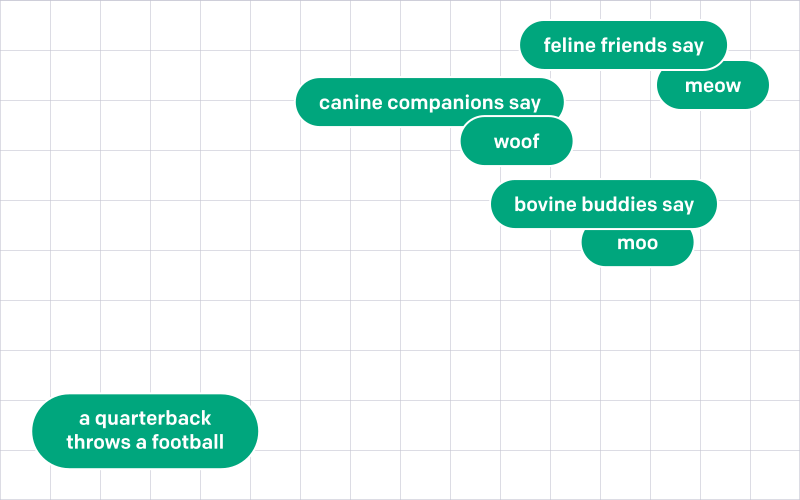
Graph Of Similar Embeddings

The new endpoint uses neural network models, which are descendants of GPT‑3, to map text and code to a vector representation—“embedding” them in a high-dimensional space. Each dimension captures some aspect of the input.

The new /embeddings(opens in a new window) endpoint in the OpenAI API(opens in a new window) provides text and code embeddings with a few lines of code:

We’re releasing three families of embedding models, each tuned to perform well on different functionalities: text similarity, text search, and code search. The models take either text or code as input and return an embedding vector.

Models

Use Cases

Text similarity: Captures semantic similarity between pieces of text.

text-similarity-{ada, babbage, curie, davinci}-001

Clustering, regression, anomaly detection, visualization

Text search: Semantic information retrieval over documents.

text-search-{ada, babbage, curie, davinci}-{query, doc}-001

Search, context relevance, information retrieval

Code search: Find relevant code with a query in natural language.

code-search-{ada, babbage}-{code, text}-001

Code search and relevance

To compare the similarity of two pieces of text, you simply use the dot product(opens in a new window) on the text embeddings. The result is a “similarity score”, sometimes called “cosine similarity(opens in a new window),” between –1 and 1, where a higher number means more similarity. In most applications, the embeddings can be pre-computed, and then the dot product comparison is extremely fast to carry out.

One popular use of embeddings is to use them as features in machine learning tasks, such as classification. In machine learning literature, when using a linear classifier, this classification task is called a “linear probe.” Our text similarity models achieve new state-of-the-art results on linear probe classification in SentEval(opens in a new window) (Conneau et al., 2018(opens in a new window)), a commonly used benchmark for evaluating embedding quality.

Text search models provide embeddings that enable large-scale search tasks, like finding a relevant document among a collection of documents given a text query. Embedding for the documents and query are produced separately, and then cosine similarity is used to compare the similarity between the query and each document.

Embedding-based search can generalize better than word overlap techniques used in classical keyword search, because it captures the semantic meaning of text and is less sensitive to exact phrases or words. We evaluate the text search model’s performance on the BEIR(opens in a new window) (Thakur, et al. 2021(opens in a new window)) search evaluation suite and obtain better search performance than previous methods. Our text search guide(opens in a new window) provides more details on using embeddings for search tasks.

FineTune Learning(opens in a new window) is a company building hybrid human-AI solutions for learning, like adaptive learning loops(opens in a new window) that help students reach academic standards.

OpenAI’s embeddings significantly improved the task of finding textbook content based on learning objectives. Achieving a top-5 accuracy of 89.1%, OpenAI’s text-search-curie embeddings model outperformed previous approaches like Sentence-BERT (64.5%). While human experts are still better, the FineTune team is now able to label entire textbooks in a matter of seconds, in contrast to the hours that it took the experts.

Fabius(opens in a new window) helps companies turn customer conversations into structured insights that inform planning and prioritization. OpenAI’s embeddings allow companies to more easily find and tag customer call transcripts with feature requests.

For instance, customers might use words like “automated” or “easy to use” to ask for a better self-service platform. Previously, Fabius was using fuzzy keyword search to attempt to tag those transcripts with the self-service platform label. With OpenAI’s embeddings, they’re now able to find 2x more examples in general, and 6x–10x more examples for features with abstract use cases that don’t have a clear keyword customers might use.

All API customers can get started with the embeddings documentation(opens in a new window) for using embeddings in their applications.