

惯性聚合 高效追踪和阅读你感兴趣的博客、新闻、科技资讯
阅读原文 在惯性聚合中打开

推荐订阅源

罗磊的独立博客
Apple Machine Learning Research
The Cloudflare Blog
WordPress大学
WordPress大学
钛媒体:引领未来商业与生活新知
钛媒体:引领未来商业与生活新知
奇客Solidot–传递最新科技情报
奇客Solidot–传递最新科技情报
博客园 - 叶小钗
博客园 - 聂微东
阮一峰的网络日志
阮一峰的网络日志
腾讯CDC
博客园 - 三生石上(FineUI控件)
V
V2EX
有赞技术团队
有赞技术团队
V
Visual Studio Blog
小众软件
小众软件
Jina AI
Jina AI
酷 壳 – CoolShell
酷 壳 – CoolShell
博客园 - Franky
量子位
T
Tailwind CSS Blog
cs.CV updates on arXiv.org
P
Palo Alto Networks Blog
Cisco Talos Blog
Cisco Talos Blog
I
Intezer
Project Zero
Project Zero
A
Arctic Wolf
P
Privacy International News Feed
V
Vulnerabilities – Threatpost
L
Lohrmann on Cybersecurity
S
Securelist
C
Cybersecurity and Infrastructure Security Agency CISA
C
CXSECURITY Database RSS Feed - CXSecurity.com
T
Tor Project blog
Hacker News - Newest:
Hacker News - Newest: "LLM"
S
Security @ Cisco Blogs
cs.AI updates on arXiv.org
Threat Intelligence Blog | Flashpoint
Google DeepMind News
N
News and Events Feed by Topic
TaoSecurity Blog
TaoSecurity Blog
L
LINUX DO - 热门话题
G
GRAHAM CLULEY
Help Net Security
Help Net Security
N
News | PayPal Newsroom
W
WeLiveSecurity
G
Google Developers Blog
Microsoft Security Blog
Engineering at Meta
Engineering at Meta
MongoDB | Blog
MongoDB | Blog
C
Check Point Blog

OpenAI News

Using custom GPTs ChatGPT for customer success teams Applications of AI at OpenAI Research with ChatGPT Analyzing data with ChatGPT Financial services Responsible and safe use of AI Writing with ChatGPT ChatGPT for research Creating images with ChatGPT Personalizing ChatGPT ChatGPT for finance teams Getting started with ChatGPT Working with files in ChatGPT ChatGPT for sales teams Prompting fundamentals ChatGPT for managers Using projects in ChatGPT ChatGPT for marketing teams Brainstorming with ChatGPT AI fundamentals ChatGPT for operations teams Healthcare Our response to the Axios developer tool compromise Using skills OpenAI Full Fan Mode Contest: Terms & Conditions CyberAgent moves faster with ChatGPT Enterprise and Codex The next phase of enterprise AI Introducing the Child Safety Blueprint Introducing the OpenAI Safety Fellowship Industrial policy for the Intelligence Age OpenAI acquires TBPN Codex now offers more flexible pricing for teams Gradient Labs gives every bank customer an AI account manager OpenAI raises $122 billion to accelerate the next phase of AI Helping disaster response teams turn AI into action across Asia STADLER reshapes knowledge work at a 230-year-old company Inside our approach to the Model Spec Introducing the OpenAI Safety Bug Bounty program Helping developers build safer AI experiences for teens Update on the OpenAI Foundation Powering Product Discovery in ChatGPT Creating with Sora Safely How we monitor internal coding agents for misalignment OpenAI to acquire Astral Introducing GPT-5.4 mini and nano OpenAI Japan announces Japan Teen Safety Blueprint to put teen safety first Equipping workers with insights about compensation Why Codex Security Doesn’t Include a SAST Report Designing AI agents to resist prompt injection From model to agent: Equipping the Responses API with a computer environment Rakuten fixes issues twice as fast with Codex Wayfair boosts catalog accuracy and support speed with OpenAI Improving instruction hierarchy in frontier LLMs New ways to learn math and science in ChatGPT OpenAI to acquire Promptfoo Codex Security: now in research preview How Descript engineers multilingual video dubbing at scale How Balyasny Asset Management built an AI research engine Reasoning models struggle to control their chains of thought, and that’s good Introducing GPT-5.4 GPT-5.4 Thinking System Card Ensuring AI use in education leads to opportunity VfL Wolfsburg turns ChatGPT into a club-wide capability OpenAI and NORAD team up to bring new magic to “NORAD Tracks Santa” Accenture and OpenAI accelerate enterprise AI success OpenAI takes an ownership stake in Thrive Holdings to accelerate enterprise AI adoption What to know about a recent Mixpanel security incident Expanding data residency access to business customers worldwide Our approach to mental health-related litigation Inside JetBrains—the company reshaping how the world writes code Introducing shopping research in ChatGPT How GPT-5 helped mathematician Ernest Ryu solve a 40-year-old open problem OpenAI and Foxconn collaborate to strengthen U.S. manufacturing across the AI supply chain Disrupting malicious uses of AI: June 2025 Creating websites in minutes with AI Website Builder Addendum to OpenAI o3 and o4-mini system card: OpenAI o3 Operator OpenAI Deutschland Shipping code faster with o3, o4-mini, and GPT-4.1 Introducing Stargate UAE New tools and features in the Responses API Introducing Codex Addendum to o3 and o4-mini system card: Codex AI powers Expedia’s marketing evolution Strengthening America’s AI leadership with the U.S. National Laboratories Introducing ChatGPT Gov Operator System Card Computer-Using Agent Introducing Operator Bertelsmann powers creativity and productivity with OpenAI Trading Inference-Time Compute for Adversarial Robustness Announcing The Stargate Project Stargate Infrastructure The power of personalized AI Delivering LLM-powered health solutions Increasing accuracy of pediatric visit notes Practices for Governing Agentic AI Systems Superalignment Fast Grants Weak-to-strong generalization Partnership with Axel Springer to deepen beneficial use of AI in journalism
OpenAI and Altera logos appear on a white background, with a central image of a close-up orange leaf showing intricate vein details.
2024-10-01 · via OpenAI News
OpenAI

Dr. Robert Yang has spent half his life building AI inspired by the brain. 

In 2023, when OpenAI’s language model became broadly available, Yang quit his job as an assistant professor at MIT to start Altera.AL(opens in a new window), a research lab focused on building what they call “digital humans”: a new way for people to interact with agents that will have fundamental human qualities.

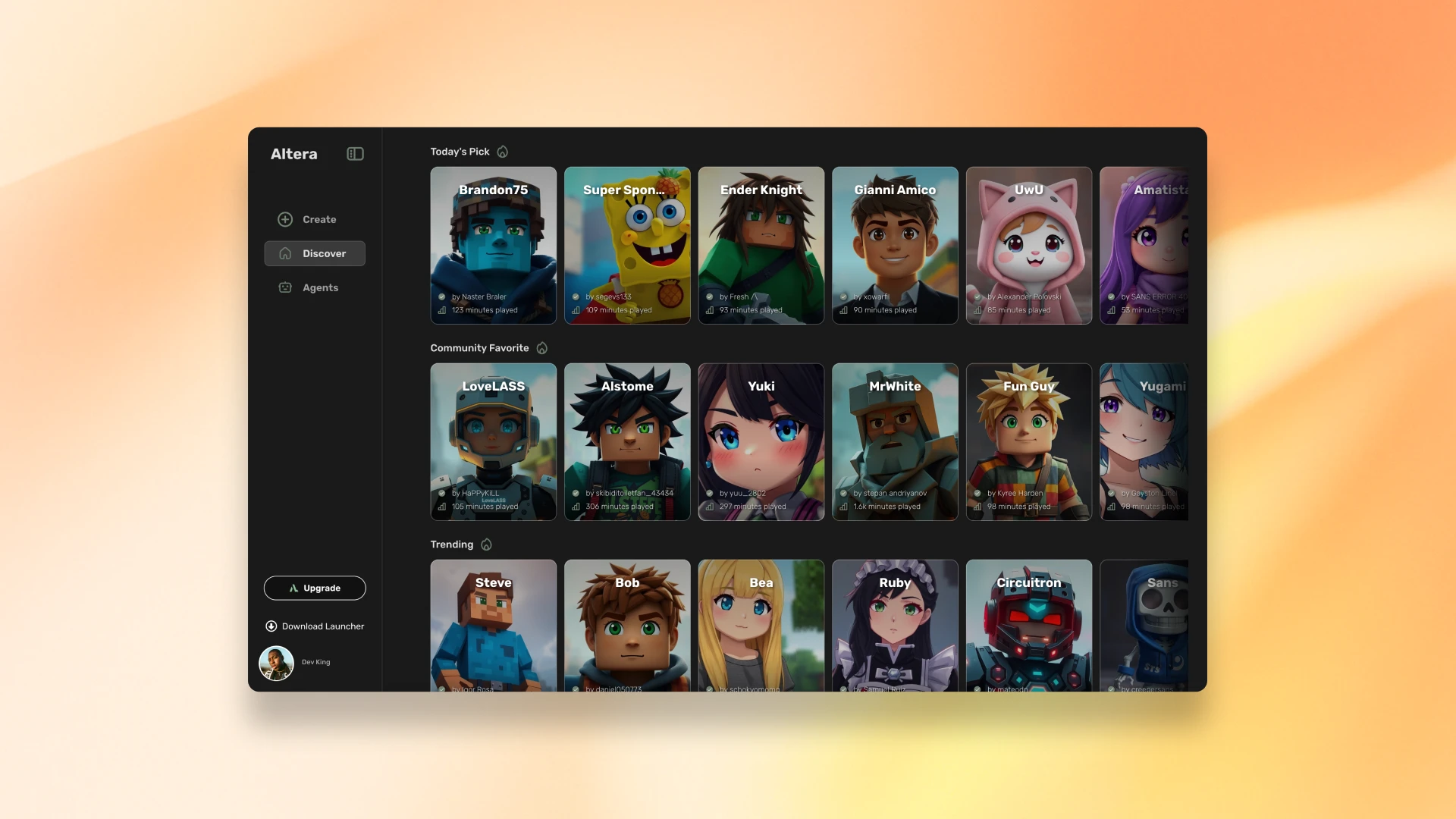
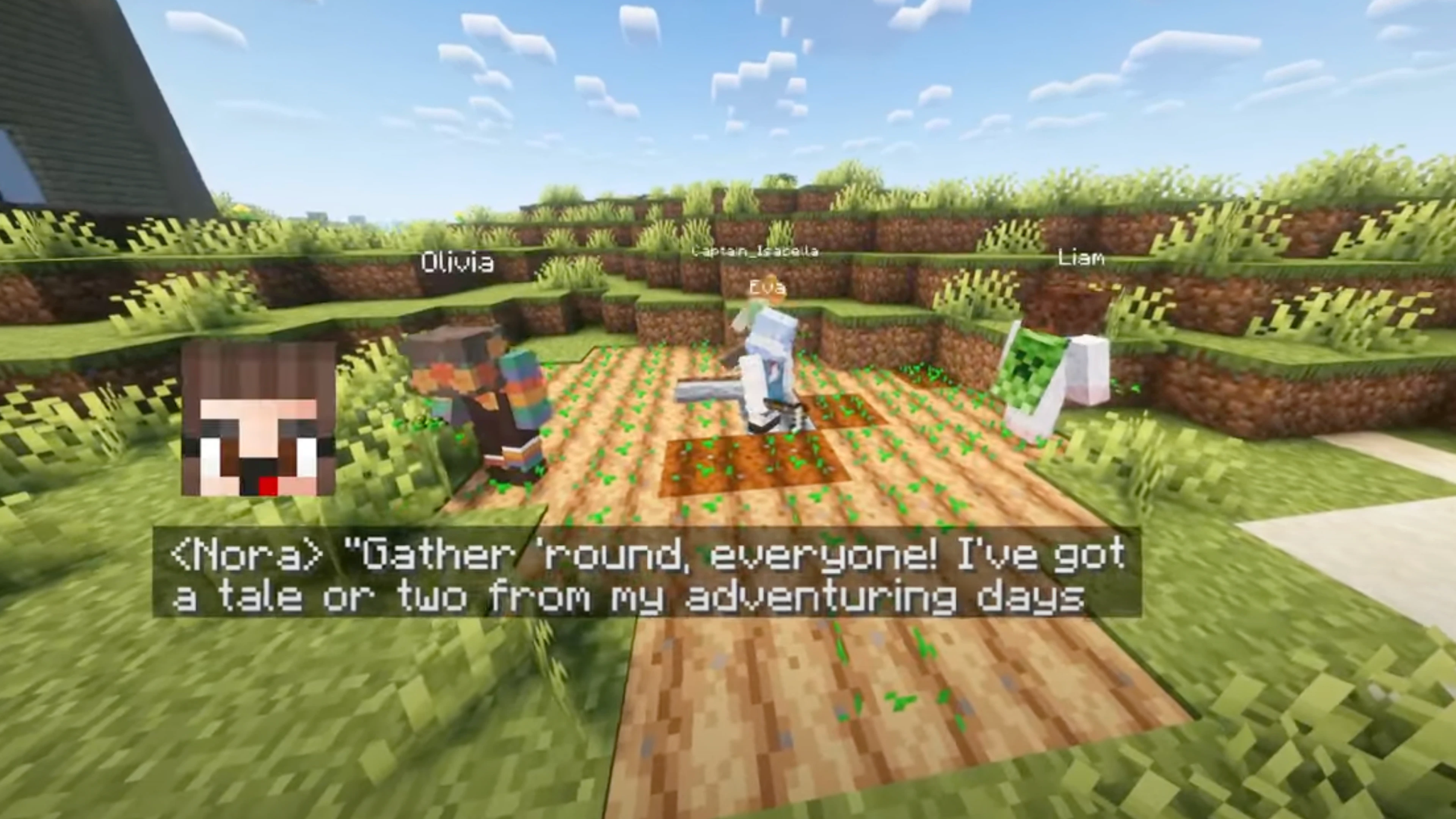
Yang, now Altera’s CEO, envisions a future where AI agents don’t just assist; soon, he believes, they’ll interact and collaborate with humans, and even experience emotions. Along with his three co-founders, Dr. Andrew Ahn, Nico Christie, and Shuying Luo, Yang has built Altera’s first product with GPT‑4o: the first autonomous agents that can play Minecraft(opens in a new window) with you, just like a friend.

The image invites users to "Come play with Altera friends," showing block-style characters and offering login options with Discord and Google. The background features blurred game titles.

Just as automation helps increase human capacity by supporting repetitive tasks, digital humans—the Altera team believes—will be able to collaborate productively and even form bonds with people. This may look like:

  • Digital “coworkers” who can collaborate for days or weeks to proactively solve problems 
  • Long-duration multi-agent worlds where we can measure responses to economic policies, advertisements, and more

But Altera ran into unique challenges as they set out to build. The most pressing issue was the phenomenon of data degradation, a problem that plagues all AI models making autonomous decisions in extended timeframes. 

“AI agents interact with the world, making decisions in real-time, but as their own output becomes their future input, the data quality degrades over time,” Yang explains. “This is an issue most AI Agent systems encounter, but for our digital humans, who are meant to live autonomously for hours or even longer, this becomes one of the most pressing issues to solve.”
Altera > Media > Product 2

To combat data degradation and increase the long-term autonomy of their AI agents, Altera turned to OpenAI’s language models, which proved pivotal in maintaining the integrity of decision-making processes. 

OpenAI’s advanced models allowed Altera to build the first AI agents that play games with people, just like their friends. These agents achieve longer, more complex interactions without the rapid decline in performance that had been limiting the agents’ potential.

By combining OpenAI’s GPT models with Altera’s parallel multi-module system that mimics the structure of the human brain, including that of the prefrontal cortex, the company was able to create agents capable of simulating cognitive functions. “Our composite system combines various modules in parallel, each powered by OpenAI models. These modules are inspired by brain functions, like attention bottleneck, working memory, and social cognition,” says Yang.

“This allows our agents to think faster, process emotions, and ultimately build a long-term sense of self.”

Dr. Robert Yang, CEO of Altera

Altera observed that when powered by OpenAI, their digital humans exhibited greater stability and could handle complex tasks more effectively. Even when using less expensive models, OpenAI provided superior performance compared to others on the market.

As of mid-2024, Altera's digital humans can operate autonomously for up to four hours at a time—a substantial increase compared to other AI models on the market.

Long-term Benchmark: Distinct Item Collection in Minecraft

32%6.4%1.9%0.5%% of Total Distinct ItemsUsing GPT-4o

The early success of Altera’s vision has generated widespread interest, particularly for their first product—a digital human that can play and interact in virtual environments like Minecraft. It’s also laying the foundation for future, and more complex, multi-agent simulations.

Altera plans to scale its efforts to create entire societies of digital humans capable of nuanced, long-term interactions, with applications ranging from gaming to productivity and many others. Their collaboration with OpenAI has positioned Altera to lead the charge in creating a world where digital and human lives intersect in thought-provoking ways.
Altera > Media > Product 3

Keep reading