
惯性聚合 高效追踪和阅读你感兴趣的博客、新闻、科技资讯
阅读原文 在惯性聚合中打开

推荐订阅源

S
Schneier on Security
F
Fortinet All Blogs
B
Blog
GbyAI
GbyAI
P
Proofpoint News Feed
量子位
The Register - Security
宝玉的分享
宝玉的分享
大猫的无限游戏
大猫的无限游戏
云风的 BLOG
云风的 BLOG
V
Visual Studio Blog
B
Blog RSS Feed
WordPress大学
WordPress大学
Recorded Future
Recorded Future
Recent Announcements
V
Vulnerabilities – Threatpost
cs.CV updates on arXiv.org
cs.AI updates on arXiv.org
S
Secure Thoughts
雷峰网
雷峰网
Stack Overflow Blog
Stack Overflow Blog
C
Cybersecurity and Infrastructure Security Agency CISA
Webroot Blog
Webroot Blog
AWS News Blog
AWS News Blog
K
KPMG report finds enterprise disconnect between AI and its ROI | CIO
Exploit-DB.com RSS Feed
The GitHub Blog
The GitHub Blog
爱范儿
爱范儿
O
OpenAI News
月光博客
月光博客
H
Hacker News: Front Page
S
Security Affairs
W
WeLiveSecurity
The Hacker News
The Hacker News
aimingoo的专栏
aimingoo的专栏
freeCodeCamp Programming Tutorials: Python, JavaScript, Git & More
Help Net Security
Help Net Security
MongoDB | Blog
MongoDB | Blog
Cyber Security Advisories - MS-ISAC
D
Docker
T
The Blog of Author Tim Ferriss
Spread Privacy
Spread Privacy
Blog — PlanetScale
Blog — PlanetScale
J
Java Code Geeks
S
Securelist
Microsoft Azure Blog
TaoSecurity Blog
TaoSecurity Blog
T
Threat Research - Cisco Blogs
M
MIT News - Artificial intelligence
A
About on SuperTechFans

OpenAI News

Using custom GPTs ChatGPT for customer success teams Applications of AI at OpenAI Research with ChatGPT Analyzing data with ChatGPT Financial services Responsible and safe use of AI Writing with ChatGPT ChatGPT for research Creating images with ChatGPT Personalizing ChatGPT ChatGPT for finance teams Getting started with ChatGPT Working with files in ChatGPT ChatGPT for sales teams Prompting fundamentals ChatGPT for managers Using projects in ChatGPT ChatGPT for marketing teams Brainstorming with ChatGPT AI fundamentals ChatGPT for operations teams Healthcare Our response to the Axios developer tool compromise Using skills OpenAI Full Fan Mode Contest: Terms & Conditions CyberAgent moves faster with ChatGPT Enterprise and Codex The next phase of enterprise AI Introducing the Child Safety Blueprint Introducing the OpenAI Safety Fellowship Industrial policy for the Intelligence Age OpenAI acquires TBPN Codex now offers more flexible pricing for teams Gradient Labs gives every bank customer an AI account manager OpenAI raises $122 billion to accelerate the next phase of AI Helping disaster response teams turn AI into action across Asia STADLER reshapes knowledge work at a 230-year-old company Inside our approach to the Model Spec Introducing the OpenAI Safety Bug Bounty program Helping developers build safer AI experiences for teens Update on the OpenAI Foundation Powering Product Discovery in ChatGPT Creating with Sora Safely How we monitor internal coding agents for misalignment OpenAI to acquire Astral Introducing GPT-5.4 mini and nano OpenAI Japan announces Japan Teen Safety Blueprint to put teen safety first Equipping workers with insights about compensation Why Codex Security Doesn’t Include a SAST Report Designing AI agents to resist prompt injection From model to agent: Equipping the Responses API with a computer environment Rakuten fixes issues twice as fast with Codex Wayfair boosts catalog accuracy and support speed with OpenAI Improving instruction hierarchy in frontier LLMs New ways to learn math and science in ChatGPT OpenAI to acquire Promptfoo Codex Security: now in research preview How Descript engineers multilingual video dubbing at scale How Balyasny Asset Management built an AI research engine Reasoning models struggle to control their chains of thought, and that’s good Introducing GPT-5.4 GPT-5.4 Thinking System Card Ensuring AI use in education leads to opportunity VfL Wolfsburg turns ChatGPT into a club-wide capability OpenAI and NORAD team up to bring new magic to “NORAD Tracks Santa” Accenture and OpenAI accelerate enterprise AI success OpenAI takes an ownership stake in Thrive Holdings to accelerate enterprise AI adoption What to know about a recent Mixpanel security incident Expanding data residency access to business customers worldwide Our approach to mental health-related litigation Inside JetBrains—the company reshaping how the world writes code Introducing shopping research in ChatGPT How GPT-5 helped mathematician Ernest Ryu solve a 40-year-old open problem OpenAI and Foxconn collaborate to strengthen U.S. manufacturing across the AI supply chain Disrupting malicious uses of AI: June 2025 Creating websites in minutes with AI Website Builder Addendum to OpenAI o3 and o4-mini system card: OpenAI o3 Operator OpenAI Deutschland Shipping code faster with o3, o4-mini, and GPT-4.1 Introducing Stargate UAE New tools and features in the Responses API Introducing Codex Addendum to o3 and o4-mini system card: Codex AI powers Expedia’s marketing evolution Strengthening America’s AI leadership with the U.S. National Laboratories Introducing ChatGPT Gov Operator System Card Computer-Using Agent Introducing Operator Bertelsmann powers creativity and productivity with OpenAI Trading Inference-Time Compute for Adversarial Robustness Announcing The Stargate Project Stargate Infrastructure The power of personalized AI Delivering LLM-powered health solutions Increasing accuracy of pediatric visit notes Practices for Governing Agentic AI Systems Superalignment Fast Grants Weak-to-strong generalization Partnership with Axel Springer to deepen beneficial use of AI in journalism
Filling crucial language learning gaps
2023-03-14 · via OpenAI News
OpenAI

GPT‑4 deepens the conversation on Duolingo.
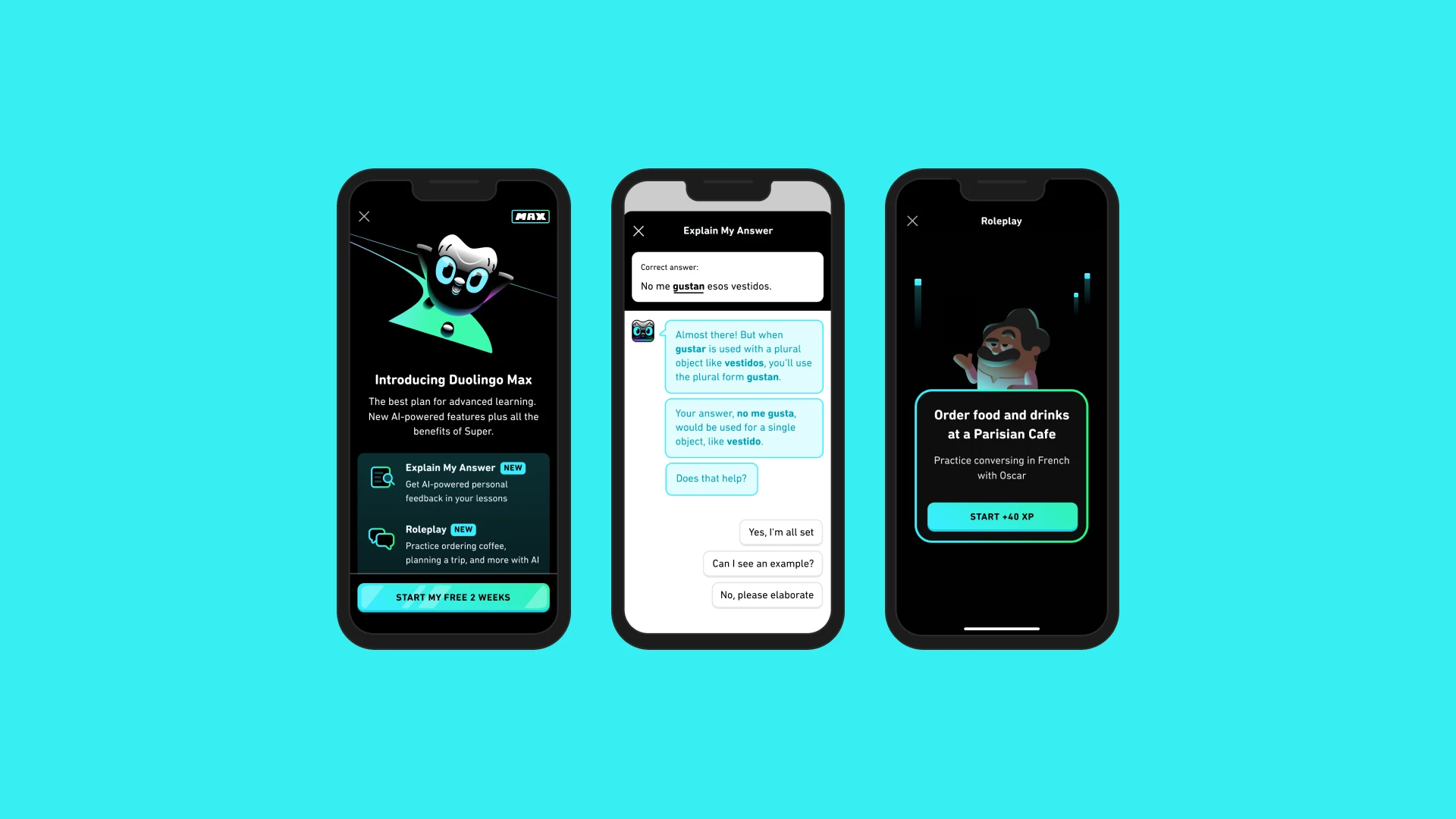
Three mobile screens of the Duolingo app.

Over 50 million learners rely on Duolingo every month to teach them a second language. With a simple user interface and fun-but-competitive leaderboards, Duolingo supports 40 languages across 100+ courses. Learners advance from simple vocabulary exercises to complicated sentence structures with taps and swipes on their phone. 

If a learner wants to advance beyond basic proficiency, it’s helpful to understand the rules of grammar. But true proficiency in a language requires conversation, ideally with a native speaker, something not everyone has access to. 

“Artificial intelligence has always been a huge part of our strategy,” says principal product manager Edwin Bodge. “We had been using it for personalizing lessons and running Duolingo English Tests. But there were gaps in a learner’s journey that we wanted to fill: conversation practice, and contextual feedback on mistakes.”
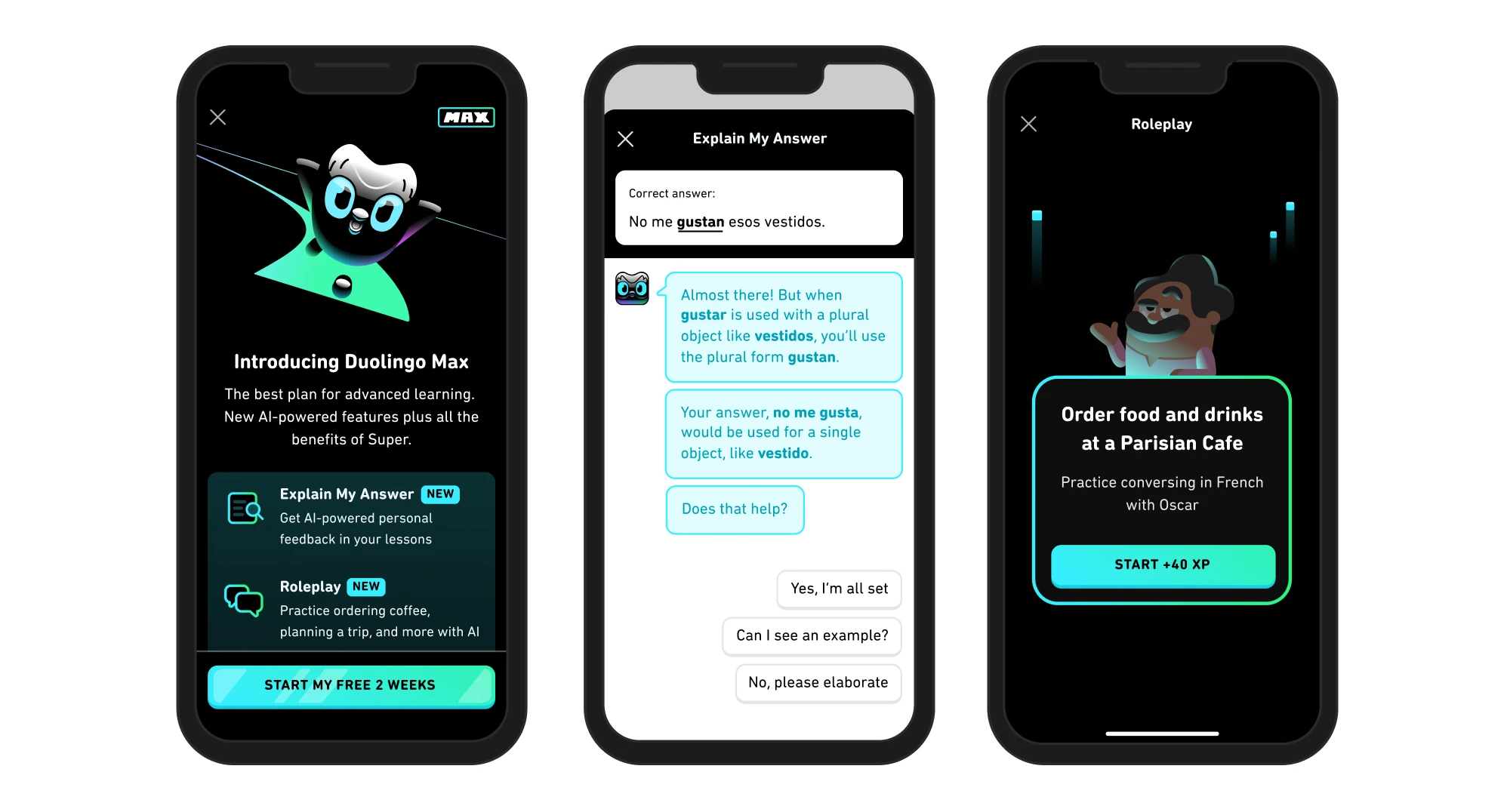
DuolingoMax mobile screens

Duolingo turned to OpenAI’s GPT‑4 to advance the product with two new features: Role Play, an AI conversation partner, and Explain my Answer, which breaks down the rules when you make a mistake, in a new subscription tier called Duolingo Max. 

“We wanted AI-powered features that were deeply integrated into the app and leveraged the gamified aspect of Duolingo that our learners love,” says Bodge.

Duolingo engineers had tried using GPT‑3 to supplement some of the human-powered features in its earlier chat feature. “It was close to being ready,” said lead engineer Bill Peterson, “but we didn’t feel it was at the point where we could confidently integrate it to handle the complex automated aspects of chats.” 

Previously, Duolingo attempted to “chat” with learners through scripted conversations incorporating classic scenarios like ordering food, meeting someone for the first time, or buying a plane ticket. But Bodge says what Duolingo needed was the ability to converse with learners in niche contexts and “immersively”—to have a free-flowing conversation about basketball or the bliss of reaching the top of a mountain. GPT‑4 has learned from enough public data to create a flexible back and forth for the learner.

“We wanted AI-powered features that were deeply integrated into the app and leveraged the gamified aspect of Duolingo that our learners love.”

Edwin Bodge, Principal Product Manager, Duolingo

There is a best practice in language learning called “implicit learning.” Learning through repeated use of vocabulary and grammar in an array of contexts—in other words, through practice—is more effective than memorizing rules. This posed an interesting challenge to Duolingo.

Many of Duolingo’s learners want to learn the explicit rules, and the company has tried to teach them with both pre-written Grammar Tips and artificial intelligence. Even with GPT‑3, the implementation was difficult. Teaching grammar requires a specific understanding of the error and why a learner made it. One incorrect term in the explanation could teach the concept incorrectly or leave the user confused and dissatisfied. 

“GPT‑4 gives us far more confidence in the accuracy of AI responses in Explain my Answer,” says Peterson.

With the new features, earners will be able to click “Explain my answer”, and GPT‑4 will give an initial response. From there, the learner can return to the lesson, or get further explanation, and GPT‑4 can dynamically update. Duolingo will gauge the quality of GPT‑4’s responses by how deep the learner needs to go before returning to the lesson.

The team sees the potential with GPT‑4 to provide a more effective and engaging learning experience than ever before, which should improve learning outcomes. In addition, Peterson says the ease of experimenting with GPT‑4 has simplified the entire engineering process. 

“Within a day we were able to build a prototype that convinced us this was something we wanted to explore more. It gets us from zero-to-ninety-five percent very quickly. Then we can work manually, hand tuning data to get the last five percent,” he says. 

Now his team focuses more on testing and honing data sets.

“It’s definitely changed our engineering process internally. And the features we’ve put together have come out faster than they would have before GPT-4.”

Bill Peterson, Lead Engineer, Duolingo

Duolingo Max is available to users today. For now, Duolingo is using these new features in Spanish and French, with plans to expand to more languages and introduce new features that will keep them at the forefront of language learning.

Related articles