
惯性聚合 高效追踪和阅读你感兴趣的博客、新闻、科技资讯
阅读原文 在惯性聚合中打开

推荐订阅源

Martin Fowler
Martin Fowler
Threat Intelligence Blog | Flashpoint
博客园 - 聂微东
IT之家
IT之家
GbyAI
GbyAI
奇客Solidot–传递最新科技情报
奇客Solidot–传递最新科技情报
Y
Y Combinator Blog
博客园 - 【当耐特】
The Cloudflare Blog
宝玉的分享
宝玉的分享
罗磊的独立博客
钛媒体:引领未来商业与生活新知
钛媒体:引领未来商业与生活新知
让小产品的独立变现更简单 - ezindie.com
V
Visual Studio Blog
小众软件
小众软件
博客园_首页
Last Week in AI
Last Week in AI
J
Java Code Geeks
V
V2EX
雷峰网
雷峰网
Apple Machine Learning Research
阮一峰的网络日志
阮一峰的网络日志
腾讯CDC
博客园 - 司徒正美
Engineering at Meta
Engineering at Meta
The GitHub Blog
The GitHub Blog
H
Hackread – Cybersecurity News, Data Breaches, AI and More
D
DataBreaches.Net
博客园 - 三生石上(FineUI控件)
MyScale Blog
MyScale Blog
云风的 BLOG
云风的 BLOG
The Register - Security
M
MIT News - Artificial intelligence
Microsoft Azure Blog
T
The Blog of Author Tim Ferriss
N
Netflix TechBlog - Medium
F
Full Disclosure
B
Blog
H
Help Net Security
C
Check Point Blog
WordPress大学
WordPress大学
人人都是产品经理
人人都是产品经理
Cyber Security Advisories - MS-ISAC
Jina AI
Jina AI
酷 壳 – CoolShell
酷 壳 – CoolShell
Blog — PlanetScale
Blog — PlanetScale
L
LangChain Blog
P
Proofpoint News Feed
D
Docker
Microsoft Security Blog

OpenAI News

Using custom GPTs ChatGPT for customer success teams Applications of AI at OpenAI Research with ChatGPT Analyzing data with ChatGPT Financial services Responsible and safe use of AI Writing with ChatGPT ChatGPT for research Creating images with ChatGPT Personalizing ChatGPT ChatGPT for finance teams Getting started with ChatGPT Working with files in ChatGPT ChatGPT for sales teams Prompting fundamentals ChatGPT for managers Using projects in ChatGPT ChatGPT for marketing teams Brainstorming with ChatGPT AI fundamentals ChatGPT for operations teams Healthcare Our response to the Axios developer tool compromise Using skills OpenAI Full Fan Mode Contest: Terms & Conditions CyberAgent moves faster with ChatGPT Enterprise and Codex The next phase of enterprise AI Introducing the Child Safety Blueprint Introducing the OpenAI Safety Fellowship Industrial policy for the Intelligence Age OpenAI acquires TBPN Codex now offers more flexible pricing for teams Gradient Labs gives every bank customer an AI account manager OpenAI raises $122 billion to accelerate the next phase of AI Helping disaster response teams turn AI into action across Asia STADLER reshapes knowledge work at a 230-year-old company Inside our approach to the Model Spec Introducing the OpenAI Safety Bug Bounty program Helping developers build safer AI experiences for teens Update on the OpenAI Foundation Powering Product Discovery in ChatGPT Creating with Sora Safely How we monitor internal coding agents for misalignment OpenAI to acquire Astral Introducing GPT-5.4 mini and nano OpenAI Japan announces Japan Teen Safety Blueprint to put teen safety first Equipping workers with insights about compensation Why Codex Security Doesn’t Include a SAST Report Designing AI agents to resist prompt injection From model to agent: Equipping the Responses API with a computer environment Rakuten fixes issues twice as fast with Codex Wayfair boosts catalog accuracy and support speed with OpenAI Improving instruction hierarchy in frontier LLMs New ways to learn math and science in ChatGPT OpenAI to acquire Promptfoo Codex Security: now in research preview How Descript engineers multilingual video dubbing at scale How Balyasny Asset Management built an AI research engine Reasoning models struggle to control their chains of thought, and that’s good Introducing GPT-5.4 GPT-5.4 Thinking System Card Ensuring AI use in education leads to opportunity VfL Wolfsburg turns ChatGPT into a club-wide capability OpenAI and NORAD team up to bring new magic to “NORAD Tracks Santa” Accenture and OpenAI accelerate enterprise AI success OpenAI takes an ownership stake in Thrive Holdings to accelerate enterprise AI adoption What to know about a recent Mixpanel security incident Expanding data residency access to business customers worldwide Our approach to mental health-related litigation Inside JetBrains—the company reshaping how the world writes code Introducing shopping research in ChatGPT How GPT-5 helped mathematician Ernest Ryu solve a 40-year-old open problem OpenAI and Foxconn collaborate to strengthen U.S. manufacturing across the AI supply chain Disrupting malicious uses of AI: June 2025 Creating websites in minutes with AI Website Builder Addendum to OpenAI o3 and o4-mini system card: OpenAI o3 Operator OpenAI Deutschland Shipping code faster with o3, o4-mini, and GPT-4.1 Introducing Stargate UAE New tools and features in the Responses API Introducing Codex Addendum to o3 and o4-mini system card: Codex AI powers Expedia’s marketing evolution Strengthening America’s AI leadership with the U.S. National Laboratories Introducing ChatGPT Gov Operator System Card Computer-Using Agent Introducing Operator Bertelsmann powers creativity and productivity with OpenAI Trading Inference-Time Compute for Adversarial Robustness Announcing The Stargate Project Stargate Infrastructure The power of personalized AI Delivering LLM-powered health solutions Increasing accuracy of pediatric visit notes Practices for Governing Agentic AI Systems Superalignment Fast Grants Weak-to-strong generalization Partnership with Axel Springer to deepen beneficial use of AI in journalism
Delivering high-performance customer support
2024-10-29 · via OpenAI News
OpenAI

Launched in 2023, Decagon(opens in a new window) has quickly become a key player in automating customer support for companies like Curology, BILT, Duolingo, Eventbrite, Notion, and Substack. OpenAI’s models are crucial in their ability to deliver fast, reliable responses—without human intervention.

From enterprises to tech-forward startups, Decagon helps businesses globally handle millions of support conversations without sacrificing quality or speed. The company uses a combination of OpenAI’s models—including GPT‑3.5, 4, 4o, 4 Turbo, and OpenAI o1‑mini—to deliver agentic bots that go beyond response generation and service the entire customer lifecycle.

Decagon’s customers require scalable, high-quality support that can handle complex inquiries. Their two founders, having successfully exited AI companies previously, recognized the need for a support solution that went beyond basic automation to deliver nuanced yet fast responses across vast numbers of interactions.

“We know that latency has a direct impact on customer satisfaction. Every second counts when you're dealing with real-time customer support,” says Ashwin Sreenivas, Decagon’s co-founder and CTO.

But maintaining a high level of automation while ensuring precision required more than just traditional automation tools—it required advanced AI models capable of reasoning through complex tasks. With OpenAI’s models, the Decagon team was able to architect a flexible solution that allows clients to fully customize their workflows to their needs.

Decagon uses a creative combination of OpenAI’s GPT models, which offers flexibility and customization to meet the diverse needs of Decagon’s customers. OpenAI’s platform also helps the Decagon team optimize performance across a range of tasks: “We found that different models have different strengths,” Sreenivas notes.

For example, Decagon fine-tuned GPT‑3.5 to rewrite customer queries before they enter retrieval-augmented generation (RAG) workflows. “We tried a bunch of other model configurations, and for customer queries, fine-tuning GPT‑3.5 got us the highest performance,” says Sreenivas. 

In other workflows, the company uses GPT‑4 for complex decision-making tasks, allowing the platform to process API requests and other intricate operations efficiently.

Decagon’s approach ensures that each part of the customer interaction pipeline is supported by the most suitable model for the task, enhancing both speed and accuracy. Says Jesse Zhang, Decagon’s co-founder and CEO, “This allows us to both capture customers' business logic and create all the software surface area around the agent that just wasn't possible before LLMs.”
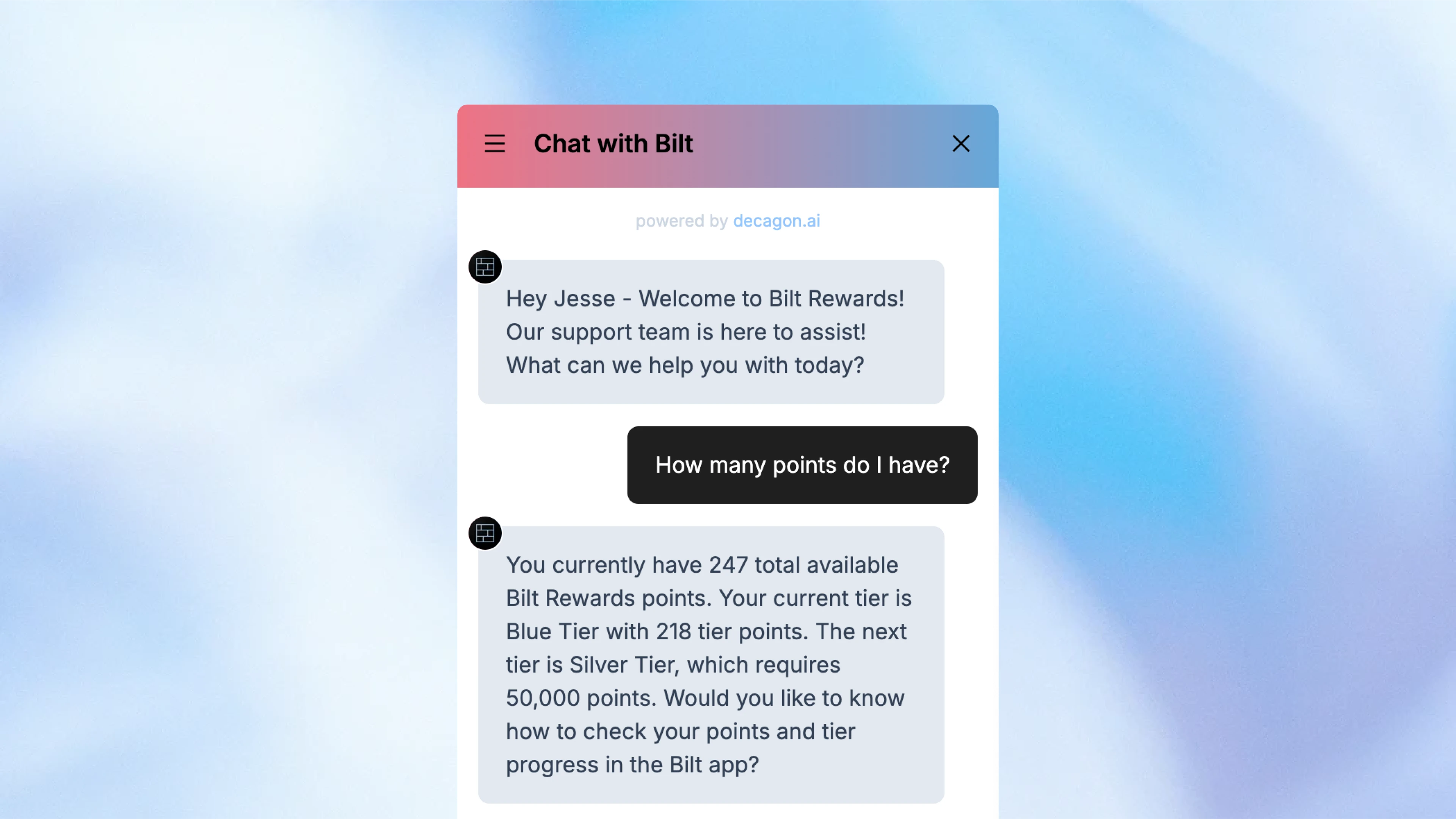
Decagon > Media > Product UI

By combining OpenAI’s models with Decagon’s tailored workflows, the company has dramatically improved the quality of customer service automation for its clients. “For one of our largest customers, we handle 91% of all their global support, without a human being involved,” says Sreenivas. 

The configurability of Decagon’s platform with OpenAI’s models allows it to adapt to each client’s specific requirements, ensuring highest performance and seamless integration. 

One key advantage is Decagon’s ability to rapidly evaluate and integrate new models. 

“Every time a model comes out, we can run them through evaluations really, really quickly,” says Sreenivas. This flexibility allows Decagon to stay on the cutting edge, ensuring that their platform is always running the most accurate and efficient models available.

As Decagon continues to grow, it’s focused on expanding its capabilities to support an even wider range of customer needs. The company is already working with new versions of OpenAI’s models—critical in Decagon’s ability to deploy AI-powered customer service quickly. “For new customers, our core infrastructure can be up and running in days,” says Sreenivas.

Looking ahead, Decagon is exploring how to further enhance its AI agents with voice capabilities, aiming to tackle voice-based customer support interactions with the same level of automation and accuracy.

By continuously powering its platform with the latest OpenAI technology, Decagon is well-positioned to lead the next wave of innovation in AI-powered customer service.

Keep reading