


惯性聚合 高效追踪和阅读你感兴趣的博客、新闻、科技资讯
阅读原文 在惯性聚合中打开

推荐订阅源

N
News and Events Feed by Topic
V
V2EX
博客园 - 【当耐特】
Vercel News
Vercel News
雷峰网
雷峰网
爱范儿
爱范儿
WordPress大学
WordPress大学
云风的 BLOG
云风的 BLOG
S
Securelist
Threat Intelligence Blog | Flashpoint
Microsoft Azure Blog
F
Full Disclosure
有赞技术团队
有赞技术团队
Hugging Face - Blog
Hugging Face - Blog
NISL@THU
NISL@THU
www.infosecurity-magazine.com
Attack and Defense Labs
Application and Cybersecurity Blog
Hacker News - Newest:
Hacker News - Newest: "LLM"
Microsoft Security Blog
腾讯CDC
P
Proofpoint News Feed
B
Blog
CTFtime.org: upcoming CTF events
K
Kaspersky official blog
I
InfoQ
Google Online Security Blog
L
LINUX DO - 最新话题
Project Zero
Project Zero
Engineering at Meta
Engineering at Meta
V
Visual Studio Blog
AI
AI
Schneier on Security
B
Blog RSS Feed
T
Tor Project blog
H
Help Net Security
H
Hackread – Cybersecurity News, Data Breaches, AI and More
L
LINUX DO - 热门话题
阮一峰的网络日志
阮一峰的网络日志
S
Security @ Cisco Blogs
T
Threat Research - Cisco Blogs
freeCodeCamp Programming Tutorials: Python, JavaScript, Git & More
C
Cyber Attacks, Cyber Crime and Cyber Security
G
Google Developers Blog
Google DeepMind News
V2EX - 技术
V2EX - 技术
让小产品的独立变现更简单 - ezindie.com
A
Arctic Wolf
Webroot Blog
Webroot Blog
Recent Commits to openclaw:main

OpenAI News

Using custom GPTs ChatGPT for customer success teams Applications of AI at OpenAI Research with ChatGPT Analyzing data with ChatGPT Financial services Responsible and safe use of AI Writing with ChatGPT ChatGPT for research Creating images with ChatGPT Personalizing ChatGPT ChatGPT for finance teams Getting started with ChatGPT Working with files in ChatGPT ChatGPT for sales teams Prompting fundamentals ChatGPT for managers Using projects in ChatGPT ChatGPT for marketing teams Brainstorming with ChatGPT AI fundamentals ChatGPT for operations teams Healthcare Our response to the Axios developer tool compromise Using skills OpenAI Full Fan Mode Contest: Terms & Conditions CyberAgent moves faster with ChatGPT Enterprise and Codex The next phase of enterprise AI Introducing the Child Safety Blueprint Introducing the OpenAI Safety Fellowship Industrial policy for the Intelligence Age OpenAI acquires TBPN Codex now offers more flexible pricing for teams Gradient Labs gives every bank customer an AI account manager OpenAI raises $122 billion to accelerate the next phase of AI Helping disaster response teams turn AI into action across Asia STADLER reshapes knowledge work at a 230-year-old company Inside our approach to the Model Spec Introducing the OpenAI Safety Bug Bounty program Helping developers build safer AI experiences for teens Update on the OpenAI Foundation Powering Product Discovery in ChatGPT Creating with Sora Safely How we monitor internal coding agents for misalignment OpenAI to acquire Astral Introducing GPT-5.4 mini and nano OpenAI Japan announces Japan Teen Safety Blueprint to put teen safety first Equipping workers with insights about compensation Why Codex Security Doesn’t Include a SAST Report Designing AI agents to resist prompt injection From model to agent: Equipping the Responses API with a computer environment Rakuten fixes issues twice as fast with Codex Wayfair boosts catalog accuracy and support speed with OpenAI Improving instruction hierarchy in frontier LLMs New ways to learn math and science in ChatGPT OpenAI to acquire Promptfoo Codex Security: now in research preview How Descript engineers multilingual video dubbing at scale How Balyasny Asset Management built an AI research engine Reasoning models struggle to control their chains of thought, and that’s good Introducing GPT-5.4 GPT-5.4 Thinking System Card Ensuring AI use in education leads to opportunity VfL Wolfsburg turns ChatGPT into a club-wide capability OpenAI and NORAD team up to bring new magic to “NORAD Tracks Santa” Accenture and OpenAI accelerate enterprise AI success OpenAI takes an ownership stake in Thrive Holdings to accelerate enterprise AI adoption What to know about a recent Mixpanel security incident Expanding data residency access to business customers worldwide Our approach to mental health-related litigation Inside JetBrains—the company reshaping how the world writes code Introducing shopping research in ChatGPT How GPT-5 helped mathematician Ernest Ryu solve a 40-year-old open problem OpenAI and Foxconn collaborate to strengthen U.S. manufacturing across the AI supply chain Disrupting malicious uses of AI: June 2025 Creating websites in minutes with AI Website Builder Addendum to OpenAI o3 and o4-mini system card: OpenAI o3 Operator OpenAI Deutschland Shipping code faster with o3, o4-mini, and GPT-4.1 Introducing Stargate UAE New tools and features in the Responses API Introducing Codex Addendum to o3 and o4-mini system card: Codex AI powers Expedia’s marketing evolution Strengthening America’s AI leadership with the U.S. National Laboratories Introducing ChatGPT Gov Operator System Card Computer-Using Agent Introducing Operator Bertelsmann powers creativity and productivity with OpenAI Trading Inference-Time Compute for Adversarial Robustness Announcing The Stargate Project Stargate Infrastructure The power of personalized AI Delivering LLM-powered health solutions Increasing accuracy of pediatric visit notes Practices for Governing Agentic AI Systems Superalignment Fast Grants Weak-to-strong generalization Partnership with Axel Springer to deepen beneficial use of AI in journalism
Unsupervised sentiment neuron
2017-04-06 · via OpenAI News
OpenAI

We’ve developed an unsupervised system which learns an excellent representation of sentiment, despite being trained only to predict the next character in the text of Amazon reviews.

linear model using this representation achieves state-of-the-art sentiment analysis accuracy on a small but extensively-studied dataset, the Stanford Sentiment Treebank (we get 91.8% accuracy versus the previous best of 90.2%), and can match the performance of previous supervised systems using 30-100x fewer labeled examples. Our representation also contains a distinct “sentiment neuron” which contains almost all of the sentiment signal.

Our system beats other approaches on Stanford Sentiment Treebank while using dramatically less data.
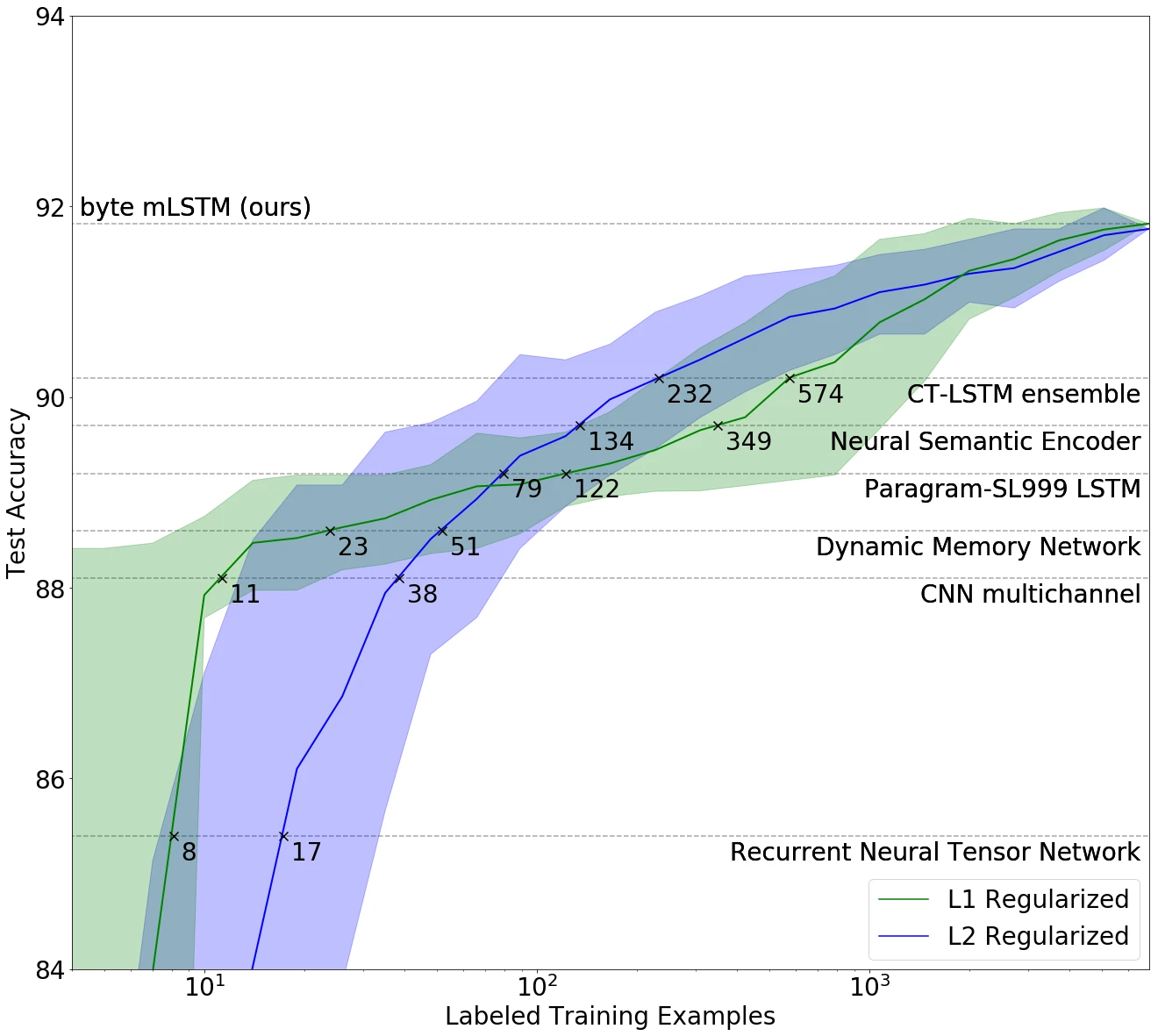
Graph of labelled training examples

The number of labeled examples it takes two variants of our model (the green and blue lines) to match fully supervised approaches, each trained with 6,920 examples (the dashed gray lines). Our L1-regularized model (pretrained in an unsupervised fashion on Amazon reviews) matches [multichannel CNN](https://arxiv.org/abs/1408.5882(opens in a new window)) performance with only 11 labeled examples, and state-of-the-art CT-LSTM Ensembles with 232 examples.

We were very surprised that our model learned an interpretable feature, and that simply predicting(opens in a new window) the next character in Amazon reviews resulted in discovering the concept of sentiment. We believe the phenomenon is not specific to our model, but is instead a general property of certain large neural networks that are trained to predict the next step or dimension in their inputs.

We first trained a multiplicative LSTM(opens in a new window) with 4,096 units on a corpus of 82 million Amazon reviews to predict the next character in a chunk of text. Training took one month across four NVIDIA Pascal GPUs, with our model processing 12,500 characters per second.

These 4,096 units (which are just a vector of floats) can be regarded as a feature vector representing the string read by the model. After training the mLSTM, we turned the model into a sentiment classifier by taking a linear combination of these units, learning the weights of the combination via the available supervised data.

While training the linear model with L1 regularization, we noticed it used surprisingly few of the learned units. Digging in, we realized there actually existed a single “sentiment neuron” that’s highly predictive of the sentiment value.
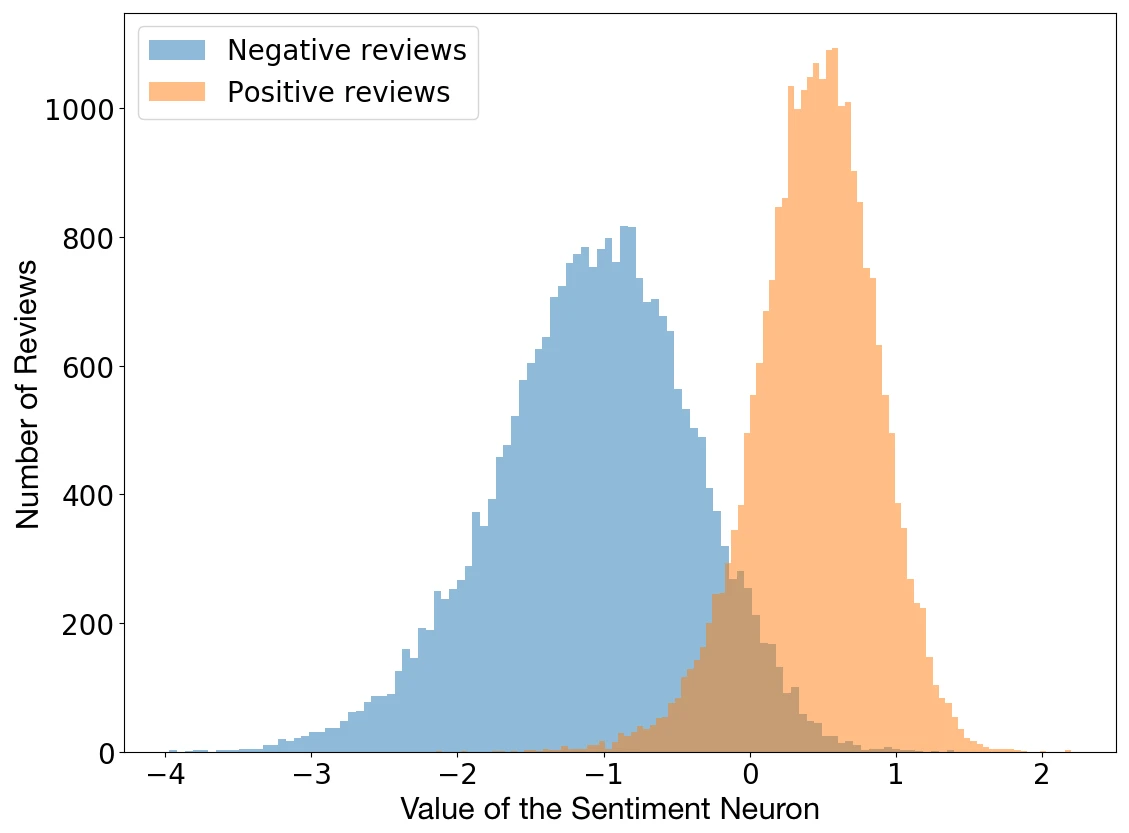
Graph depicting positive and negative reviews of the value of the sentiment neuron

Just like with similar models, our model can be used to generate text. Unlike those models, we have a direct dial to control the sentiment of the resulting text: we simply overwrite the value of the sentiment neuron.

The diagram below represents the character-by-character value of the sentiment neuron, displaying negative values as red and positive values as green. Note that strongly indicative words like “best” or “horrendous” cause particularly big shifts in the color.
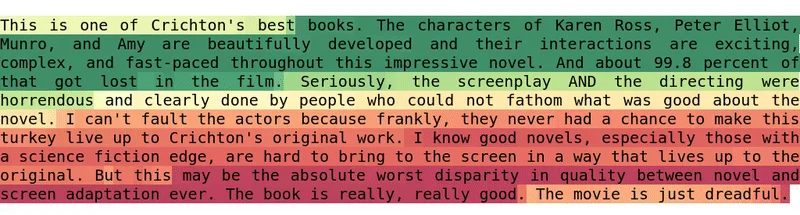
Sentiment Prediction

The sentiment neuron adjusting its value on a character-by-character basis.

It’s interesting to note that the system also makes large updates after the completion of sentences and phrases. For example, in “And about 99.8 percent of that got lost in the film”, there’s a negative update after “lost” and a larger update at the sentence’s end, even though “in the film” has no sentiment content on its own.

Labeled data are the fuel for today’s machine learning. Collecting data is easy, but scalably labeling that data is hard. It’s only feasible to generate labels for important problems where the reward is worth the effort, like machine translation, speech recognition, or self-driving.

Machine learning researchers have long dreamed of developing unsupervised(opens in a new window) learning(opens in a new window) algorithms(opens in a new window) to(opens in a new window) learn(opens in a new window) a good representation of a dataset, which can then be used to solve tasks using only a few labeled examples. Our research implies that simply training large unsupervised next-step-prediction models on large amounts of data may be a good approach to use when creating systems with good representation learning capabilities.

Our results are a promising step towards general unsupervised representation learning. We found the results by exploring whether we could learn good quality representations as a side effect of language modeling, and scaled up an existing model on a carefully-chosen dataset. Yet the underlying phenomena remain more mysterious than clear.

  • These results were not as strong for datasets of long documents. We suspect our character-level model struggles to remember information over hundreds to thousands of timesteps. We think it’s worth trying hierarchical models that can adapt the timescales at which they operate. Further scaling up these models may further improve representation fidelity and performance on sentiment analysis and similar tasks.
  • The model struggles the more the input text diverges from review data. It’s worth verifying that broadening the corpus of text samples results in an equally informative representation that also applies to broader domains.
  • Our results suggest that there exist settings where very large next-step-prediction models learn excellent unsupervised representations. Training a large neural network to predict the next frame in a large collection of videos may result in unsupervised representations for object, scene, and action classifiers.

Overall, it’s important to understand the properties of models, training regimes, and datasets that reliably lead to such excellent representations.