惯性聚合 高效追踪和阅读你感兴趣的博客、新闻、科技资讯
阅读原文 在惯性聚合中打开

推荐订阅源

大猫的无限游戏
大猫的无限游戏
H
Help Net Security
The Cloudflare Blog
Y
Y Combinator Blog
A
Arctic Wolf
Cyberwarzone
Cyberwarzone
G
Google Developers Blog
Recent Announcements
S
SegmentFault 最新的问题
Microsoft Security Blog
WordPress大学
WordPress大学
博客园 - Franky
罗磊的独立博客
Martin Fowler
Martin Fowler
Threat Intelligence Blog | Flashpoint
博客园 - 三生石上(FineUI控件)
N
News and Events Feed by Topic
F
Fortinet All Blogs
N
News | PayPal Newsroom
J
Java Code Geeks
www.infosecurity-magazine.com
博客园 - 【当耐特】
M
MIT News - Artificial intelligence
Google Online Security Blog
Recorded Future
Recorded Future
博客园 - 聂微东
S
Securelist
C
CERT Recently Published Vulnerability Notes
小众软件
小众软件
Cisco Talos Blog
Cisco Talos Blog
S
Security Affairs
NISL@THU
NISL@THU
A
About on SuperTechFans
PCI Perspectives
PCI Perspectives
N
News and Events Feed by Topic
cs.AI updates on arXiv.org
Jina AI
Jina AI
Microsoft Azure Blog
AWS News Blog
AWS News Blog
GbyAI
GbyAI
C
Cyber Attacks, Cyber Crime and Cyber Security
V
Vulnerabilities – Threatpost
D
Docker
P
Proofpoint News Feed
W
WeLiveSecurity
Help Net Security
Help Net Security
The GitHub Blog
The GitHub Blog
The Last Watchdog
The Last Watchdog
The Hacker News
The Hacker News
博客园 - 叶小钗

Google DeepMind News

Strengthening Singapore’s AI Future: A New National Partnership Simulate real-world places with Project Genie and Street View Introducing Gemini Omni Gemini for Science: AI experiments and tools for a new era of discovery Making it easier to understand how content was created and edited Gemini 3.5: frontier intelligence with action Co-Scientist: A multi-agent AI partner to accelerate research How WeatherNext helped the National Hurricane Center better predict Hurricane Melissa’s historic landfall in Jamaica Fast-tracking genetic leads to reverse cellular aging Finding the molecular switches behind new infectious diseases Opening new paths in aging research Accelerating discovery of liver disease mechanisms Uniting biological toolkits for a new approach to ALS Uncovering repurposed medicines to fight liver fibrosis Google Antigravity We’re launching the Google DeepMind Accelerator program in Asia Pacific to tackle environmental risks. AlphaEvolve: How our Gemini-powered coding agent is scaling impact across fields Enabling a new model for healthcare with AI co-clinician Announcing our partnership with the Republic of Korea Decoupled DiLoCo: A new frontier for resilient, distributed AI training Partnering with industry leaders to accelerate AI transformation Gemini 3.1 Flash TTS: the next generation of expressive AI speech Gemini Robotics-ER 1.6: Powering real-world robotics tasks through enhanced embodied reasoning Protecting people from harmful manipulation From games to biology and beyond: 10 years of AlphaGo’s impact A new way to express yourself: Gemini can now create music Accelerating discovery in India through AI-powered science and education Accelerating Mathematical and Scientific Discovery with Gemini Deep Think D4RT: Teaching AI to see the world in four dimensions Veo 3.1 Ingredients to Video: More consistency, creativity and control Gemma Scope 2: helping the AI safety community deepen understanding of complex language model behavior Google DeepMind supports U.S. Department of Energy on Genesis: a national mission to accelerate innovation and scientific discovery Gemini 3 Flash: frontier intelligence built for speed Improved Gemini audio models for powerful voice interactions Deepening our partnership with the UK AI Security Institute Strengthening our partnership with the UK government to support prosperity and security in the AI era FACTS Benchmark Suite: Systematically evaluating the factuality of large language models Engineering more resilient crops for a warming climate AlphaFold: Five years of impact Revealing a key protein behind heart disease How we’re bringing AI image verification to the Gemini app Build with Nano Banana Pro, our Gemini 3 Pro Image model Introducing Nano Banana Pro We’re expanding our presence in Singapore to advance AI in the Asia-Pacific region Start building with Gemini 3 A new era of intelligence with Gemini 3 Google Antigravity SIMA 2: An Agent that Plays, Reasons, and Learns With You in Virtual 3D Worlds Teaching AI to see the world more like we do How AI is giving Northern Ireland teachers time back Mapping, modeling, and understanding nature with AI Accelerating discovery with the AI for Math Initiative MedGemma: Our most capable open models for health AI development VaultGemma: The world's most capable differentially private LLM Bringing AI to the next generation of fusion energy Introducing Veo 3.1 and advanced capabilities in Flow Introducing the Gemini 2.5 Computer Use model Introducing CodeMender: an AI agent for code security Gemini Robotics 1.5 brings AI agents into the physical world Strengthening our Frontier Safety Framework Discovering new solutions to century-old problems in fluid dynamics Gemini achieves gold-medal level at the International Collegiate Programming Contest World Finals Using AI to perceive the universe in greater depth Image editing in Gemini just got a major upgrade Introducing Gemma 3 270M: The compact model for hyper-efficient AI How AI is helping advance the science of bioacoustics to save endangered species Genie 3: A new frontier for world models Rethinking how we measure AI intelligence Try Deep Think in the Gemini app AlphaEarth Foundations helps map our planet in unprecedented detail Aeneas transforms how historians connect the past Gemini 2.5 Flash-Lite is now stable and generally available Exploring the context of online images with Backstory Advanced version of Gemini with Deep Think officially achieves gold-medal standard at the International Mathematical Olympiad T5Gemma: A new collection of encoder-decoder Gemma models Introducing Gemma 3n: The developer guide AlphaGenome: AI for better understanding the genome Gemini Robotics On-Device brings AI to local robotic devices We’re expanding our Gemini 2.5 family of models Gemini 2.5: Updates to our family of thinking models Behind “ANCESTRA”: combining Veo with live-action filmmaking How we're supporting better tropical cyclone prediction with AI Advanced audio dialog and generation with Gemini 2.5 Gemini 2.5: Our most intelligent models are getting even better SynthID Detector — a new portal to help identify AI-generated content Our vision for building a universal AI assistant Fuel your creativity with new generative media models and tools Announcing Gemma 3n preview: powerful, efficient, mobile-first AI Gemini 2.5 Pro Preview: even better coding performance Build rich, interactive web apps with an updated Gemini 2.5 Pro Start building with Gemini 2.5 Flash Generate videos in Gemini and Whisk with Veo 2 DolphinGemma: How Google AI is helping decode dolphin communication Gemini 2.5: Our most intelligent AI model Experiment with Gemini 2.0 Flash native image generation Introducing Gemma 3: The most capable model you can run on a single GPU or TPU Start building with Gemini 2.0 Flash and Flash-Lite Gemini 2.0 is now available to everyone State-of-the-art video and image generation with Veo 2 and Imagen 3 Introducing Gemini 2.0: our new AI model for the agentic era
WeatherNext 2: Our most advanced weather forecasting model
The WeatherNext team · 2025-11-17 · via Google DeepMind News

The new AI model delivers more efficient, more accurate and higher-resolution global weather predictions.

General summary

Google's WeatherNext 2 is here, giving you faster and more detailed weather forecasts using AI. This new model predicts hundreds of weather scenarios in under a minute. You can now access WeatherNext 2 forecast data in Earth Engine and BigQuery, or join the early access program on Google Cloud's Vertex AI.

Summaries were generated by Google AI. Generative AI is experimental.

Bullet points

  • "WeatherNext 2" is Google's new AI weather model, forecasting faster and more efficiently than ever before.
  • WeatherNext 2 generates hundreds of possible weather scenarios in under a minute, using just one TPU.
  • This model surpasses the previous WeatherNext model on 99.9% of variables and lead times.
  • WeatherNext 2 data is now available in Earth Engine and BigQuery, with Vertex AI early access.
  • WeatherNext 2 upgrades weather forecasts in Search, Gemini, Pixel Weather, Maps Platform, and Maps.

Summaries were generated by Google AI. Generative AI is experimental.

Basic explainer

Google made a super smart weather tool called WeatherNext 2. It uses computers to guess the weather faster and better than before. It can even show many different weather possibilities. Now, people can use it to help make important choices about the weather.

Summaries were generated by Google AI. Generative AI is experimental.

Explore other styles:
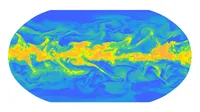
A global map projection showing humidity levels from the WeatherNext 2 weather forecasting model, with blue indicating low humidity and yellow-orange indicating high humidity, particularly clustered along the equator.

The weather affects important decisions we make everyday — from global supply chains and flight paths to your daily commute. In recent years, artificial intelligence (AI) has dramatically enhanced what’s possible in weather forecasting and the ways in which we can use it.

Today, Google DeepMind and Google Research are introducing WeatherNext 2, our most advanced and efficient forecasting model. WeatherNext 2 can generate forecasts 8x faster and with resolution up to 1-hour. This breakthrough is enabled by a new model that can provide hundreds of possible scenarios. Using this technology, we’ve supported weather agencies in making decisions based on a range of scenarios through our experimental cyclone predictions.

We're now taking our research out of the lab and putting it into the hands of users. WeatherNext 2's forecast data is now available in Earth Engine and BigQuery. We’re also launching an early access program on Google Cloud’s Vertex AI platform for custom model inference.

By incorporating WeatherNext technology, we’ve now upgraded weather forecasts in Search, Gemini, Pixel Weather and Google Maps Platform’s Weather API. In the coming weeks, it will also help power weather information in Google Maps.

Predicting more possible scenarios

From a single input, we use independently trained neural networks and inject noise in function space to create coherent variability in weather forecast predictions.
Diagram showing the new algorithm used in WeatherNext 2.

Weather predictions need to capture the full range of possibilities — including worst case scenarios, which are the most important to plan for.

WeatherNext 2 can predict hundreds of possible weather outcomes from a single starting point. Each prediction takes less than a minute on a single TPU; it would take hours on a supercomputer using physics-based models.

Our model is also highly skillful and capable of higher-resolution predictions, down to the hour. Overall, WeatherNext 2 surpasses our previous state-of-the-art WeatherNext model on 99.9% of variables (e.g. temperature, wind, humidity) and lead times (0-15 days), enabling more useful and accurate forecasts.

This improved performance is enabled by a new AI modelling approach called a Functional Generative Network (FGN), which injects ‘noise’ directly into the model architecture so the forecasts it generates remain physically realistic and interconnected.

This approach is particularly useful for predicting what meteorologists refer to as “marginals” and “joints.” Marginals are individual, standalone weather elements: the precise temperature at a specific location, the wind speed at a certain altitude or the humidity. What's novel about our approach is that the model is only trained on these marginals. Yet, from that training, it learns to skillfully forecast 'joints' — large, complex, interconnected systems that depend on how all those individual pieces fit together. This 'joint' forecasting is required for our most useful predictions, such as identifying entire regions affected by high heat, or expected power output across a wind farm.

Continuous Ranked Probability Score (CRPS) comparing WeatherNext 2 to WeatherNext Gen
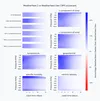
Heatmaps showing WeatherNext 2 consistently outperforms WeatherNext Gen across nearly all atmospheric variables, pressure levels, and lead times.

From research to reality

With WeatherNext 2, we're translating cutting edge research into high-impact applications. We’re committed to advancing the state of the art of this technology and making our latest tools available to the global community.

Looking ahead, we’re actively researching capabilities to improve our models, including integrating new data sources, and expanding access even further. By providing powerful tools and open data, we hope to accelerate scientific discovery and empower a global ecosystem of researchers, developers and businesses to make decisions on today’s most complex problems and build for the future.

To learn more about geospatial platforms and AI work at Google, check out Google Earth, Earth Engine, AlphaEarth Foundations, and Earth AI.

Learn more about WeatherNext 2

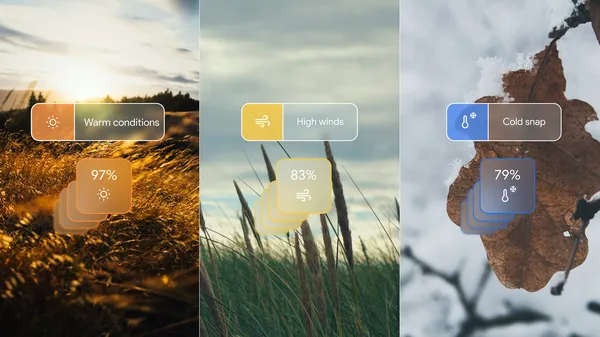
side by side images of weather and predictions
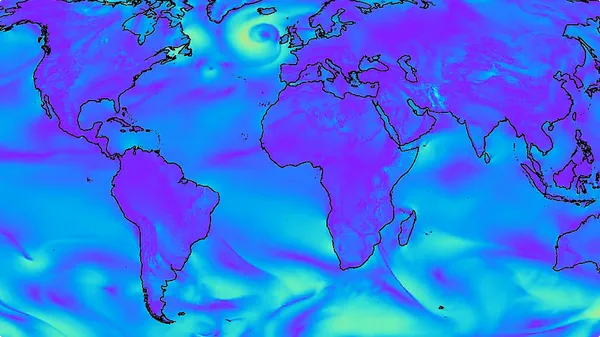
world map with purple and blue swirls

Related stories