
惯性聚合 高效追踪和阅读你感兴趣的博客、新闻、科技资讯
阅读原文 在惯性聚合中打开

推荐订阅源

Spread Privacy
Spread Privacy
P
Palo Alto Networks Blog
P
Proofpoint News Feed
AI
AI
Help Net Security
Help Net Security
S
Securelist
T
Troy Hunt's Blog
K
KPMG report finds enterprise disconnect between AI and its ROI | CIO
C
Cisco Blogs
Scott Helme
Scott Helme
Hacker News - Newest:
Hacker News - Newest: "LLM"
Vercel News
Vercel News
Exploit-DB.com RSS Feed
CTFtime.org: upcoming CTF events
B
Blog
GbyAI
GbyAI
Recent Commits to openclaw:main
D
Darknet – Hacking Tools, Hacker News & Cyber Security
P
Proofpoint News Feed
S
Security Affairs
Cisco Talos Blog
Cisco Talos Blog
AWS News Blog
AWS News Blog
T
Tenable Blog
H
Help Net Security
NISL@THU
NISL@THU
F
Fortinet All Blogs
博客园_首页
G
GRAHAM CLULEY
L
LINUX DO - 最新话题
P
Privacy International News Feed
G
Google Developers Blog
博客园 - Franky
Cyber Security Advisories - MS-ISAC
cs.CL updates on arXiv.org
Security Archives - TechRepublic
The Register - Security
L
LangChain Blog
aimingoo的专栏
aimingoo的专栏
T
Tor Project blog
P
Privacy & Cybersecurity Law Blog
量子位
C
Cyber Attacks, Cyber Crime and Cyber Security
Forbes - Security
Forbes - Security
S
Secure Thoughts
Simon Willison's Weblog
D
Docker
Recorded Future
Recorded Future
博客园 - 三生石上(FineUI控件)
L
Lohrmann on Cybersecurity
T
Tailwind CSS Blog

Google DeepMind News

Strengthening Singapore’s AI Future: A New National Partnership Simulate real-world places with Project Genie and Street View Introducing Gemini Omni Gemini for Science: AI experiments and tools for a new era of discovery Making it easier to understand how content was created and edited Gemini 3.5: frontier intelligence with action Co-Scientist: A multi-agent AI partner to accelerate research How WeatherNext helped the National Hurricane Center better predict Hurricane Melissa’s historic landfall in Jamaica Fast-tracking genetic leads to reverse cellular aging Finding the molecular switches behind new infectious diseases Opening new paths in aging research Accelerating discovery of liver disease mechanisms Uniting biological toolkits for a new approach to ALS Uncovering repurposed medicines to fight liver fibrosis Google Antigravity We’re launching the Google DeepMind Accelerator program in Asia Pacific to tackle environmental risks. AlphaEvolve: How our Gemini-powered coding agent is scaling impact across fields Enabling a new model for healthcare with AI co-clinician Announcing our partnership with the Republic of Korea Decoupled DiLoCo: A new frontier for resilient, distributed AI training Partnering with industry leaders to accelerate AI transformation Gemini 3.1 Flash TTS: the next generation of expressive AI speech Gemini Robotics-ER 1.6: Powering real-world robotics tasks through enhanced embodied reasoning Protecting people from harmful manipulation From games to biology and beyond: 10 years of AlphaGo’s impact A new way to express yourself: Gemini can now create music Accelerating discovery in India through AI-powered science and education Accelerating Mathematical and Scientific Discovery with Gemini Deep Think D4RT: Teaching AI to see the world in four dimensions Veo 3.1 Ingredients to Video: More consistency, creativity and control Gemma Scope 2: helping the AI safety community deepen understanding of complex language model behavior Google DeepMind supports U.S. Department of Energy on Genesis: a national mission to accelerate innovation and scientific discovery Gemini 3 Flash: frontier intelligence built for speed Improved Gemini audio models for powerful voice interactions Deepening our partnership with the UK AI Security Institute Strengthening our partnership with the UK government to support prosperity and security in the AI era FACTS Benchmark Suite: Systematically evaluating the factuality of large language models Engineering more resilient crops for a warming climate AlphaFold: Five years of impact Revealing a key protein behind heart disease How we’re bringing AI image verification to the Gemini app Build with Nano Banana Pro, our Gemini 3 Pro Image model Introducing Nano Banana Pro We’re expanding our presence in Singapore to advance AI in the Asia-Pacific region Start building with Gemini 3 A new era of intelligence with Gemini 3 Google Antigravity WeatherNext 2: Our most advanced weather forecasting model SIMA 2: An Agent that Plays, Reasons, and Learns With You in Virtual 3D Worlds Teaching AI to see the world more like we do How AI is giving Northern Ireland teachers time back Mapping, modeling, and understanding nature with AI Accelerating discovery with the AI for Math Initiative MedGemma: Our most capable open models for health AI development VaultGemma: The world's most capable differentially private LLM Bringing AI to the next generation of fusion energy Introducing Veo 3.1 and advanced capabilities in Flow Introducing the Gemini 2.5 Computer Use model Introducing CodeMender: an AI agent for code security Gemini Robotics 1.5 brings AI agents into the physical world Strengthening our Frontier Safety Framework Discovering new solutions to century-old problems in fluid dynamics Gemini achieves gold-medal level at the International Collegiate Programming Contest World Finals Using AI to perceive the universe in greater depth Image editing in Gemini just got a major upgrade Introducing Gemma 3 270M: The compact model for hyper-efficient AI How AI is helping advance the science of bioacoustics to save endangered species Genie 3: A new frontier for world models Rethinking how we measure AI intelligence Try Deep Think in the Gemini app Aeneas transforms how historians connect the past Gemini 2.5 Flash-Lite is now stable and generally available Exploring the context of online images with Backstory Advanced version of Gemini with Deep Think officially achieves gold-medal standard at the International Mathematical Olympiad T5Gemma: A new collection of encoder-decoder Gemma models Introducing Gemma 3n: The developer guide AlphaGenome: AI for better understanding the genome Gemini Robotics On-Device brings AI to local robotic devices We’re expanding our Gemini 2.5 family of models Gemini 2.5: Updates to our family of thinking models Behind “ANCESTRA”: combining Veo with live-action filmmaking How we're supporting better tropical cyclone prediction with AI Advanced audio dialog and generation with Gemini 2.5 Gemini 2.5: Our most intelligent models are getting even better SynthID Detector — a new portal to help identify AI-generated content Our vision for building a universal AI assistant Fuel your creativity with new generative media models and tools Announcing Gemma 3n preview: powerful, efficient, mobile-first AI Gemini 2.5 Pro Preview: even better coding performance Build rich, interactive web apps with an updated Gemini 2.5 Pro Start building with Gemini 2.5 Flash Generate videos in Gemini and Whisk with Veo 2 DolphinGemma: How Google AI is helping decode dolphin communication Gemini 2.5: Our most intelligent AI model Experiment with Gemini 2.0 Flash native image generation Introducing Gemma 3: The most capable model you can run on a single GPU or TPU Start building with Gemini 2.0 Flash and Flash-Lite Gemini 2.0 is now available to everyone State-of-the-art video and image generation with Veo 2 and Imagen 3 Introducing Gemini 2.0: our new AI model for the agentic era
AlphaEarth Foundations helps map our planet in unprecedented detail
AlphaEarth Foundations team · 2025-07-30 · via Google DeepMind News

New AI model integrates petabytes of Earth observation data to generate a unified data representation that revolutionizes global mapping and monitoring

Every day, satellites capture information-rich images and measurements, providing scientists and experts with a nearly real-time view of our planet. While this data has been incredibly impactful, its complexity, multimodality and refresh rate creates a new challenge: connecting disparate datasets and making use of them all effectively.

Today, we’re introducing AlphaEarth Foundations, an artificial intelligence (AI) model that functions like a virtual satellite. It accurately and efficiently characterizes the planet’s entire terrestrial land and coastal waters by integrating huge amounts of Earth observation data into a unified digital representation, or "embedding," that computer systems can easily process. This allows the model to provide scientists with a more complete and consistent picture of our planet's evolution, helping them make more informed decisions on critical issues like food security, deforestation, urban expansion, and water resources.

To accelerate research and unlock use cases, we are now releasing a collection of AlphaEarth Foundations’ annual embeddings as the Satellite Embedding dataset in Google Earth Engine. Over the past year, we’ve been working with more than 50 organizations to test this dataset on their real-world applications.

Our partners are already seeing significant benefits, using the data to better classify unmapped ecosystems, understand agricultural and environmental changes, and greatly increase the accuracy and speed of their mapping work. In this blog, we are excited to highlight some of their feedback and showcase the tangible impact of this new technology.

How AlphaEarth Foundations works

AlphaEarth Foundations provides a powerful new lens for understanding our planet by solving two major challenges: data overload and inconsistent information.

First, it combines volumes of information from dozens of different public sources— optical satellite images, radar, 3D laser mapping, climate simulations, and more. It weaves all this information together to analyse the world's land and coastal waters in sharp, 10x10 meter squares, allowing it to track changes over time with remarkable precision.

Second, it makes this data practical to use. The system's key innovation is its ability to create a highly compact summary for each square. These summaries require 16 times less storage space than those produced by other AI systems that we tested and dramatically reduces the cost of planetary-scale analysis.

This breakthrough enables scientists to do something that was impossible until now: create detailed, consistent maps of our world, on-demand. Whether they are monitoring crop health, tracking deforestation, or observing new construction, they no longer have to rely on a single satellite passing overhead. They now have a new kind of foundation for geospatial data.
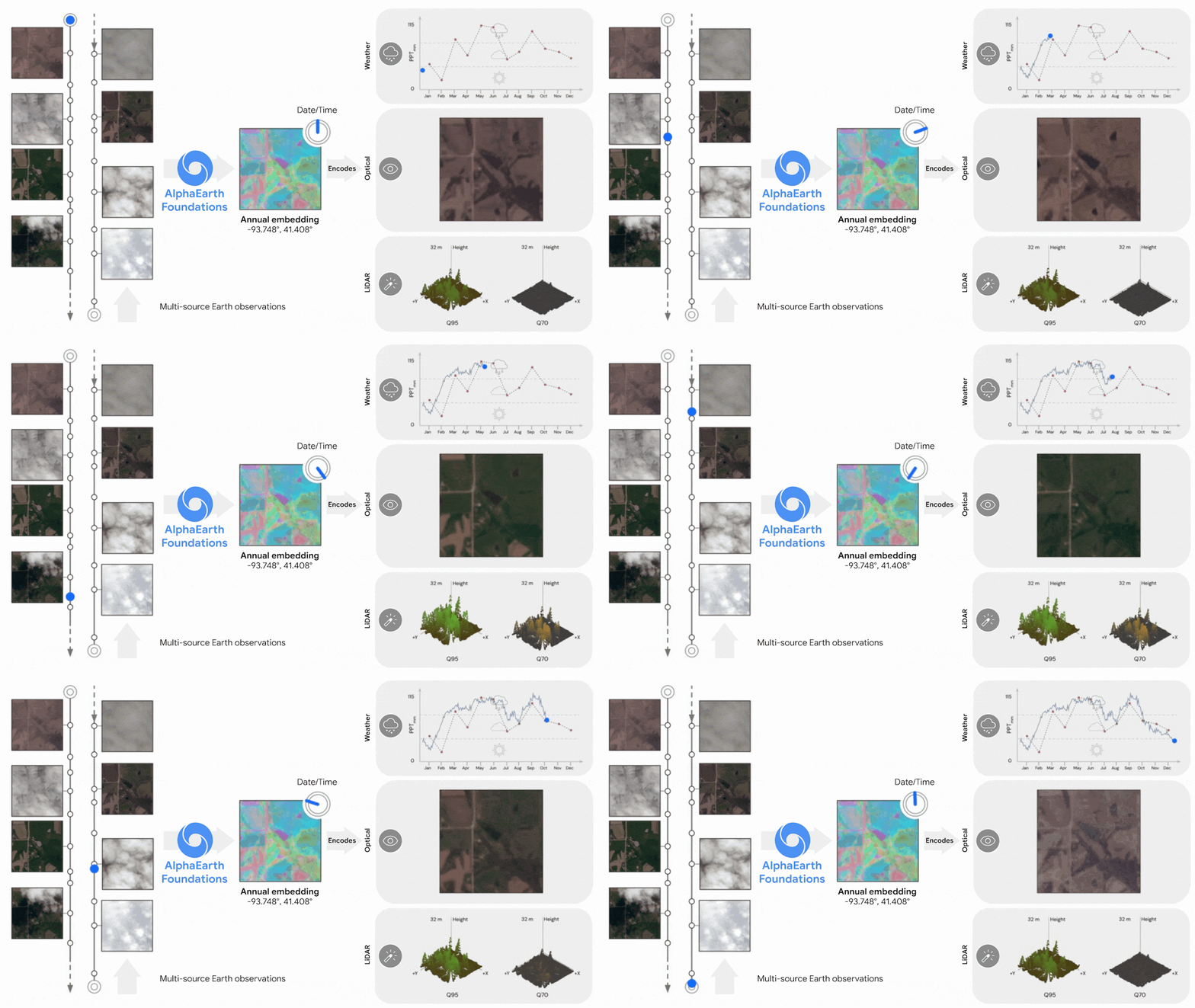
Diagram showing how AlphaEarth Foundations works, taking non-uniformly sampled frames from a video sequence to index any position in time. This helps the model create a continuous view of the location, while explaining numerous measurements.

To ensure AlphaEarth Foundations was ready for real-world use, we rigorously tested its performance. When compared against both traditional methods and other AI mapping systems, AlphaEarth Foundations was consistently the most accurate. It excelled at a wide range of tasks over different time periods, including identifying land use and estimating surface properties. Crucially, it achieved this in scenarios when label data was scarce. On average, AlphaEarth Foundations had a 24% lower error rate than the models we tested, demonstrating its superior learning efficiency. Learn more in our paper.

Diagram showing a global embedding field broken down into a single embedding, from left to right. Each embedding has 64 components which map to coordinates on a 64-dimensional sphere.

Generating custom maps with the Satellite Embedding dataset

Powered by AlphaEarth Foundations, the Satellite Embedding dataset in Google Earth Engine is one of the largest of its kind with over 1.4 trillion embedding footprints per year. This collection of annual embeddings is already being used by organizations around the world, including the United Nations’ Food and Agriculture Organization, Harvard Forest, Group on Earth Observations, MapBiomas, Oregon State University, the Spatial Informatics Group and Stanford University, to create powerful custom maps that drive real-world insights.

For example, Global Ecosystems Atlas, an initiative aiming to create the first comprehensive resource to map and monitor the world’s ecosystems, is using this dataset to help countries classify unmapped ecosystems into categories like coastal shrublands and hyper-arid deserts. This first of its kind resource will play a critical role in helping countries better prioritize conservation areas, optimize restoration efforts, and combat the loss of biodiversity.

The Satellite Embedding dataset is revolutionizing our work by helping countries map uncharted ecosystems - this is crucial for pinpointing where to focus their conservation efforts.

Nick Murray

Director of the James Cook University Global Ecology Lab and Global Science Lead of Global Ecosystems Atlas

In Brazil, MapBiomas is testing the dataset to more deeply understand agricultural and environmental changes across the country. This type of map informs conservation strategies and sustainable development initiatives in critical ecosystems like the Amazon rainforest.

As Tasso Azevedo, founder of MapBiomas said, "The Satellite Embedding dataset can transform the way our team works - we now have new options to make maps that are more accurate, precise and fast to produce - something we would have never been able to do before."

Read more about the Satellite Embedding dataset and see tutorials in the Google Earth Engine blog .

Empowering others with AI

AlphaEarth Foundations represents a significant step forward in understanding the state and dynamics of our changing planet. We’re currently using AlphaEarth Foundations to generate annual embeddings and believe they could be even more useful in the future when combined together with general reasoning LLM agents like Gemini. We are continuing to explore the best ways to apply our model's time-based capabilities as part of Google Earth AI, our collection of geospatial models and datasets to help tackle the planet’s most critical needs.

Learn more about AlphaEarth Foundations

Acknowledgements

This work was a collaboration between teams at Google DeepMind and Google Earth Engine.

Christopher Brown, Michal Kazmierski, Valerie Pasquarella, William Rucklidge, Masha Samsikova, Olivia Wiles, Chenhui Zhang, Estefania Lahera, Evan Shelhamer, Simon Ilyushchenko, Noel Gorelick, Lihui Lydia Zhang, Sophia Alj, Emily Schechter, Sean Askay, Oliver Guinan, Rebecca Moore, Alexis Boukouvalas, Pushmeet Kohli