惯性聚合 高效追踪和阅读你感兴趣的博客、新闻、科技资讯
阅读原文 在惯性聚合中打开

推荐订阅源

C
CXSECURITY Database RSS Feed - CXSecurity.com
WordPress大学
WordPress大学
美团技术团队
Last Week in AI
Last Week in AI
Microsoft Azure Blog
D
DataBreaches.Net
Hugging Face - Blog
Hugging Face - Blog
腾讯CDC
B
Blog RSS Feed
J
Java Code Geeks
The GitHub Blog
The GitHub Blog
人人都是产品经理
人人都是产品经理
Recorded Future
Recorded Future
The Register - Security
博客园 - 三生石上(FineUI控件)
Recent Announcements
Recent Commits to openclaw:main
V
Vulnerabilities – Threatpost
C
Cybersecurity and Infrastructure Security Agency CISA
T
The Exploit Database - CXSecurity.com
博客园 - 【当耐特】
C
Check Point Blog
酷 壳 – CoolShell
酷 壳 – CoolShell
Simon Willison's Weblog
T
Troy Hunt's Blog
P
Privacy International News Feed
S
Security Affairs
The Cloudflare Blog
P
Proofpoint News Feed
G
GRAHAM CLULEY
Engineering at Meta
Engineering at Meta
A
Arctic Wolf
博客园_首页
Blog — PlanetScale
Blog — PlanetScale
D
Docker
S
SegmentFault 最新的问题
N
News | PayPal Newsroom
Cyberwarzone
Cyberwarzone
H
Help Net Security
T
Threatpost
A
About on SuperTechFans
L
LINUX DO - 热门话题
CTFtime.org: upcoming CTF events
N
News and Events Feed by Topic
Attack and Defense Labs
M
MIT News - Artificial intelligence
Schneier on Security
月光博客
月光博客
F
Fortinet All Blogs
L
Lohrmann on Cybersecurity

Jiajun的技术笔记

你好,2026! TiDB 源码阅读(六):TiDB Coprocessor 源码解析 性能优化的核心思想 TiDB 源码阅读(五):索引 TiDB 源码阅读(四):AST、逻辑计划、物理计划 CockroachDB Serverless Architecture podman 无故退出 Cursor Control-L (CTRL-L) Keyboard Shortcuts in Terminal Replace docker with podman Using xmonad with xfce4 A RC script for freebsd frpc 自己动手写一个k8s controller AI 会取代你的(编程)岗位吗? 自建DERP服务器提升Tailscale连接速度(使用Nginx转发) 自动升级Docker容器 再读《程序员修炼之道-从小工到专家》 让浏览器下载文件 再读《软件随想录》/《黑客与画家》/《软技能》 HTTP 压力测试中的 Coordinated Omission 2的补码 编程语言中的 context 是什么? flutter macOS 构建出错 Flatpak 使用小记 Golang CAS 操作是怎么实现的 PostgreSQL 当MQ来使用 Clash 结合 工作VPN 的网络设计 使用 PostgreSQL 搭建 JuiceFS PostgreSQL 配置优化和日志分析 有GitHub Copilot?那就可以搭建你的ChatGPT4服务 窗口函数的使用(以PG为例) 读《为什么学生不喜欢上学》 OpenAI Prompt Engineering 摘录和总结 读《打造真正的新产品》 VueJS 总结 Linux 自动挂载 alist 提供的webdav FreeBSD 使用 vm-bhyve 安装Debian虚拟机 FreeBSD 和 Linux 网卡聚合实现提速 GPT 帮我搞定了时区转换问题 长任务系统如何处理? macOS/Linux 编译 InputLeap 使用开源软KVM - synergy-core 解决 macOS 终端hostname一直变化问题 KVM 共享 Intel 集成显卡 PromQL 备忘 读《格鲁夫给经理人的第一课》 读《打开心智》 为什么要把复杂的联表操作拆成多个单表查询? 红包系统的设计 MySQL Index Condition Pushdown Optimization Go mod 简明教程 OpenWRT 使用 Android/iOS USB 网络 搭建旁路由 Golang gRPC 错误处理 编写可维护的单元测试代码 OAuth 2 详解(六):Authorization Code Flow with PKCE OAuth 2 详解(五):Device Authorization Flow OAuth 2 详解(三):Resource Owner Password Credentials Grant OAuth 2 详解(四):Client Credentials Flow OAuth 2 详解(二):Implict Grant Flow OAuth 2 详解(一):简介及 Authorization Code 模式 ElasticSearch 学习笔记 三种git流程以及发版模型 错误处理实践 权限模型(RBAC/ABAC) OIDC(OpenID Connect) 简介 任务队列简介 PostgreSQL 操作笔记 使用Drone CI构建CI/CD系统 Golang migrate 做数据库变更管理 使用PostgreSQL做搜索引擎 Nginx 源码阅读(三): 连接池、内存池 Nginx 源码阅读(二): 请求处理 Nginx 源码阅读(一): 启动流程 Go 泛型简明教程 KVM 显卡穿透给 Windows 使用 HTTP Router 处理 Telegram Bot 按钮回调 使用反射(reflect)对结构体赋值 GIN 是如何绑定参数的 你好 2022(2021 年终总结) 用Go导入大型CSV到PostgreSQL 使用 OpenWRT 搭建软路由 使用软KVM切换器 barrier 共享键鼠 SQL 防注入及原理 使用 gomock 测试 Go 代码 gevent不是黑魔法(二): gevent 实现 gevent不是黑魔法(一): greenlet 实现 用 entgo 替代 gorm 应用内使用crontab不是那么方便 单测时要不要 mock 数据库? Sentry 自建指南 用selenium完成自动化任务 用闲置的安卓手机做垃圾电话短信过滤 推荐三个时间管理工具 一次事故反思 当JS遇到uint64:JS整数溢出问题 SQLite3 存储以及ACID原理 Redis源码阅读:pub/sub实现 Redis源码阅读:zset实现 Redis源码阅读:bitmap 位图的运算 Redis源码阅读:set是怎么做交并集运算的?
GFS 论文阅读
2017-03-02 · via Jiajun的技术笔记
  • 预期背景

    • Component failures are the norm rather than the exception. So constant monitoring, error detection, fault tolerance, and automatic recovery must be integral to the system.

    • Files are huge by traditional standards. Multi-GB files are common.

    • Most files are mutated by appending new data rather than overwriting existing data.

    • Co-designing the applications and the file system API benefits the overall system by increasing our flexibility.

  • Architecture

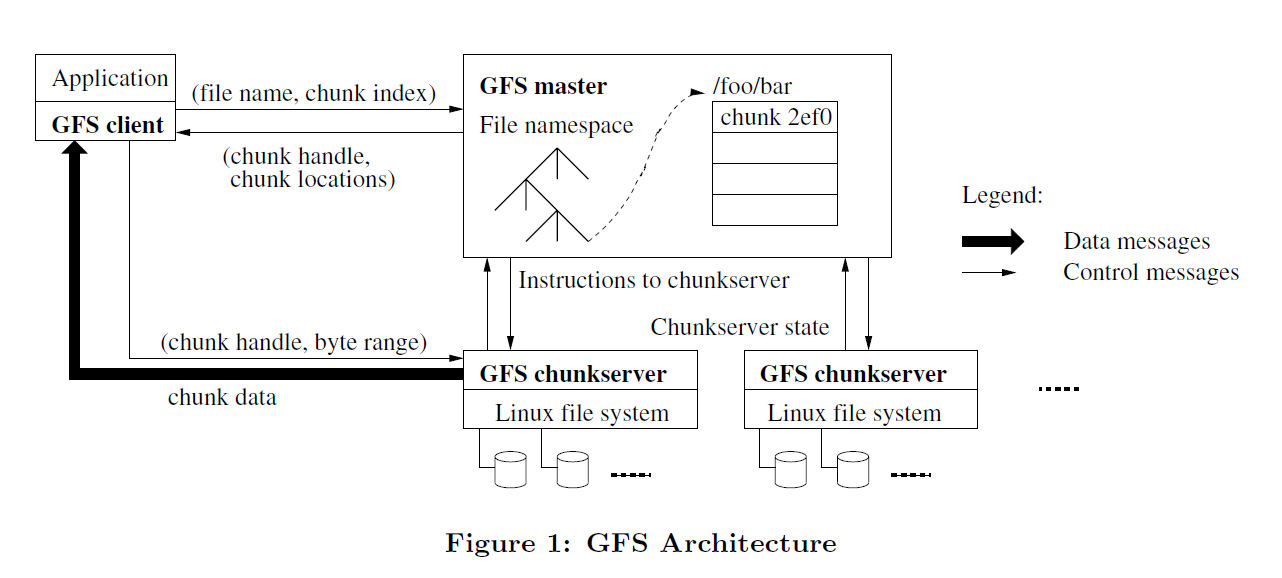
architecture

- A GFS cluster consists of a single master and multiple chunkservers and
is accessed by multiple client.

- Files are divided into fixed-size chunks. Each chunk is identified by an
immutable and globally unique 64 bit chunk handle assigned by the master
at the time of chunk creation. Chunkservers store chunks on local disks as
Linux files and read or write chunk data specified by a chunk handle and
byte range. Each chunk is replicated on multiple chunkservers.

- The master maintains all file system metadata. This includes the
namespace, access control infomation, the mapping from files to chunks,
and the current locations of chunks. It also controls system-wide activities
such as chunk lease management, garbage collection of orphaned chunks, and
chunk migration between chunkservers.

- Neither the client nor the chunkserver caches file data.

    - for client, that's too big
    - for chunkserver, Linux's buffer cache already do this
  • Single master, to prevent the single master become a bottleneck, clients never read and write file data through the master, instead, a client asks the master which chunkservers it should contact, and it caches this infomation for a limited time and interacts with the chunkservers directly for many subsequent operations.

  • Chunk Size

A large chunk size offers serveral important advantages.

- Reduces clients' need to interact with the master

- A client is more likely to perform many operations on a given
chunk, it can reduce network overhead by keeping a persistent TCP
connection to the chunkserver over an extended period of time.

- Reduces the size of the metadata stored on the master.

and it’s disadvantage:

- A small file consists of a small number of chunks, perhaps just one, so
it is more likely to become hot spots.
  • Metadata

The master stores three major types of metadata:

- The file and chunk namespaces

- The mapping from files to chunks

- The locations of each chunk's replicas

All metadata is kept in the master’s memory. And the first two types(namespaces and the mapping from files to chunks) are also kept persistent by logging mutations to an operation log stored on the master’s local disk and replicated on remote machines. Chunkserver store chunk location infomation, and the master asks every chunkserver for chunk location infomation.

- Chunk Locations. The master does not keep a persistent record of which
chunkservers have a replica of a given chunk, it can keep itself up-to-date
by monitor chunkserver status with regular HeartBeat messages.

- The operation log contains a historical record of critical metadata
changes. So it is central to GFS. Also, it's been kept both in local disk
and remote, and the file size should be small.
  • Chunk replicas

Chunk replicas are created for three reasons: chunk creation, re-replication, and rebalancing.


相关文章