
惯性聚合 高效追踪和阅读你感兴趣的博客、新闻、科技资讯
阅读原文 在惯性聚合中打开

推荐订阅源

H
Heimdal Security Blog
P
Privacy International News Feed
S
Schneier on Security
P
Proofpoint News Feed
L
Lohrmann on Cybersecurity
Spread Privacy
Spread Privacy
P
Privacy & Cybersecurity Law Blog
D
Darknet – Hacking Tools, Hacker News & Cyber Security
Scott Helme
Scott Helme
K
Kaspersky official blog
大猫的无限游戏
大猫的无限游戏
freeCodeCamp Programming Tutorials: Python, JavaScript, Git & More
aimingoo的专栏
aimingoo的专栏
Simon Willison's Weblog
S
Securelist
Help Net Security
Help Net Security
B
Blog
H
Hackread – Cybersecurity News, Data Breaches, AI and More
Security Archives - TechRepublic
云风的 BLOG
云风的 BLOG
The GitHub Blog
The GitHub Blog
N
News and Events Feed by Topic
Hacker News: Ask HN
Hacker News: Ask HN
cs.CV updates on arXiv.org
CTFtime.org: upcoming CTF events
M
MIT News - Artificial intelligence
雷峰网
雷峰网
博客园 - 司徒正美
V
V2EX
AWS News Blog
AWS News Blog
Know Your Adversary
Know Your Adversary
N
News | PayPal Newsroom
T
Tor Project blog
Cisco Talos Blog
Cisco Talos Blog
OSCHINA 社区最新新闻
OSCHINA 社区最新新闻
PCI Perspectives
PCI Perspectives
Google DeepMind News
Threat Intelligence Blog | Flashpoint
U
Unit 42
C
Cybersecurity and Infrastructure Security Agency CISA
P
Palo Alto Networks Blog
G
Google Developers Blog
T
Threat Research - Cisco Blogs
博客园 - Franky
I
InfoQ
D
DataBreaches.Net
爱范儿
爱范儿
Y
Y Combinator Blog
博客园 - 叶小钗
奇客Solidot–传递最新科技情报
奇客Solidot–传递最新科技情报

Jiajun的技术笔记

你好,2026! TiDB 源码阅读(六):TiDB Coprocessor 源码解析 性能优化的核心思想 TiDB 源码阅读(五):索引 TiDB 源码阅读(四):AST、逻辑计划、物理计划 CockroachDB Serverless Architecture podman 无故退出 Cursor Control-L (CTRL-L) Keyboard Shortcuts in Terminal Replace docker with podman Using xmonad with xfce4 A RC script for freebsd frpc 自己动手写一个k8s controller AI 会取代你的(编程)岗位吗? 自建DERP服务器提升Tailscale连接速度(使用Nginx转发) 自动升级Docker容器 再读《程序员修炼之道-从小工到专家》 让浏览器下载文件 再读《软件随想录》/《黑客与画家》/《软技能》 HTTP 压力测试中的 Coordinated Omission 2的补码 编程语言中的 context 是什么? flutter macOS 构建出错 Flatpak 使用小记 Golang CAS 操作是怎么实现的 PostgreSQL 当MQ来使用 Clash 结合 工作VPN 的网络设计 使用 PostgreSQL 搭建 JuiceFS PostgreSQL 配置优化和日志分析 有GitHub Copilot?那就可以搭建你的ChatGPT4服务 窗口函数的使用(以PG为例) 读《为什么学生不喜欢上学》 OpenAI Prompt Engineering 摘录和总结 读《打造真正的新产品》 VueJS 总结 Linux 自动挂载 alist 提供的webdav FreeBSD 使用 vm-bhyve 安装Debian虚拟机 FreeBSD 和 Linux 网卡聚合实现提速 GPT 帮我搞定了时区转换问题 长任务系统如何处理? macOS/Linux 编译 InputLeap 使用开源软KVM - synergy-core 解决 macOS 终端hostname一直变化问题 KVM 共享 Intel 集成显卡 PromQL 备忘 读《格鲁夫给经理人的第一课》 读《打开心智》 为什么要把复杂的联表操作拆成多个单表查询? 红包系统的设计 MySQL Index Condition Pushdown Optimization Go mod 简明教程 OpenWRT 使用 Android/iOS USB 网络 搭建旁路由 Golang gRPC 错误处理 编写可维护的单元测试代码 OAuth 2 详解(六):Authorization Code Flow with PKCE OAuth 2 详解(五):Device Authorization Flow OAuth 2 详解(三):Resource Owner Password Credentials Grant OAuth 2 详解(四):Client Credentials Flow OAuth 2 详解(一):简介及 Authorization Code 模式 ElasticSearch 学习笔记 三种git流程以及发版模型 错误处理实践 权限模型(RBAC/ABAC) OIDC(OpenID Connect) 简介 任务队列简介 PostgreSQL 操作笔记 使用Drone CI构建CI/CD系统 Golang migrate 做数据库变更管理 使用PostgreSQL做搜索引擎 Nginx 源码阅读(三): 连接池、内存池 Nginx 源码阅读(二): 请求处理 Nginx 源码阅读(一): 启动流程 Go 泛型简明教程 KVM 显卡穿透给 Windows 使用 HTTP Router 处理 Telegram Bot 按钮回调 使用反射(reflect)对结构体赋值 GIN 是如何绑定参数的 你好 2022(2021 年终总结) 用Go导入大型CSV到PostgreSQL 使用 OpenWRT 搭建软路由 使用软KVM切换器 barrier 共享键鼠 SQL 防注入及原理 使用 gomock 测试 Go 代码 gevent不是黑魔法(二): gevent 实现 gevent不是黑魔法(一): greenlet 实现 用 entgo 替代 gorm 应用内使用crontab不是那么方便 单测时要不要 mock 数据库? Sentry 自建指南 用selenium完成自动化任务 用闲置的安卓手机做垃圾电话短信过滤 推荐三个时间管理工具 一次事故反思 当JS遇到uint64:JS整数溢出问题 SQLite3 存储以及ACID原理 Redis源码阅读:pub/sub实现 Redis源码阅读:zset实现 Redis源码阅读:bitmap 位图的运算 Redis源码阅读:set是怎么做交并集运算的? Redis源码阅读:list实现(ziplist, quicklist)
OAuth 2 详解(二):Implict Grant Flow
Jiajun Huang · 2022-10-09 · via Jiajun的技术笔记

RFC6749 中,Implict Grant Flow的流程图比较复杂:

+----------+
| Resource |
|  Owner   |
|          |
+----------+
     ^
     |
    (B)
+----|-----+          Client Identifier     +---------------+
|         -+----(A)-- & Redirection URI --->|               |
|  User-   |                                | Authorization |
|  Agent  -|----(B)-- User authenticates -->|     Server    |
|          |                                |               |
|          |<---(C)--- Redirection URI ----<|               |
|          |          with Access Token     +---------------+
|          |            in Fragment
|          |                                +---------------+
|          |----(D)--- Redirection URI ---->|   Web-Hosted  |
|          |          without Fragment      |     Client    |
|          |                                |    Resource   |
|     (F)  |<---(E)------- Script ---------<|               |
|          |                                +---------------+
+-|--------+
  |    |
 (A)  (G) Access Token
  |    |
  ^    v
+---------+
|         |
|  Client |
|         |
+---------+

但是实际应用中,我们通常只会采用 ABCG 四步,省略DEF。Implict Grant 是一种简化的授权流程,它的流程如下:
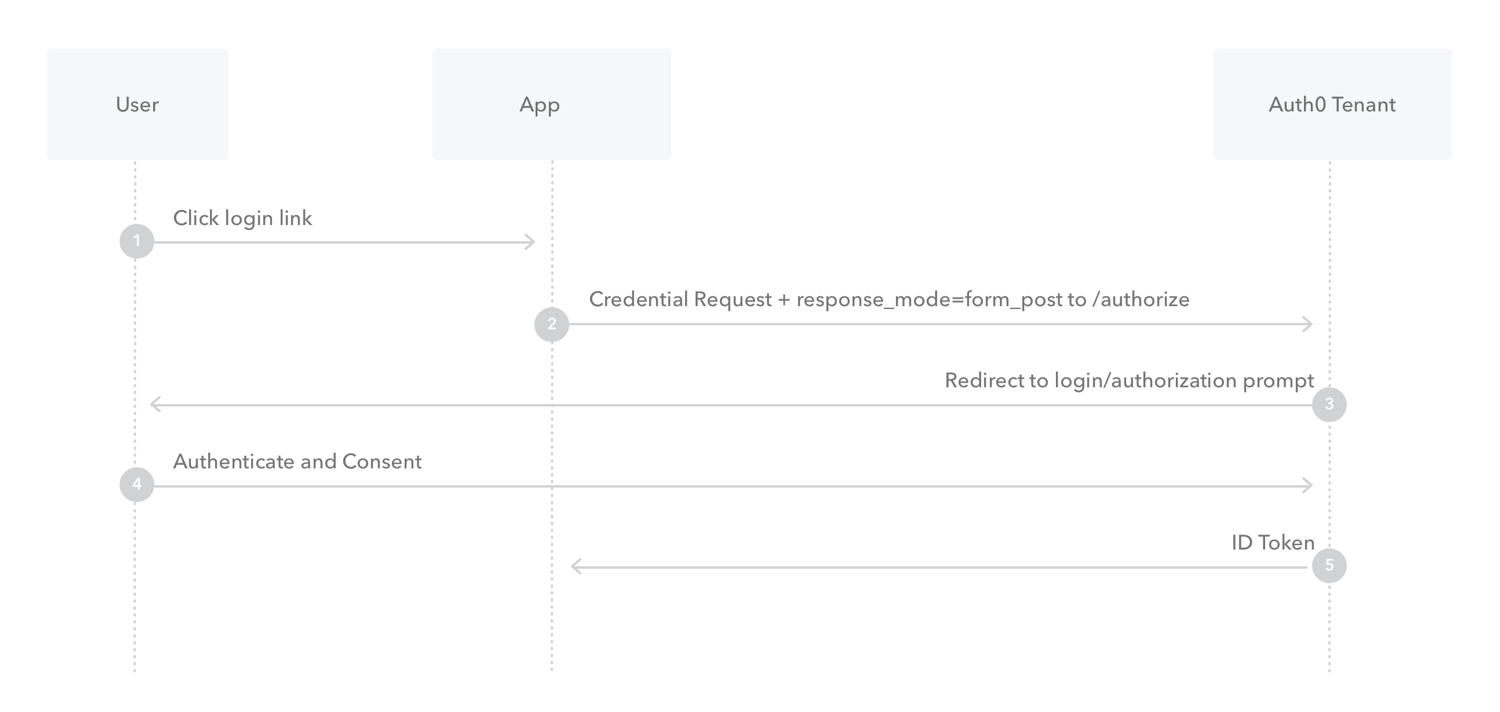
Implict Grant Flow

  1. 用户点击登录
  2. 浏览器(或者App打开webview)重定向到Authorization Server,带上 client_id, redirect_uri, scope, state, response_type 设置为 token
  3. Authorization Server 检测到用户没有登录或没有授权过,重定向到授权页面(如果没有登录,先到登录页)
  4. 用户同意授权
  5. Authorization Server 重定向回第2步设置的 redirect_uri,并且带上 access_token, state, expires_in

至此,我们就已经拿到了 access_token,从而可以进行后续步骤。而RFC中,多出了 D、E两步,我们可以看一下RFC中的流程描述:

The flow illustrated in Figure 4 includes the following steps:

   (A)  The client initiates the flow by directing the resource owner's
        user-agent to the authorization endpoint.  The client includes
        its client identifier, requested scope, local state, and a
        redirection URI to which the authorization server will send the
        user-agent back once access is granted (or denied).

   (B)  The authorization server authenticates the resource owner (via
        the user-agent) and establishes whether the resource owner
        grants or denies the client's access request.

   (C)  Assuming the resource owner grants access, the authorization
        server redirects the user-agent back to the client using the
        redirection URI provided earlier.  The redirection URI includes
        the access token in the URI fragment.

   (D)  The user-agent follows the redirection instructions by making a
        request to the web-hosted client resource (which does not
        include the fragment per [RFC2616]).  The user-agent retains the
        fragment information locally.

   (E)  The web-hosted client resource returns a web page (typically an
        HTML document with an embedded script) capable of accessing the
        full redirection URI including the fragment retained by the
        user-agent, and extracting the access token (and other
        parameters) contained in the fragment.

   (F)  The user-agent executes the script provided by the web-hosted
        client resource locally, which extracts the access token.

   (G)  The user-agent passes the access token to the client.

   See Sections 1.3.2 and 9 for background on using the implicit grant.
   See Sections 10.3 and 10.16 for important security considerations
   when using the implicit grant.

我们结合实际的例子,那就是在App里,使用Google帐号登录,那么就应该先弹出一个Webview才能进行URL跳转,所以结合这个例子,步骤就是:

  • 步骤A: App打开webview,将网页重定向到授权服务器,授权服务器展示授权页面
  • 步骤B: 用户同意授权
  • 步骤C: 授权服务器重定向回步骤A中给定的 redirect_uri,并且在URL中携带 access_token
  • 步骤D: 由于这是一个浏览器页面,App无法直接将 access_token 返回给App,所以再次重定向到一个客户端获取access_token用的页面
  • 步骤E: 该页面执行一段 JS 脚本,将 access_token 提取出来
  • 步骤F: 返回给App

实际上,我们可以把步骤D、E、F合并成一个步骤,也就是当授权服务器重定向回来时,我们就在该页面执行一段JS脚本,将 access_token 提取出来,然后使用JS Bridge,或者deeplink的方式将access token提交给App,这样就简化了整个流程。

Implict Grant Flow缺点

Implict Grant Flow 的优点就是,简单,比起 Authorization Code Flow来说,少了很多步骤,但是缺点就是由于 access_token 是存放 在URL里,如果将URL分享出去了,那么拿到 access_token 就可以访问对应的资源,不是很安全。现在业界不是很推荐使用这种授权方式。


refs: