

惯性聚合 高效追踪和阅读你感兴趣的博客、新闻、科技资讯
阅读原文 在惯性聚合中打开

推荐订阅源

罗磊的独立博客
Forbes - Security
Forbes - Security
Blog — PlanetScale
Blog — PlanetScale
P
Proofpoint News Feed
Apple Machine Learning Research
Google DeepMind News
MyScale Blog
MyScale Blog
GbyAI
GbyAI
B
Blog RSS Feed
S
SegmentFault 最新的问题
freeCodeCamp Programming Tutorials: Python, JavaScript, Git & More
cs.AI updates on arXiv.org
CTFtime.org: upcoming CTF events
小众软件
小众软件
The Last Watchdog
The Last Watchdog
W
WeLiveSecurity
Webroot Blog
Webroot Blog
S
Security @ Cisco Blogs
Hugging Face - Blog
Hugging Face - Blog
Microsoft Security Blog
月光博客
月光博客
博客园 - 聂微东
F
Fortinet All Blogs
H
Hacker News: Front Page
A
About on SuperTechFans
Application and Cybersecurity Blog
C
Check Point Blog
V
V2EX
Threat Intelligence Blog | Flashpoint
Y
Y Combinator Blog
酷 壳 – CoolShell
酷 壳 – CoolShell
N
News | PayPal Newsroom
Cisco Talos Blog
Cisco Talos Blog
Exploit-DB.com RSS Feed
The Cloudflare Blog
P
Privacy & Cybersecurity Law Blog
N
Netflix TechBlog - Medium
C
CXSECURITY Database RSS Feed - CXSecurity.com
Recorded Future
Recorded Future
Cyber Security Advisories - MS-ISAC
Google DeepMind News
大猫的无限游戏
大猫的无限游戏
美团技术团队
Security Latest
Security Latest
钛媒体:引领未来商业与生活新知
钛媒体:引领未来商业与生活新知
I
InfoQ
Recent Announcements
The GitHub Blog
The GitHub Blog
Google Online Security Blog
T
The Exploit Database - CXSecurity.com

夜行人

回家路上 第一期的直播演示项目 震动检测器 正能量 在线参观CodeLab Neverland 发布 CodeLab Adapter 3.3.1 DynamicTable 之 纸糊方向盘 CodeLab DynamicTable: 一个可实施的技术方案 CodeLab Insight 发布 Alpha 版 情人节 Home Assistant 周报 && IoT 周报 (02) Joplin: 关注隐私的 Evernote 开源替代软件 浏览器的未来与 Web 传感器 Home Assistant 周报 && IoT 周报 (01) 百宝箱(01) 论自由 介绍 WebThings Home Assistant 周报 && iot 周报 (00) 百宝箱(00) 毛姆读书心得 传世之作 周末徒步 CodeLab Adapter ❤️ Jupyter/Python 航班 躲雨 夏令营途中 [译]思想--作为一种技术 The future of coding 美国之行 三门问题的程序模拟 从Python转向Pharo https://blog.just4fun.site/post/iot/iot-open-source-projects/ Python异步编程笔记 https://blog.just4fun.site/post/iot/iot-open-source-hardware-community/ 万物积木化开发者社区 CodeLab ❤️ Blender Scratch3技术分析之云变量 API(第7篇) [译]对管道(Pipes)的偏爱 [译]提出正确的问题比得到正确答案更重要 蓝牙设备与Scratch3.0 创建你的第一个Scratch3.0 Extension Scratch3技术分析之项目内部数据(第6篇) Scratch3技术分析之社区 API(第5篇) Scratch3技术分析之User API(第4篇) Scratch3技术分析之项目主页API(第3篇) Scratch3技术分析之静态资源API(第2篇) Scratch3.0、micro:bit与Windows7 https://blog.just4fun.site/post/iot/zerynth-vs-micropython/ 核聚变、方所与半宅空间 可视化编程为何是个糟糕的主意 codelab.club周末聚会 关于codelab.club '下一件大事'是一个房间 Hungry Robot - Eat everything 编程作为一种思考方式 今日简史 史蒂夫·乔布斯传 罗素自选文集 https://blog.just4fun.site/post/edx/tianjin-scratch-ai/ https://blog.just4fun.site/post/edx/richie-cms-openedx/ 徒步武功山 WebUSB与micro:bit 积木化编程与3D场景 夜宿武功山顶 scratch3-adapter接入优必选Alpha系列机器人 https://blog.just4fun.site/post/edx/video-migration-note/ scratch3-adapter重构笔记 https://blog.just4fun.site/post/edx/edx-community-members/ 两种硬件编程风格的比较 使用micro:bit自制PPT翻页笔 柏拉图对话集 scratch3.0 + micro:bit 七月电影放映计划 非营利组织的管理 Screenly--用树莓派让任何屏幕变为可编程的数字标牌 以最佳实践开始你的Django项目 micro:bit与事件驱动 为Scratch3.0设计的插件系统(上篇) OCR应用一例 近两年读过的一些好书 blockly开发之使用python驱动浏览器中的turtle(2) 牛顿新传 文学理论入门 逻辑的引擎 人生的意义 blockly开发之生成并运行js代码(1) blockly开发之hello world(0) micro:bit使用笔记 神器之Termux https://blog.just4fun.site/post/iot/micropython-notes/ Cozmo what is this Scratch的前世今生 下段旅程 我行在远方 爆裂 途中杂记 https://blog.just4fun.site/post/edx/open-edx-startup/ cozmo系列之入门 - 有性格且可编程的机器人 PaperWeekly开发笔记 创业二三事
Snap! websocket 驱动库
种瓜 · 2023-11-17 · via 夜行人

文章目录

前言

在上一篇文章(Snap! 蓝牙驱动库)中, 我们记录了如何通过构建 BLE echo client, 得到通用的 BLE primitives。

Snap 与外部系统的交互, 就消息传递层面而言是相似的, 有三种操作: write/read/notify。这三种操作在 Adapter EIM primitives 和 BLE primitives 中都有体现。 read 和 notify 都是为了从外部系统获取数据, 但采用了不同的方式, read 是"拉"模式, notify 是"推"模式。 notify 一般适合使用 callback, 将数据抛到 Snap! 里。

由于都是 write/read/notify 操作。我们便可以参考 BLE primitives, 实现 websocket primitives。

如何调试

上一篇文章写道:

这与调试 HTTP API 颇为相似。调试 HTTP API 时,我们经常需要弄清楚,客户端代码是否按照接口的要求,发送了正确的数据。达成目标的一种方法是构建一个 echo server, 它将我们发送消息原样返回,如一面镜子一样,让客户端知道自己做了什么。 httpbin 是这个领域的出色工具。

我想在调试 BLE 客户端(BLE 主机)时,拥有类似的东西,它能够原样返回我发出的数据。我需要构建一个 BLE echo server。有 2 个不错的方案可供选择…

同样地, 在此也想要一个 echo server , “它将我们发送消息原样返回”, 有了 echo server的反馈, 我们才知道构建出的 primitives , 它做的事情到底对不对。

使用以下 Python 代码, 可以构建出一个简单的 websocket echo server, 将其命名为 websocket-echo-server.py, 运行之前需要先安装依赖: python -m pip install websockets, 然后你就可以运行它 python websocket-echo-server.py

运行起来之后, 可以通过这个url连接它: ws://localhost:8765

 1
 2
 3
 4
 5
 6
 7
 8
 9
10
11
# pip install websockets
from websockets.sync.server import serve

def echo(websocket):
    for message in websocket:
        print("recv: ", message)
        websocket.send(message)

with serve(echo, "localhost", 8765) as server:
    print("websocket echo server is running...")
    server.serve_forever()

同步版本:

1
2
3
4
5
6
7
8
import websockets

def echo(websocket):
    for message in websocket:
        websocket.send(message)

with websockets.sync.server.serve(echo) as server:
    server.serve_forever()

如果你更喜欢在 MicroBlocks 的活性环境, 也可以使用 MicroBlocks(esp32) 运行一个 websocket echo server。

示例代码

运行之后, 你需要先获知板子的 IP 地址, 然后通过这个url连接它ws://IP:81 (将IP替换为真实地址)。

了解 websocket client 的 API

为了制作 websocket primitives, 我们还需要熟悉下 websocket client 的 API。 以下这段简短的代码很好地展示了我们将使用的 API

 1
 2
 3
 4
 5
 6
 7
 8
 9
10
11
12
13
14
15
16
17
18
19
20
// https://developer.mozilla.org/en-US/docs/Web/API/WebSocket

// Create WebSocket connection.
const socket = new WebSocket("ws://localhost:8765");

// Connection opened
socket.addEventListener("open", (event) => {
  socket.send("Hello Server!");
});

// Listen for messages
socket.addEventListener("message", (event) => {
  console.log("Message from server ", event.data);
});

socket.addEventListener('close', function (event) {
    console.log('disconnected');
});

// socket.close();

编写 primitives

编写 primitives 的工作可以交给 ChatGPT, 但由于我们已经有了 BLE primitives , 手动调整为 websocket primitives 会更快。不然交给 ChatGPT 写, 等它写完后, 我们还是得调整。

使用 primitives
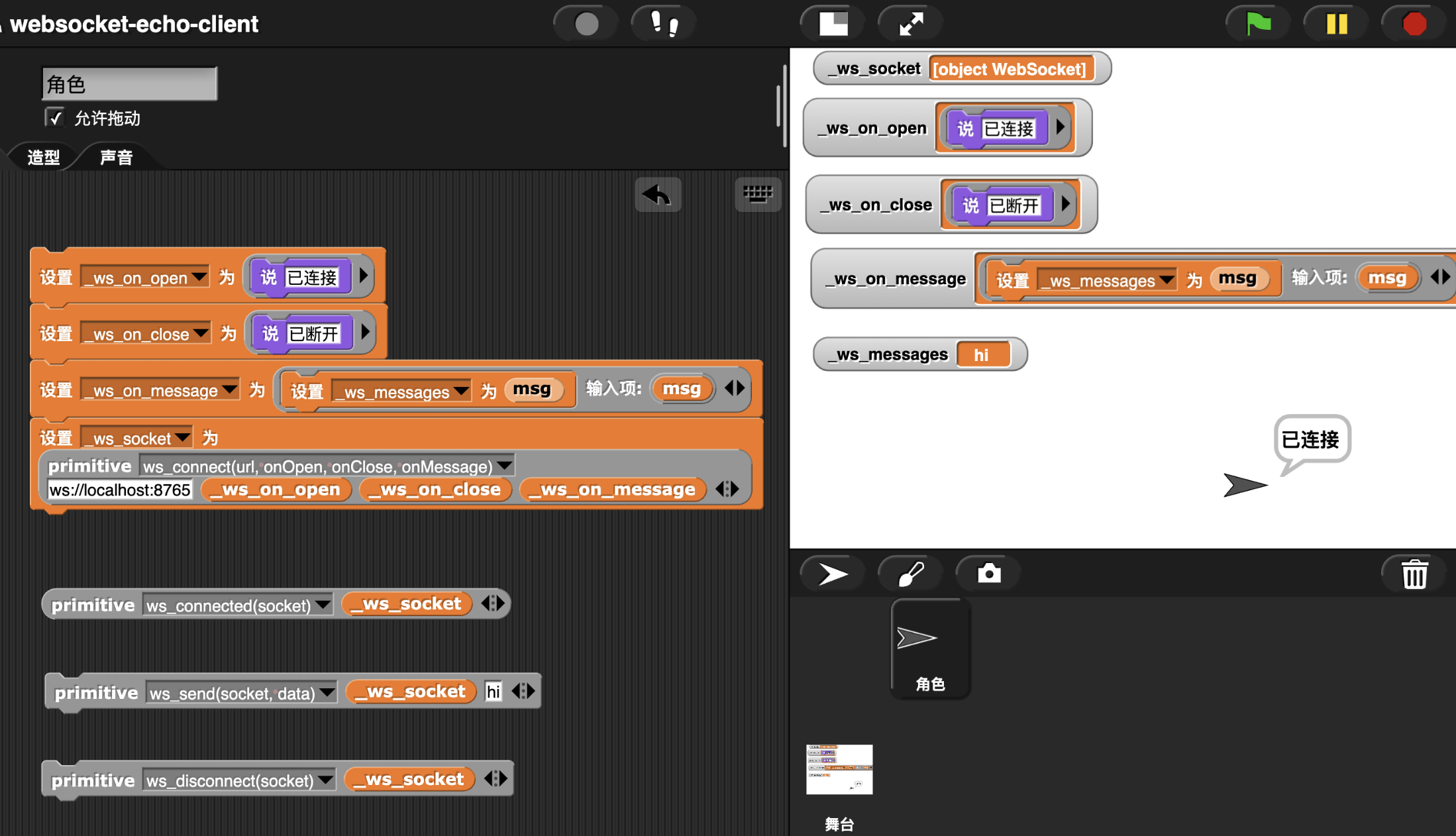
将这些积木放入自定义积木里, 就可以构建出 websocket echo client, 和上一篇文章基本相同, 就不在此展示了,作为给读者的课后作业 :)

参考