






Udacity and DataCamp both show up constantly in conversations about learning data science, machine learning, and analytics online, but they take very different approaches to getting you there.
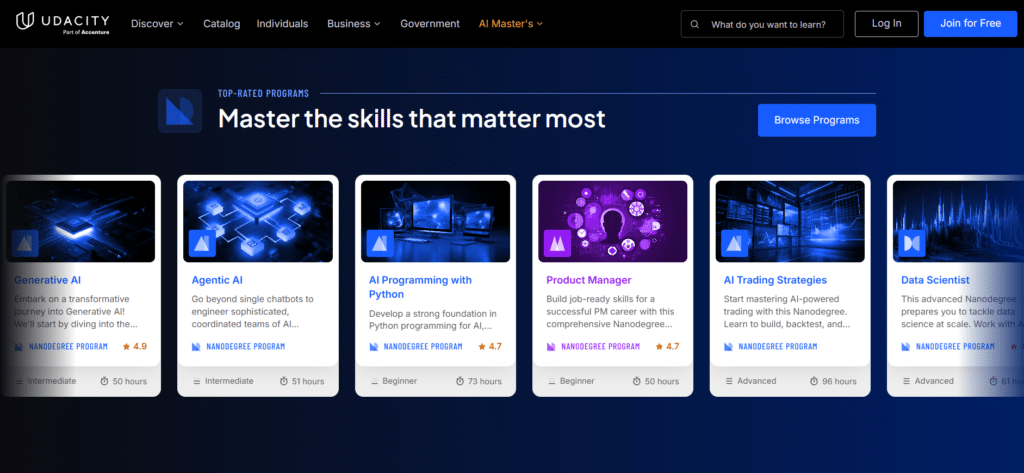
One is built around long-form, project-driven Nanodegree programs with human mentorship.
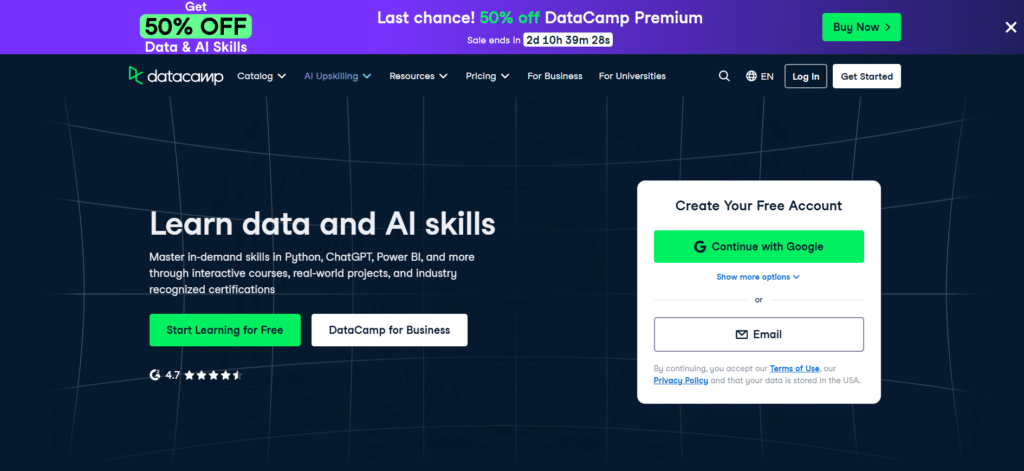
The other is built around fast, interactive, browser-based exercises designed to get you writing code within minutes of starting a course. Both have loyal followings.
Udacity teaches you to complete a data science project from messy data to a finished deliverable, with a mentor and a human reviewer guiding you the entire way.
DataCamp teaches you specific technical skills through fast, repeatable, interactive coding exercises, with no mentor and minimal hand-holding once you understand the mechanics.
Everything else in this comparison flows from that core distinction.
Udacity’s Nanodegree format:
DataCamp’s skill track and career track format:
The practical experience of using each platform feels noticeably different. DataCamp sessions are short, satisfying, and easy to fit into a lunch break or a commute. Udacity sessions require more sustained focus because you are working toward a project deliverable, not just completing an exercise.
Neither format is inherently better. DataCamp’s bite-sized approach builds consistent habits and works well for repetitive skill practice. Udacity’s longer-form structure suits people who learn best by building something complete from start to finish.
This is where the two platforms diverge most sharply, and it matters a great deal depending on what you are trying to achieve.
DataCamp’s interactive coding environment is genuinely excellent at what it does. Every lesson includes embedded coding challenges where you write real code, get immediate pass/fail feedback, and move to the next concept.
There is no setup required, no local environment to configure, and the instant feedback loop makes it easy to identify exactly where your understanding breaks down.
The limitation is that these exercises are narrow by design. You are usually working with a pre-cleaned dataset and a specific, well-defined task: write this function, calculate this statistic, build this plot.
That is excellent for learning syntax and individual techniques. It does not simulate the experience of facing a messy, real-world dataset with no clear instructions, which is most of what actual data science work looks like.
Udacity’s project model asks you to do exactly that. Projects in the Data Science Nanodegree, the Machine Learning Engineer Nanodegree, and similar programs hand you open-ended problems: clean this messy dataset, build a model that solves this business problem, deploy it, and explain your results.
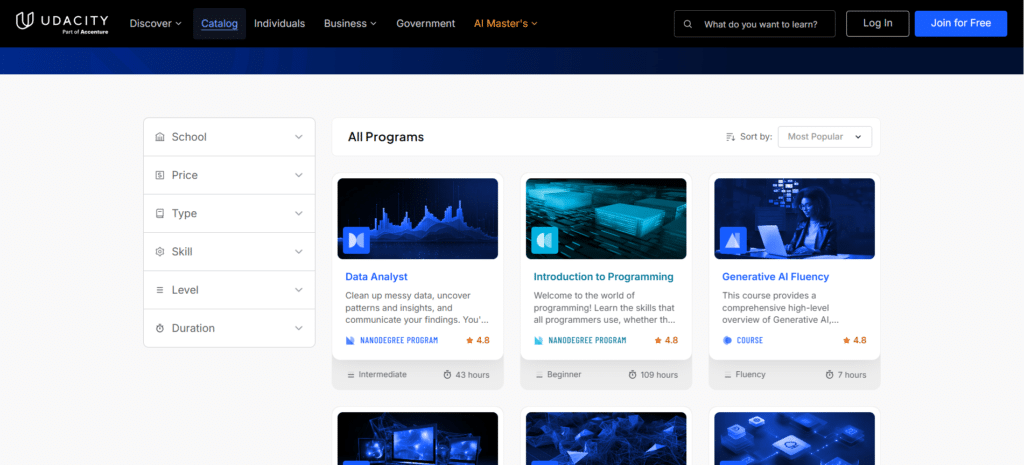
A human reviewer then evaluates your submission against a rubric and gives you specific written feedback on what to fix before you can move forward.
This difference matters enormously for portfolio building. A DataCamp completion certificate tells an employer you worked through a structured curriculum.
A Udacity project, reviewed and approved by a human expert, is something you can put directly into a GitHub portfolio and discuss in a technical interview as something you actually built and defended.
Udacity includes one-on-one mentorship as a core part of every Nanodegree. You get scheduled video sessions with an assigned mentor, ongoing access to ask questions, and career coaching as you approach the end of your program.
Mentor quality varies across the network, but having a real person to unblock you on a stuck concept is a meaningful advantage that shapes how far you actually get through a difficult program.
DataCamp has no mentorship system. Support is limited to community forums, written documentation, and occasional instructor Q&A on certain courses.
If you get stuck on a concept that the lesson does not explain clearly, you are largely on your own to search forums or look elsewhere for an explanation.
For self-directed learners who rarely get stuck or who are comfortable troubleshooting independently, this gap matters less.
For career switchers tackling genuinely new material, the absence of a mentor is one of the more significant trade-offs DataCamp asks you to accept in exchange for its lower price.
DataCamp’s catalog is built entirely around data: data science, data analysis, data engineering, machine learning, AI, and the surrounding tools (SQL, Python, R, Power BI, Tableau, Spark, cloud data platforms).
Within this focus, the catalog is genuinely deep, with dozens of courses on specific libraries, techniques, and tools, frequently updated as new versions and tools emerge.
Udacity’s catalog covers data science and machine learning as part of a broader technology offering that also includes cloud computing, programming, cybersecurity, and product management.
Within data science specifically, the curriculum is narrower than DataCamp’s in terms of raw course count, but each Nanodegree goes deeper into a complete, end-to-end skill set rather than isolated technique practice.
If your goal is broad exposure to many data tools and techniques across a long learning journey, DataCamp’s catalog depth serves that well.
If your goal is mastering a specific, complete skill set tied to a job role, Udacity’s narrower, more structured approach gets you there with fewer detours.
Udacity positions itself explicitly around career transitions. Beyond the technical curriculum, Nanodegrees include resume review, LinkedIn and GitHub portfolio feedback, interview preparation, and access to hiring partner job postings.
The Nanodegree certificate carries reasonable name recognition in technical hiring circles, particularly in data science and machine learning roles, partly because the curriculum is built with input from companies actively hiring for these positions.
DataCamp does not offer career services. Its certificates verify skill completion but carry less weight in hiring conversations than a portfolio of real projects would. DataCamp has, however, built a stronger reputation specifically as a credible signal of technical proficiency among data professionals who recognise the brand, since its certifications (including specific technical skill assessments) are used internally by some companies for screening.
For someone actively trying to land their first data science role, Udacity’s career layer adds real, tangible value that DataCamp simply does not provide. For someone upskilling within a current job or adding tools to an existing skill set, the absence of career services on DataCamp matters far less.
Udacity pricing in 2026:
DataCamp pricing in 2026:
The cost gap between the two platforms is significant. A full year of DataCamp costs roughly what one to two months of a Udacity Nanodegree costs.
This is the central trade-off of the entire comparison: DataCamp gives you a much lower financial commitment with continuous access to a constantly updated catalog, while Udacity asks for a larger one-time investment in exchange for a structured path, project feedback, and mentorship.
DataCamp has built out a respected internal certification system, including Data Scientist, Data Analyst, and Data Engineer certifications that combine a timed practical exam with a case study presentation.
These certifications are increasingly recognised among data professionals as a credible signal of applied skill, partly because the assessment format requires demonstrating ability under time pressure rather than just completing course content.
Udacity’s Nanodegree certificate functions differently. It is awarded on completion of the full program and its projects rather than through a separate timed exam.
It signals that you completed a structured curriculum and had your work evaluated by a human reviewer at each stage, which is a different kind of credibility than a standalone certification exam provides.
Neither credential carries the institutional weight of a university degree or a vendor certification like an AWS or Google Cloud credential, but both are reasonably well recognised within their respective communities.
Many learners do, and it is a genuinely smart combination. DataCamp works well as an ongoing, low-cost way to build and maintain technical fluency across many tools, while Udacity serves as the focused, structured investment for the specific career transition itself.
A common pattern looks like this: spend a few months on DataCamp building foundational comfort with Python, SQL, and core statistics at a low monthly cost, then commit to a Udacity Nanodegree once you are confident in the direction you want to take and ready to invest in the mentored, project-heavy program that builds your actual portfolio.
Using DataCamp first also reduces the risk of paying for a Udacity Nanodegree and discovering early on that foundational gaps are slowing you down.
Arriving at Udacity already comfortable with basic Python and SQL means your mentor sessions and project time go toward the harder, more valuable parts of the curriculum rather than catching up on fundamentals.
DataCamp and Udacity are not really competing for the same dollar. DataCamp is the better tool for continuous, affordable, hands-on skill maintenance and exploration across a wide range of data topics.
Udacity is the better tool for a focused, accountable, mentor-supported transition into a specific data science or machine learning role, backed by real projects and career support that actually move the needle on getting hired.
If your goal in 2026 is genuinely changing careers into data science and you want the platform most likely to get you there with a portfolio, a mentor, and career support behind you, Udacity remains the stronger choice despite the higher price.
If your goal is building and maintaining technical skills affordably over the long term, DataCamp delivers excellent value and a catalog that keeps pace with how fast data tools change.
The honest answer for most serious learners is that the two platforms solve different problems well, and using DataCamp to build fluency before committing to a focused Udacity program is one of the more cost-effective learning paths available right now.
此内容由惯性聚合(RSS阅读器)自动聚合整理,仅供阅读参考。 原文来自 — 版权归原作者所有。