





April 27, 2026 Timothy Prickett Morgan
With the Power11 systems upgrade cycle only nine months old and with price increases that have been happening monthly since early April 1 and possibly continuing through the end of the year, we expect for the Power Systems business to be up in 2026 for the full year.
In the first quarter of 2026 ended in March, IBM’s Infrastructure group, which includes sales of servers, storage, operating systems, and used gear, posted sales of $3.33 billion, up 15.3 percent. Gross profits rose by 24.2 percent for the Infrastructure group, to just a tad under $1.9 billion, and pre-tax income for the systems business as a whole came to $1.6 billion, 2.1X higher than a year ago thanks in part to some price increases instituted last fall and despite ever-declining revenues for infrastructure support.
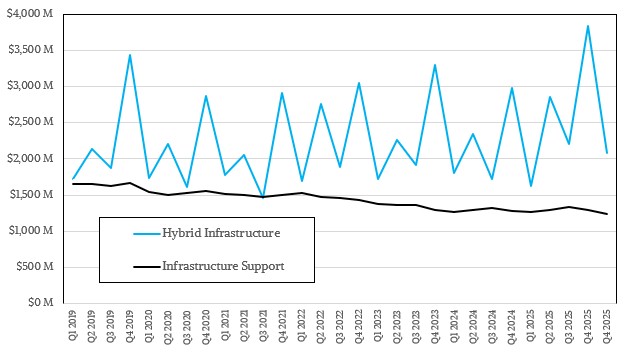
Here is how what IBM calls Hybrid Infrastructure sales – meaning everything except support – have stacked up against tech support services for IBM’s Power Systems and System z platforms over the past six years:
IBM is caught in a bit of a quandary when it comes to tech support. If it raises its prices, then a percentage of the IBM Faithful will go off support and wing it with third party suppliers of tech support or hardware replacement services. But it has to generate more revenue to generate more profits – unless it uses GenAI to do more of the tech support grunt work. If it does too much of that, then customers will catch wind of it and just start using a frontier model pumped up with IBM i system data and wing it.
We don’t advise this for Power Systems any more than we would for the mainframe. IBM may call the Power Systems a part of a division called Distributed Systems, and while it may have sold clusters of Power iron for massively distributed supercomputers in the past, most of the revenues for IBM systems aside from X86 iron were to run back office applications running atop relational databases. They are essentially just a flavor of mainframe.
So you can imagine how annoyed I get when Power Systems revenues get lumped into this amorphous blob of Power iron plus all external storage products for all IBM machinery. It is deliberate obfuscation because IBM does not want us to see the independent ups and downs of the Power Systems and Storage divisions, which absolutely exist distinct from each other the way Big Blue runs its business.
And so, I have to try to pull it all apart and make our best estimate of where the Power Systems business is and how it is doing relatively to the storage products from the very few statements that Arvind Krishna, IBM’s chief executive officer, and James Kavanaugh, the company’s chief financial officer, make on their quarterly calls with Wall Street.
Let’s do the math, then.
In the quarter, Hybrid Infrastructure revenues rose by 28.3 percent to $2.09 billion, in our model, while Infrastructure Support was down 1.5 percent to $1.24 billion. System z sales were up 51 percent as reported, but against what we figure was a pretty weak Q1 2025 with the System z17 machines still on the horizon at that time, just as was the case with the Power11 iron. Distributed Infrastructure, that hodge-podge of stuff that includes Power iron and systems software, rose by 17 percent. IBM does not give out specific revenue numbers, as we have said, and you can forget about getting a breakdown between IBM i, AIX, and Linux.
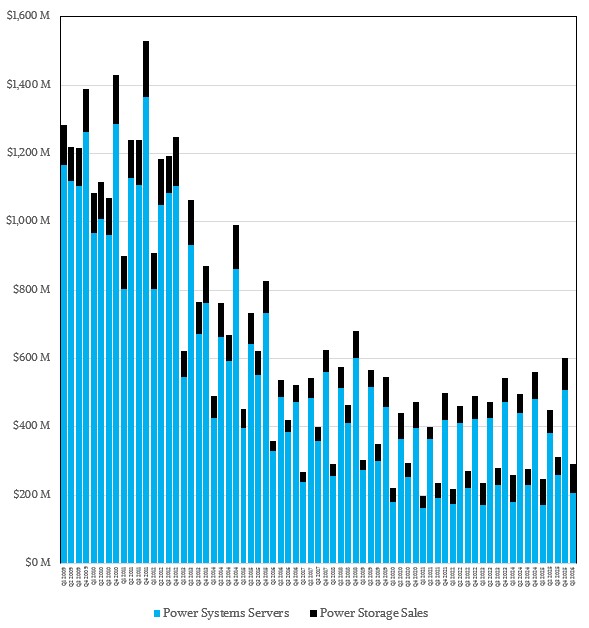
Our best guess is that Power Systems machines proper – those sold into the channel or directly to customers to be used mostly as back office or regional office, mainframe-style centralized systems as has been the case for decades, accounted for $205 million in sales, up 19 percent. Storage arrays based on Power iron accounted for another $86 million in sales, up 15 percent year on year in our model. That is $292 million in revenues, up 17.8 percent.
The jump in Power Systems sales in Q1 2026 is before the April 1 and now May 1 price increases kicked in, which most definitely will be part of the Q2 2026 financial results. There was enough warning in the channel of an impending price hike – which we kept you appraised of well before it happened – that maybe the March revenue figures were boosted by the April 1 price hikes a little bit as word got out that some big changes in the price list were coming. It will be interesting to see how these rather dramatic price increases – the price of DRAM memory and flash for Power Systems machines has nearly doubled in two months – translates into extra revenues for Big Blue. It may do so, but hurt profits depending on how much Big Blue is sharing the pain with customers. We think rising DRAM and flash prices in 2025 definitely hurt all server makers.
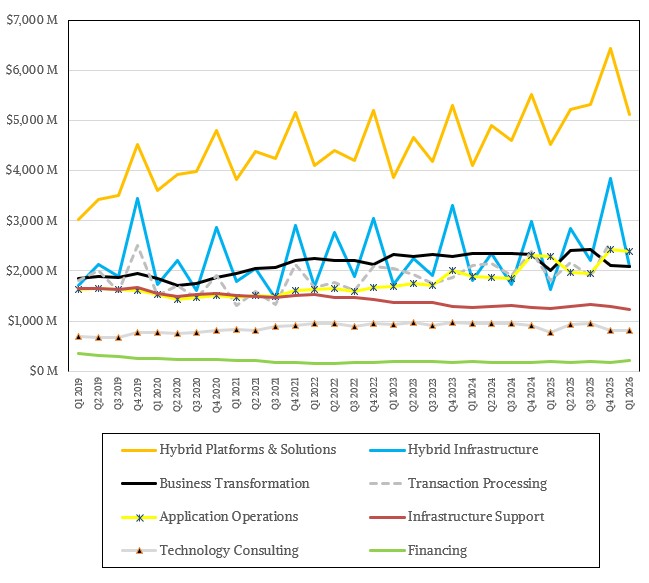
Thanks to an ever-embiggening software business driven by the Linux platform and the commercialization of various data analytics and AI workloads (and not just GenAI, but also classical machine learning), IBM’s Software group has been growing beyond its System z and Power Systems core. The Software group had $7.05 billion in sales, up 11.3 percent, and had a pre-tax income of $2.1 billion. It is no exaggeration to say that this software business is the profit engine of the company.
The Consulting group, which drove $5.27 billion in sales (up 4 percent) had a mere $558 million in pre-tax income. IBM has to work very hard to make a buck here, and the margins are comparatively thin. This consulting work opens doors, but it also gives Big Blue a chance to preserve its multi-pronged relationships with customers – which is worth a hell of a lot.
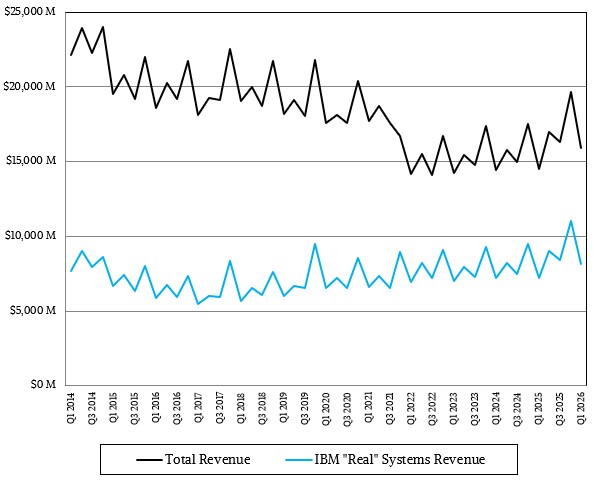
Based on my model, I think IBM’s “real” systems business – servers, storage, switching, operating systems, middleware, and any financing and tech support for it – was $8.17 billion, up 13.2 percent, with a pre-tax income of maybe $3.77 billion, up 17.2 percent.
Anyway, any way you dice it and slice it, IBM had $15.92 billion in sales (up 9.5 percent), pre-tax income of $1.39 billion (up 19.8 percent), and net income was $1.22 billion (up 15.3 percent).
What we want to know is how IBM intends to capture the GenAI wave with Power Systems. Krishna didn’t talk about that, but he did talk about how mainframe shops are doing it and this may be a blueprint for what your IBM i shop might do. Have a listen to what he said on the call with Wall Street analysts about how System z shops are doing it:
“Today, if people are doing a payment authorization, almost all the credit card companies in the world use the mainframe for their credit card authorizations. If they want to do fraud detection, they can run a few rules in that engine, but then they will take a sampling of the transactions – let’s call it 10 percent – off the platform because the latency that it introduces to take it off platform, you can’t take them all. It will just slow the whole system down. That’s what they do often.”
“What happens if you could run a 20 billion, 30 billion parameter model right on the mainframe? Suddenly because that is only milliseconds of latency, you can do that to every single transaction. So if you can take your fraud rate down from 50 basis points to 40, you can now do the math on what that is. They are all seeing that. So as I do that, we can do that for credit card authorizations. We can do it for retail banking transactions. We can do it for other payment operations. We can do it for claims and billing purposes. So those are the workloads that are now coming on. So it is effectively a new capacity of the mainframe that previously was either very small but outside the mainframe or running on systems that are what we would call distributed infrastructure.”
“We believe that this is going to play out. We see a large majority of our clients asking for the capacity. And currently, I believe if we have a fully populated system, we can do about 450 billion inferences a day on the mainframe. So that gives you a sense of that. We monetize that both through the extra hardware that is sold, but also by the supporting software for all of the AI inferencing that then runs on that increased capacity.”
We could not agree more. And we hope Krishna is right.
RELATED STORIES
Perhaps 2026 Is The Year For Power Systems To Boom A Little
Power Systems Grows Nicely In Q3, Looks To Grow For All 2025, Too
The Turning Point For Power Systems Is Here, And Now
Will The Turbulent Economy Downdraft IBM Systems Or Lift It?
IBM Power On Track To Get Above $2 Billion A Year
Power10 Keeps Plugging Along As Power11 Looms For 2025
Power Systems Continues Its Slight Upward Trend
Power Systems Poised To Embiggen This Year?
Power Systems Grows For The Second Year In A Row
Power Systems Still Climbing Despite This Weird Economy
The Plus Things Change, The Plus Things Stay The Same
Power Systems Down A Bit, But Holding Steady In Q2
Storage Helps Power Systems Grow In The First Quarter
Power Systems Did Indeed Grow Revenues Last Year
Power Systems Revenues Look To Grow In 2022
IBM Finally Shows Some Growth In Sales And Profits
The Power Systems And System z Mainframe Cycles Start Anew
The Low-Down On IBM’s Power Systems Sales
IBM Says Nothing About Power Systems In Q4
The Pivotal Year Ahead For Big Blue And IBM i Shops
A Proper Accounting Of The Power Business
The Big Iron Customers That The Power E1080 Is Aimed At
IBM Drops Power10 Into Big, Bad Iron First
Balancing Supply And Demand For Impending Big Power10 Iron
Awaiting The Power10 Rollout And The New Sales Cycle
IBM Grows, Power Systems Slows
Taking The Full Measure Of Power Servers
Just How Big Is The Whole Power Systems Business?
Power Systems Slump Is Not As Bad As It Looks
The Ups And Downs Of The Server Cycle
IT Starts To Feel The Impact Of The Great Infection
The IT Sector Could Weather The Pandemic Storm