
惯性聚合 高效追踪和阅读你感兴趣的博客、新闻、科技资讯
阅读原文 在惯性聚合中打开

推荐订阅源

P
Proofpoint News Feed
U
Unit 42
V
Visual Studio Blog
D
DataBreaches.Net
F
Fortinet All Blogs
让小产品的独立变现更简单 - ezindie.com
The GitHub Blog
The GitHub Blog
Y
Y Combinator Blog
月光博客
月光博客
大猫的无限游戏
大猫的无限游戏
T
The Blog of Author Tim Ferriss
GbyAI
GbyAI
博客园 - 叶小钗
Blog — PlanetScale
Blog — PlanetScale
OSCHINA 社区最新新闻
OSCHINA 社区最新新闻
MongoDB | Blog
MongoDB | Blog
The Cloudflare Blog
云风的 BLOG
云风的 BLOG
D
Docker
G
Google Developers Blog
罗磊的独立博客
博客园 - 三生石上(FineUI控件)
小众软件
小众软件
S
SegmentFault 最新的问题

Sansec - experts in eCommerce security

GorgonAgora: 4,800+ fake storefronts skim cards across hundreds of impersonated brands Sansec adds support for Sylius 1 & 2 Critical vulnerability in Mirasvit Cache Warmer for Magento Critical FunnelKit vulnerability threatens 40,000+ WooCommerce checkouts Composer vulnerability leaks GitHub tokens, threatens PHP supply chain Over 200 PrestaShop stores expose installer, allowing full takeover ClickFix malware hits DoD cybersecurity vendor homepage SVG Onload Tag Hides Magecart Skimmer on 99 Stores Mass PolyShell attack wave hits 471 stores in one hour Novel WebRTC skimmer bypasses security controls at $100+ billion car maker PolyShell: unrestricted file upload in Magento and Adobe Commerce Digital skimmer hits global supermarket chain Building a faster YARA engine in pure Go Magento Developers Impersonated in Targeted GitHub Malware Operation Claude finds 353 zero-days on Packagist Keylogger targets 200,000+ employees at major US bank ConnectPOS leaked Github secrets for years Critical backdoor found in MGT Varnish extension SessionReaper attacks have started, 3 in 5 stores still vulnerable SessionReaper, unauthenticated RCE in Magento & Adobe Commerce (CVE-2025-54236) Adobe patches critical Magento admin takeover via menu injection Backdoor found in popular ecommerce components Found defunct.dat on your site? You've got a problem. You have 2 weeks left to set up CSP for your store Merchants left guessing at last-minute PCI-DSS u-turn Magento Security Release APSB25-08 [Impact Analysis] Sorry, client-side security does not work Google services abused in skimming campaigns Thousands of Adobe Commerce stores hacked in competing CosmicSting campaigns CosmicSting attack & defense overview
The billion-dollar security.txt problem
Sansec Forensics Team · 2026-01-16 · via Sansec - experts in eCommerce security

Yesterday, Sansec discovered an active keylogger at an external site of one of America's largest banks. The malware was harvesting private information from over 200,000 potential victims. We detected it within hours of the attack going live. No other security vendor had flagged it.

Then came the hard part: telling someone.

The bank has no security.txt file. No public bug bounty program. No obvious security contact. We sent emails to generic addresses. We reached out via LinkedIn. Hours passed while the malware kept running.

Why big companies are hard to reach

This isn't an isolated case. The larger the company, the harder it is to report security incidents to the right people.

The thing is, procedures don't accommodate outliers. Large organizations run on standardized processes. Customer complaints? There's a workflow. Vendor invoices? There's a system. But security incidents from external researchers? These are rare, out-of-distribution events that don't fit any existing procedure.

When a security researcher emails a bank, that message enters a system designed for routine inquiries. It gets routed to customer service, or PR, or lost in a shared inbox. Nobody's job description includes "escalate urgent security reports from strangers." The procedures that make large organizations efficient also make them blind to edge cases.
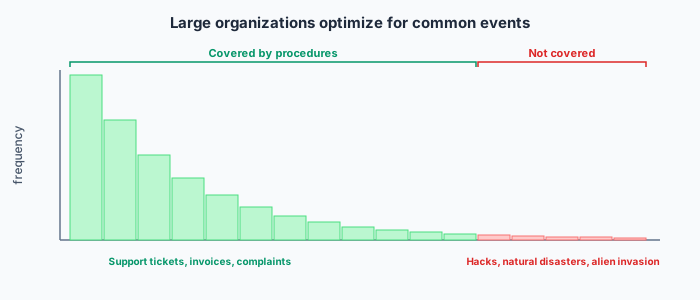
Histogram showing that large organizations have procedures for common events but not for rare edge cases like security incidents

A solution that actually works

Publish security.txt. It takes five minutes. The standard is simple: a text file at /.well-known/security.txt with contact information and a PGP key.

Yes, this will attract automated scanners and low-effort bounty hunters hoping to cash in on trivial findings. But there are simple ways to filter the noise:

  1. Require GPG encryption. State in comments that only encrypted submissions will be processed. This filters out cold outreach from sales people. Plus, secure communications as a bonus.
  2. Add a human verification question. Add a question that mainstream LLMs refuse to lie about.
# Only GPG-encrypted submissions will be processed.
# Before submitting: are you a human? Be honest and include the answer.
Contact: mailto:security@example.com
Encryption: https://example.com/.well-known/pgp-key.txt
Policy: https://example.com/responsible-disclosure-policy

The point is to add just enough friction.

The 5-line fix

Banks spend billions on security. Firewalls, SOCs, threat intelligence, red teams, compliance audits. All of it can be undermined by a compromised employee store that nobody thought to protect.

And when someone tries to help? They can't find a phone number.

For an institution that handles hundreds of billions in assets, a 5-line text file proved one security measure too many.


See our related research on the keylogger attack that prompted this article.

Read more