
惯性聚合 高效追踪和阅读你感兴趣的博客、新闻、科技资讯
阅读原文 在惯性聚合中打开

推荐订阅源

The Register - Security
云风的 BLOG
云风的 BLOG
U
Unit 42
F
Fortinet All Blogs
The GitHub Blog
The GitHub Blog
cs.CV updates on arXiv.org
D
Docker
Cyber Security Advisories - MS-ISAC
S
Secure Thoughts
Hacker News: Ask HN
Hacker News: Ask HN
Vercel News
Vercel News
S
Security @ Cisco Blogs
GbyAI
GbyAI
Stack Overflow Blog
Stack Overflow Blog
Exploit-DB.com RSS Feed
I
Intezer
MongoDB | Blog
MongoDB | Blog
AI
AI
MyScale Blog
MyScale Blog
Engineering at Meta
Engineering at Meta
Y
Y Combinator Blog
Threat Intelligence Blog | Flashpoint
P
Proofpoint News Feed
钛媒体:引领未来商业与生活新知
钛媒体:引领未来商业与生活新知
W
WeLiveSecurity
博客园 - 叶小钗
S
SegmentFault 最新的问题
N
News | PayPal Newsroom
WordPress大学
WordPress大学
freeCodeCamp Programming Tutorials: Python, JavaScript, Git & More
D
DataBreaches.Net
小众软件
小众软件
Microsoft Azure Blog
Spread Privacy
Spread Privacy
H
Help Net Security
美团技术团队
博客园 - 司徒正美
T
Threat Research - Cisco Blogs
cs.AI updates on arXiv.org
K
Kaspersky official blog
Application and Cybersecurity Blog
K
KPMG report finds enterprise disconnect between AI and its ROI | CIO
V
Vulnerabilities – Threatpost
TaoSecurity Blog
TaoSecurity Blog
N
Netflix TechBlog - Medium
L
Lohrmann on Cybersecurity
J
Java Code Geeks
量子位
Martin Fowler
Martin Fowler
博客园_首页

Sansec - experts in eCommerce security

Sansec adds support for Sylius 1 & 2 Critical vulnerability in Mirasvit Cache Warmer for Magento Critical FunnelKit vulnerability threatens 40,000+ WooCommerce checkouts Composer vulnerability leaks GitHub tokens, threatens PHP supply chain Over 200 PrestaShop stores expose installer, allowing full takeover ClickFix malware hits DoD cybersecurity vendor homepage SVG Onload Tag Hides Magecart Skimmer on 99 Stores Mass PolyShell attack wave hits 471 stores in one hour Novel WebRTC skimmer bypasses security controls at $100+ billion car maker PolyShell: unrestricted file upload in Magento and Adobe Commerce Digital skimmer hits global supermarket chain Building a faster YARA engine in pure Go Magento Developers Impersonated in Targeted GitHub Malware Operation Claude finds 353 zero-days on Packagist The billion-dollar security.txt problem Keylogger targets 200,000+ employees at major US bank ConnectPOS leaked Github secrets for years Critical backdoor found in MGT Varnish extension SessionReaper attacks have started, 3 in 5 stores still vulnerable SessionReaper, unauthenticated RCE in Magento & Adobe Commerce (CVE-2025-54236) Adobe patches critical Magento admin takeover via menu injection Backdoor found in popular ecommerce components Found defunct.dat on your site? You've got a problem. You have 2 weeks left to set up CSP for your store Merchants left guessing at last-minute PCI-DSS u-turn Magento Security Release APSB25-08 [Impact Analysis] Sorry, client-side security does not work Google services abused in skimming campaigns Thousands of Adobe Commerce stores hacked in competing CosmicSting campaigns CosmicSting attack & defense overview Persistent backdoors injected on Adobe Commerce via new CosmicSting attack CosmicSting attacks have started hitting major stores Polyfill supply chain attack hits 100K+ sites CosmicSting attack threatens 75% of Adobe Commerce stores Persistent Magento backdoor hidden in XML Sansec joins forces with Google's VirusTotal Sansec and Europol counter online skimming Magento wish list exploit bypasses WAF protection Is your store’s newsletter being used for phishing? Malware Persistence via Telegram and GitHub Postponed Exfiltration Evades Detection Sansec analysis: 12% of online stores leak private backups Vendors defeat Magento security patch (+ simple check) Fake Klaviyo accounts added to Magento Adobe Commerce merchants to be hit with TrojanOrders this season Extortion of Magento merchants Surge in Magento 2 template attacks Magento vendor Fishpig hacked, backdoors added Magento 2 critical vulnerability (CVE-2022-24086 & CVE-2022-24087) NaturalFreshMall: a Magento Mass Hack Magento and the Log4j vulnerability NginRAT parasite targets Nginx CronRAT malware hides behind February 31st New linux_avp malware hits eCommerce sites Case Study: How eCommerce Hackers Silently Steal Credit Card Data Google Apps Script used to steal data Fake payment page before checkout on Shopify and BigCommerce eCommerce trojan accidentally leaks victims Hackers exploit security flaw right before Black Friday Payment skimmer hides in social media buttons Cardbleed: 3% of Magento install base hacked North Korean hackers are skimming US and European shoppers Digital skimmer runs entirely on Google, defeats CSP Lockdown: Stores closed, online stores hacked Do these two things to keep your Magento 1 store running after June Magento 1 still PCI compliant after 1 July 2020? Sansec reveals longest Magecart skimming operation to date [Analysis] Maxcluster and Sansec partner to secure German stores Indonesian Magecart hackers arrested Payment skimmers have impersonated Sansec American Cancer Society hit by payment skimmer Magento security extentions vendor got hacked FBI recommends eCommerce malware protection Sansec at Europol training: 50,000+ stores hacked PCI-SSC/RHISAC quote Sansec: 20% stores reinfected Critical Magento 2 flaw exploited within 16 hours 57 payment gateways from Germany to Brazil targeted Sports brand Puma infected with advanced malware Credit cards of Atlanta Hawks fans stolen Bad extensions now main source of Magento hacks: a solution! Large sites hacked via Adminer database tool PHP tool 'Adminer' leaks passwords Competing digital skimmers sabotage each other Merchants struggle with MageCart reinfections Backdoor found in Webgility Unpublished security flaws (0days) massively exploited German political party store hacked before election MageCart: now with tripwire ABS-CBN next in series of high profile breaches Is your Google Analytics code malicious? MagentoCore group hacks 7,339 stores and counting Hackers breached Magento through helpdesk Cryptojacking found on 2496 online stores Why ordering HTTP headers is important Warning: fake Magento patch 9789 contains virus A Magento breach analysis: part 1 An OpenCart/Magento hacking dashboard Self-healing malware restores itself after deletion Visbot malware found on 6691 stores [analysis] Criminals have rewired 3,500 online stores
OptinMonster supply chain attack hits 1.2 million sites
Sansec Forensics Team · 2026-06-13 · via Sansec - experts in eCommerce security

Sansec discovered an active supply-chain attack hitting over 1.2 million sites that use the popular OptinMonster, TrustPulse and PushEngage Wordpress plugins, all operated by Wordpress giant Awesome Motive.

Attackers added malicious JavaScript to the legitimate files served by Awesome Motive, which are embedded in their customer's sites.

The malware waits for a logged-in administrator, creates a backdoor admin account, and installs a self-hiding backdoor plugin. It then sends the new credentials to tidio.cc, a lookalike of the real tidio.com. The campaign is ongoing as of 13 June 2026.

The OptinMonster plugin alone has over a million active WordPress installations, and TrustPulse and PushEngage add many more. The payload only fires for logged-in admins, not for ordinary visitors. But as the threat actor effectively gains full control of individual sites, further abuse of regular visitors is to be expected.

Meanwhile, OptinMonster customers are complaining about a service outage:
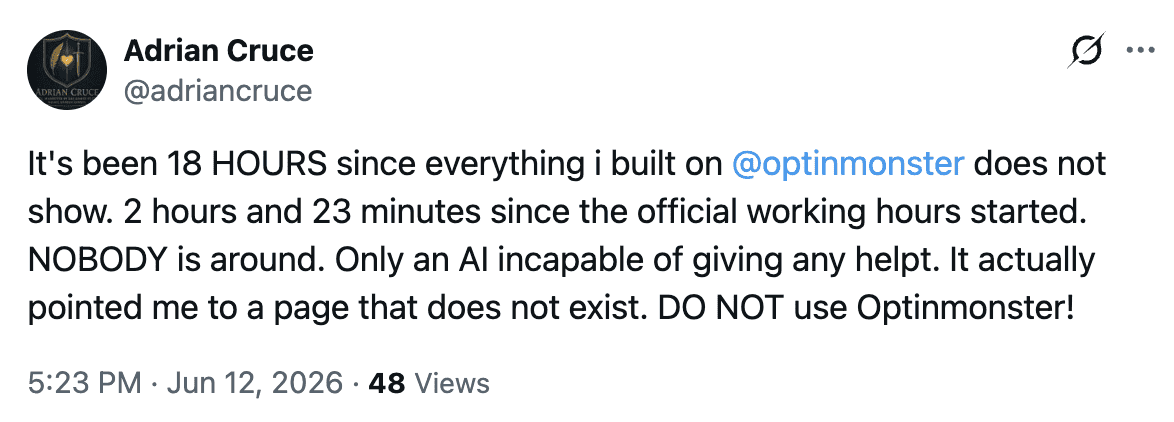
Tweet from a customer complaining about an OptinMonster service outage

Awesome Motive runs one of the largest WordPress plugin portfolios in the world, used across tens of millions of sites. Other products include WPForms (over 6 million active installs), MonsterInsights (around 2 million) and All in One SEO (around 3 million). So far we have only confirmed a breach of OptinMonster, TrustPulse and PushEngage code, but anyone running an Awesome Motive plugin should stay alert, watch the indicators below, and patch as the company responds.

Supply chain jackpot

The malicious code did not live on any victim's own server but was injected via Awesome Motive's CDN endpoints. Any WordPress site loading one of these scripts pulled the tampered file directly from the source:

HostBrand
a.omappapi.com/app/js/api.min.jsOptinMonster
a.opmnstr.com/app/js/api.min.jsOptinMonster
a.optnmstr.com/app/js/api.min.jsOptinMonster
a.trstplse.com/app/js/api.min.jsTrustPulse
clientcdn.pushengage.com/sdks/pushengage-web-sdk.jsPushEngage

This resembles the Polyfill supply chain attack that Sansec discovered in 2024: tamper with a single upstream file, and the malware reaches thousands of downstream sites without ever touching them individually.

What the injected JavaScript does

The payload is heavily gated and runs in stages:

  1. It exits immediately on navigator.webdriver, headless browsers, or a zero-size window. It only proceeds if it detects a WordPress admin context: a wp-admin path, the admin bar, or a wordpress_logged_in_ cookie. A 24-hour throttle stored in localStorage['_pe_ts'] keeps it from running repeatedly.
  2. It locates the WordPress root and admin path, fingerprints the WordPress version, and harvests REST and AJAX nonces (wpApiSettings.nonce, admin-ajax.php?action=rest-nonce, and scraped from user-new.php).
  3. It creates an administrator using four fallback methods in sequence: the user-new.php form, admin-ajax.php, the REST endpoint wp/v2/users, and finally a hidden iframe form submit. It even recognises "user already exists" responses in roughly twenty languages. It plants a fixed account, developer_api1 / customer1usx@gmail.com, plus randomised dev_xxxxxx accounts.
  4. It silently uploads a self-hiding PHP plugin.
  5. The new admin user:password, site origin, logout URL, admin path, method, timing and WordPress version are XOR-encrypted (key jX9kM2nP4qR6sT8v), base64-encoded, and sent to tidio.cc/cdn-cgi/*. Delivery falls back through sendBeacon, then fetch (no-cors), then XHR, then an Image().src beacon.

The self-hiding backdoor plugin

The plugin that gets installed is built to disappear. It hides itself from the user list, the plugin list (both the admin screen and the REST /wp/v2/plugins endpoint), update checks, and the "recently active" list. On init, with no authentication required, it exposes two entry points:

  • ?developer_api1_fm opens a web shell branded "WPM File Manager & Shell", which runs system($_POST['cmd']) and accepts file uploads.
  • A POST to developer_api1_eval runs eval(base64_decode(...)) on attacker-supplied input.

The operator rotates the plugin's disguise while keeping the logic byte-identical across renames. We have observed it shipping as "Content Delivery Helper" (content-delivery-helper, v2.7.1) and, currently, as "Database Optimizer" (database-optimizer, v2.9.4). The plugin ZIP is generated fresh on each request: the script fetches tidio.cc/cdn-cgi/{pe-,}l?t=gen&u=developer_api1, which returns a base64 blob that decodes through the same XOR key into the plugin id, slug and ZIP.

Root cause

The malware was distributed via Awesome Motive-operated domains via the BunnyNet CDN. It is unknown which got hacked: Awesome Motive's own servers (likely), their CDN account (possible) or BunnyNet (unlikely). The fact that the malware for two of the three plugins quickly disappeared, suggest that they were aware of the breach. We have reached out to Awesome Motive but not received a response yet.

Timeline

  • 2026-04-28: tidio.cc registered and a TLS certificate issued. C2 resolves to 84.201.6.54 (Ultahost, AS214036). No observed activity yet.
  • 2026-06-12 22:17 UTC: first verified malware in OptinMonster and TrustPulse code via a.* domains in our intel.
  • 2026-06-12 22:42 UTC: last verified malware on OptinMonster and TrustPulse
  • 2026-06-13 19:02 UTC: the OptinMonster and TrustPulse paths are clean, but the PushEngage SDK is still serving the injected code from certain CDN edges. The C2 remains live and is generating fresh payloads.
  • 2026-06-14: PushEngage no longer serving the injected code.

Am I affected?

If you have one of these plugins installed and an admin logged in during the injection window, the damage is already done. Sorry.

  • Look for developer_api1 (customer1usx@gmail.com) and any unexpected dev_xxxxxx accounts. Remove them.
  • Search the filesystem under wp-content/plugins, not just the admin screen, for content-delivery-helper / "Content Delivery Helper" and database-optimizer / "Database Optimizer". The plugin actively hides from the dashboard, so trust the disk over the UI.

If you find any indicators of compromise: rotate every admin password and secret, and assume the attacker has had unauthenticated code execution. Because the payload only ever ran for logged-in admins, server-side scanning is one of the most reliable ways to catch it.

You can run eComscan on your server to detect the backdoor plugin and rogue admin accounts, plus other malware, backdoors and vulnerabilities that may already be on your site.

Indicators of compromise

# C2
tidio.cc                                    84.201.6.54   Ultahost AS214036   reg/cert 2026-04-28
tidio.cc/cdn-cgi/p                          exfil (OptinMonster / TrustPulse variant)
tidio.cc/cdn-cgi/b
tidio.cc/cdn-cgi/l                          payload generation
tidio.cc/cdn-cgi/pe-p                       exfil (PushEngage variant)
tidio.cc/cdn-cgi/pe-b
tidio.cc/cdn-cgi/pe-l                       payload generation

# Unique strings
jX9kM2nP4qR6sT8v                            XOR key used by the malware
WPM File Manager & Shell                    backdoor shell UI

# Rogue accounts
developer_api1 / customer1usx@gmail.com     fixed operator account
dev_xxxxxx / dev_xxxxxx@gmail.com           randomised accounts

# Backdoor plugin disguises (rotating)
content-delivery-helper                     "Content Delivery Helper"   v2.7.1
database-optimizer                          "Database Optimizer"        v2.9.4

Read more