


Organizations use digital signatures when an agreement needs more than convenience. They use them when a workflow requires stronger signer verification, tamper evidence and a better evidentiary trail than a basic electronic signature provides.
That distinction matters because not every document needs the same level of trust. Routine approvals may only need a simple e-signature, while regulated, high-value or dispute-sensitive transactions often benefit from certificate-based digital signatures.
In practice, the goal is to match the signing method to the risk. The right question is not whether a business can sign electronically. It is whether the transaction needs stronger identity assurance, document integrity controls and compliance support.
Digital signatures vs. e-signatures
Organizations must understand the difference between digital signatures and e-signatures so they can implement a level of security that meets their needs.
An e-signature is a broad term that includes any signature a user sends electronically. Some e-signatures, such as those retail stores use for small transactions, don't require identity verification. However, other types, such as digital signatures, involve a strict authentication process.
In the U.S., the E-SIGN Act gives electronic signatures legal standing when key conditions are met, but organizations still use digital signatures when they need stronger identity assurance and tamper evidence. In the EU, trust-service frameworks make those assurance levels even more explicit.
Digital signatures rely on public key cryptography and digital certificates to verify authenticity and detect tampering. In a typical workflow, the system creates a hash of the document and signs that hash with the sender's private key. The recipient then uses the corresponding public key and certificate to verify the signature and confirm that the document has not been altered since it was signed.
To create a digital signature, organizations typically use an e-signature system. E-signature systems offer digital signature capabilities, but they can also streamline workflows. For example, they can send reminder notifications to late signatories and assign roles to specific individuals.
What are digital signatures used for?
Organizations can use digital signatures anywhere a signature is required, but they usually reserve them for transactions where stronger trust, signer verification and document integrity matter most. Common examples include the following:
- Real estate purchase and sale agreements
- Sales contracts
- Insurance agreements
- Tax documents and forms
- Construction change orders
- Clinical trials
- Loans
- Mortgages
- Leases
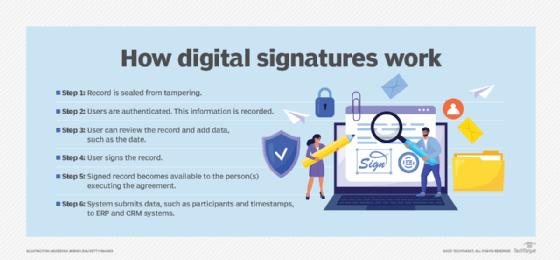
How digital signatures work
Digital signatures rely on digital certificates that trust service providers issue to signers. These providers are legal entities that use processes and tools in accordance with a national authority, such as the U.S. government or EU, to verify e-signatures' authenticity.
"The trust service provider verifies the identity of the signer prior to the issuance of the digital certificate using various mechanisms, [such as] near-field communication, automated video-based identity documents and biometric verification," Manaila said.
After the trust service provider verifies the signer's identity, it issues the digital certificate in the cloud. It stores the required cryptographic keys on a hardware security module (HSM) and protects it with two-factor authentication (2FA). These security measures let people sign documents and get digital certificates from any type of platform, device or smartphone, Manaila said.
Some countries issue electronic identification cards that store the owner's biometric data, such as their fingerprint or facial structure, on a chip. Citizens and organizations can use these cards to prove their identity online and quickly obtain a digital certificate.
How cloud affected the digital signature landscape
Before the proliferation of cloud services, organizations relied on physical devices, such as security tokens or smart cards, to protect their digital certificates with an HSM. This traditional approach posed implementation challenges. For example, the approach isn't user-friendly because it requires users to carry a physical device, Manaila said.
Cloud tools, on the other hand, store the cryptographic keys on the cloud provider's HSM so organizations don't need to track physical tokens or replace them over time. Cloud products are also more scalable and require no physical maintenance costs.
The digital signature landscape changed after the CSC standardized remote, cloud-based digital signatures with its open source API. This technology offers the following benefits:
- Generates remote digital signatures across desktop, web and mobile devices.
- Protects legally binding signatures with 2FA.
- Integrates with various ERP and digital transaction management systems.
- Reduces IT governance costs.
- Ensures compliance with e-signature laws in the U.S. and EU, such as the Electronic Identification, Authentication and Trust Services Regulation.
Security benefits of digital signatures
Digital signature technology can help organizations prevent bad actors from tampering with important transactions. Security benefits include the following:
- Links signer's identity to the signature.
- Makes the signer legally responsible for their actions.
- Securely stores the digital certificate's cryptographic keys on a certified HSM and protects them with 2FA.
- Offers access control to strengthen security.
- Can prove a signature's authenticity in court.
Digital signatures add assurance, but they also add process and training overhead. That is why organizations should treat them as a fit-for-purpose control: use them where the business needs higher trust, stronger evidence or stricter compliance, and use simpler e-signatures where speed and convenience matter more.
Editor's note: This article was originally published in 2023 and was updated in 2026 to reflect current digital-signature workflows, legal context and enterprise use cases.