





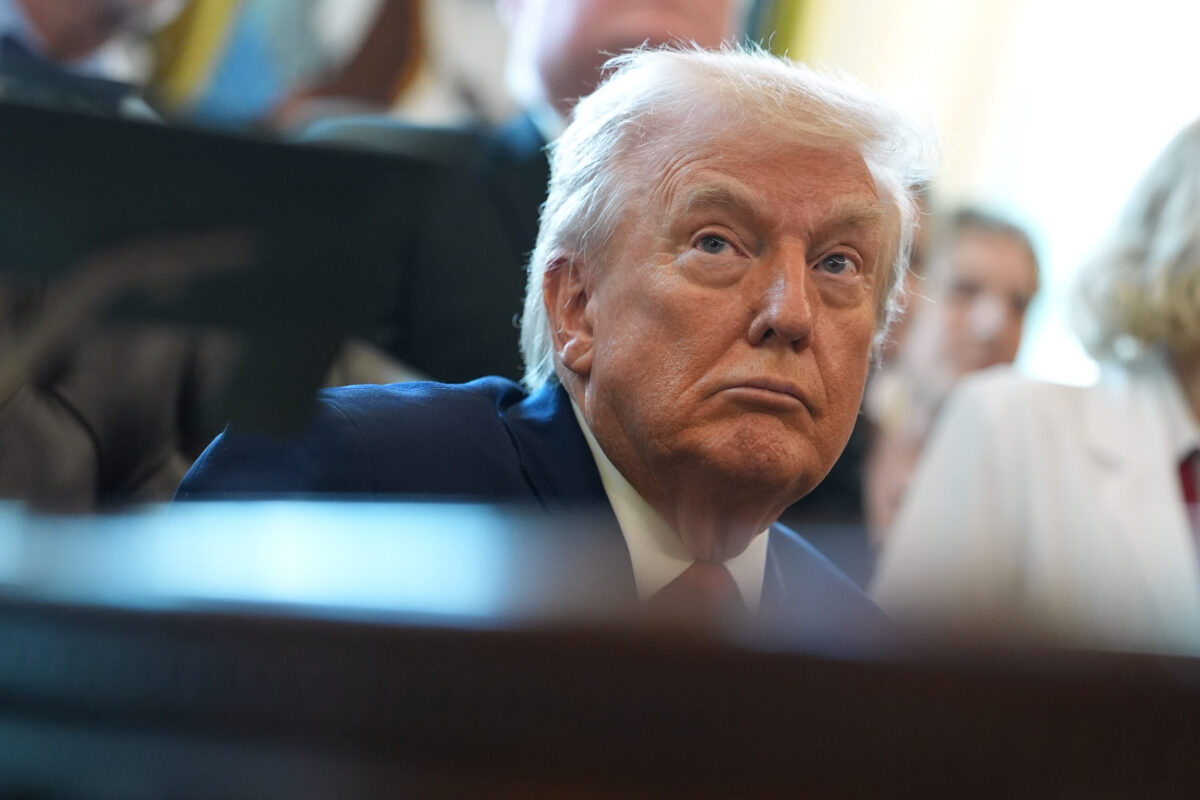
AP Photo/Evan Vucci
A three-judge panel — two of whom were appointed by President Donald Trump — shot down Alabama’s redistricted congressional map in a ruling released Tuesday after finding it to be “intentionally discriminatory.”
As the midterm elections have loomed closer, Trump has pushed GOP-majority states to engage in a nontraditional mid-decade redistricting in an effort to create more Republican-leaning House districts. Multiple states, under both Republican and Democratic majority control, have since redrawn their lines in a variety of ways under their laws, some by gubernatorial executive orders, some by bills passed by legislatures, and some through voter ballot initiatives.
It’s far from certain how the new district lines will truly play out in the midterms — several Republicans have expressed concerns that districts were drawn based on overly optimistic numbers from Trump’s 2024 victory that polls show the GOP may not be able to sustain in November — and numerous lawsuits have been filed across the country.
This case in Alabama actually involves a redistricted map passed by the GOP-majority Alabama legislature in 2023 that reduced the number of majority-minority districts in the state from two to one. The ongoing litigation has already traveled back and forth from the Supreme Court a few times, and the appellate undertook a thoroughly detailed review of the case in the wake of the U.S. Supreme Court’s opinion in Louisiana v. Callais earlier this year. In that opinion, the nation’s highest court banned racial gerrymandering — whether done to create more or fewer majority-minority districts or to benefit or dilute minority voters — pursuant to Section 2 of the Voting Rights Act and the Fourteenth and Fifteenth Amendments of the U.S. Constitution. The VRA neither required nor allowed drawing district lines based on race, the Supreme Court held.
In a 102-page ruling posted on Tuesday, Circuit Judge Stanley Marcus of the U.S. Court of Appeals for the Eleventh Circuit and District Judges Anna M. Manasco and Terry F. Moorer of the U.S. District Court for the Northern District of Alabama ruled that the state’s 2023 redrawn maps were in violation of the Fourteenth Amendment to the U.S. Constitution. Marcus was previously appointed to the U.S. District Court for the Southern District of Florida by President Ronald Reagan and then was promoted to the appellate gig with the Eleventh Circuit by President Bill Clinton. Both Manasco and Moorer were appointed to the federal bench by Trump.
The judges noted the impact of Callais and the tight time frame involved with November’s elections rapidly approaching, noting that the Supreme Court had expressly “instructed us to give these cases further consideration in light of Callais,” which they did, writing that they had “carefully reviewed the extensive evidentiary record in these cases with fresh eyes in light of Callais.”
The court wrote that this case carried “exceptional public importance” and they were having to make “a critical decision on a very tight timeline,” with only two-and-a-half months remaining before the Alabama primaries, and five months before the general election in November.
A preliminary injunction barring the use of the 2023 maps was appropriate, the judges wrote, because they would “requir[e] Alabamians to cast their votes in the 2026 elections under a districting plan tainted by intentional race-based discrimination,” and using a “race-blind map” previously ordered by the court “will not disrupt Alabama’s elections” because “all candidates ran under the race-blind map until fifteen days ago, and all voters remain districted under the race-blind map in electoral computer systems.”
The “undisputed evidence left us in no doubt that Alabama’s legislatively enacted plan (the “2023 Plan”) intentionally discriminated based on race in violation of the Constitution,” the opinion declared, and “[o]ur re-examination in light of Callais yields the same conclusion.”
The court described in detail its reasoning, highlighting how the legislature had “made a calculated, purposeful decision to refuse to provide the remedy for discriminatory vote dilution that our order (affirmed by the Supreme Court) required,” and “well knew that a plan without an additional Black-opportunity district would dilute Black Alabamians’ opportunity to participate in the political process, and it intentionally enacted that very plan.”
The judges rejected the state’s arguments that the legislature was motivated by partisan reasons, not unconstitutional race-based ones, because their “exhaustive analysis of an extensive record” found “no evidence of a partisan motive” and in fact, some evidence to the contrary, testimony from legislative leaders that “overtures from national party leaders did not affect their work.”
“We reject in the strongest possible terms the State’s attempt to finish its intentional decision to dilute minority votes with a veneer of legislative regularity,” the court wrote, explaining their reasoning:
Further, the Legislature well knew what dilutive mechanisms would prevent Black voters in Alabama’s Black Belt and Gulf Coast communities from having any opportunity to elect representatives of their choice, and the Legislature employed precisely those mechanisms. The Legislature also took a series of highly unusual steps along the way. Those unprecedented steps culminated in the enactment of novel legislative findings (“the 2023 legislative findings”) that departed sharply from the Legislature’s norms and made it impossible not only to remediate the vote dilution we identified, but also to respect the longstanding community of interest the Legislature identified in Alabama’s Black Belt. These events, along with legislators’ contemporaneous statements about race, support only one inference: the purpose of the 2023 Plan was to distribute Black voters across districts to dilute their votes, at least in part because they are Black.
The court also rejected arguments from the state that there was not enough time before the 2026 elections, because ” the record here is clear: enjoining the unconstitutional 2023 Plan will improve the administrative situation in Alabama, not worsen it.”
Because the legislature “has not adopted a lawful remedial map in time for Alabama’s 2026 elections…it falls to us to order a remedy,” the court wrote. That remedy would be to use the “Special Master Plan” previously created “is race-blind and satisfies all applicable constitutional and statutory requirements, while hewing as closely as possible to the 2023 Plan,” “will not disrupt Alabama’s elections,” and has been used by Alabama “not only for the last congressional elections, but also for the 2026 congressional elections until just fifteen days ago.”
“As we see it, the irreducible minimum is that federal law requires that all Alabamians have an opportunity to vote under districting plans untainted by intentional race-based discrimination,” the court wrote, and therefore they were “duty-bound” to preliminarily enjoin the 2023 map. The court further ordered an expedited schedule for discovery and pleadings in the case, noting that the schedule will be amended “as necessary upon any further districting by the Legislature.”
The case is not over, and is expected to continue after the November elections, even with the expedited schedule. The ruling concluded by instructing the parties to “make every effort to ensure this case will be trial ready not later than January 11, 2027.”
The NAACP issued a statement applauding the ruling:
We applaud the Federal Court’s ruling today, preserving Black representation. Redrawing maps to silence the voices of entire communities cannot be tolerated. It goes against the very values of democracy that our ancestors fought and died for,” said NAACP President Derrick Johnson. “Throughout history, Alabama fought to preserve slavery, resisted the Supreme Court’s ruling to desegregate schools, and violently oppressed and silenced Black people — from arresting Rosa Parks after she refused to give up her seat on the bus, beating John Lewis’ skull on the Edmund Pettus Bridge, jailing Dr. Martin Luther King, Jr. repeatedly, and unleashing dogs on peaceful protesters. This attempt to redistrict is a continuation of Alabama’s gruesome and bloody history. Our NAACP chapters in Alabama mobilized to reject this map, and we will continue to fight across the country to protect our voice. Today’s ruling is good news, but we know it is not the end of this fight.
Later Tuesday after the ruling was released, Alabama filed a notice that it was appealing the court’s ruling to the Supreme Court, as expected.
This article has been updated to add the appeal filed by the state.
New: The Mediaite One-Sheet "Newsletter of Newsletters"
Your daily summary and analysis of what the many, many media newsletters are saying and reporting. Subscribe now!
此内容由惯性聚合(RSS阅读器)自动聚合整理,仅供阅读参考。 原文来自 — 版权归原作者所有。