

惯性聚合 高效追踪和阅读你感兴趣的博客、新闻、科技资讯
阅读原文 在惯性聚合中打开

推荐订阅源

cs.AI updates on arXiv.org
SecWiki News
SecWiki News
Recent Commits to openclaw:main
Forbes - Security
Forbes - Security
Schneier on Security
W
WeLiveSecurity
cs.CV updates on arXiv.org
Google Online Security Blog
O
OpenAI News
Exploit-DB.com RSS Feed
S
Secure Thoughts
PCI Perspectives
PCI Perspectives
人人都是产品经理
人人都是产品经理
Blog — PlanetScale
Blog — PlanetScale
S
SegmentFault 最新的问题
Help Net Security
Help Net Security
G
GRAHAM CLULEY
Latest news
Latest news
V
Visual Studio Blog
The Cloudflare Blog
T
Troy Hunt's Blog
Threat Intelligence Blog | Flashpoint
Stack Overflow Blog
Stack Overflow Blog
GbyAI
GbyAI
I
InfoQ
Know Your Adversary
Know Your Adversary
B
Blog RSS Feed
V2EX - 技术
V2EX - 技术
奇客Solidot–传递最新科技情报
奇客Solidot–传递最新科技情报
Cyber Security Advisories - MS-ISAC
H
Heimdal Security Blog
Y
Y Combinator Blog
Security Archives - TechRepublic
The GitHub Blog
The GitHub Blog
P
Palo Alto Networks Blog
OSCHINA 社区最新新闻
OSCHINA 社区最新新闻
T
Tor Project blog
T
Threat Research - Cisco Blogs
博客园 - 三生石上(FineUI控件)
Cloudbric
Cloudbric
博客园 - Franky
博客园 - 叶小钗
S
Security @ Cisco Blogs
cs.CL updates on arXiv.org
阮一峰的网络日志
阮一峰的网络日志
WordPress大学
WordPress大学
T
Threatpost
MongoDB | Blog
MongoDB | Blog
V
Vulnerabilities – Threatpost
Martin Fowler
Martin Fowler

VMware Blogs

Mastering Infrastructure Policies in VMware Cloud Foundation Automation 9.1 Modernizing the Private Cloud: Why VCF 9.1 Lifecycle Management is a Game Changer Announcing the VMware Cloud Foundation 9.1 Upgrade Planning Tool VCF Breakroom Chats Episode 86 – Containers Made Easy: The New “Container-as-a-Service” in VCF 9.1 Securing Your VCF 9.1 Infrastructure with the Symantec Identity Security Platform Virtually Speaking: The AI Reality Check with Dave Linthicum Zero Touch Provisioning: Activating Edge Sites with VMware Cloud Foundation Edge 9.1 VCF Breakroom Chats Episode 85 – Cloning Success at Scale: Inside VCF 9.1’s App Stack Formation VMware Cloud on AWS の使用状況を確認できる API Unlocking the Full Potential of Programmable Infrastructure with VMware Cloud Foundation 9.1 – New Features and Capabilities Smarter Patching at Scale: Vulnerability Assessment and Remediation with VMware Tanzu Platform Encrypted vMotion Offload to Intel QAT in VMware Cloud Foundation 9.1 Deepen Your Expertise: Four Key Benefits of Attending Increase Deployment Flexibility with VCF Edge Automation 1.0.3 Avi Advantage: Automating Certificate Management of VCF Workloads More Memory, Less Effort: Configuring Memory Tiering in VCF 9.1 VCF 9.1 Licensing: Programmatic, Centralized, and Built to Scale Why APJ Networking Professionals Need Private Cloud Expertise VCF 9.1 Networking: Simpler VPC Connectivity Control VCF 9.1 Networking: Exploring Network Services for Virtual Private Clouds VCF Networking 9.1: Seamless DDI Integration with Infoblox The Open Source Advantage: Building from Source for Ultimate Security Expand Shared VMDKs with Clustered Applications in VMware vSAN for VCF 9.1 Monetizing Zero-Trust Security with VCF 9.1 and VMware vDefend VMware vSAN Protection and Recovery Enhancements for VCF 9.1 Deliver Production SQL Server DBaaS with VMware Data Services Manager 9.1 Maximizing Profitability: VCF 9.1 Cost-Focused Approach for VMware Cloud Service Providers Modernizing Your Infrastructure: Introducing VMware Cloud Foundation 9.1 to VCSPs VCF 9.1 is Available: Explore the New Features in Hands-on Labs What’s New with vSphere in VMware Cloud Foundation 9.1? Resizing VMware vCenter in VMware Cloud Foundation 9 Non-Disruptive VMware vCenter Patching in VMware Cloud Foundation 9.1 VMware vCenter Virtual Hardware Gets an Upgrade in vSphere with VCF 9.1 AI Has Changed the Threat Landscape. Is Your Infrastructure Ready? Simplifying Storage with the New Effective Capacity View in VMware vSAN for VCF 9.1 Auto-RAID in VMware vSAN for VCF 9.1 – Comprehensive System-Managed Data Resilience Introducing VMmark 4.1: Enhanced Power Efficiency Benchmarking for Private Cloud Infrastructure Advanced Memory Tiering Enhancements in VMware Cloud Foundation 9.1 VCF 9.1 Is Here. See It in Action. 博通發布 VMware Cloud Foundation 9.1 How Broadcom Is Helping Enterprises Win the AI Security Sprint How to Prepare for the World of AI Driven Exploits Avi Innovations for VCF 9.1: Powering Kubernetes, Agentic AI and VPC Workloads VCF 9.1: The Secure, Cost-Effective Private Cloud Platform for Production AI Announcing VCF 9.1: Modern Private Cloud Built for Efficiency and Resilience Announcing VMware Cloud Foundation Edge 9.1: A Scalable, Autonomous Edge Platform Accelerate, Streamline, and Control Your Self-Service Private Cloud with VMware Cloud Foundation 9.1 Deploy Modern Apps Faster, Scale Smarter, and Lower Your TCO with VMware vSphere Kubernetes Service in VCF 9.1 Scale Smarter, Save More: Redefining Infrastructure Economics with VMware vSphere in VCF 9.1 AI with VCF 9.1 on AMD GPUs: Build with open frameworks and simplify management, at a lower TCO Streamline, Simplify and Protect all your AI workloads with VCF 9.1 Simplify Workload Connectivity and Enhance Network Scale and Performance with VCF 9.1 VMware and CrowdStrike Deliver New Integration for Cyber Recovery Workflows How Many Users Can Your LLM Server Really Handle? From Infrastructure to Agents: A Hands-On Guide to Secure Private AI with Broadcom – Part 2 The New Frontier: Leading the Cloud-Native Evolution Replicating VMware vSphere Configuration Profile Desired State Webinar Recap: Design and Architecture Considerations for VMware vSphere Kubernetes Service on VMware Cloud Foundation Kubernetes 1.36: What Actually Changed for Enterprise Platforms Enhance Lateral Security and Ingress Load Balancing for Kubernetes Workloads Avi Load Balancer Analytics: Root Cause Application Performance Issues in Minutes Analyst Insight Series #3: Policy-Driven Governance and Multi-Tenant Control Post-Quantum Readiness on VMware Cloud Foundation Registration Is Live for Las Vegas | $ave with Early-Bird May 21, 2026: What’s New in VMware Tanzu Data Intelligence 10.4 From Infrastructure to Agents: A Hands-On Guide to Secure Private AI with Broadcom – Part 1 Stop Guessing: Advanced Monitoring and Troubleshooting for Data Services CPU, Disk, Network, and Memory Workload Profiles for DVD Store Database Testing How VMware Salt Automates Compliance Across Private Cloud Analyst Insight Series #2: Operational Scalability and Lifecycle Management MCP vs. APIs: Why You Need Both for AI Applications The Real Constraint on Enterprise AI isn’t GPUs; It’s Power Deploying Harbor Service in Air-Gapped VMware Cloud Foundation 9.0 Why Enhanced DirectPath Wins for High-Performance Apps Bridging the (.Local) Gap: A Split-Domain Design for VMware Cloud Foundation Deployment Observability on VMware vSphere Kubernetes Service VMware Cloud on AWS: Introducing the Usage Report APIs Converging VMware vSphere to VMware Cloud Foundation 9.0: The Top 10 Questions Answered May 6, 2026: What’s New in Tanzu Platform 10.4: Powering Agentic Apps at Scale VMware Tanzu RabbitMQ Powers the Modern Data Lakehouse with New Spark Integration and Enterprise Tooling Tanzu Data Intelligence 10.4 Delivers AI-Driven Analytics, Unified Real-Time Operations, and Sovereign Resilience Enterprise-Ready Agents Made Simple & Safe with VMware Tanzu Platform Agent Foundations Introducing Tanzu Platform 10.4: Extending Platform as a Service to Agentic Applications How AI-Assisted Analytics in Tanzu Data Intelligence Can Help Remove the SQL Bottleneck From Prototype to Production: Securing Database MCP at Enterprise Scale The Compelling Case for a Private Cloud Data Intelligence Platform The Unification Dividend: Consolidating Database Operations on VMware Cloud Foundation The Modern Spring Workflow Is Enterprise-Ready and AI-Boosted [TAM Blog] セキュアブート証明書の有効期限切れに関する注意点と対応について Accelerate Lateral Security and Ingress Load Balancing for Kubernetes Workloads From Platform to Data: Building a Cloud-Native Developer Experience On-Prem with VMware Cloud Foundation How VMware Cloud Foundation (VCF) Training Helps Keep Top Tech Talent in APJ Build Your Case for Attending VMware Explore 2026 Spring 開発元が提供する商用サポート「VMware Tanzu® Spring Essentials」とは VMware Cloud on AWS より i7i.metal-24xl インスタンスの提供開始 VMware Advanced Memory Tiering Tips for Success VMware Cloud Foundation Edge 9.0: Two-Host Edge Site Deployment with Brownfield Import Your Database Is About to Become an AI Tool. Is It Ready? Applying GitOps Principles to Maintain Desired State Configuration using VMware vSphere Configuration Profile – Part 3 Webinar Recap: Converging VMware vSphere to VMware Cloud Foundation 9.0
PostgreSQL Diagnostic Superpowers: Deep Visibility with VMware Data Services Manager 9.1
Sue Ulintz · 2026-06-24 · via VMware Blogs

Every database practitioner knows the dread of the classic “black box” window. An application response time spikes, a critical service slows to a crawl, and the classic cross-team finger-pointing begins. As a DBA or platform engineer, you are suddenly responsible for finding the missing piece of the puzzle. You will have to look through broken logs, analyze query plans, and try to figure out what went wrong after the anomaly has happened.

Historically, managing open-source databases on-premises meant sacrificing the rich, built-in observability suites native to public cloud alternatives. You either cobbled together a fragile framework of open-source monitoring agents, or you operated in the dark.

With the release of VMware Data Services Manager (DSM) 9.1 on VMware Cloud Foundation (VCF) 9.1, the data layer gets a massive visibility injection. By introducing native, advanced diagnostic tools built specifically for PostgreSQL 17, DSM 9.1 equips practitioners with the diagnostic superpowers needed to identify and resolve query bottlenecks in minutes, not days.

Here is a technical look at how DSM 9.1 shines a light into your PostgreSQL estates.

Technical Performance and Insight Highlights

1. Advanced Diagnostics Tailored for PostgreSQL

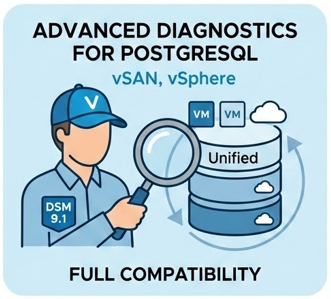
DSM 9.1 provides full compatibility with PostgreSQL, alongside highly granular diagnostic capabilities explicitly engineered for enterprise PostgreSQL environments. Rather than forcing you to jump between independent host metrics and database telemetry, DSM unifies the stack. Practitioners can correlate physical infrastructure anomalies (like vSAN storage latency or vSphere CPU throttling) directly with database engine performance. This single-pane-of-glass view completely eliminates the “infrastructure vs. database” guessing game during root-cause analysis.
2. Time-Travel Triage: The Metrics History View

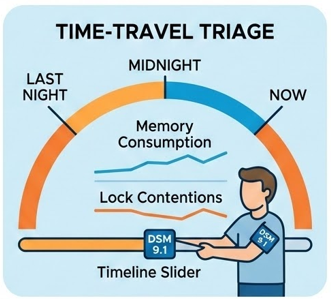
Spotting a spike in real-time is easy; diagnosing a bottleneck that occurred during a batch job last midnight is where replication fails. DSM 9.1 introduces an enhanced Metrics History View that allows users to define custom time ranges to explore historical performance and database health metrics.

Practitioner Impact: This allows DBAs to perform precise trend analysis and backward-looking root cause investigations. You can visually trace memory consumption, active connection counts, and lock contentions across a historical timeline to pinpoint the exact moment query degradation began.
3. Granular Alert Routing with Multi-Watcher Endpoints

Generic, noisy email alerts are the fastest path to alert fatigue. DSM 9.1 completely overhauls its alerting mechanism with a dedicated Notification tab within the Database Monitoring UI.

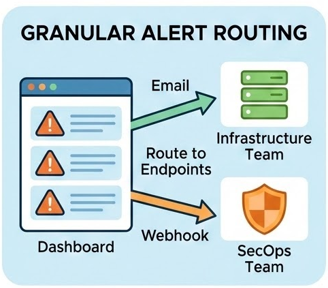
Instead of a single global destination for database alerts, you can now configure multiple independent watchers per database. Each watcher can be mapped to its own unique email destination or webhook endpoint.
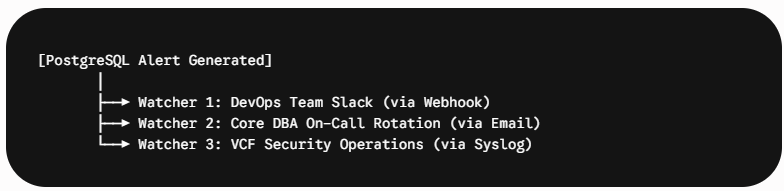
This ensures that a warning about a storage capacity threshold pings the infrastructure team via a webhook, while an anomalous authentication spike is routed directly to the SecOps team.
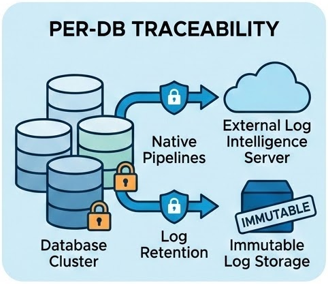
4. Per-DB Traceability: Expanded Audit Log Forwarding

In highly regulated environments, local log retention on the database appliance is a major compliance risk. DSM 9.1 expands enterprise security by allowing database audit logs to be forwarded natively to external log intelligence servers. This feature provides per-database traceability across your entire hybrid cloud footprint, giving security teams a transparent, immutable record of database access and administrative actions without impacting engine performance.

Hardened Security for Practitioner Workflows

Observability is nothing without an ironclad security posture. To ensure that your deep diagnostic capabilities don’t open new risk vectors, DSM 9.1 embeds strict data protection safeguards natively into the deployment workflow:

  • Certificate-Based Authentication: Move beyond vulnerable static passwords. DSM 9.1 natively enforces certificate-based authentication mechanisms for PostgreSQL deployments, establishing tight cryptographic access controls over who – and what application – can query your data assets.
  • Governed Isolation with Root Access: DSM 9.1 beautifully abstracts away underlying platform and Kubernetes complexities while ensuring technical practitioners retain the tools they need. DevOps teams and DBAs maintain direct, authenticated kubectl access, granting you the power to run low-level configurations within strict IT-defined guardrails.

Shifting Focus from Maintenance to Optimization

At the end of the day, deep visibility is an operational multiplier. By automating the routine manual labor of performance monitoring, log aggregation, and alert configurations, DSM 9.1 drives an average 75% productivity gain for Day 2 operations.

Instead of spending your day babysitting environments, chasing configuration drift, or guessing at query bottlenecks, DSM 9.1 gives you the diagnostic toolkit to act as a true data architect. You can improve query speed, manage large database environments at scale, and ensure your private cloud infrastructure runs smoothly.

The era of the database black box on-premises is over.
The path forward is transparent, performant, and unified.


Discover more from VMware Cloud Foundation (VCF) Blog

Subscribe to get the latest posts sent to your email.