


Managing modern applications at scale requires a delicate balancing act. To deploy these workloads successfully, platform teams must constantly juggle competing priorities: accelerating developer velocity, hardening security, and adopting leading edge ecosystem tools—all while operating within strict compliance guardrails. The release of VMware vSphere Kubernetes Service (VKS) 3.7 will directly address these priorities.
VKS is the CNCF certified Kubernetes runtime built into VMware Cloud Foundation (VCF), the unified private cloud platform that enables enterprises to run modern applications alongside traditional workloads. VKS enables platform teams to deploy, manage, and scale Kubernetes clusters while leveraging a comprehensive set of cloud services included in VCF, as well as all conformant third-party services.
By focusing heavily on automated compliance, critical-sector scale, operational efficiency, and an entirely reimagined Add-on framework, this release of VKS drives definitive business advantages while vastly simplifying daily life for the Platform Engineering team. VKS 3.7 will add support for Kubernetes version 1.36, continuing Broadcom’s commitment to delivering CNCF-certified Kubernetes that is designed for modern enterprise use.
VKS 3.7 delivers value across four key pillars.
1. Hardening platform security and compliance
For organizations operating under regulatory frameworks, security posture is only as strong as its consistency. Compliance configurations that hold at cluster creation but drift over time create audit exposure and remediation cycles that consume platform team capacity. VKS 3.7 will close this gap with automation that enforces security controls from initial setup through every subsequent lifecycle operation.
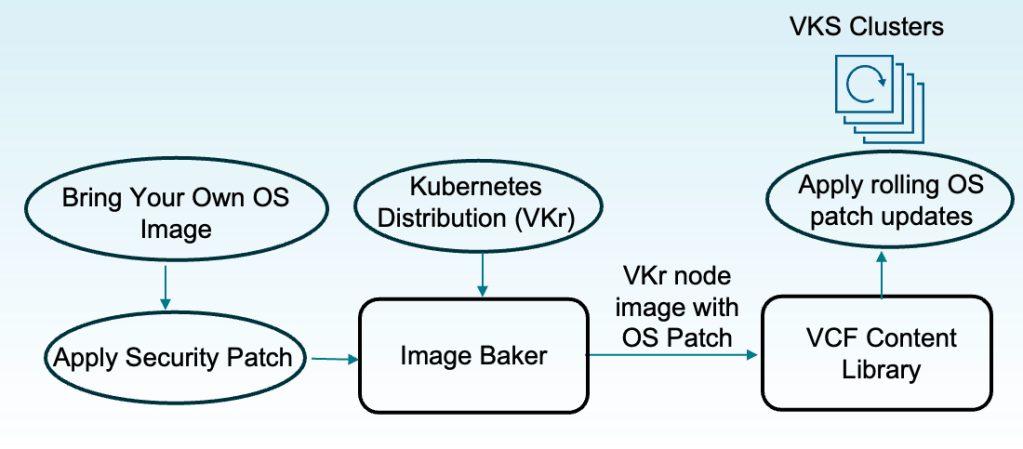
The result is a security posture that accelerates audit readiness and reduces operational pressure. Compliance and business leaders gain automated consistency across common compliance standards while closing the window between vulnerability detection and remediation. Platform teams gain the controls and flexibility to manage patching on their own schedule, with every configuration enforced by the platform rather than depend on manual verification.
Securing the infrastructure is the necessary foundation. But for organizations in critical sectors like telecommunications, government, healthcare, and energy, security alone is not sufficient. These industries require infrastructure that can absorb the scale and network demands of their most critical workloads. VKS 3.7 helps address these requirements.
2. Accelerating workload deployments in critical sectors
Mission-critical applications leave no room for infrastructure that cannot match their availability and performance requirements. Telco 5G core deployments, large-scale data processing pipelines, and government workloads each place distinct demands on Kubernetes infrastructure: high node counts, fault tolerance against localized failures, and the ability to route high-bandwidth traffic over isolated, high-performance network interfaces. To address these challenges VKS 3.7 delivers the following three key capabilities:
These capabilities translate directly to production-readiness for industries where downtime or degraded performance carries real consequences. Business stakeholders gain infrastructure capable of running 5G core, government, healthcare, and energy workloads with superior quality of experience and lower latency those applications demand.
Platform teams gain API server resiliency and high performance networking capabilities, with Multus and Whereabouts integration removing the manual complexity of configuring secondary networks from scratch.
Reaching the scale these sectors require solves one dimension of the problem. The other is reducing the operational burden of keeping infrastructure at that scale healthy over time. That is the focus of the next area of investment – operational efficiency.
3. Increasing operational efficiency
Day-2 operations are where the hidden costs of Kubernetes lie. VKS 3.7 will focus on reducing the manual toil and anxiety around cluster deployments and upgrades.
For business stakeholders, the payoff is measurable: faster time-to-value with accelerated application delivery through templatized configurations and smoother deployments leveraging the latest open-source innovations. For platform teams, it means automated rollback on detected failures, simplified desired-state management across the fleet, and the freedom to focus on deployment rather than manual remediation.
These gains build on two commitments that remain core to the VKS operating model: VKS upgrades stay decoupled from the control plane, so the Supervisor can continue running on an older version without blocking team progress, and Broadcom’s 24-month extended support per Kubernetes version at no additional cost and with overlapping version coverage gives large organizations the room to move forward on their own timelines without forcing fleet-wide upgrades or compressed maintenance windows.
Operational efficiency gains compound when platform teams also have the right ecosystem tooling to work with. That is why the fourth area of investment in VKS 3.7 is a complete rethinking of how Add-ons are delivered, supported, and expanded.
4. Simplifying adoption of third-party services
The breadth of tools a platform team needs changes constantly as applications evolve and new open-source capabilities emerge. A rigid packaging model limits how quickly teams can adopt those tools and creates ambiguity about what level of support applies to each.
VKS 3.7 will replace the previous core and standard package structure with a four-tier Add-on Management Framework that accelerates ecosystem expansion and provides clarity on Broadcom’s support commitment to customers.
Product, Partner, and Ecosystem Add-ons include orchestrated lifecycle with automated install, upgrade, and VKr alignment. With Community Add-ons, customers gain the flexibility to manage installs and upgrades, or orchestrate the entire lifecycle using the Add-on Manager.
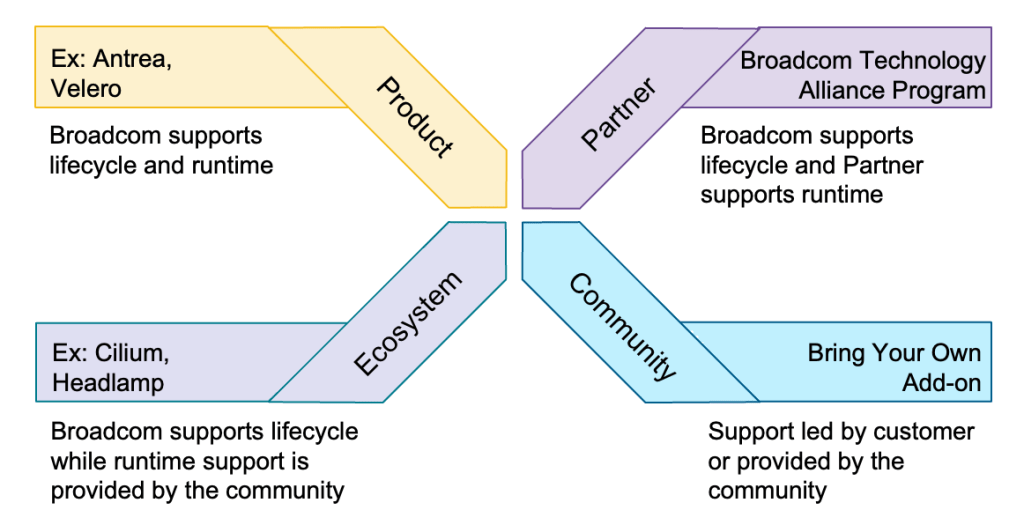
For business stakeholders, the four-tier framework future-proofs investments by accelerating ecosystem expansion and improving deployment readiness across a broader range of integration tools. For platform teams, transparent support tiers mean faster issue resolution and a predictable operational experience as the fleet grows.
New Add-ons being introduced in VKS 3.7
Platform teams in highly regulated sectors like Telco and 5G can easily isolate control plane traffic from heavy data plane workloads with Multus. This architecture leverages VMXNET3 or SR-IOV to satisfy ultra-low latency requirements, while utilizing Whereabouts to eliminate the complexity of advanced networking with critical cluster-wide IP Address Management (IPAM).
New Add-ons introduced in VKS 3.6.x
Conclusion: The VKS 3.7 Advantage
VKS 3.7 will bridge the gap between maximum operational control and rapid developer execution. Decoupled zero-impact OS patching removes the forced trade-off between security velocity and workload stability. Telco-grade scalability accelerates critical-sector workload deployments eliminating the need for purpose-built infrastructure. Declarative lifecycle management through the Helm Controller and Add-on API eliminates the manual toil that slows platform teams down. And the four-tier Add-on Management Framework gives platform teams a predictable, extensible toolkit to manage their fleets with confidence as requirements evolve.
By addressing automated compliance, critical-sector scale, operational efficiency, and ecosystem integration together, this release ensures that as infrastructure grows, operational overhead does not grow with it.
Subscribe to get the latest posts sent to your email.
此内容由惯性聚合(RSS阅读器)自动聚合整理,仅供阅读参考。 原文来自 — 版权归原作者所有。