

惯性聚合 高效追踪和阅读你感兴趣的博客、新闻、科技资讯
阅读原文 在惯性聚合中打开

推荐订阅源

F
Fox-IT International blog
Security Latest
Security Latest
S
Security @ Cisco Blogs
L
LINUX DO - 热门话题
T
Threatpost
W
WeLiveSecurity
cs.CL updates on arXiv.org
腾讯CDC
雷峰网
雷峰网
Cyberwarzone
Cyberwarzone
V
V2EX - 技术
freeCodeCamp Programming Tutorials: Python, JavaScript, Git & More
P
Proofpoint News Feed
T
Tailwind CSS Blog
Cisco Talos Blog
Cisco Talos Blog
人人都是产品经理
人人都是产品经理
罗磊的独立博客
P
Privacy International News Feed
The Register - Security
T
Threat Research - Cisco Blogs
IT之家
IT之家
T
True Tiger Recordings
SecWiki News
SecWiki News
V
Vulnerabilities – Threatpost
博客园_首页
OSCHINA 社区最新新闻
OSCHINA 社区最新新闻
博客园 - 司徒正美
月光博客
月光博客
P
Privacy & Cybersecurity Law Blog
N
News | PayPal Newsroom
Google DeepMind News
The Cloudflare Blog
美团技术团队
Simon Willison's Weblog
博客园 - Franky
V
Visual Studio Blog
E
Exploit-DB.com RSS Feed
酷 壳 – CoolShell
酷 壳 – CoolShell
F
Future of Privacy Forum
J
Java Code Geeks
Microsoft Azure Blog
奇客Solidot–传递最新科技情报
奇客Solidot–传递最新科技情报
Recent Commits to openclaw:main
C
Cisco Blogs
AWS News Blog
AWS News Blog
cs.AI updates on arXiv.org
Scott Helme
Scott Helme
D
Darknet – Hacking Tools, Hacker News & Cyber Security
I
InfoQ
U
Unit 42

VMware Blogs

VMware Cloud on AWS の使用状況を確認できる API Unlocking the Full Potential of Programmable Infrastructure with VMware Cloud Foundation 9.1 – New Features and Capabilities Smarter Patching at Scale: Vulnerability Assessment and Remediation with VMware Tanzu Platform Encrypted vMotion Offload to Intel QAT in VMware Cloud Foundation 9.1 Deepen Your Expertise: Four Key Benefits of Attending Increase Deployment Flexibility with VCF Edge Automation 1.0.3 Avi Advantage: Automating Certificate Management of VCF Workloads More Memory, Less Effort: Configuring Memory Tiering in VCF 9.1 VCF 9.1 Licensing: Programmatic, Centralized, and Built to Scale Why APJ Networking Professionals Need Private Cloud Expertise VCF Networking 9.1: Simpler VPC Connectivity Control VCF Networking 9.1: Exploring Network Services for Virtual Private Clouds VCF Networking 9.1: Seamless DDI Integration with Infoblox The Open Source Advantage: Building from Source for Ultimate Security Expand Shared VMDKs with Clustered Applications in VMware vSAN for VCF 9.1 Monetizing Zero-Trust Security with VCF 9.1 and VMware vDefend VMware vSAN Protection and Recovery Enhancements for VCF 9.1 Deliver Production SQL Server DBaaS with VMware Data Services Manager 9.1 Maximizing Profitability: VCF 9.1 Cost-Focused Approach for VMware Cloud Service Providers Modernizing Your Infrastructure: Introducing VMware Cloud Foundation 9.1 to VCSPs VCF 9.1 is Available: Explore the New Features in Hands-on Labs What’s New with vSphere in VMware Cloud Foundation 9.1? Resizing VMware vCenter in VMware Cloud Foundation 9 Non-Disruptive VMware vCenter Patching in VMware Cloud Foundation 9.1 VMware vCenter Virtual Hardware Gets an Upgrade in vSphere with VCF 9.1 AI Has Changed the Threat Landscape. Is Your Infrastructure Ready? Simplifying Storage with the New Effective Capacity View in VMware vSAN for VCF 9.1 Auto-RAID in VMware vSAN for VCF 9.1 – Comprehensive System-Managed Data Resilience Introducing VMmark 4.1: Enhanced Power Efficiency Benchmarking for Private Cloud Infrastructure Advanced Memory Tiering Enhancements in VMware Cloud Foundation 9.1 VCF 9.1 Is Here. See It in Action. 博通發布 VMware Cloud Foundation 9.1 How to Prepare for the World of AI Driven Exploits How Broadcom Is Helping Enterprises Win the AI Security Sprint Avi Innovations for VCF 9.1: Powering Kubernetes, Agentic AI and VPC Workloads VCF 9.1: The Secure, Cost-Effective Private Cloud Platform for Production AI Announcing VCF 9.1: Modern Private Cloud Built for Efficiency and Resilience Announcing VMware Cloud Foundation Edge 9.1: A Scalable, Autonomous Edge Platform Accelerate, Streamline, and Control Your Self-Service Private Cloud with VMware Cloud Foundation 9.1 Deploy Modern Apps Faster, Scale Smarter, and Lower Your TCO with VMware vSphere Kubernetes Service in VCF 9.1 Scale Smarter, Save More: Redefining Infrastructure Economics with VMware vSphere in VCF 9.1 AI with VCF 9.1 on AMD GPUs: Build with open frameworks and simplify management, at a lower TCO Streamline, Simplify and Protect all your AI workloads with VCF 9.1 Simplify Workload Connectivity and Enhance Network Scale and Performance with VCF 9.1 How Many Users Can Your LLM Server Really Handle? From Infrastructure to Agents: A Hands-On Guide to Secure Private AI with Broadcom – Part 2 The New Frontier: Leading the Cloud-Native Evolution Replicating VMware vSphere Configuration Profile Desired State Webinar Recap: Design and Architecture Considerations for VMware vSphere Kubernetes Service on VMware Cloud Foundation Kubernetes 1.36: What Actually Changed for Enterprise Platforms Enhance Lateral Security and Ingress Load Balancing for Kubernetes Workloads Avi Load Balancer Analytics: Root Cause Application Performance Issues in Minutes Analyst Insight Series #3: Policy-Driven Governance and Multi-Tenant Control Post-Quantum Readiness on VMware Cloud Foundation Registration Is Live for Las Vegas | $ave with Early-Bird May 21, 2026: What’s New in VMware Tanzu Data Intelligence 10.4 From Infrastructure to Agents: A Hands-On Guide to Secure Private AI with Broadcom – Part 1 Stop Guessing: Advanced Monitoring and Troubleshooting for Data Services CPU, Disk, Network, and Memory Workload Profiles for DVD Store Database Testing How VMware Salt Automates Compliance Across Private Cloud Analyst Insight Series #2: Operational Scalability and Lifecycle Management MCP vs. APIs: Why You Need Both for AI Applications The Real Constraint on Enterprise AI isn’t GPUs; It’s Power Deploying Harbor Service in Air-Gapped VMware Cloud Foundation 9.0 Why Enhanced DirectPath Wins for High-Performance Apps Bridging the (.Local) Gap: A Split-Domain Design for VMware Cloud Foundation Deployment Observability on VMware vSphere Kubernetes Service VMware Cloud on AWS: Introducing the Usage Report APIs Converging VMware vSphere to VMware Cloud Foundation 9.0: The Top 10 Questions Answered May 6, 2026: What’s New in Tanzu Platform 10.4: Powering Agentic Apps at Scale From Prototype to Production: Securing Database MCP at Enterprise Scale How AI-Assisted Analytics in Tanzu Data Intelligence Can Help Remove the SQL Bottleneck Introducing Tanzu Platform 10.4: Extending Platform as a Service to Agentic Applications Enterprise-Ready Agents Made Simple & Safe with VMware Tanzu Platform Agent Foundations Tanzu Data Intelligence 10.4 Delivers AI-Driven Analytics, Unified Real-Time Operations, and Sovereign Resilience VMware Tanzu RabbitMQ Powers the Modern Data Lakehouse with New Spark Integration and Enterprise Tooling The Compelling Case for a Private Cloud Data Intelligence Platform The Unification Dividend: Consolidating Database Operations on VMware Cloud Foundation The Modern Spring Workflow Is Enterprise-Ready and AI-Boosted [TAM Blog] セキュアブート証明書の有効期限切れに関する注意点と対応について Accelerate Lateral Security and Ingress Load Balancing for Kubernetes Workloads How VMware Cloud Foundation (VCF) Training Helps Keep Top Tech Talent in APJ Build Your Case for Attending VMware Explore 2026 Spring 開発元が提供する商用サポート「VMware Tanzu® Spring Essentials」とは VMware Cloud on AWS より i7i.metal-24xl インスタンスの提供開始 VMware Advanced Memory Tiering Tips for Success VMware Cloud Foundation Edge 9.0: Two-Host Edge Site Deployment with Brownfield Import Your Database Is About to Become an AI Tool. Is It Ready? Webinar Recap: Converging VMware vSphere to VMware Cloud Foundation 9.0 Applying GitOps Principles to Maintain Desired State Configuration using VMware vSphere Configuration Profile – Part 3
From Platform to Data: Building a Cloud-Native Developer Experience On-Prem with VMware Cloud Foundation
2026-04-10 · via VMware Blogs

Today’s developer expects friction-free access to infrastructure. In the public cloud, if a developer needs a Kubernetes cluster, a virtual machine, or a database, they simply press a button or an API call and the resources are ready in minutes.

But what happens when data sovereignty, compliance, or cost predictability dictates that these workloads run on-premises?

Historically, on-prem infrastructure meant submitting IT tickets and waiting days or weeks for provisioning. This delay often creates a major bottleneck for time to market. Frustrated by the queue, developers sometimes spin up their own “shadow IT” databases on unmanaged VMs just to move faster. The result? A massive headache of database sprawl, configuration drift, lack of governance, and significant security risks.

Today, platform engineering on VMware Cloud Foundation (VCF) has changed the game. By leveraging the VCF private cloud platform, organizations can bridge the gap between IT operations and development teams. VCF delivers a true “platform-to-data” self-service experience equivalent to public cloud, giving developers the speed they crave and platform engineers the centralized fleet management they require.

Bridging the Gap: The Cloud Equivalents

To understand the power of VCF as a private cloud platform, it helps to map its capabilities to the public cloud services developers already know. If you are familiar with how to build on AWS, the on-prem VCF equivalents will look like this:

  • Amazon EC2 -> VCF VM Service: Allows developers to deploy and manage traditional VMs declaratively alongside their containers.
  • Amazon EKS -> VCF VKS (vSphere Kubernetes Service): Provides self-service, conformant Kubernetes clusters natively on VCF.
  • Amazon RDS ->VCF DSM (Data Services Manager): Offers an on-demand Database-as-a-Service (DBaaS) fleet management tool.

By combining these three pillars, platform teams can offer a comprehensive, API-driven catalog of services directly from their own data centers.

The Platform Engineer’s Workflow: Setting the Guardrails

The magic of this architecture lies in the persona-based governance. As a system administrator or platform engineer, you define the “guardrails” and maintain control, while the developer consumes the resources within those boundaries.

Here is how the workflow operates.

1. Creating the boundary

The infrastructure admin creates a vSphere namespace in VCF. This namespace acts as the tenancy boundary, binding compute, memory, and storage limits to a specific project or development team.

2. Defining the infrastructure and policy

On this namespace, the platform engineer defines the rules of engagement:

  • Compute and resources: Defining cluster sizes, resource pools, and VM classes (T-shirt sizing like small, medium, or large) to ensure developers don’t over-consume resources
  • Storage and networking: Setting specific storage policies (like vSAN or NFS) and mapping workloads to the correct VLANs and VPC subnets
  • Data services in DSM: Enabling specific database engines and versions that have been vetted by the DBA team

The Developer Experience: Self-Service Deployment

Once the admin has set the policies, the platform engineering can deploy these services and from there the developer experience is seamless. The platform engineer hands access over to the development team via a secure API token. From this moment on, they are entirely self-sufficient.

No more waiting for tickets to be cleared. Using standard Kubernetes tooling (like kubectl), the DSM portal or API, or their own Terraform pipelines, developers can:

  • Spin up a new Kubernetes cluster (VKS) to test their microservices.
  • Select a database engine like PostgreSQL, MySQL, or Microsoft SQL Server (coming in 9.1).

Crucially, these self-provisioned resources automatically comply with corporate backup, networking, and security policies established by the admin.

Automation and Infrastructure-as-Code Integration

This entire environment setup can be automated using Infrastructure as Code (IaC). The platform team can consume these namespaces and service configurations via multiple options based on the preference of the teams. It could be deployed through Kubernetes CRDs, a Terraform manifest, or an enterprise blueprint that can conclude comprehensive set of resources like a VKS cluster with a set of VMs, data services from DSM, and even ArgoCD to push apps to the VKS clusters all within one set of API calls.

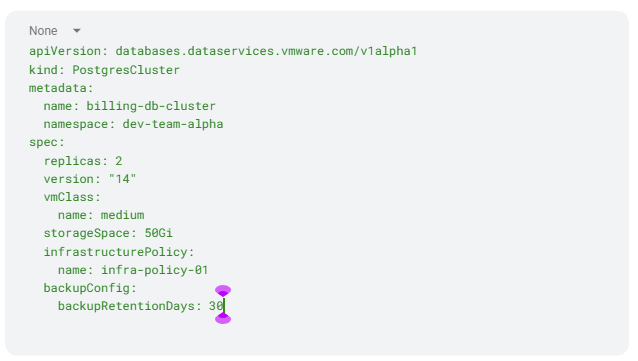
Here is an example of a CRD to deploy a database in the namespace declaratively to show how simple it is. This CRD can be used as part of a GitOps operation:
Beyond Dev: Day 2 Operations

Perhaps one of the most significant advantages of this platform approach, specifically with Data Services Manager, is that it doesn’t stop at the initial “push button” deployment. It automates critical Day 2 operations once the application needs to hit production. Operations that typically drain DBA resources are now done in a simple click of declarative parameter change in a CRD:

  • High availability: Automated cluster deployments for immediate resilience
  • Scalability: The ability to easily add read replicas as application demand grows
  • Data protection: Automated backups and point-in-time recovery (PITR) built right in
  • Governance: Centralized visibility for the platform team to monitor usage and eliminate database sprawl across all workload domains
  • Post-sale support for OSS databases: DSM offers commercial-grade features and support which are not available with free open-source databases such as PostgreSQL or MySQL. 

Conclusion

Creating a self-service catalog from platform to data doesn’t require moving everything to public cloud. By utilizing VCF, VKS, and DSM, organizations get the agility of the public cloud with the security and control of their own private infrastructure. 

With these features, platform engineers transform from IT gatekeepers into enablers – providing developers with the API endpoints, Kubernetes clusters, and managed databases they need to build software faster, more securely, and be ready for production.


Discover more from VMware Cloud Foundation (VCF) Blog

Subscribe to get the latest posts sent to your email.